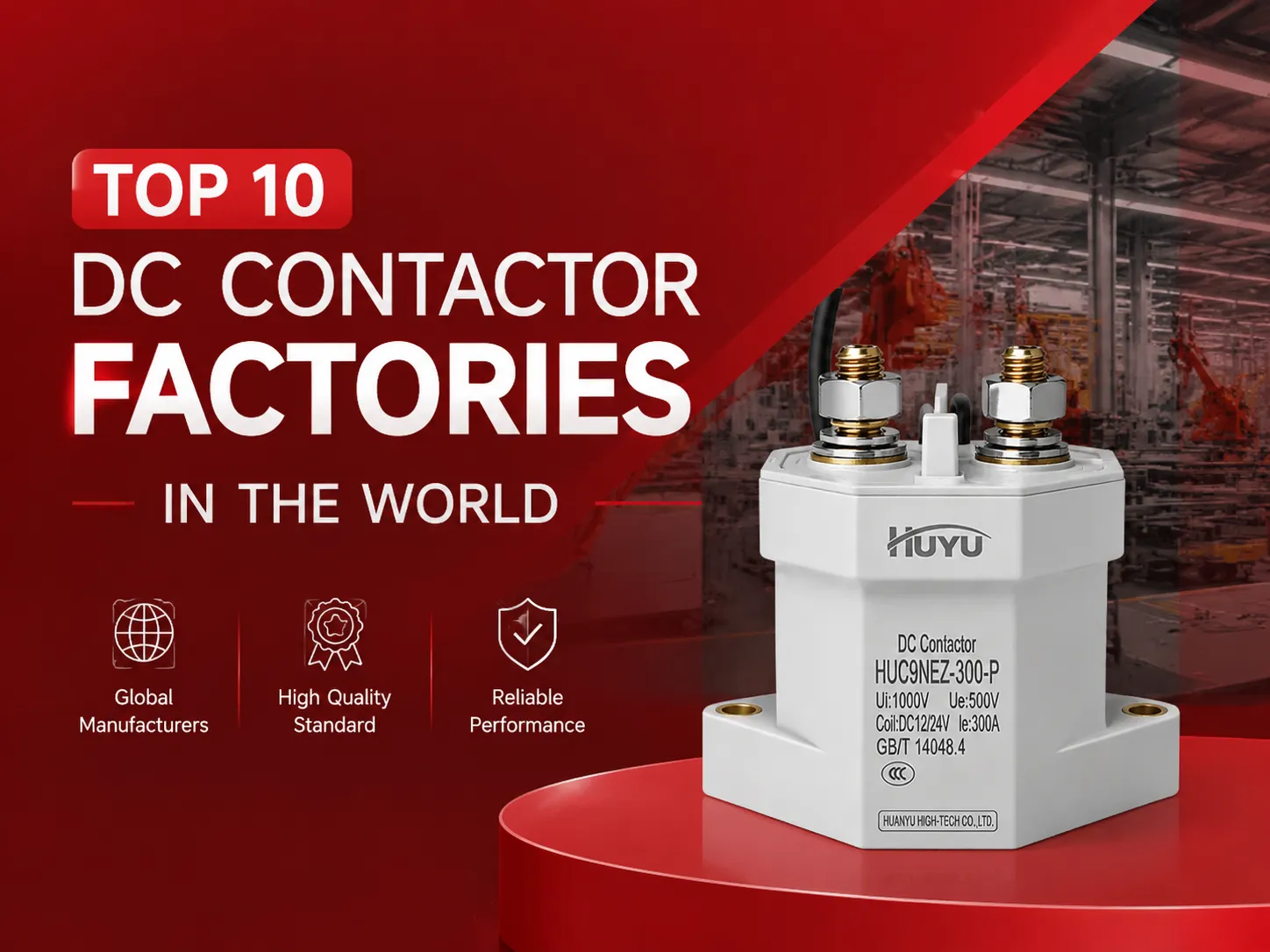
When choosing a DC contactor for use at 400V and under load to isolate a battery pack in EV, or where a solar inverter designer specifies a contactor with thousands of DC circuits that must switch on/off without welding, it is vital to select a contactor manufacturer that meets your application at a high level of safety. A DC contractor is more than an AC contactor with a new label. An arc forms when separating DC contacts; however, this arc does not self extinguish at zero crossing—this must be extinguished through magnetic blowout or an arc chute, and in many cases using an inert gas fill. Top factories building these products use top quality elements to ensure they meet very high manufacturing standards by employing methods such as precision welding, clean-room assembly, and 100% electrical testing. Understanding the leading global manufacturers and the products they offer is critical to developing a certification and reliability of your DC switching solution.
What Sets a DC Contactor Factory Apart
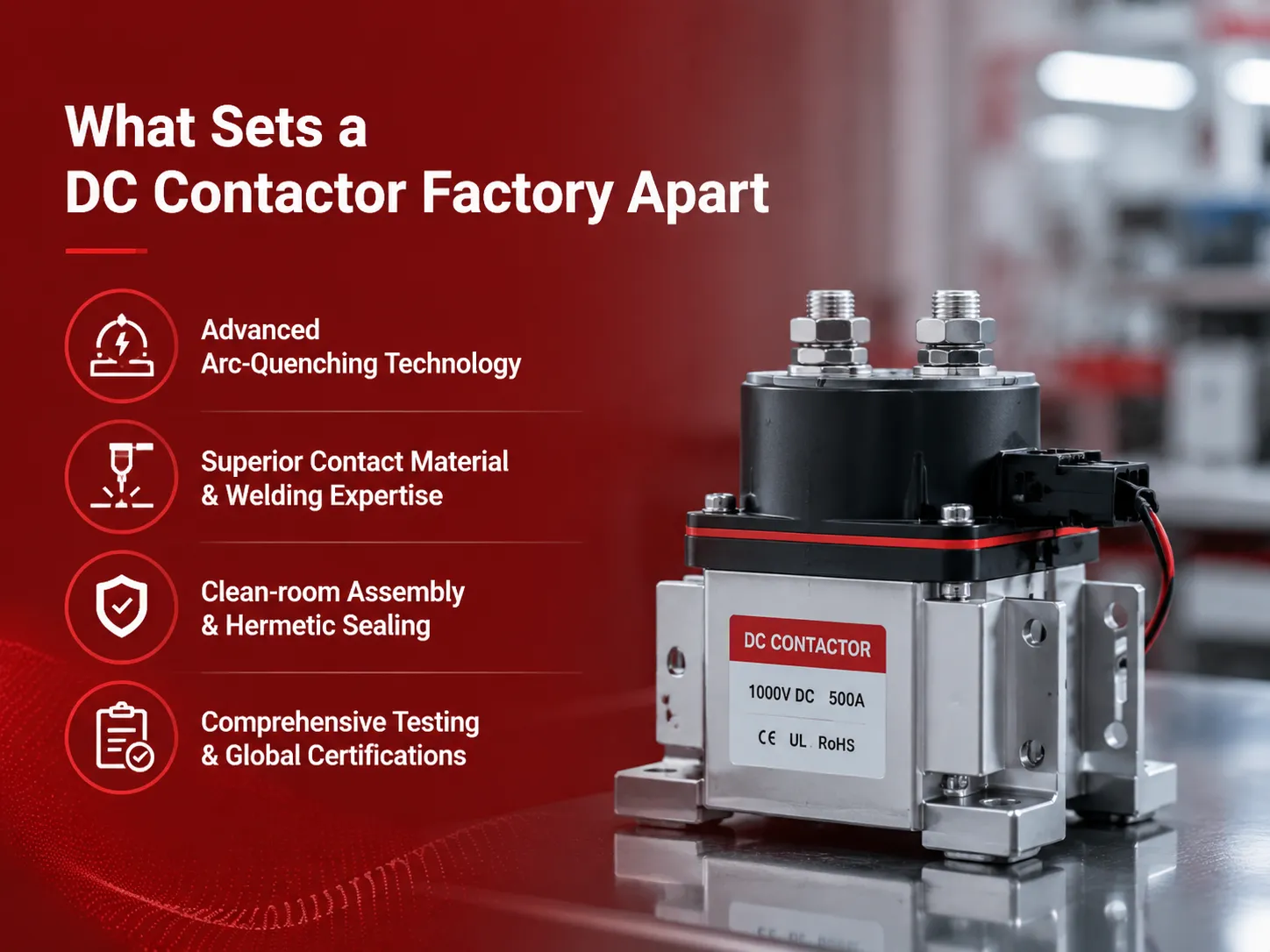
To manufacture a high quality DC contactor requires more than you will find in a general electrical assembly facility. The main things that separate one facility from another are:
- Arc‑quenching technology. To effectively extinguish an arc in an DC circuit, you must use precision-engineered magnetic blowout fields, optimized geometries for the arc chute, and hermetically sealed (typically nitrogen or hydrogen-filled) enclosures for higher voltage applications. If the factory understands the arc behavior at the rated voltage/current, it can build contactors that will reliably clear faults through multiple cycles of operation.
- Contact material and welding expertise. Welded contacts are needed to make and break an electrical circuit. The strength of the connection between two pieces of metal is determined by their material properties, how they have been joined together, and how they have been finished. A factory that performs resistance welding and has precise control over its metallurgical processes can produce consistent and reliable results.
- Clean‑room assembly and hermetic sealing. For EVs and energy storage, high-voltage DC contactors are usually enclosed in a controlled atmosphere to protect the internal components from dust, moisture, or oxygen which can greatly reduce their lifespan. Automotive and aerospace manufacturers have factory-certified clean rooms for assembly and helium leak detection systems.
- Certification and testing. It is critical that you test each DC contactor separately. You need to measure and record coil resistance, pull-in and drop-out voltages, contact resistance, and dielectric withstand. Manufacturers holding the appropriate certifications (e.g. UL, TUV, CE, IATF 16949 for automotive) issue the documentation required by global OEMs.
Ten Leading DC Contactor Manufacturers
1. TE Connectivity (Switzerland / Global)
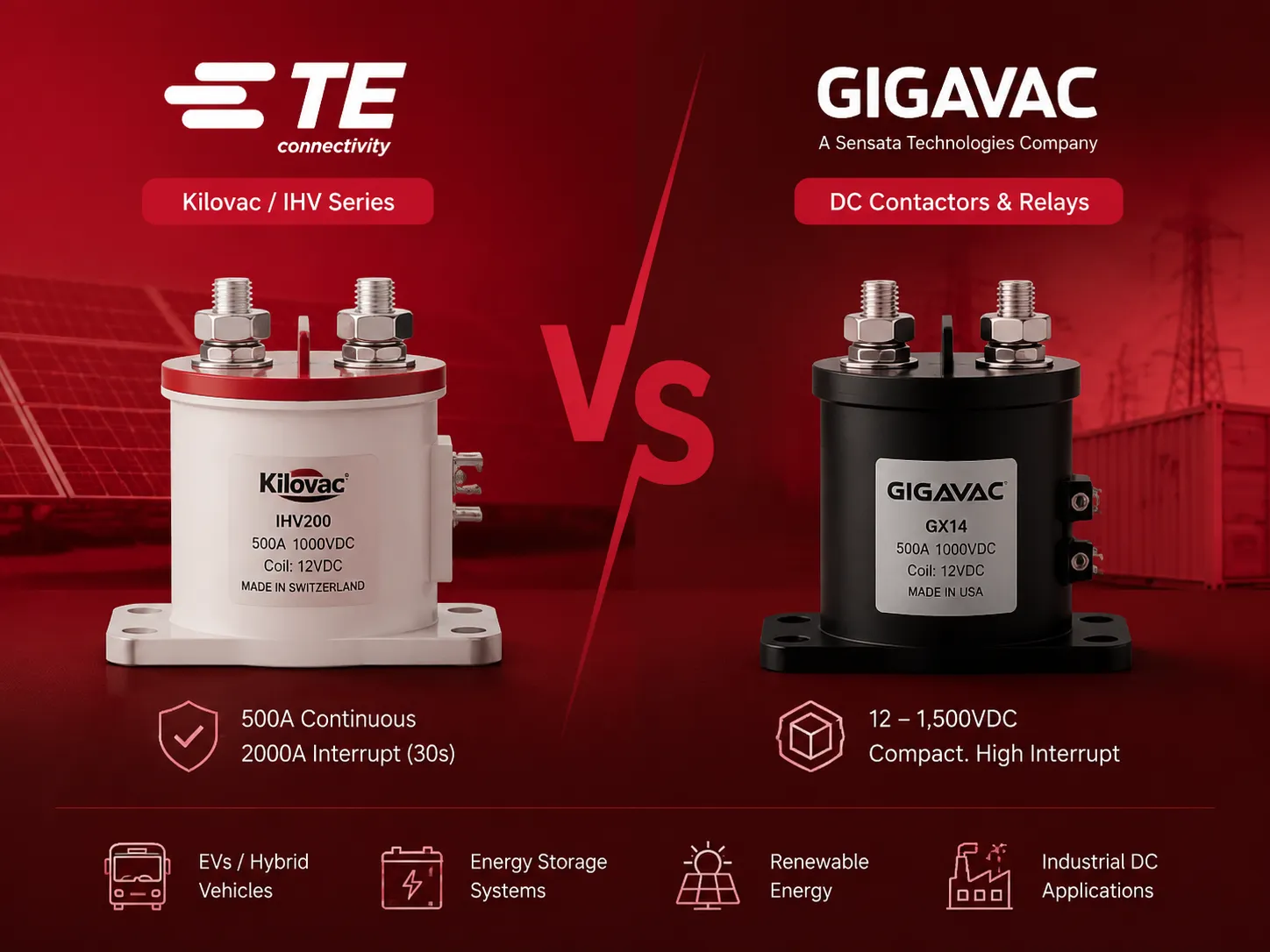
Core strength: TE Connectivity’s Kilovac and IHV series of high-voltage DC contactors are among the most popular products in this market as they are found in almost every application worldwide. An example of this is the IHV200 contactor, which has an uninterrupted continuous rated current rating of 500A and a maximum interruption current rating of 2000A (for 30 seconds) and is commonly used in electric buses, trucks, and grid scale energy storage. TE’s manufacturing capabilities allow for complete control of the entire manufacturing process including in-house contact welding, coil winding, and cleanroom sealing.
Typical purchasers include OEMs of electric/hybrid vehicles, battery energy storage system integrators, and industrial DC power distribution companies.
Price position is at the top end of the scale; TE’s contactors require a higher unit price due to the level of engineering, hermetic seal design, and automotive certification process that went into designing these products.
2. Gigavac (USA, part of Sensata Technologies)
Core strength: Gigavac manufactures DC high voltage contactors and relays that are mostly used between 12-1,500 volts; and provides hermetically (sealed) contactors that are used in all types of permanent battery circuit disconnects for electric vehicles (EVs), in addition to being included as part of the solar combiner box assembly used in renewable energy systems, and for industrial applications involving DC switching. Gigavac has also produced epoxy- (sealed) and gas- (filled) contactors that are recognised for their small size with high interrupt ratings.
Typical customer base includes manufacturers of EV and hybrid vehicles, builders of renewable energy (RE) systems, and industries requiring DC switching.
Pricing typical of all Gigavac products is premium level; you’ll pay a similar amount for contactors with the same voltage (or amperage) rating if you purchased your contactors from TE Connectivity.
3. Panasonic Industry (Japan)
Core strength: Panasonic’s EV relays and DC contactors, especially the AEV Series, serve as the backbone of both the Asian and Global EV markets. The Company has unique strengths relating to the miniaturisation of highly-rated contactors — producing contactors with high currents in lower volumes — and the reliability of these products which allows them to be used in mass production automotive applications.
Buyers of this product would typically be automotive OEMs, EV battery pack manufacturers, and providers of Electric Vehicle Charging Infrastructure.
The pricing of the products is a premium position based on both the automotive qualifications required of the product and the Panasonic brand.
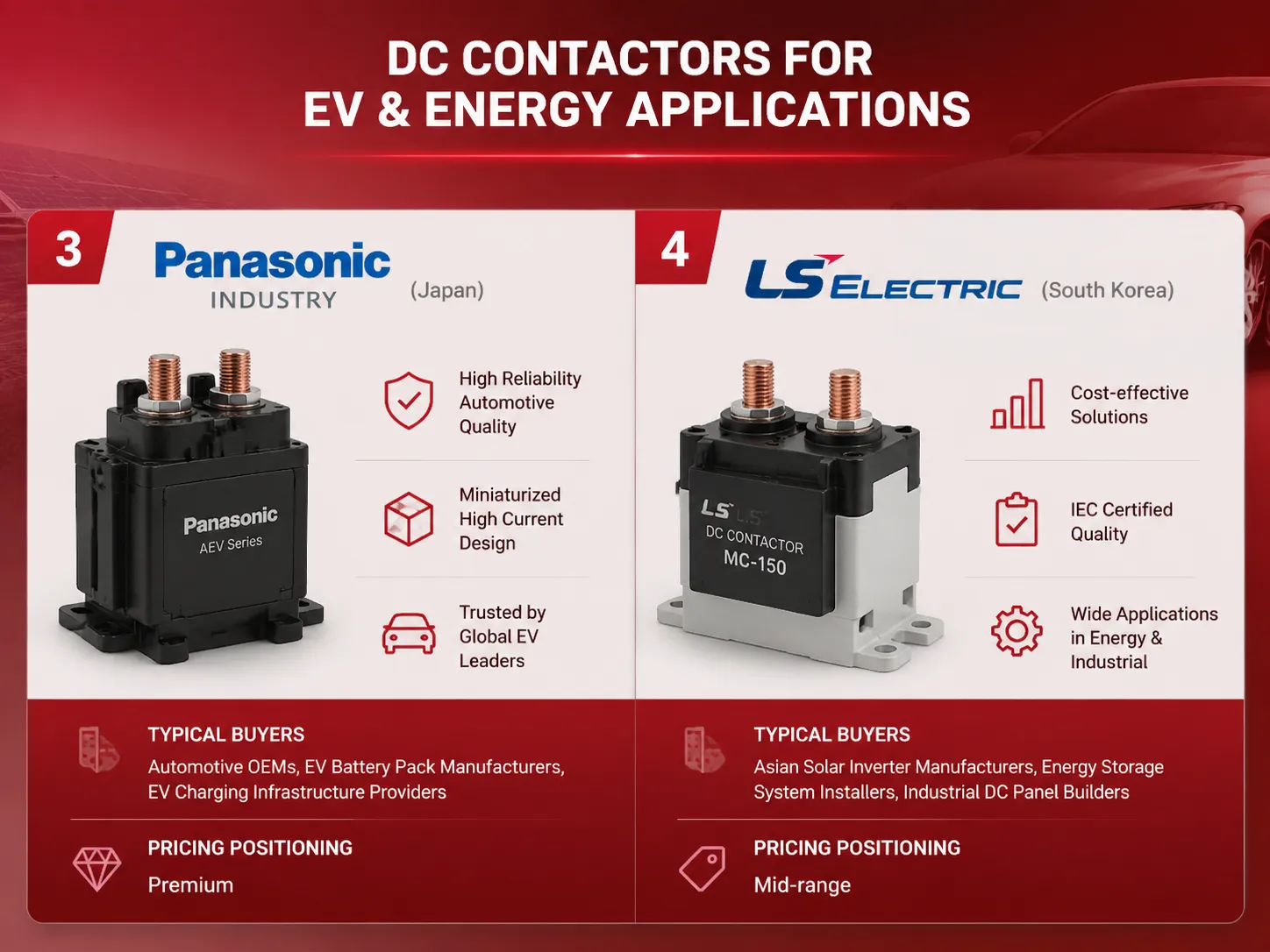
4. LS Electric (South Korea)
Core strength: LS Electric, formerly known as LS Industrial Systems, is a leading producer of electrical equipment in the Asian market. They manufacture low-voltage electrical equipment, such as DC contactors, for a variety of industries and applications, including: solar, energy storage, and industrial markets. They produce DC Contactors in the medium voltage and medium current range; Pricing is based on competitive average pricing with emphasis on cost-effective solutions with an IEC approval certification.
Typical Types of Buyers: Manufacturers of Asian solar inverters, energy storage system installers, and Industrial DC Panel Builders.
Pricing Positioning: Mid-range pricing with an attractive market value and appeal to Additional IEC Certified product inquiries.
5. Schaltbau (Germany)
Core strength: Schaltbau is a company based in Germany and has been manufacturing DC switching devices and components since 1929. Their contactors are found in applications ranging from rail traction to industrial DC drives to renewable energy. The materials used to construct their contactors are built for high levels of mechanical and electrical durability, with many different designs capable of withstanding multiple million cycle operations.
Typical Customers: Manufacturers of rail and traction equipment, industrial DC motor Controls, very demanding applications for industrial DC.
Price Point: Premium – due to the heavy-duty manufacture and origins in the rail industry.
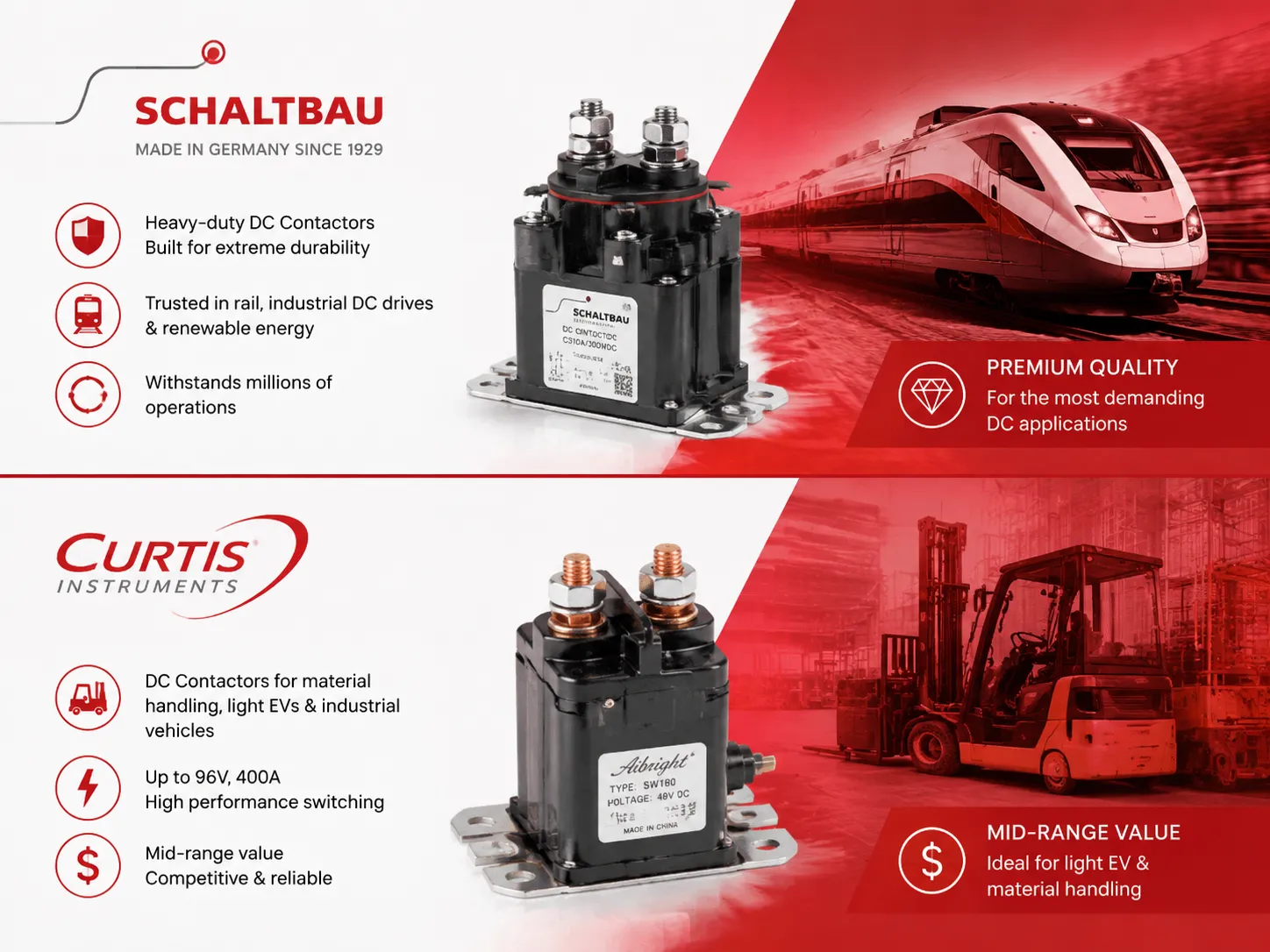
6. Curtis Instruments (USA)
Core strength: Although Curtis manufactures motor controllers primarily, their DC contactor range, especially the Albright variant, is very popular for use on electric forklifts, golf carts and light EVs. Curtis contactors are designed for moderate voltage (typically maximally up to 96V) and higher-current applications (typically maximally 400 amps) for high frequency DC switching.
Typical customer base includes OEMs who manufacture material handling equipment, manufacturers of light EVs and builders of DC industrial vehicles.
Price positioning should be mid-range in order to be competitive in both the light EV and material handling equipment sectors.
7. Zhejiang Dongya (China)
Core strength: Dongya manufactures DC contactors for the new energy vehicle and energy storage industry. The company produces hermetically sealed, gas-filled DC contactors up to 750 volts (V) and 500 amperes (A) and directly competes with global tier-one brands with respect to product specifications, but offers products at a more accessible price point. The typical buyer of Dongya products will be Chinese original equipment manufacturer (OEM) electric vehicle (EV) and battery manufacturers and builders of export-oriented energy storage systems that use battery storage technology and renewable energy. Dongya products are competitively priced and provide manufacturers with a cost advantage over European and Japanese competitors with equivalent electrical ratings on their products.
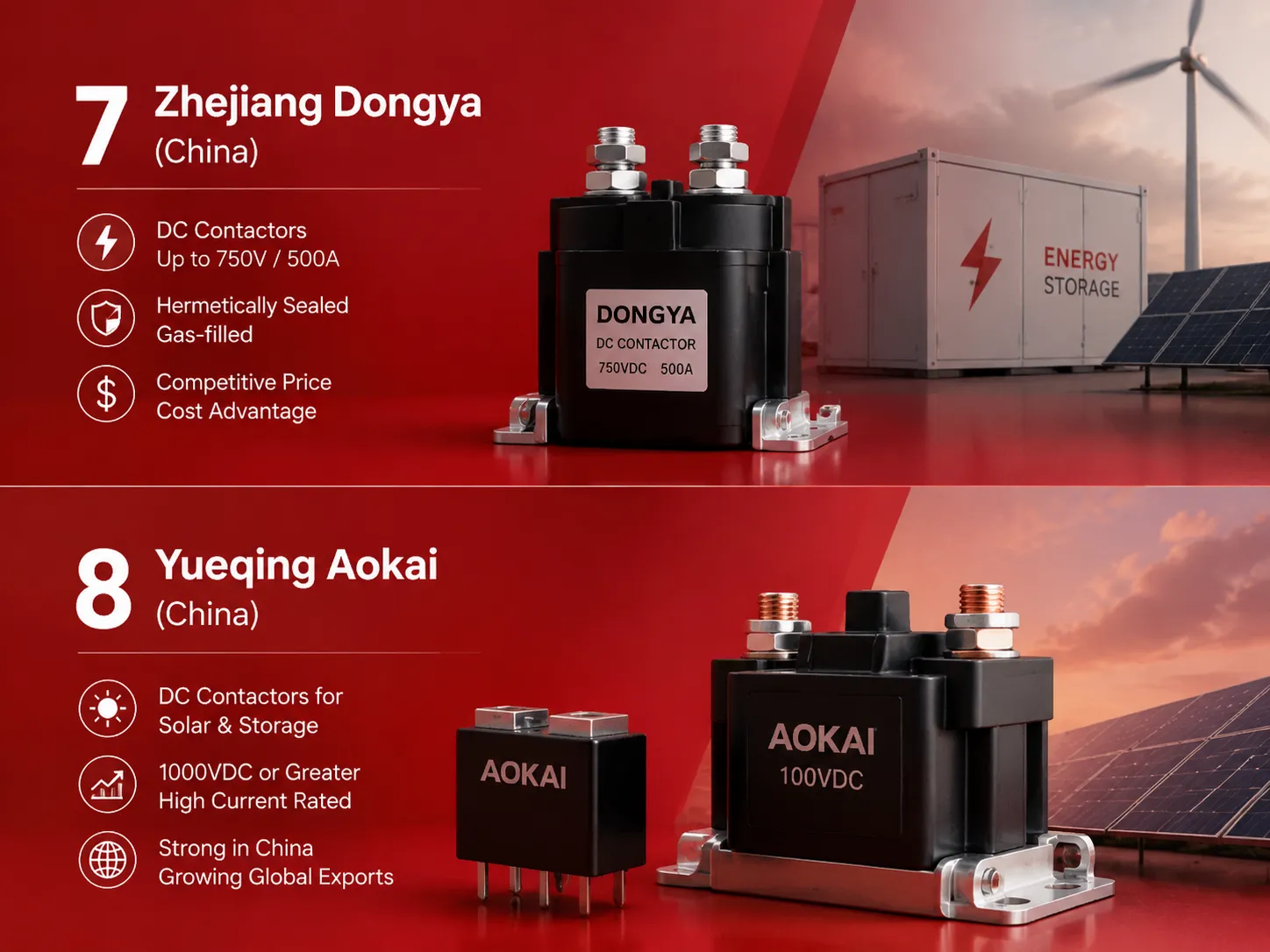
8. Yueqing Aokai (China)
Core strength: Aokai focuses on developing DC contactors for solar energy and storage technologies, producing both small printed circuit board (PCB) mounted DC relays and large, high current-rated DC contactors (1000 VDC or greater). In addition to Aokai’s well-established presence in the Chinese domestic solar industry, their export business has been growing rapidly.
Typical customer base: Manufacturers of solar inverters and combiner boxes as well as distributors of DC electrical equipment.
Price Positioning: Aokai products are competitively priced and targeted to be cost effective for high volume application within the solar and renewable energy sector.
9. Sanyou (China)
Core strength: Sanyou is an established manufacturer of relays and contactors based in China, and is expanding its product offering within the DC contactor market. Sanyou’s relays and contactors are used for electric vehicle charging, solar inverters, and industrial DC control. With the scale of its manufacturing operations, Sanyou can provide a high level of production quality for its customers who have large-volume OEM requirements.
Typical customers are manufacturers of electric vehicle charging stations, original equipment manufacturers (OEMs) of solar inverters, and industrial automation firms.
Price positioning is competitive mid-range based on a combination of high-quality production and broad range of products.
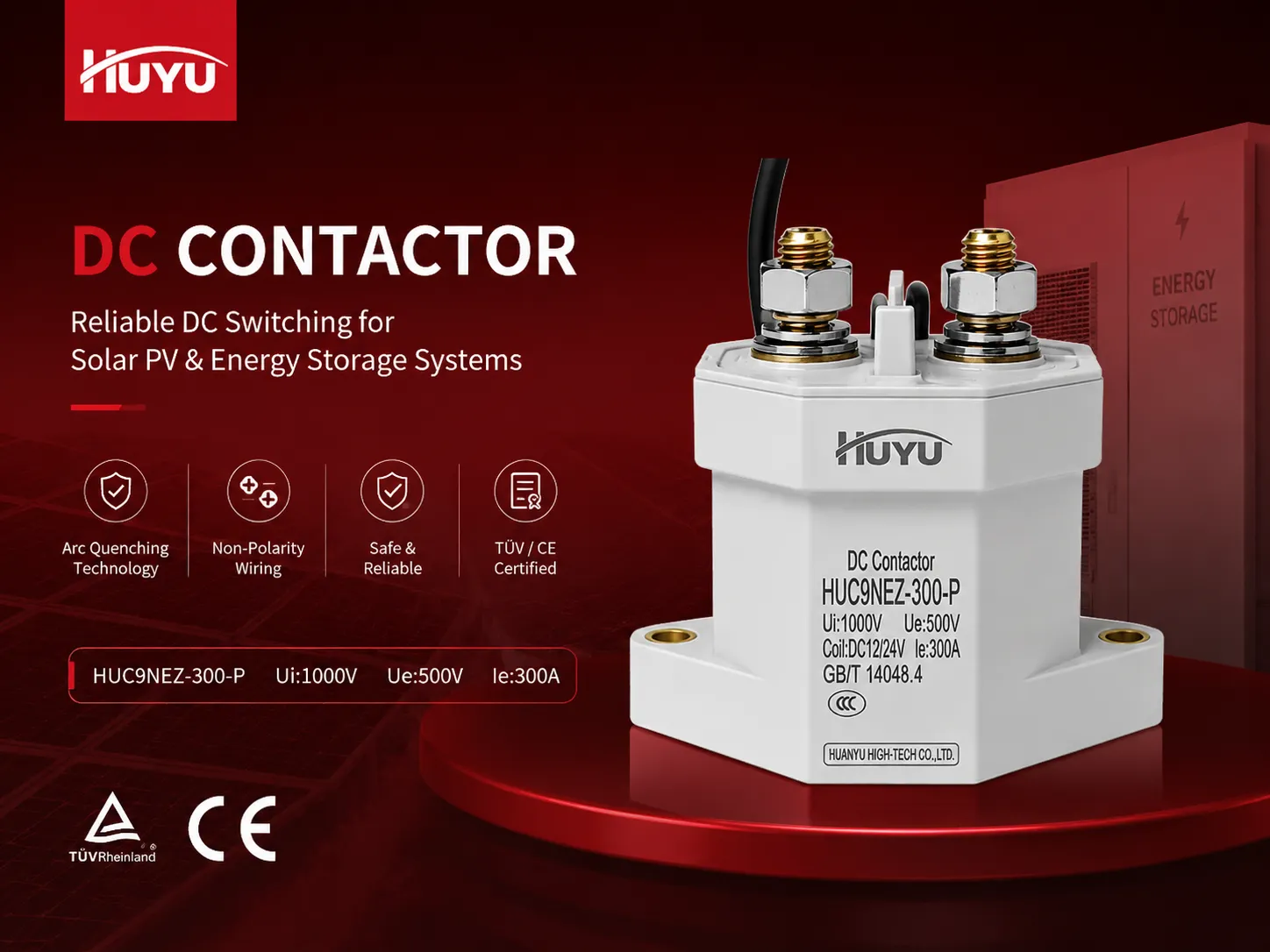
10. HUYU (China)
Core strength: Manufacturer of electrical protection and switching components. Their unique DC contactors are designed for use in Solar PV, battery energy storage, and Industrial DC applications. HUYU’s DC contactors have been designed to meet international certification requirements (TUV, CE) and are built with non-polarity wiring and arc quenching needed for DC circuits. HUYU focuses on low-voltage electrical manufacturing, and their DC product offering includes DC MCBs, DC MCCBs, DC Disconnects, and DC surge protection devices; this provides buyers an opportunity to source multiple components from a single supplier.
Typical buyers of HUYU products include builders of Solar PV systems, Battery Storage Integrators, and manufacturers of DC panels who require certified DC switching devices at competitive pricing, as well as would benefit from the responsive support and consistent lead times HUYU provides as a focused manufacturer.
Competitive mid-range pricing. HUYU DC contactor products provide certified tested DC switching without the price premium found with global Tier 1 automotive companies.
How to Select the Right DC Contactor Manufacturer
Selecting a manufacturer for DC contactor production involves many variables. Here are some criteria to assist buyers in evaluating possible suppliers:
- Match the voltage and current rating to the application. There is a difference in the types of products that two different voltages can provide – a 48V DC sports car contactor and a 1000V DC solar panel contactor. The manufacturer will be required to demonstrate that they have experience and testing data at the exact voltage and amperage that you are using.
- Verify the certifications. In Europe, CE marking and TUV certification are mandatory. In North America, UL listing (usually under UL 508 or UL 60947‑4‑1) is required to sell products there. You should ask for the certificate rather than just the approval logo.
- Understand the arc‑quenching technology. It is necessary for voltages above 100 VDC to utilize a magnetic blowout device. For voltages above 300 VDC, an hermetic seal containing an auxiliary gas is typical; therefore, please consult with your manufacturer regarding how their product will stop the DC arc at rated voltage/current.
- Request cycle‑life data. Endurance data documentation for a DC contactor switching thousands of times must be supplied. The manufacturer must provide testing reports that include contact resistance readings and dielectric withstand measurements following the specified number of operation cycles.
- Evaluate the supply chain and lead time. A perfect contactor design that takes 26 weeks to manufacture won’t fit a production need. A manufacturer that is focused, has quick response times, and has responsive engineering support can be a strategic resource.
Frequently Asked Questions
What is a DC contactor?
An electromagnetic switch designed to close or open circuits under load and to turn DC current on and off through load utilizing magnetic blowout and arc chute(s) for DC sustained arcs. This is used in electric vehicles, solar inverters, battery storage systems, and industrial motor controls for DC motors.
What is the difference between AC and DC contactor?
Ac contactors use the natural current zero cross to help quenching the arc, whereas Dc contactors lack this and must utilize magnetic blowouts, larger contact gaps (to help keep the contact open longer), and gas chambers for larger voltages to assist in extinguishing the arc. In general, dc contactors tend to occupy more space, cost more and be polarity sensitive compared to their respective ac equivalent current sizes.
How to use DC contactor?
A DC circuit will contain a DC Contactor with the coil connected to control voltage (usually 12V or 24V DC). Polarity should be observed at the terminals of the main circuit, if the contactor is polarities sensitive, When mounting the contactor, it should be placed so that there is no excessive heat or vibration in the area where the contactor is mounted, and an appropriate Coil Suppression (i.e. a free-wheeling diode) must be used to protect the control circuit from inductive voltage spikes.
How to tell if a contactor is AC or DC?
There is a label on the nameplate that denotes coil voltage and current type of the contactor as “24VAC” or “24VDC”. Visually, the DC contactor will usually have an assembly (magnetic blowout or set of permanent magnets) located by the contacts. Furthermore, the contact space will usually be greater than that of an AC contactor. Inances that you are not sure of using a DC contactor to check the manufacturer’s part number and documentation to confirm.
References
- TE Connectivity — Kilovac DC Contactors — Manufacturer of high‑voltage, hermetically sealed DC contactors for EV and energy storage.
- Gigavac (Sensata) — High‑Voltage DC Contactors — Specialist in sealed DC contactors up to 1,500 VDC.
- Panasonic Industry — EV Relays and DC Contactors — Compact, automotive‑grade DC contactors for EV and battery applications.
- LS Electric — DC Contactors for Solar and Energy Storage — IEC‑certified DC contactors for renewable energy applications.
- Schaltbau — DC Contactors for Railway and Industrial DC — Heavy‑duty DC contactors for traction and industrial drives.
- Curtis Instruments — Albright DC Contactors — DC contactors for material handling and light electric vehicles.
The top DC contactor factories in the world share a common capability: they understand the DC arc, and they have built their manufacturing around controlling it. From TE Connectivity’s hermetically sealed EV contactors to HUYU’s certified, cost‑effective DC switching solutions for solar and storage, the right manufacturer for any project is the one that can demonstrate the electrical performance, the cycle‑life data, and the certification documentation that the application demands — and deliver it on time. For the EV engineer, the solar installer, and the industrial panel builder, that factory is a partner, not just a supplier.