
The circuit breakers used in the majority of home electrical panels are single pole types, so it’s normal that very few people take notice of them. The double pole types, on the other hand, are larger, costlier, and combined together physically. But what goes on inside them?
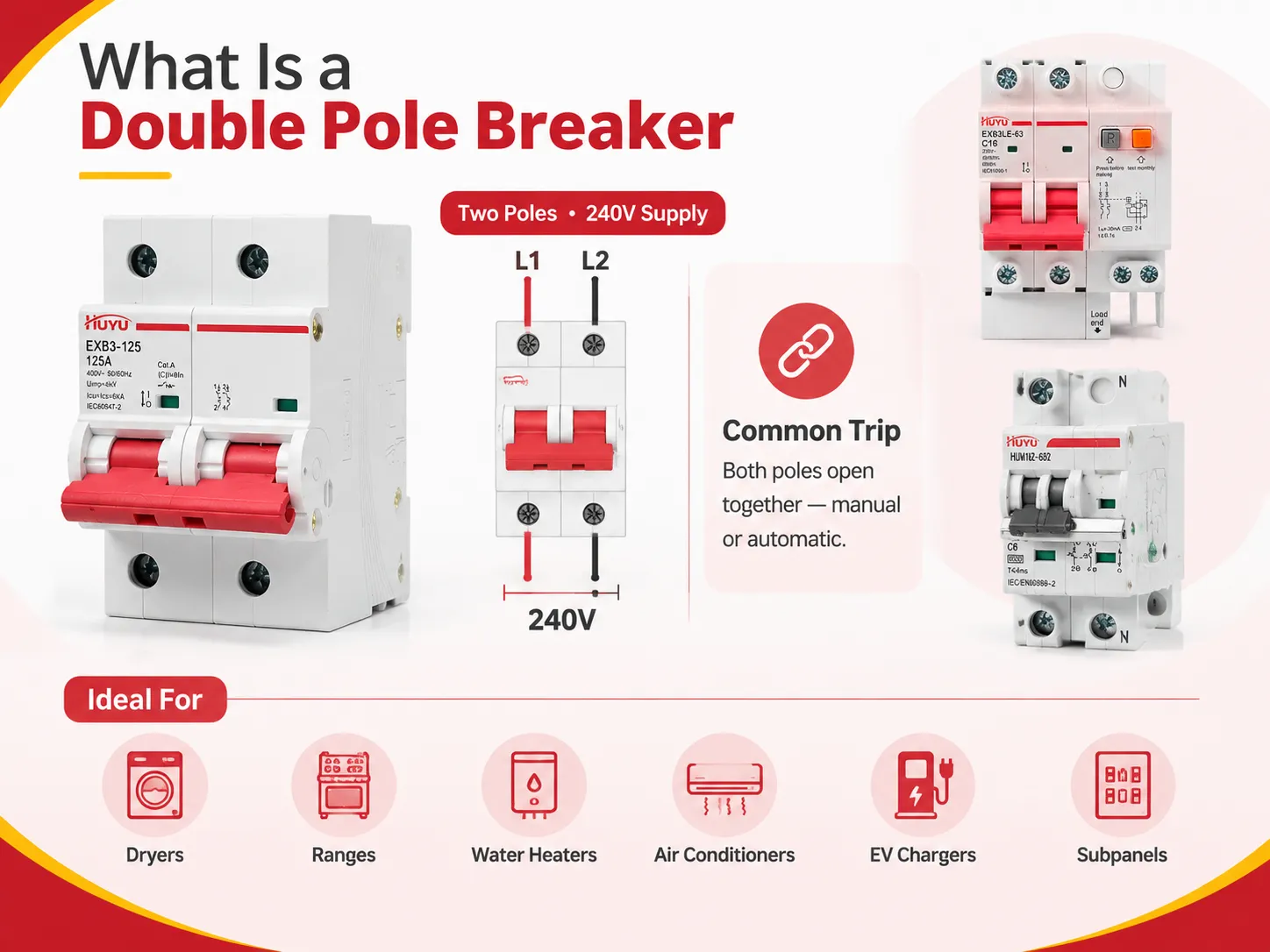
A brief answer to your question: A two-pole circuit breaker can also be referred to as a double-pole circuit breaker, or simply a double-pole breaker for short. This apparatus has two poles for current conduction that are enclosed as a unit in a single casing and interconnected with the remaining two terminals of the busbar. The working voltage of these types of circuit breakers may be 240v or 120v, or in other words either one or the other or both. It has an inbuilt tripping mechanism which can be activated either automatically or by human intervention A two-pole circuit breaker is commonly used in electric appliances such as water heaters, devices, electrical equipment, air conditioning, etc.
What “double pole” actually means
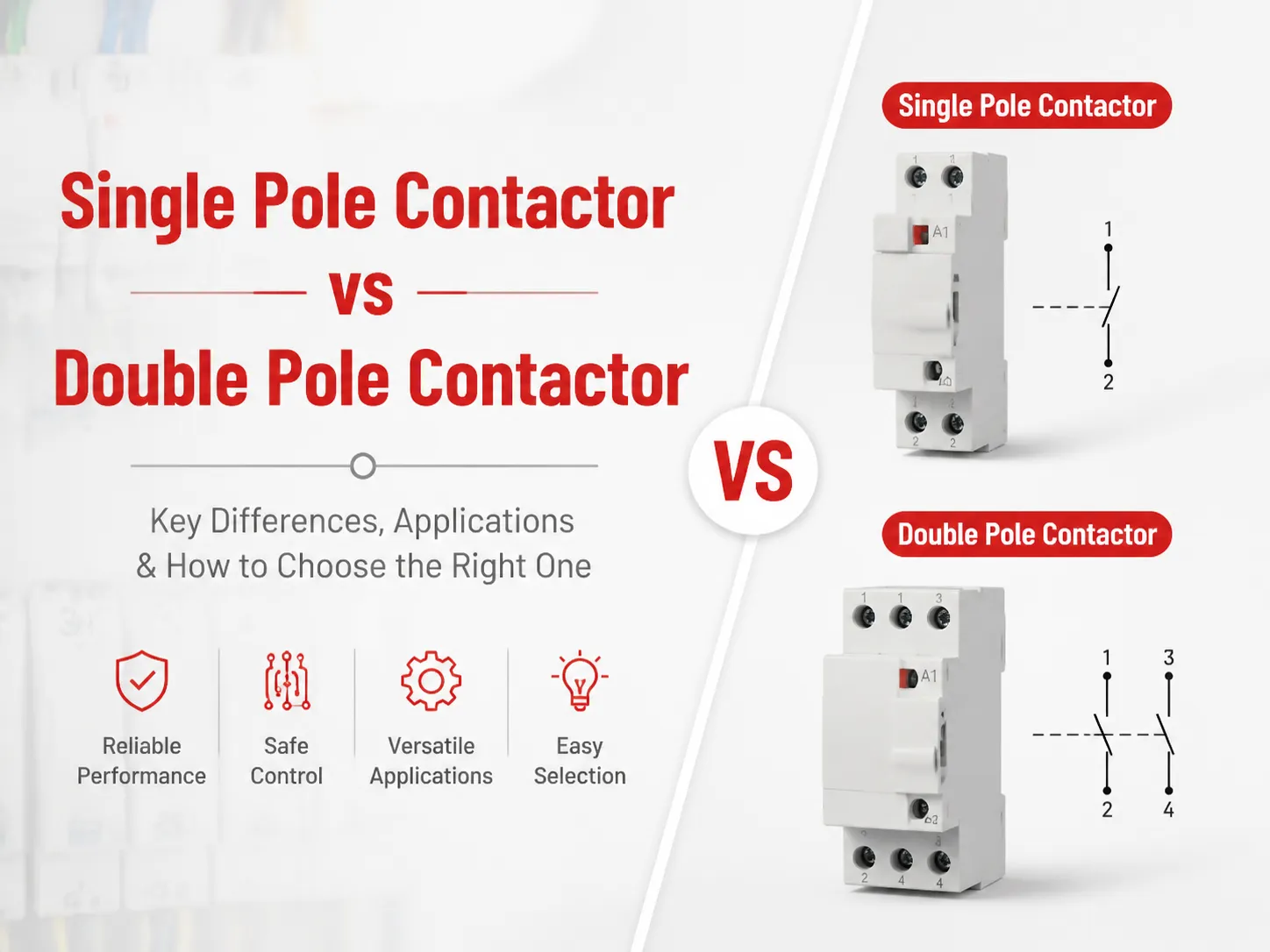
A breaker may be characterized as being made of different circuits. A single pole breaker has one circuit, makes a connection at one busbar, takes one inch of the panel width, and is responsible for one 120 V circuit. A double pole breaker has two circuits, sits on two adjacent busbars, takes up two inches of panel width, and operates on two wires at the same time.
What is important is that the two circuits being used are on different legs of the supply. In the North American split-phase panel with two legs, the voltage between the legs is 240 V, but the voltage between each leg and neutral is 120 V. This makes it possible to use the same apparatus for both cases of getting 240 V voltage for certain purposes like running a heater, as well as 120/240 V voltage with neutral for other uses.If you want the comparison laid out side by side, this look at 1 pole versus 2 pole circuit breakers covers how the two differ in construction and where each is used.
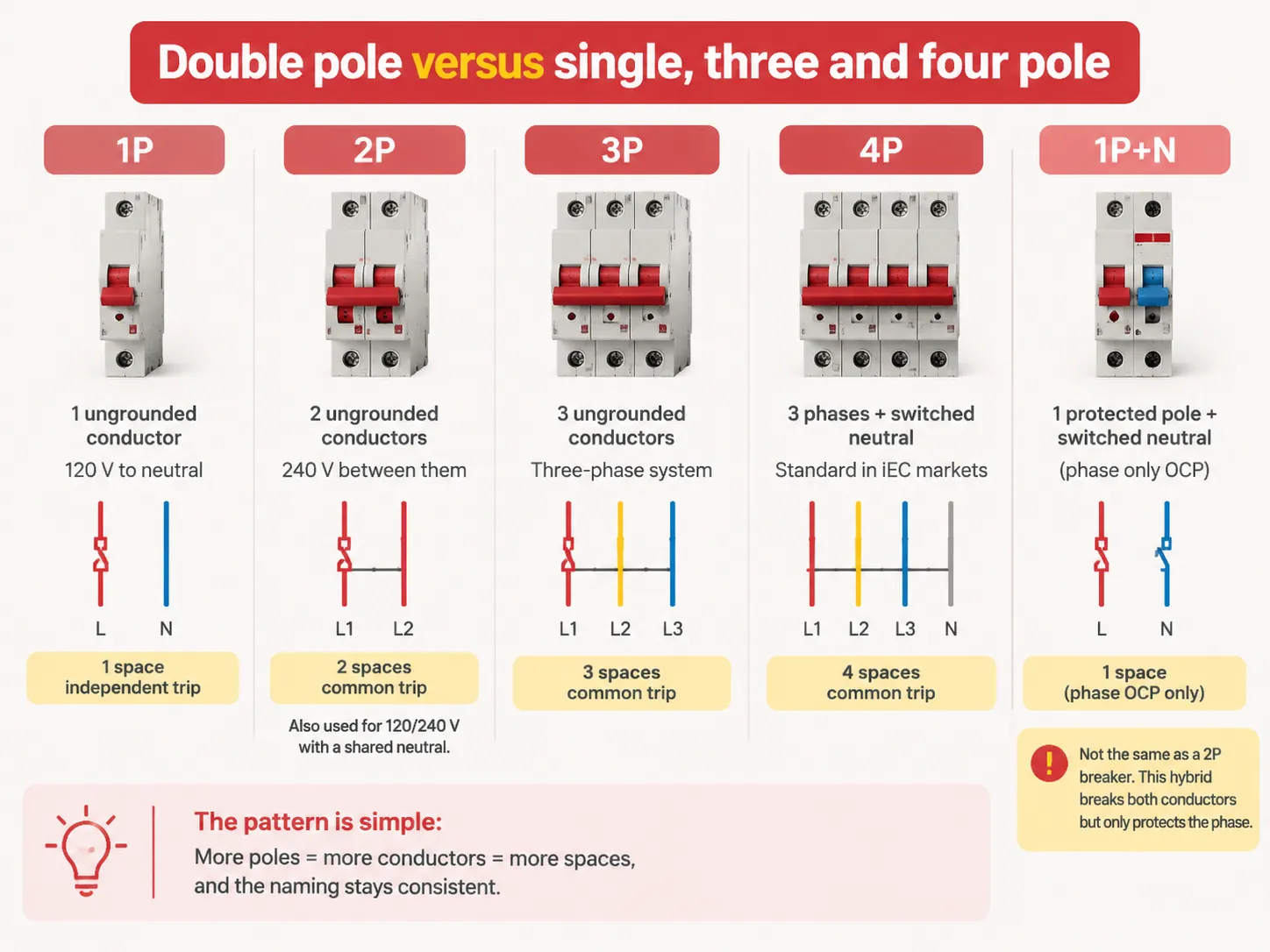
Double pole versus single, three and four pole
The poles increase according to the same system to provide you with names once you become familiar with how they are measured.
- 1 Pole (1P): one ungrounded conductor available of 120 V to neutral, taking one unit of panel space and an independent trip.
- 2 Pole (2P): it has two ungrounded conductors that reach 240 V when the two of them communicate with each other, taking 2 spaces in a panel, sharing trip too, or give 120/240 V with neutral shared by two wires.
- 3 Pole (3P): popular for three-phase systems such as motor loads; 3 spaces are also required, but trip in this case is common.
- 4 Pole (4P): three phases as well as switched neutral; a regular item in IEC markets; it is possible to say the neutral is disconnected from the phases.
Hybrid devices should be also noted; they are known as 1P + N having one pole protected by neutral that can be broke as well; the differences between other types of devices are clear here and this results in mistakes of users looking for an appropriate device for other markets.
When you actually need a double pole breaker
The simple response is that “everything that uses electricity powered on 240 volts”.
- Electric dryers — which are normally rated at 30A and use a NEMA 14-30 outlet with a 10 AWG wire.
- Electric ovens and cookers — which normally run at either 40A or 50A and use the NEMA 14-50 connector and either an 8 AWG or 6 AWG wire.
- Water heaters — that are powered by 30 A (240 V without a last neutral wire).
- Air conditioners and heat pumps — that operate at either 30 A to 60 A.
- Electric chargers — that run at 40 A to 60 A on a dedicated circuit.
- Sub circuit breakers — 60 to 125 A using a garage or workshop circuit.
- Large shop appliances and well-switch pumps used at 20 to 30 A with a two-wire air operation.
Then there’s the missed situation of a multiwire branch circuit, where two 120 V circuits tie together through a common neutral. In this case, two circuits must come in on opposite phases, and they must also be turned off together, so a two-pole breaker must be utilized or two single-pole breakers with a tie must be installed. This is a common way to create a situation where a shared neutral carries the total of both circuits instead of the difference, which can be a fire hazard instead of just an inconvenience. Thirty-amp circuits are where people most often get the pole count wrong, and this comparison of a 50 amp single pole versus double pole breaker explains why the amperage tells you nothing about the number of poles you need.
Common trip, handle ties and what the code actually requires
The term “Common trip” signifies that both poles either open together automatically or manually. The two poles are connected within the breaker via the trip bar and if one pole creates overload, then both poles trip at the same time. This is what makes a real two-pole breaker different from a handle tie.
A handle tie refers to a piece of plastic or metal which connects two single-pole breakers which are separate and unique, and therefore one operation causes the other operation as well. It allows for simultaneous manual operation but does not mean that the trip is automatic. The code allows certain types of handle ties to be used in the multiwire branch wiring, however this invention should not be used in circuits such as a double 240V load because the poles of the circuit must open simultaneously otherwise there will not be a complete separation with no neutral path for current.
1P+N versus 2P: the mix-up worth knowing
If you procure a breaker from both an IEC supply and from a North American supply, you will ultimately face the consequences of this fact.
A 2 pole breaker is designed to provide overcurrent protection for both poles. In other words, in the case of excessive current and short circuit, both conductors are protected.
A 1 pole plus neutral breaker has overcurrent protection only on the supply pole with the other pole serving only as wiring for the neutral pole. Besides, such a breaker is generally smaller – it is a single module breaker which can be found in the majority of IEC breaker ranges – and cheaper.
But this is not a 2 pole breaker and it must not be used in a situation where the breaker should also protect the neutral as well in a situation where the neutral can be at a hazardous potential.
Both types can be similar because they are mounted on a DIN rail and it may be difficult to check what kind of breaker you are buying due to the similarity in their appearance and the fact that with the urgency of placing an order, it is easily to miss important details and information.
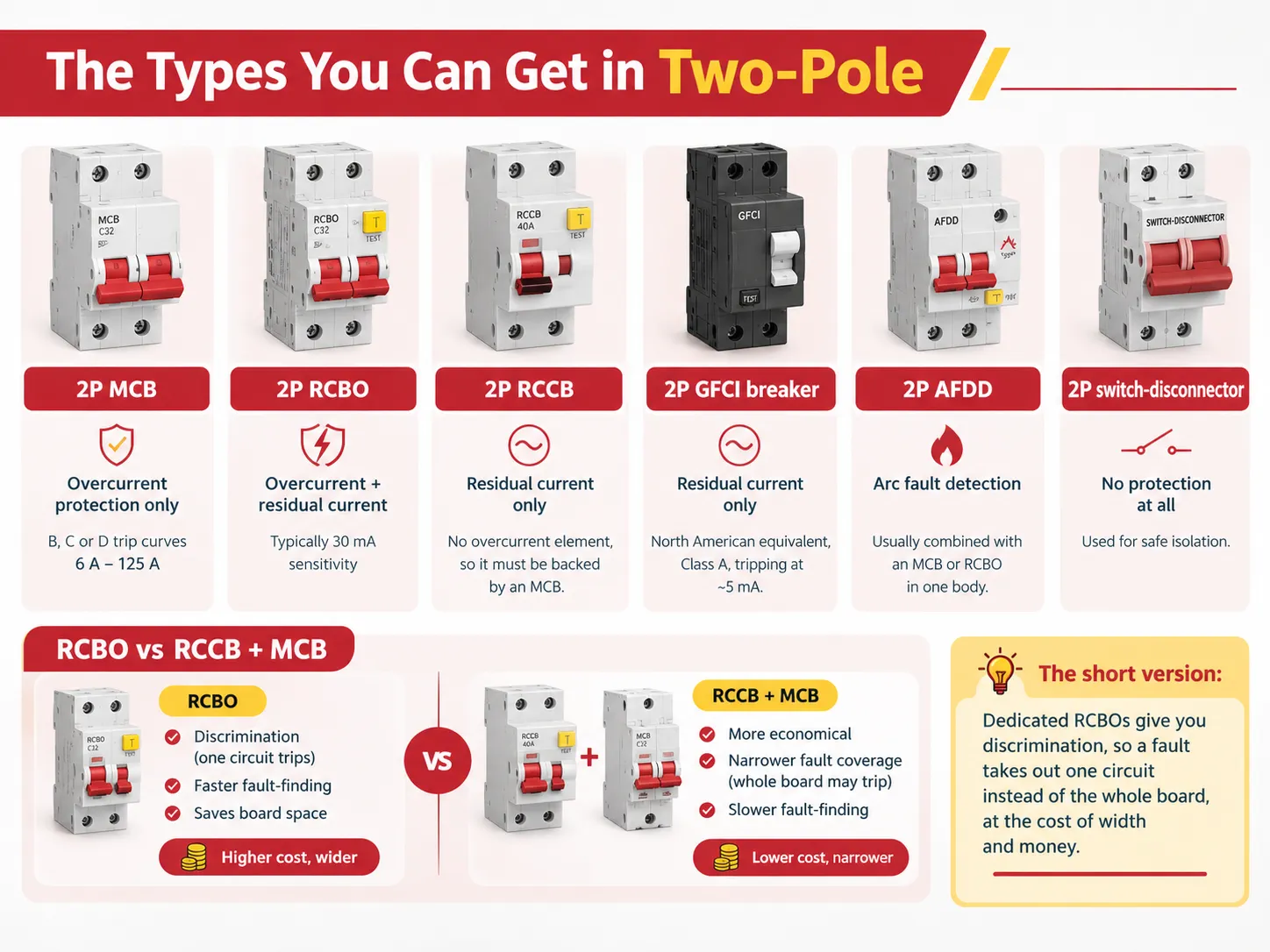
The types you can get in two-pole
The two-pole form is not limited to a simple circuit breaker. The primary categories are:
- 2P MCB – simply overcurrent protection offered in trip curves B, C and D with current rating from 6 A to 125 A.
- 2P RCBO – overcurrent protection along with residual current protection in a single device, usually with sensitivity of 30 mA.
- 2P RCCB – only residual current protection meaning that it requires some other protection like MCB.
- 2P GFCI breaker – North American equivalent a.k.a Class A which trips at around 5 mA.
- 2P AFDD — essentially arc fault detector usually installed along with MCB or RCBO.
- 2P switch-disconnector – de-energizing device with no protection.
It is more of an engineering decision whether to opt for an RCBO or RCCB plus MCB as the choice itself has implications on the board width, time taken in fault finding and costs.This comparison of RCCB versus RCBO sets out when each makes more sense. The bottom line is that using RCBOs gives you the benefit of discrimination where a fault will cut off just one circuit, rather than the entire board, but at the expense of cost and board width.
Arc fault protection in a two-pole device
Arc fault detecting devices certainly deserve a separate statement, as it is their two-pole versions that can solve the problem of single-pole devices. When we have a series arc on a 240 V circuit, like a loose terminal of range outlet or an element inside a dryer, the current might not be sufficient to trip the ordinary breaker or RCD.
An AFDD recognizes the high-frequency signature of the sustained arcs and disconnects the circuit before any heat is produced. The devices must also be utilized in some places in a number of 240 voltage circuits and nowadays they are more and more often specified for use on dryers, ranges and electric vehicle circuits. In most cases two-pole AFDD is actually a combined device providing overcurrent protection. This means it replaces MCB rather than being connected next to it.If the technology is unfamiliar, this explanation of what an arc detector breaker does covers how the detection works and where it is mandated.
Amp ratings, wire sizes and prices
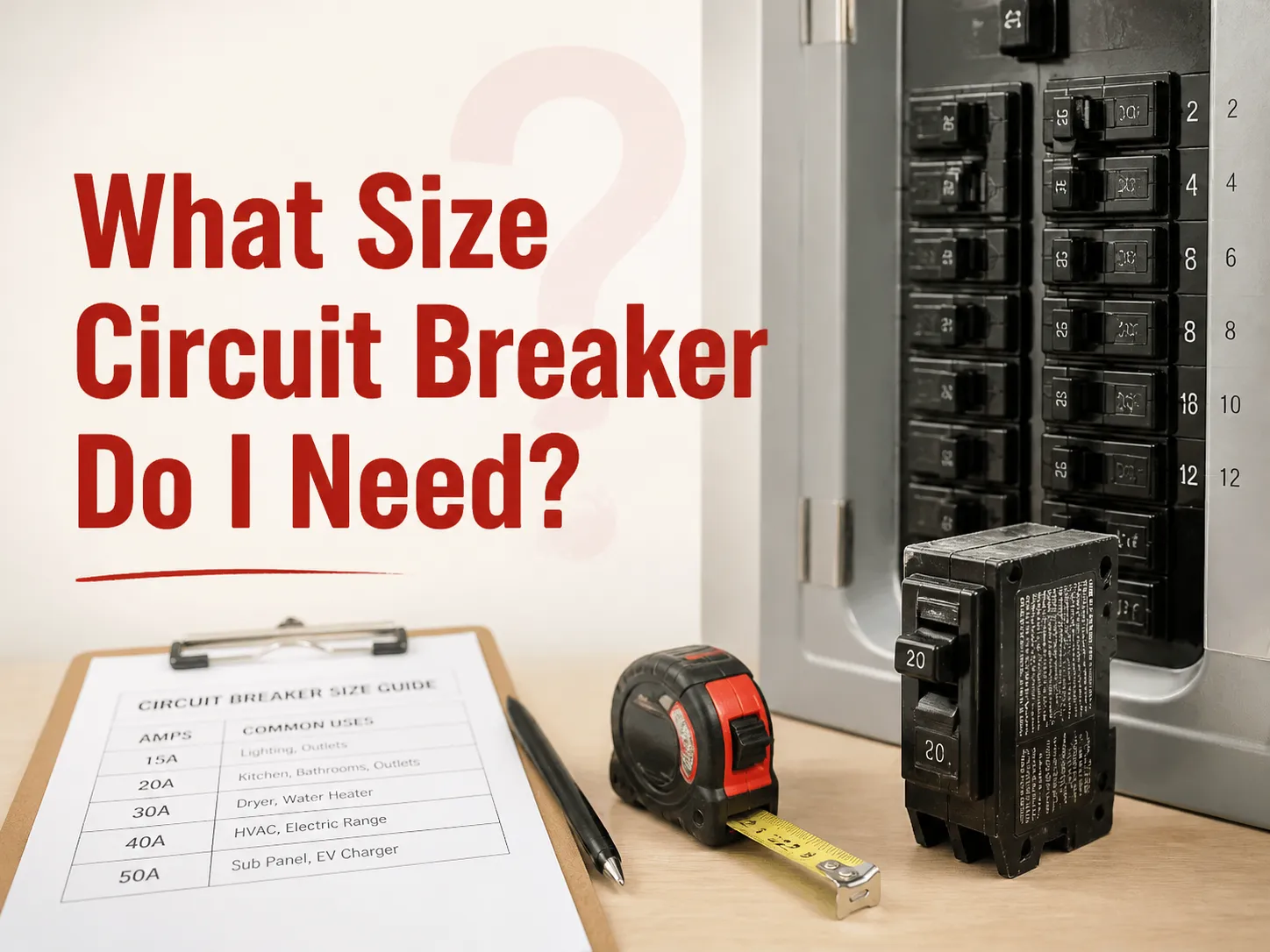
Two-pole circuit breakers come in all the ranges of current. Here is the pairing of the sizes with the copper:
- 15 A: 14 AWG
- 20 A: 12 AWG
- 30 A: 10 AWG
- 40 A: 8 AWG
- 50 A: 6 AWG
- 60 A up to 125 A: 6 AWG to 1/0 AWG depending on the run and termination rating
In terms of cost, a plain two-pole mini circuit breaker costs anywhere between $14 and $35, depending on brand and rated current, while the equivalent single-phase device costs around $6 to $12. If you want protection, expect to pay a lot; the two-pole residual-circuit breaker will usually cost between $25 and $60, the two-pole ground fault breaker between $80 and $150, and the two-pole arc-fault breaker anywhere from $100 and up to $200 and more. This means that the device is rarely the expensive part of the job — the installation and the wires usually come at a higher price.
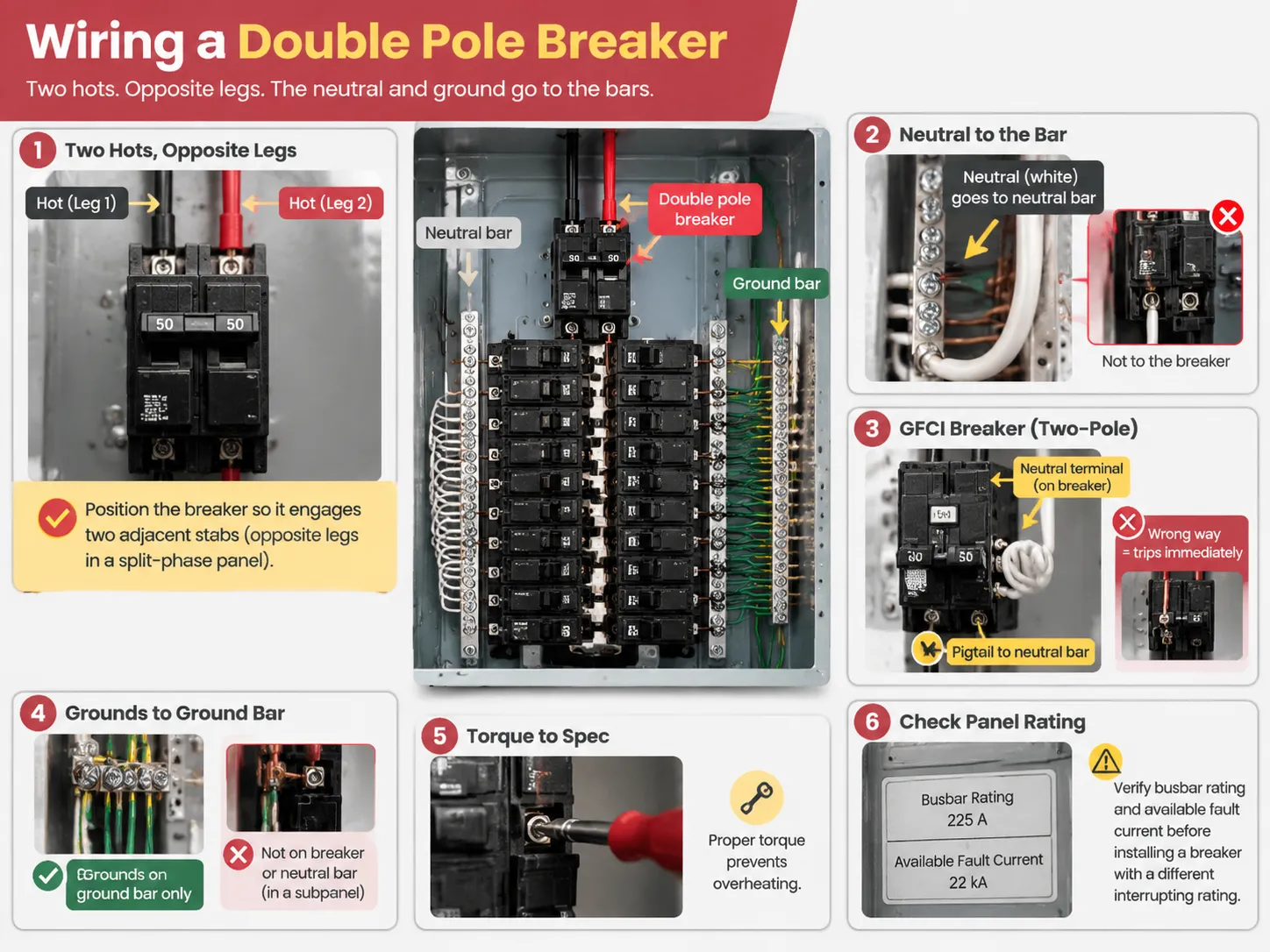
Wiring a double pole breaker
Concepts are clear but confusing point needs clarity.
- Two-hot wires work with two terminals. Two black wires connect with two terminal points. Breaker should be fitted to connect with both stab points of breaker. In a split-phase panel, given that adjacent positions are located in different opposite legs.
- Normally, neutral wire does not connect with breaker. In case of NEMA 14-30 or NEMA 14-50 circuits, neutral wire connects to neutral bars but not to the breaker. Breaker is designed to break faults of the ungrounded conductors.
- GFCI works differently. Two-pole GFCI contains one breaking point which usually works opposite to the neutral ones. Pigtail goes to neutral. Breaker connects with neutral pigtail. Reverse connection will block breaker from working.
- Ground wire must always be left connected to the ground bar. Connection through breaker or through neutral bar is not possible.
- Make fasteners tight. The looseness of the connections is the main cause of overheating the devices.
In the case of replacing existing two-pole breaker, it is recommended to double check the bus rating and fault current rate before connecting a device with other interruption.
Which brands to look at
The common North American brands are recognizable and priced appropriately. With IEC-spec appliances, the market is much more diverse and often provides a better deal than people think.
We build the HUYU range of MCBs, RCBOs and AFDDs, including the HUM18-63N miniature circuit breaker in 1P through 4P, 63 A, with type B, C and D curves. In a two-pole requirement, one family will cover the basic 240 V load with the RCBO variant used for shock protection and the AFDD used for arc protection. Moreover, this is provided at a cost that allows for a fully protected board, rather than something extravagant. When sourcing for a project rather than a single board, it is important to engage the manufacturer portion of the business in any talks.
Frequently asked questions
What is the difference between a single pole and a double pole breaker?
A single pole breaker is used to protect one wire only and gives output of 120 V from one busbar stab. On the other hand, a double pole breaker safeguards two wires, gives 240 V, occupies twice the panel width.
Do I need a double pole breaker for 240 volts?
Indeed. Any line-to-line 240V load – dryer, range, water heater, air conditioner, electric vehicle charger – is required to have a two-pole device with a trip connection so that both ungrounded conductors are turned off simultaneously. A dual-pole circuit breaker also provides the proper 240V supply, which two separate breakers on the same circuit do not provide.
Can I use two single pole breakers instead of a double pole breaker?
This applies only in limited cases. Two single pole breakers that come with an identified handle tie can be used for multiwire branch circuits when the two circuits have a common neutral and need to be turned off at the same time for safety reasons. They cannot be used for any straight 240V load as handle tie does not help ensure that the two poles will trip at the same instant.
What is the difference between a 1P+N and a 2P breaker?
The two-pole breaker has overcurrent security in both poles. The single-pole with neutral (1P+N) breaker protects the phase pole only and switches the neutral. The single-phase with neutral breaker is slimmer and less pricey compared to the other one and is often seen in installations complying with International Electrotechnical Commission (IEC) rules.
How much does a double pole breaker cost?
The price range of a basic 2P MCB is in the ballpark of approximately $14-$35, depending on brand as well as rating. The price increases considerably when residual current protection is included, bringing the cost of an RCBO to around $25-$60. A 2P GFCI breaker costs around $80-$150 and a 2P AFDD may go from $100-$200 or even more depending on the model of the appliance, which is to say that labor and cabling are generally the most expensive components of any circuit.
References
- NFPA 70 — National Electrical Code, Articles 210, 240 and 250
- IEC 60947-2 — Low-voltage switchgear and controlgear, Part 2: Circuit-breakers
- UL Solutions — UL 489 molded case circuit breakers and UL 943 ground-fault circuit interrupters
- Electrical Safety Foundation International — home circuit breaker and GFCI safety guidance
- Eaton — residential circuit breaker and load centre technical documentation
Conclusion
The double pole breaker has two functions. The main job of the double pole breaker is to provide a voltage of 240 to power the load through both lines of the service. The secondary function of a double pole breaker is to ensure that both poles are disconnected simultaneously which is vital for safety. Hence, a handle tie is not a viable option over the double pole breaker in standard 240 volt setups.
The type of breaker used depends on what kind of protection you need. For example, you can use a regular two-pole circuit breaker for a heater, or use a two-pole RCD circuit breaker in areas with the danger of getting shocked, or employ a two-pole AFDD in cases of arcature. All of these technologies fall under the same category of technologies which means that the dimensions of the equipment remains the same allowing for the use of a suitable panelboard.