
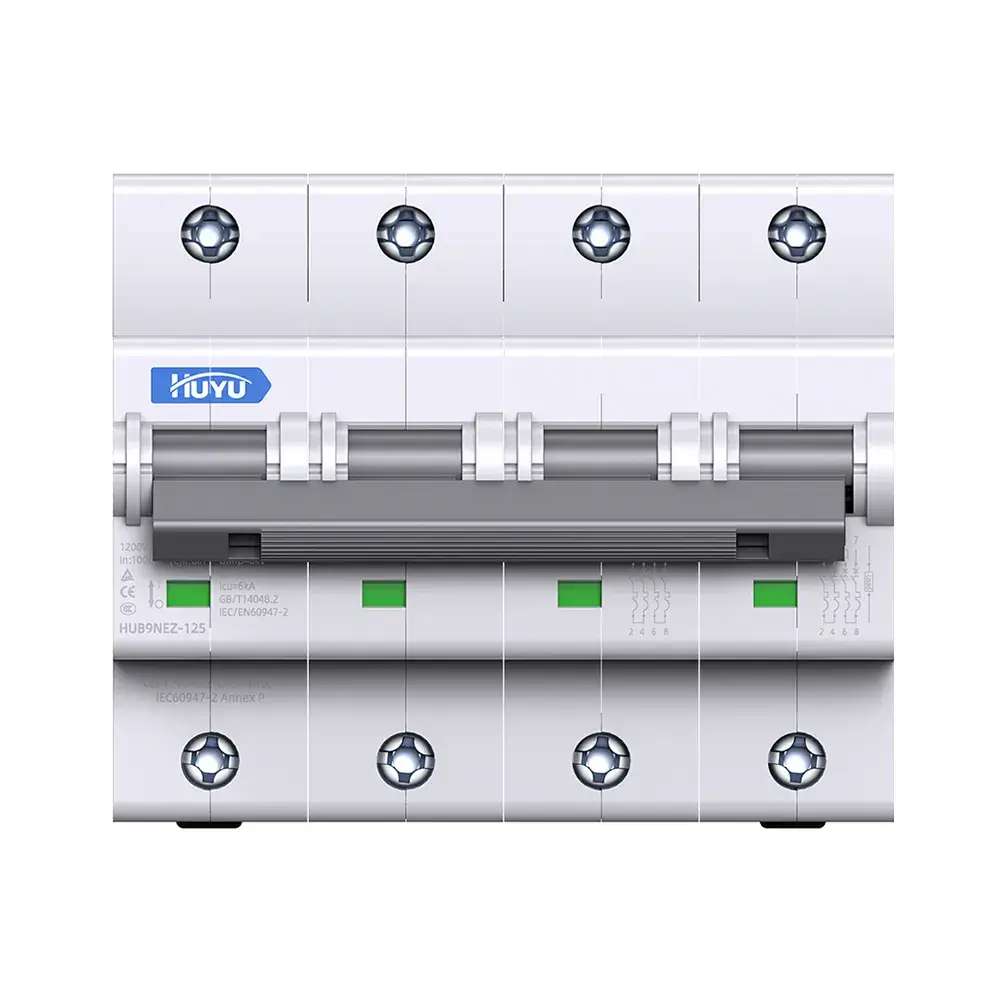
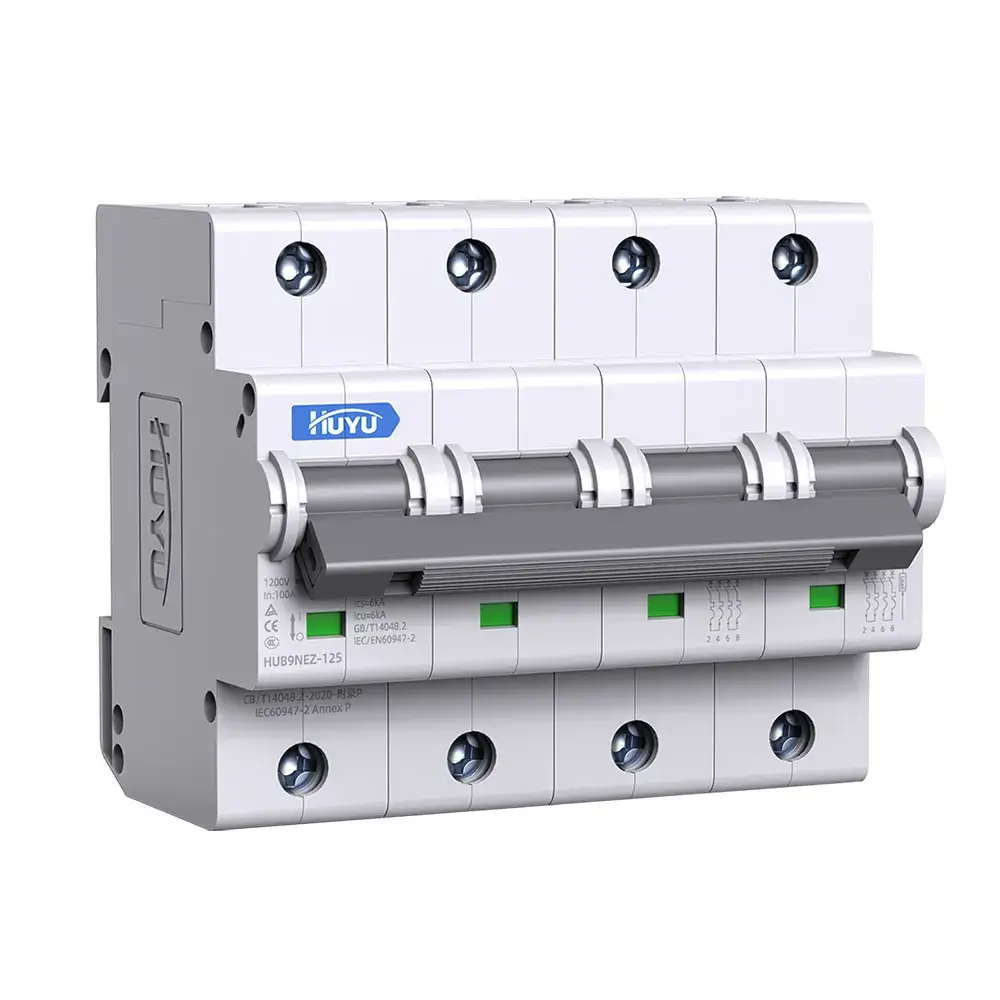
HUB9NEZ-125 DC Breakers for Solar 63A-125A
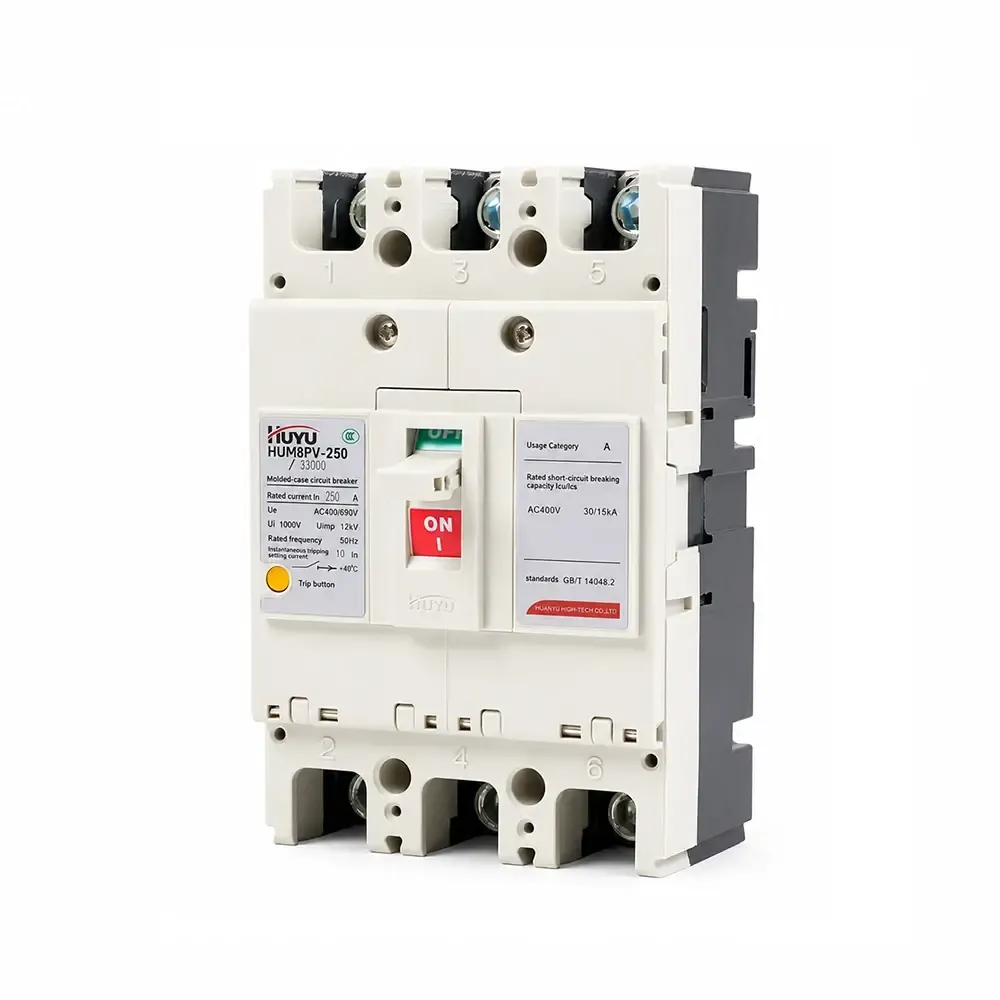
The HUB9NEZ-125 is a high-capacity DC breaker for solar rated 63A–125A up to DC 1500V. Non-polarity design for simplified installation. 10kA Icu (H type), B and C curves. 1P/2P/3P/4P. For high-current PV strings, battery storage, and DC distribution.
Standard: IEC 60947-2
Rated Current: 63A, 80A, 100A, 125A
Rated Voltage: DC 300V(1P) – 1500V(4P)
Breaking Capacity: 10kA Icu (H type)
Poles: 1P, 2P, 3P, 4P
Tripping Curves: B, C
Applications: PV string protection, battery storage, high-current DC distribution
Product Information
HUB9NEZ-125 DC Breakers for Solar – High Current, 1500V, Non-Polar Design
The HUB9NEZ-125 series DC breakers for solar extend HUYU Electric’s NE NEW ENERGY SERIES into higher current capacities. Rated from 63A to 125A and up to 1500V DC, these solar DC breakers are designed for the largest PV strings, battery storage DC feeders, and high-current DC distribution where standard 63A breakers cannot suffice. The 4-pole configuration enables users to operate at 1500V DC, matching the voltage of next-generation utility-scale PV systems without additional voltage derating.
The HUB9NEZ-125 features a non-polarity design, which eliminates terminal polarity constraints, reducing the risk of wiring errors that can cause significant damage. These DC breakers are available in H type with 10kA Icu breaking capacity and B or C trip curves, while their engineering is consistent across the NE series. HUYU Electric offers factory-direct OEM/ODM services with complete documentation for buyers sourcing these breakers for high-current PV and battery storage applications.
Technical Data
| Parameter | HUB9NEZ-125 / HUB9NEZ-125H |
|---|---|
| Rated Current In | 63A – 125A (63, 80, 100, 125A) |
| Rated Voltage Ue | 1P: DC 300V/375V | 2P: DC 600V/750V | 3P: DC 900V/1125V | 4P: DC 1200V/1500V |
| Poles | 1P, 2P, 3P, 4P |
| Insulation Voltage Ui | 1500V |
| Impulse Withstand Uimp | 6kV |
| Tripping Characteristics | B: 4In (1±20%) / C: 8In (1±20%) |
| Tripping Type | Thermal-magnetic |
| Icu (Ordinary / H type) | 6kA / 10kA |
| Ics (Ordinary / H type) | 6kA / 7.5kA |
| Mechanical / Electrical Life | 10,000 / 1,500 operations |
| Protection Degree | IP40 (enclosure), IP20 (terminals) |
| Operating Temperature | -30°C to +85°C |
| Wiring Capacity | 16–50mm² |
| Mounting | DIN rail |
| MOQ | Contact for project quotation |
Request a Quotation for HUB9NEZ-125 DC Breakers for Solar – Factory Direct
63A–125A, up to 1500VDC. Non-polarity design. 10kA Icu (H type), B/C curves. 1P–4P. For high-current PV and battery storage. OEM/ODM with full documentation. Contact us for pricing and lead time.
Project-Based Quotation • IEC 60947-2 • Worldwide Shipping
OEM/ODM Supply – High-Current 1500V DC Breakers for Utility-Scale Projects
HUB9NEZ-125 – 1500V, 125A, and Ready for the Largest DC Circuits
For utility-scale PV and large battery storage, a DC breaker for solar must handle both high continuous current and high voltage in a single device. The HUB9NEZ-125 delivers this with 125A at 1500V DC in a 4-pole configuration. Its non-polarity design is particularly valuable at these power levels — a reverse-polarity fault in a 125A DC circuit can cause catastrophic equipment damage. For solar OEMs and EPC contractors currently specifying DC breakers for battery storage from ABB, Schneider Electric, or Eaton, HUYU Electric provides equivalent high-current protection with factory-direct pricing, private labeling, and complete type-test documentation from an established manufacturing facility.
How to Size and Select DC Breakers for Solar and Storage
Key criteria for choosing the HUB9NEZ-125 in high-current PV and battery applications.
1. When to Move Up from 63A to 125A DC Breakers
Standard DC breakers for solar typically max out at 63A. For PV strings with Isc exceeding 50A — common with bifacial modules or parallel string configurations — a 63A breaker leaves insufficient headroom. The HUB9NEZ-125 provides 80A, 100A, and 125A ratings that maintain the standard 1.25 × Isc safety margin for larger strings. In battery storage, DC bus currents often reach 100A–125A in containerized systems, requiring appropriately sized DC breakers for battery storage.
2. Voltage Selection: 1000V or 1500V?
For 1000V PV systems, a 3-pole solar DC breaker rated at 900V/1125V is sufficient. For 1500V systems, the 4-pole 1200V/1500V configuration is required. The HUB9NEZ-125’s 1500V rating means one breaker can isolate the full string voltage in a 1500V plant without series connection of separate breakers. Always select the pole count such that the rated voltage exceeds the string’s maximum open-circuit voltage at the lowest expected ambient temperature.
3. Ordinary vs. H Type Breaking Capacity
The ordinary type (6kA Icu) covers most PV string applications where the string’s short-circuit current is the limiting factor. The H type (10kA Icu) provides additional margin for: large parallel-connected arrays with higher available fault current, battery storage systems where the DC bus can deliver substantial short-circuit current, and installations near transformers or other fault current sources.
4. Non-Polarity at High Currents
At 125A, a reverse-polarity wiring error is not just a nuisance — it can cause immediate equipment damage. The HUB9NEZ-125’s non-polarity design eliminates this risk entirely. For DC breakers for PV installed in field combiner boxes where wiring conditions are less controlled than factory assembly, this design feature provides an important safety margin.

Frequently Asked Questions
Do I need a DC breaker for solar panels?
Yes, DC breakers for solar are a code requirement in most jurisdictions for PV installations. They provide overcurrent protection for each string and serve as a manual isolation point for maintenance and emergency shutdown. Without a properly rated solar DC breaker on each string, a fault in one string could draw current from all parallel-connected strings, exceeding the cable rating and creating a fire hazard. The HUB9NEZ-125 provides this protection for strings up to 125A and 1500V DC.
What is a DC breaker in solar?
A DC breaker in solar is a circuit protection device installed between the PV modules and the inverter. Its function is to protect the DC wiring from overcurrent — either from a short circuit within the PV array or from backfeed from parallel strings — and to provide a manual disconnection point for safe maintenance. Unlike an AC breaker, a DC breaker for PV must extinguish a DC arc with no natural zero-crossing, using magnetic blowout and arc chute technology. The HUB9NEZ-125 is purpose-built for this role, with a 10kA Icu breaking capacity and voltage rating up to 1500V DC.
How to size a solar DC breaker?
To size a solar DC breaker, take the PV string’s short-circuit current (Isc) from the module datasheet and multiply by 1.25 (for NEC compliance) or 1.5 (for IEC markets). For example, a string with Isc = 64A requires a breaker rated at least 80A (1.25 × 64 = 80A). For the voltage rating, the breaker’s rated voltage must exceed the string’s open-circuit voltage (Voc) at the lowest expected ambient temperature — temperature-corrected Voc can be up to 20% higher than STC ratings. The HUB9NEZ-125 DC breakers for solar cover the 63A–125A range and 300V–1500V voltage range, accommodating most string configurations from residential to utility-scale.
What type of breaker for solar?
Solar PV systems require DC-rated circuit breakers — not AC breakers. The appropriate DC breaker for solar must: be rated for DC voltage at or above the string’s maximum Voc, have a DC breaking capacity (Icu) that exceeds the available fault current, be rated for the appropriate continuous current (typically 1.25 × Isc), and carry relevant certifications (IEC, UL, or TUV) for the project’s jurisdiction. The HUB9NEZ-125 meets all these criteria with its DC-specific thermal-magnetic trip unit, 10kA Icu (H type), 1500V rating, and non-polarity design. For PV applications, avoid using AC-rated MCBs — they cannot safely interrupt DC fault currents and violate electrical codes.
No documents available for download at this moment.