
When a hyperscale facility in Northern Virginia was building its new 100-megawatt site, its power distribution system was not an afterthought. It was the most expensive item on the capital project list, it was delayed the longest in procurement, and it was the system that allowed the least defect tolerance. The design included the 34.5 kV primary service, level transformed to 480 V and 208 V at the rack, as well as the redundant A/B feeds to each cabinet, the calculations of arc flash incident energies for each bus, and SCADA system with monitoring of current, voltage, temperature, and partial discharge for each circuit breaker from the main switchgear down to the branching units. If there was a mistake with just one bus bar or breaker with the wrong breaking rating, the whole uptime certification of the data center would be put at risk.
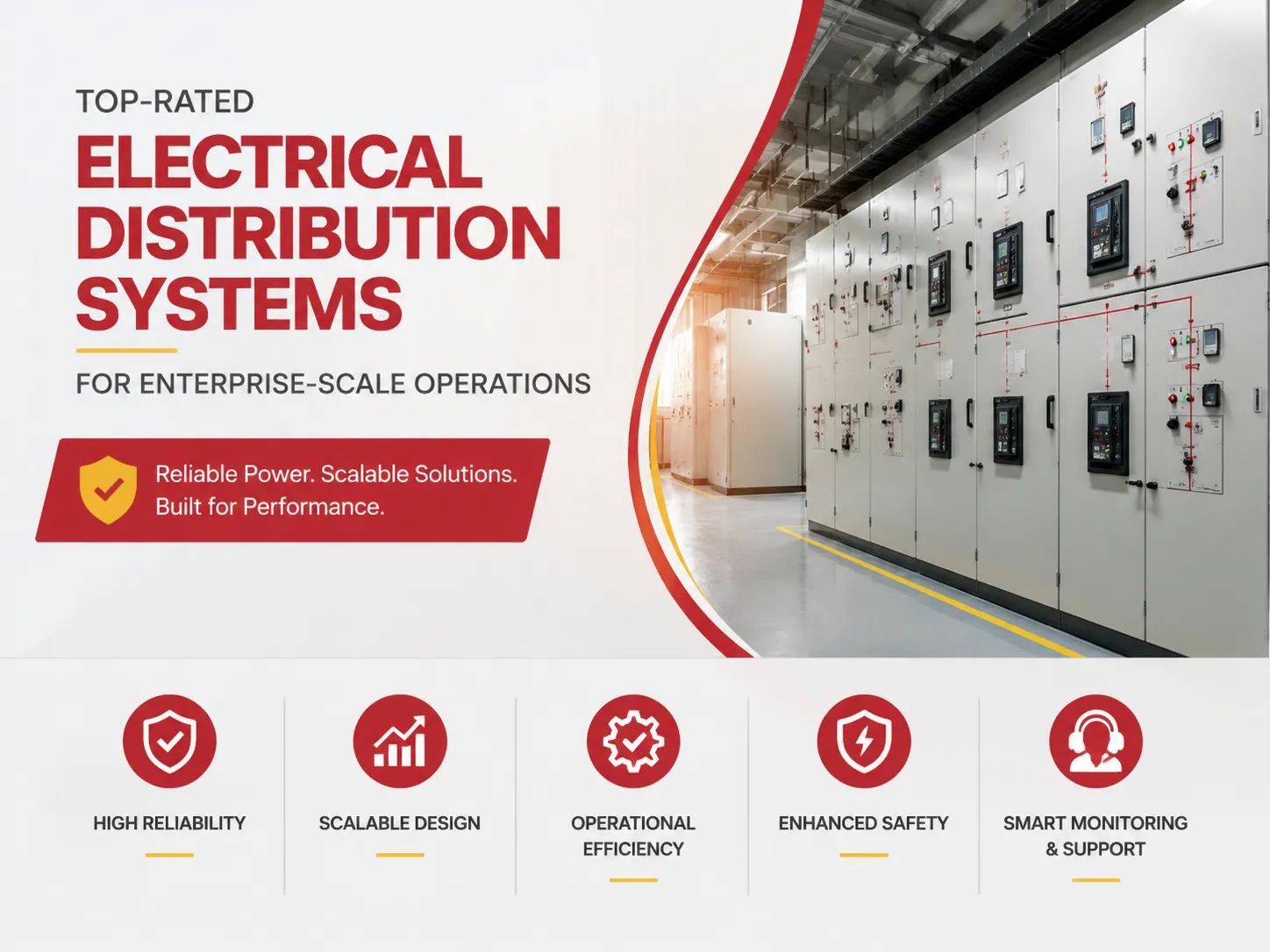
System Summary: Top-rated enterprise scale electrical distribution system is a comprehensive system of switchgear devices, switchboards, panelboards, transformers, circuit breakers, busway, and power monitoring equipment that transfers power from utility service point to all loads in an enterprise. The main characteristics of such a system include selective coordination (a fault would be cleared at the fixed point by the nearest upstream device with no impact on other parts of the system), scalability and expandability (the system can accommodate the load growth with no need to redesign), energy transparency (amount of energy used by each electrical device is constantly monitored and can be tracked), and maintainability (one does not need to stop the entire system to repair and replace components). The largest producers of power distribution equipment in the world, such as Schneider Electric, Siemens, ABB, Eaton, and HUYU, produce integrated packages from the medium voltage switchgear to the low voltage circuit breakers and terminals along with communication and software tools for solving the many questions related to the system.
The Architecture of an Enterprise Electrical Distribution System
The electrical distribution system at enterprise level is arranged in certain layers, every layer having a specific voltage level, its own protective devices and devices. The overall structure is hierarchical: power is fed into the facility at the service entrance, often at medium voltage (4,160 V to 34,500 V in North America; 3,300 V to 33,000 V in other markets), goes through several stages of transformation and is distributed to the end users at utilization voltage level (480 V for induction motors and fans; 208 V or 120 V for lighting, plugs and PCs for North America; 400 V and 230 V for IEC markets). The main elements used at every stage are presented in the table below.
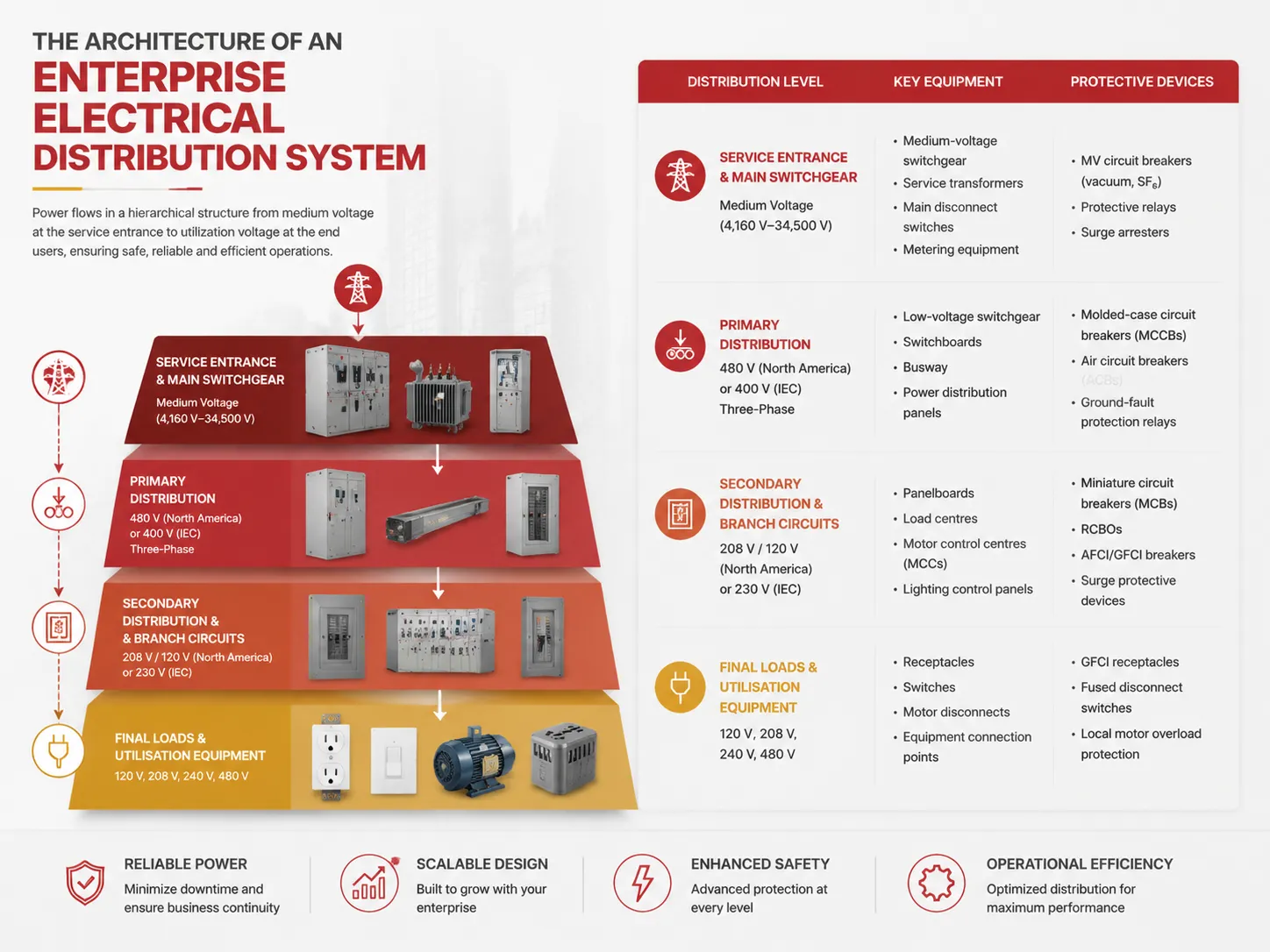
| Distribution Level | Typical Voltage | Key Equipment | Protective Devices |
|---|---|---|---|
| Service entrance and main switchgear | Medium voltage (4,160 V–34,500 V) | Medium‑voltage switchgear, service transformers, main disconnect switches, metering equipment | MV circuit breakers (vacuum, SF₆), protective relays, surge arresters |
| Primary distribution | 480 V (North America) or 400 V (IEC) three‑phase | Low‑voltage switchgear, switchboards, busway, power distribution panels | Molded‑case circuit breakers (MCCBs), air circuit breakers (ACBs), ground‑fault protection relays |
| Secondary distribution and branch circuits | 208 V / 120 V (North America) or 230 V (IEC) | Panelboards, load centres, motor control centres (MCCs), lighting control panels | Miniature circuit breakers (MCBs), RCBOs, AFCI/GFCI breakers, surge protective devices |
| Final loads and utilisation equipment | 120 V, 208 V, 240 V, 480 V | Receptacles, switches, motor disconnects, equipment connection points | GFCI receptacles, fused disconnect switches, local motor overload protection |
Critical Design Principles: What Separates a Top‑Rated System from an Adequate One
The highest-rated electrical distribution systems in business are not simply a collection of equipment that meets the necessary code requirements. These systems are designed from the onset to meet a combination of criteria of performance and operation above and beyond safety requirements. A few of the most crucial criteria include selective coordination (meaning that the selection and settings of the protection devices in the whole distribution line, from the main breaker to the MCBs, are directed in such a way that once a malfunction happens in any section, the fault will be eliminated by the closest upstream device only and the illumination in other sections will not be affected; selective coordination between systems of various voltages implies undertaking a thorough time-current coordination analysis and this is what makes a difference between a top-rated and a code-minimum system), scalability and expandability (the system is designed for the expected load increase over a period of 10-20 years in the future; that is why during the specifications of the switchgear bus ratings, transformer capacities, and panelboards slots additional margin of around 20-30% is set over estimated initial values which allows adding circuits without changing critical equipment), transparency and energy reporting (as a rule, all important circuits of a modern enterprise system are traced from the switchgear to the panelboard, and even to each individual circuit, with the help of the power monitoring system that allows receiving dashboards in real-time and undertaking trend analysis of energy consumption), as well as maintainability and service continuity (the essential components of the system can be put out of operation for the repair without turning off the system completely; draw-out breaker designs, dual-bus switchgear, and bypass isolation switch enable the maintenance team to perform reparations without interruptions in power supply).
How to Choose the Right Distribution System for Your Industry and Environment
The electrical distribution needs of a data center are significant from the demands of a pharmaceutical production facility, an office building high up in the sky, or a solar energy installation. The practice of locating the electrical distribution system to the sector and physical location becomes the relevant design step.
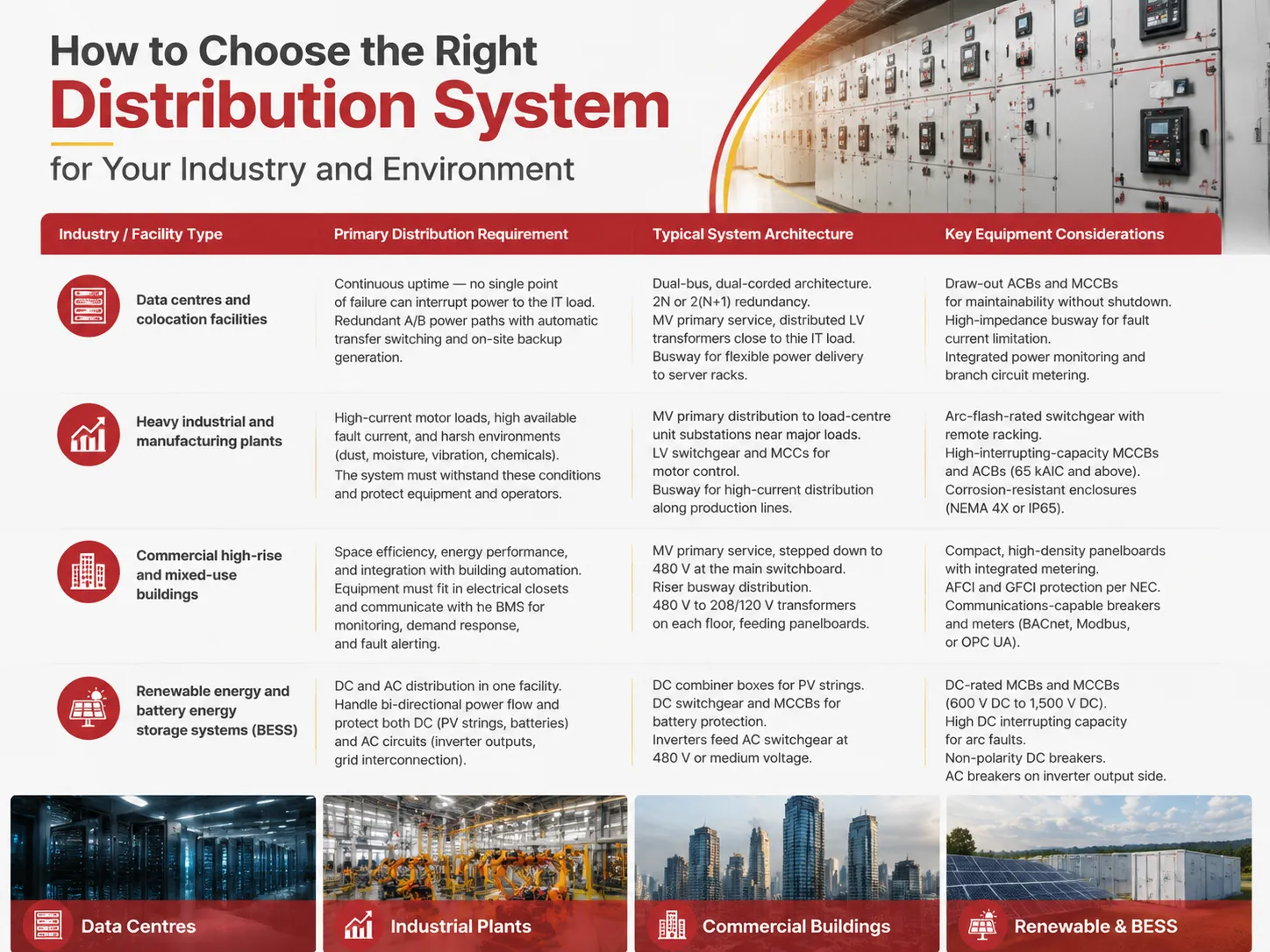
| Industry / Facility Type | Primary Distribution Requirement | Typical System Architecture | Key Equipment Considerations |
|---|---|---|---|
| Data centres and colocation facilities | Continuous uptime — no single point of failure can interrupt power to the IT load. Redundant A/B power paths from the utility service to the rack, with automatic transfer switching and on‑site backup generation. | Dual‑bus, dual‑corded architecture. 2N or 2(N+1) redundancy. MV primary service, distributed LV transformers close to the IT load. Busway for flexible, reconfigurable power delivery to server racks. | Draw‑out ACBs and MCCBs for maintainability without shutdown. High‑impedance busway for fault current limitation. Integrated power monitoring and branch circuit metering for energy reporting and capacity planning. |
| Heavy industrial and manufacturing plants | High‑current motor loads, high available fault current, and harsh environments (dust, moisture, vibration, chemicals). The distribution system must withstand these conditions and protect both the equipment and the operators. | MV primary distribution to load‑centre unit substations located close to the major process loads. LV switchgear and MCCs for motor control. Busway for high‑current, flexible distribution along production lines. | Arc‑flash‑rated switchgear with remote racking for operator safety. High‑interrupting‑capacity MCCBs and ACBs (65 kAIC and above). Corrosion‑resistant enclosures (NEMA 4X or IP65) for wet or chemical environments. |
| Commercial high‑rise and mixed‑use buildings | Space efficiency, energy performance, and integration with building automation. The distribution equipment must fit in dedicated electrical closets on each floor, and it must communicate with the building management system for energy monitoring, demand response, and fault alerting. | MV primary service, stepped down to 480 V at the main switchboard, distributed vertically through a riser busway. 480 V to 208/120 V transformers on each floor, feeding panelboards in electrical closets. Lighting control panels integrated with the building automation system. | Compact, high‑density panelboards and switchboards with integrated metering. AFCI and GFCI branch circuit protection per NEC requirements. Communications‑capable breakers and meters that support BACnet, Modbus, or OPC UA for integration with the building management system. |
| Renewable energy and battery energy storage systems (BESS) | DC and AC distribution within the same facility. The system must handle bi‑directional power flow from the inverters, and it must protect both the DC circuits (PV strings, battery racks) and the AC circuits (inverter outputs, grid interconnection) with devices rated for the specific current type and voltage. | DC combiner boxes for PV string aggregation. DC switchgear and DC MCCBs for battery rack protection. Central inverters or string inverters feeding AC switchgear at 480 V or medium voltage. AC/DC segregation and clear labelling throughout. | DC‑rated MCBs and MCCBs with the appropriate voltage rating (600 V DC to 1,500 V DC) and interrupting capacity for the DC arc. Non‑polarity DC breakers for simplified installation. AC breakers on the inverter output side. HUYU’s DC breaker range, including the HUB9NEZ‑80 DC circuit breaker, is designed specifically for these applications. |
Leading Manufacturers of Enterprise Electrical Distribution Equipment
The worldwide enterprise electrical distribution device market is handled by a handful of international companies that manufacture equipment for the complete range of voltages and currents – from medium voltage switchgear to low voltage panels, as well as circuit breakers. Some manufacturers are always rated among the top ones in the design, production, and service of enterprise electrical distribution systems.
Schneider Electric (France) is among the largest producers of electrical distribution equipment in the world. It has a broad product range of MV switchgear, LV switchgear and switchboards, panel boards, busway, and circuit breakers. The company operates several brands, including Square D and Masterpact. Their EcoStruxure platform adds a new dimension to their products, thus facilitating the integration of power monitoring, energy management, as well as building automation in the entire distribution system. The strength of Schneider lies in its global reach, integrated software and hardware ecosystem, and a wide base of installations in commercial buildings, data centers, and industrial plants. The pricing strategy of Schneider is mid-to-premium priced.
Siemens (Germany) The company is a worldwide leader in electrical infrastructure. It has various products including MV gas and air-insulated switchgear, LV switchgear, and switchboards, busway and Sentron series molded-case and miniature circuit breakers. The company has a strong background in engineering, integrated automation and power distribution (TIA Portal at SENTRON power monitoring), and strong presence in industrial, data center, and utility applications. The company has a price position at a premium.
ABB (Switzerland/Sweden) a global leader in electrification and automation, is a provider of distribution equipment that includes high voltage switchgear, low voltage switchgear (MNS and System pro E power), panels and Emax 2 and Formula series of circuit breakers. Among other strengths, ABB has advanced digital integration. The ABB Ability solution delivers cloud-based monitoring of electric energy consumption and predicts maintenance needs.
Eaton (Ireland/USA) is an important North American and worldwide producer of electrical distribution manufacturing, with products such as MV switchgear, LV switchgear and switchboards, panel board, busway, and a complete variety of molded case and small circuit breakers under the Cutler Hammer and Eaton brands. Eaton’s power lies in its large manufacturing and distribution network in North America, its vast experience in the commercial building and industrial markets, and its competitive average prices.
HUYU (China) is a manufacturer of low‑voltage electrical protection and distribution equipment. The range of products includes miniature circuit breakers (MCBs), molded case circuit breakers (MCCBs), residual current devices (RCDs and RCBOs), direct current (DC)-rated breakers for solar and batteries storage, surge protection devices and automatic transfer switches. HUYU also partners with Eaton in their venture to merge global engineering expertise and quality management with manufacturing which is economical and quality-oriented. For the enterprise customer such as a panel builder, distributor, or facility manager, HUYU offers both tested and certified protected devices at a medium price while maintaining fastest lead times and continuous engineering support. In a distribution system of any scale, the regulators and protectors that fill the panels are essential components which must work properly and HUYU products are manufactured accordingly to make that possible by being UL, TUV, and CE certified. For a detailed look at the certification that every breaker in an enterprise system must carry, our article on what UL 489 breakers are explains the testing and listing framework.
Frequently Asked Questions
Who are the top electrical distributors in the United States?
In the U.S., Sonepar (which includes Hagemeyer and OneSource), WESCO (with Anixter), Graybar, Rexel (which includes Gexpro), and CED (Consolidated Electrical Distributors) are among the leading electric wholesalers in terms of revenue and distribution network coverage. These electric distributors do not make distribution equipment but are suppliers, delivering equipment made by distributors like Schneider Electric, Siemens, Eaton, and ABB to end-users, system suppliers, and maintenance engineers.
Which company db box is best?
Distribution board (db box) manufacturer choice depends on application, local standards, and required certification. Among the top manufacturers in this field are Hager, Schneider Electric, and Legrand in the UK and IEC markets, and Eaton, Siemens, and Schneider Electric (Square D) in North America. HUYU offers certified, competitively priced dbs and safety devices for the IEC market, along with the necessary documentation needed for professional installation.
What are the four types of distribution systems?
According to the international standard IEC 60364, which has been accepted in many countries, there are four basic categories of electrical distribution systems, as defined by earthing arrangements. The first of these is called TN-S (earthing using separate neutral and protective earth conductors). Second in line is TN-C-S (earthing using the neutral in the distribution system and separating the two in the entrance of the service). Third is TT system (earthing of source accompanied by the installation of its own independent earth electrode). Finally, the fourth category of electrical system is IT system (earthing of the source by means of isolation from the earth, or high impedance connection to the latter). The choice of earthing system determines the type of protective devices required and the maximum earth fault loop impedance that must be met. Our guide on power supply systems explained covers each type in detail.
Who is the largest electrical distributor in the world?
Sonepar, a privately held French company, is the world’s largest electrical distributor by revenue, with operations in over 40 countries and annual sales exceeding €30 billion. WESCO (including Anixter) and Rexel are the next largest, with significant global footprints in North America, Europe, and Asia‑Pacific. These distributors do not manufacture equipment; they are the logistics, inventory, and service providers that connect manufacturers with the end users who install and maintain the equipment.
References
- Schneider Electric — Enterprise Electrical Distribution Solutions. Manufacturer of MV and LV switchgear, switchboards, panelboards, busway, and circuit breakers with integrated power monitoring and energy management software.
- Siemens — Electrical Distribution and Power Monitoring. Manufacturer of medium‑voltage and low‑voltage switchgear, Sentron circuit breakers, and the SENTRON power monitoring platform.
- ABB — Electrification and Distribution Solutions. Manufacturer of MV switchgear, LV switchgear (MNS), Emax 2 air circuit breakers, and the ABB Ability power monitoring platform.
- Eaton — Electrical Distribution Equipment for Commercial and Industrial Applications. Manufacturer of MV and LV switchgear, panelboards, busway, and molded‑case circuit breakers for the North American and global markets.
Top‑rated electrical distribution systems for enterprise‑scale operations are defined not by a single brand or a single component, but by the architecture that integrates those components into a coordinated, scalable, and transparent whole. A system that is selectively coordinated, so that a fault on a branch circuit does not darken an entire building. A system that is instrumented, so that every circuit’s energy consumption is known and managed. A system that is maintainable, so that critical components can be serviced without shutting down the facility. And a system that is built on certified, tested, and documented protective devices — the breakers, the RCDs, the surge protectors — that will trip when they must and hold when they should, for decades of reliable service. HUYU manufactures those protective devices for the enterprise systems that power the data centres, the factories, the hospitals, and the renewable energy installations of the future.