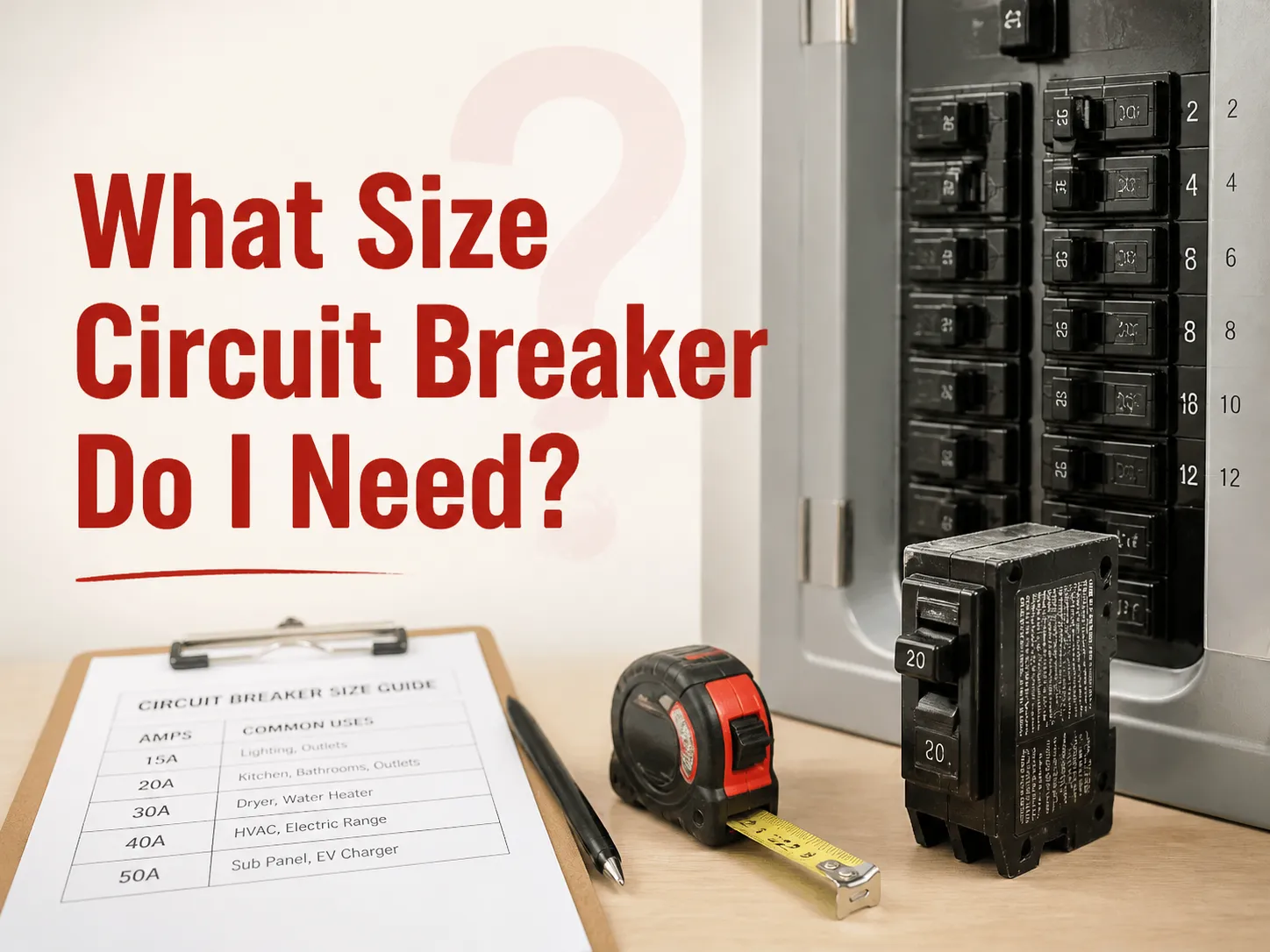

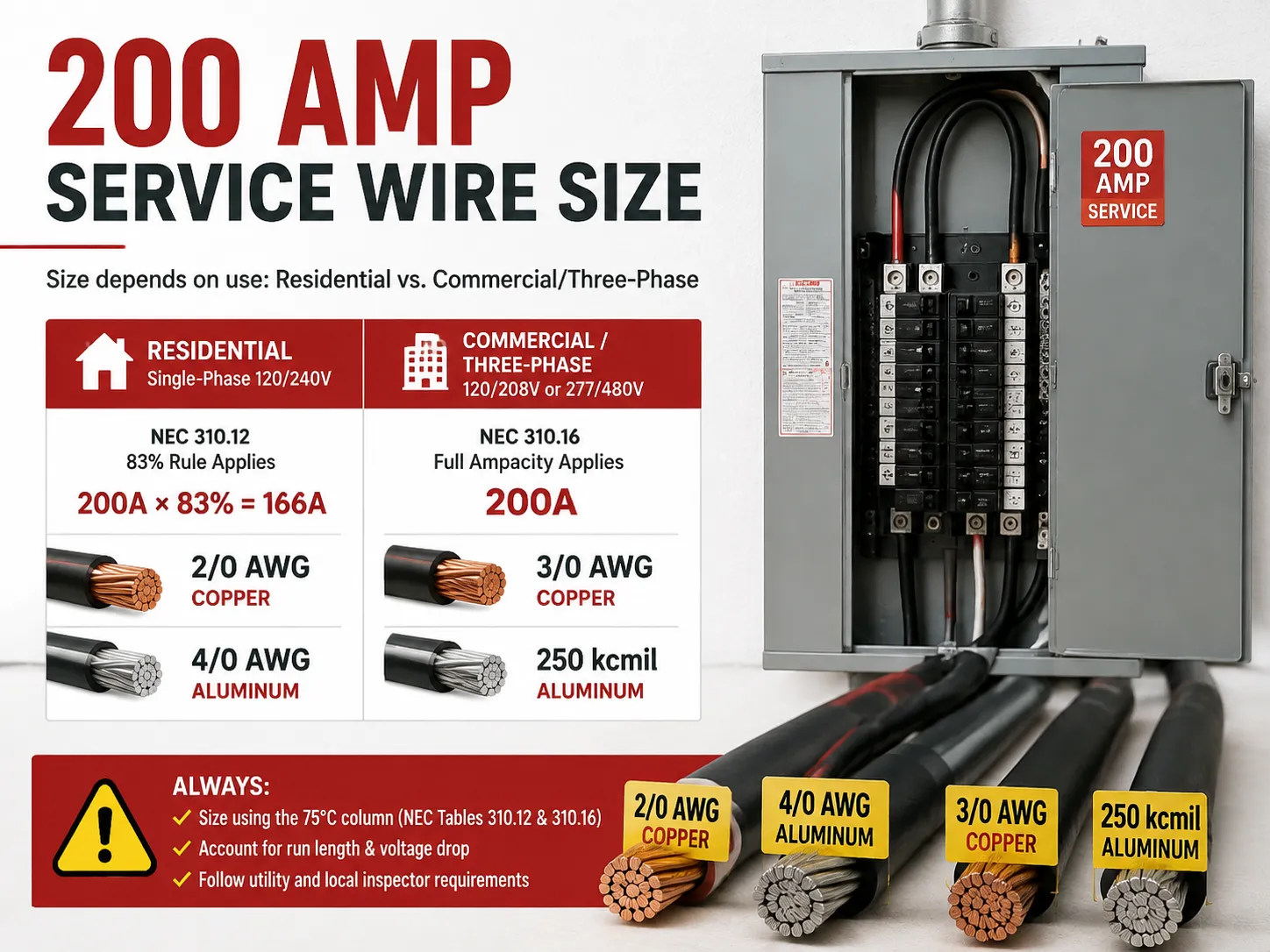
In case you have found out that the electrical panel is full, and the inspector defined the service to be too small, or in case you are going to construct a building and want to know that the installation of the electric car and the heat pump of your home is fresh so that there are no problems with it, you will see that the answer to the question “what wire size is suitable for 200 amp service” is not only one particular number, and it depends on the kind and type of the building (the widely known 83% principle is being applied in case of a house – take into account NEC Table 310.12), commercial properties (everything known about voltage 310.16 also comes into consideration), and on the type of material of the cable (either copper or aluminum), as well as on the distance of the cable.
In summary, NEC 310.12 states that a house with a 200A service consisting of 120/240V can use 2/0 AWG copper and 4/0 AWG aluminum wire in the electrical system. In general, whenever there is a need for a 200A three-phase service that does not take into account the 83% rule, it is advisable to use the regulations set forth in NEC Table 310.16. According to the NEC Table 310.16, the different types of the copper 3/0 wire or 250kcmil aluminum conductor must be used at the temperature of 75 degrees Celsius. At the same time, it is also important to consider the utility run length requirements and the local inspector’s requirements.
The Direct Answer: Wire Size for 200A Service
Here is the honest, complete answer in one table. There are two different rules, and which one applies depends on the building type:
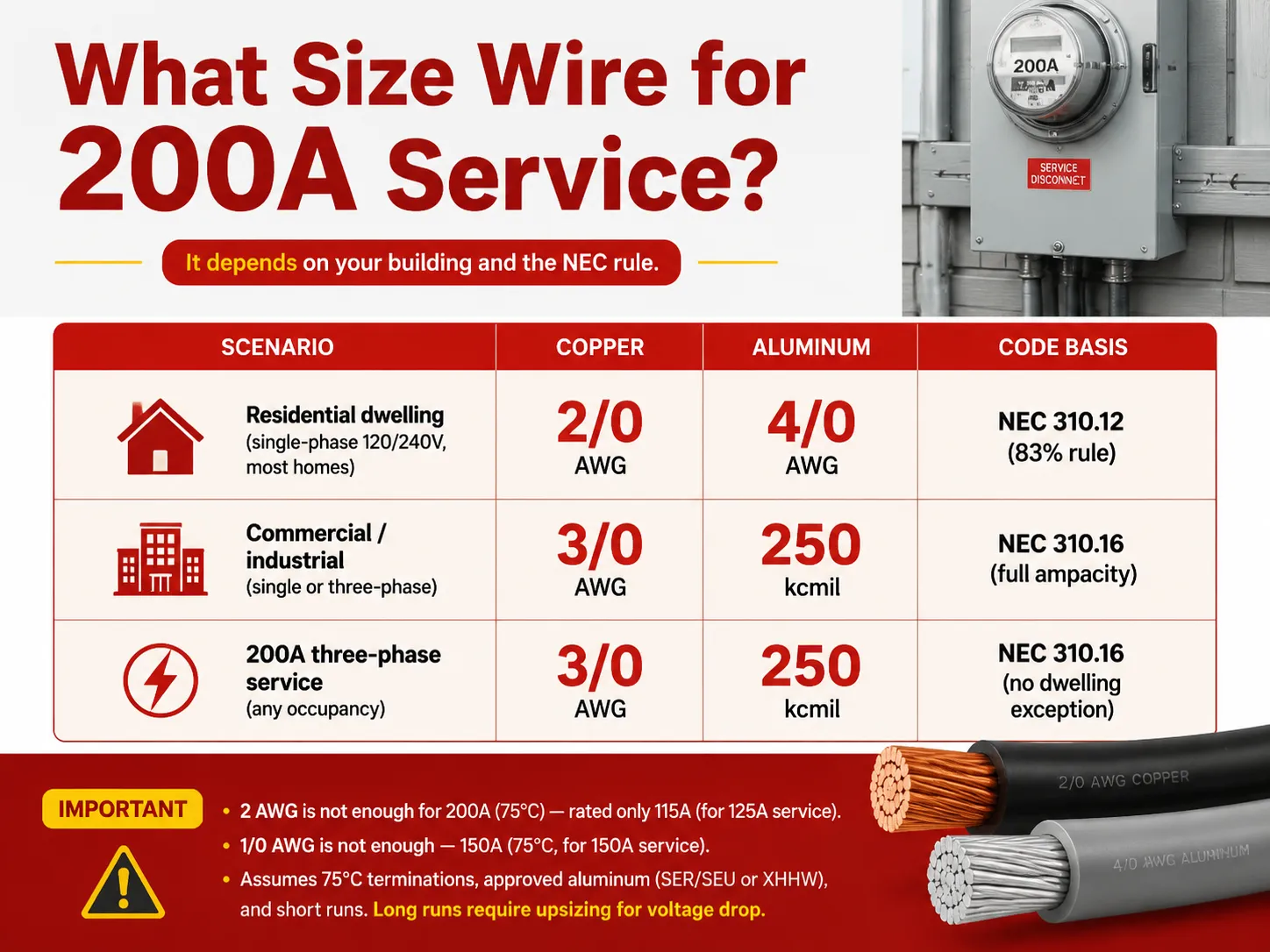
| Scenario | Copper | Aluminum | Code Basis |
|---|---|---|---|
| Residential dwelling (single-phase 120/240V, most homes) | 2/0 AWG | 4/0 AWG | NEC 310.12 (83% rule) |
| Commercial / industrial (single or three-phase) | 3/0 AWG (min) | 250 kcmil (min) | NEC 310.16 (full ampacity) |
| 200A three-phase service (any occupancy) | 3/0 AWG (min) | 250 kcmil (min) | NEC 310.16 (no dwelling exception) |
There are three important clarifications that need to be made:
- 2 AWG wires are not sufficient for 200A wires because at 75°C, 2 AWG ratings were only up to 115A. They can be used for 125A wires.
- 1/0 wires are also insufficient for 200A service because 1/0 wire ratings go up to 150A only.
- The above wire sizes are applicable on the conditions of being used in a service equipment rated up to 75°C and using properly rated aluminum conductors.
NEC 310.12 & the 83% Rule (Dwelling Services)
The NEC 310.12 code, popularly known as the “83% rule,” is the most significant clause for sizing residential 200A electrical service. It states that for one-family houses (as well as separate apartments in multi-family buildings) running on a 120/240V system, the size of the service and feeder conductors for the maximum load to be connected could in fact be designated at only 83% of the total load.
Why is the code based on this principle? The answers lie in the results of multiple research studies: over many decades, survey results have shown that the maximum power demanded by a house is only about 83% of its rated load. Otherwise speaking, it is unlikely that all appliances would operate simultaneously.
The mathematics involved in finding the value required: 200 ÷ 0.83 = 241A. When looking at it this way, one can see that 2/0 copper cable (175A at 75°C × 1/0.83 = 211A before rounding) and 4/0 aluminum (180A at 75°C × 1/0.83 = 217A) shall be used. That is why 2/0 copper or 4/0 aluminum electrical service is the standard in houses wired by 200A systems.
The following constraints apply to the 83% code:
- Commercial structures such as offices or warehouses do not have the relief in load calculations.
- Three-phase systems do not comply with the 310.12 rule but are to follow the Full Table 310.16.
- Feeders to subpanels fall under the traditional Article 215/310.16 rules.
NEC 310.16: The Full Ampacity Table (Commercial & 3-Phase)
In situations where the dwelling exception is not applicable, the dimensions of the service conductors are determined using the complete amperage capacity tables, specifically NEC 310.16, while the 75°C column is utilized because the terminals of the service apparatus are often classified at 75°C. For the purpose of 200A:
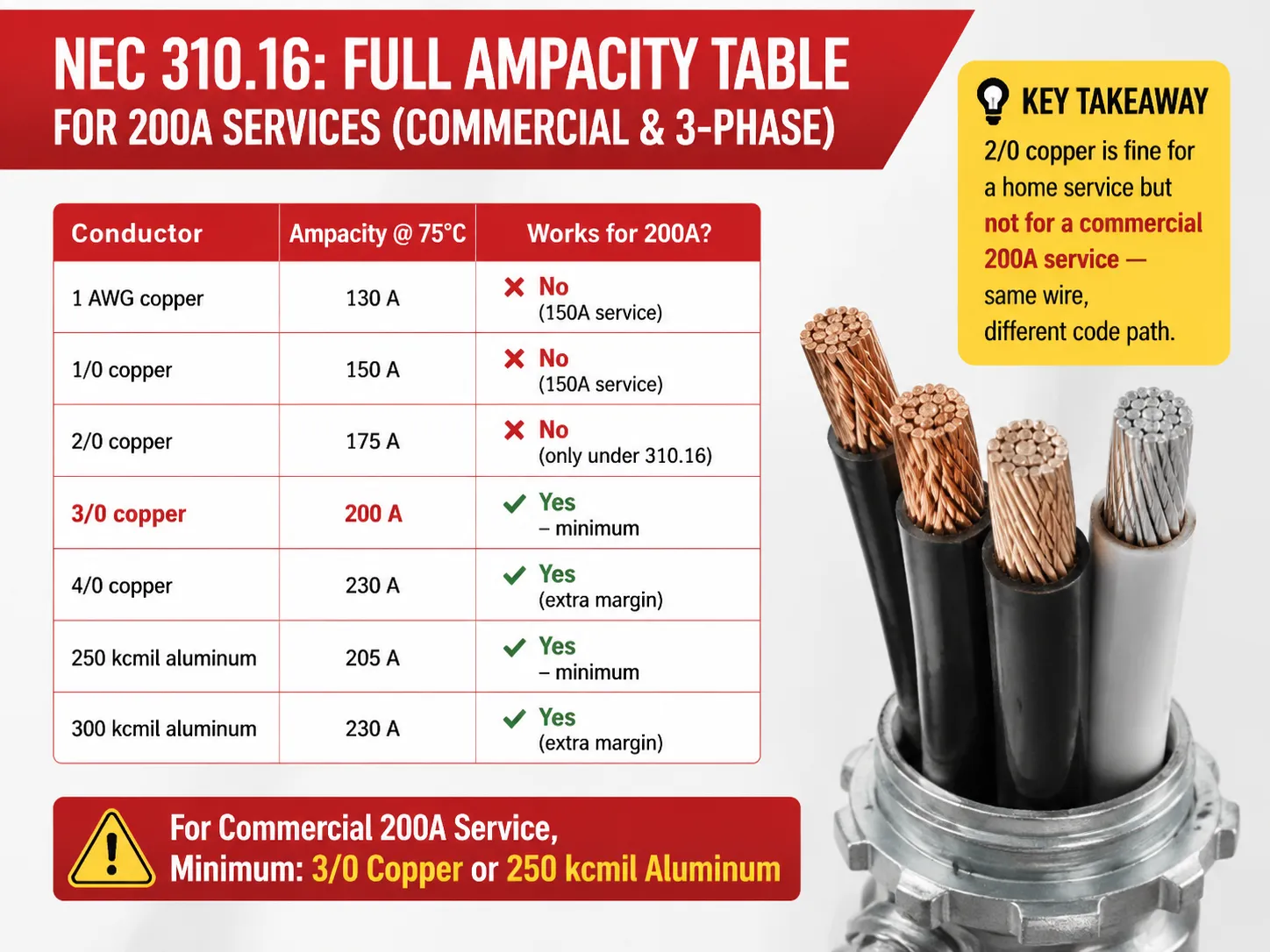
| Conductor | Ampacity @ 75°C | Works for 200A? |
|---|---|---|
| 1 AWG copper | 130 A | No (150A service) |
| 1/0 copper | 150 A | No (150A service) |
| 2/0 copper | 175 A | No under 310.16 (only under 310.12) |
| 3/0 copper | 200 A | Yes — minimum |
| 4/0 copper | 230 A | Yes (extra margin) |
| 250 kcmil aluminum | 205 A | Yes — minimum |
| 300 kcmil aluminum | 230 A | Yes (extra margin) |
The key point is that 2/0 copper works well for residential applications, whereas it doesn’t suffice for a commercial application of 200A current, so this question comes down to proper code. This has been the root cause of most misunderstandings when people see 200A = 2/0 copper on paper and make use of it in shops and offices.
200 Amp Three-Phase Service: What Size Wire?
In the case of a three-phase 200A service or 208Y/120V or 480Y/277V commercial installations, the rule of 83% for residences doesn’t apply. We will use 100% NEC 310.16 ampacity at 75°C:The minimum copper should be 3/0 AWG (200A) while minimum aluminum should be 250 kcmil (205A).
Most engineers will recommend 4/0 copper and or 300 kcmil aluminum wire for three-phase 200A installations for safety reasons, lower heat and future growth. Remember that three-phase system has three ungrounded conductors (all the same type); when it comes to neutral conductor (if in your system type 208Y/120V there is one present), it can be downsized according to the code but ungrounded conductors must comply with full ampacity rules. Always check with the utility company regarding their service requirements as they might have their own minimums because they are responsible for metering.
Copper vs Aluminum: Which Should You Choose?
Both are code-compliant for 200A service; the choice is mostly economics plus a few installation rules:
| Factor | Copper (2/0 residential / 3/0 commercial) | Aluminum (4/0 residential / 250 kcmil commercial) |
|---|---|---|
| Relative cost | Baseline (expensive) | Roughly 1/3 the material cost of copper at these sizes |
| Ampacity per size | Higher | Needs one to two sizes larger |
| Weight & handling | Heavy, stiff | Lighter, easier to pull |
| Termination requirements | Standard | Anti-oxidant compound, aluminum-rated lugs, correct torque (mandatory) |
| Corrosion concerns | Minimal | Oxidizes at terminations if not coated — this is the #1 aluminum failure mode |
| Common cable types | THHN/THWN-2 in conduit, or XHHW-2 | SER/SEU cable (residential), XHHW-2, THWN-2 |
In reality, aluminum SER (4/0) is the most used 200A residential application due to great savings and ease of installation by licensed electricians. Copper is good for short, tight spaces or other commercial specifications. If you are using aluminum, remember three rules: use anti-oxidizing compound for connections, use aluminum-rated lugs and terminals (never bare copper lugs), and always use wrench with the right torque.
What Does “4/0-4/0-2/0” Mean on SER Cable?
When buying a residential service cable, you may come across labels such as “SER 4/0-4/0-2/0” or “4-4-2”. These labels are abbreviations for types of conductors present in the cable in the order of arrangement, namely: two 4/0 conductors (hot conductors) and one 2/0 neutral conductor. Under NEC 310.12, it is regarded as a standard 200A residential service configuration:
- 4/0 copper or aluminum wires — two unground (hot) wires
- 2/0 neutral conductor — grounded conductor which can be of smaller gauge since it only carries the unbalanced load.
Thus, “4/0-4/0-2/0” is an abbreviation for a typical residential cable, which is intended for a 200A service. When someone asks the question “Is 4/0-4/0-2/0 allowed for a 200A service?” The answer is affirmative since this type of cable complies with the standards according to NEC 310.12. More so, “2/0-2/0-1/0” denotes service cable in copper that contains two 2/0 conductors and one 1/0 neutral conductor. In case of commercial service cable of 200A, one must look for “3/0-3/0-3/0” to achieve the service cable which has adequate full ampacity.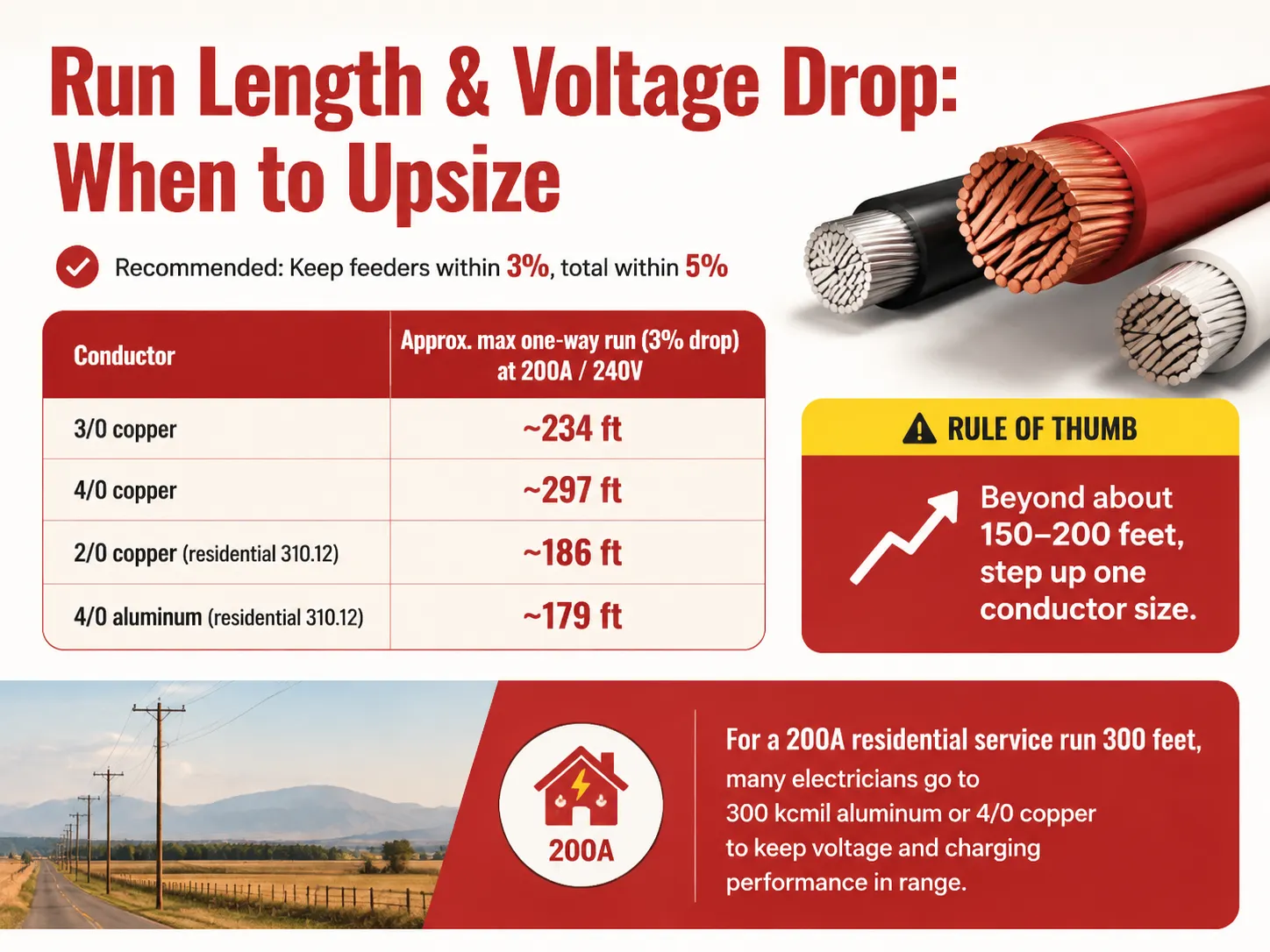
Run Length & Voltage Drop: When to Upsize
Typically, voltage drop is not a minimum code requirement for services in the majority of U.S. jurisdictions. (Recommended: 3% for feeders & 5% for total drop). A rough guideline at 200A shows how it becomes important for long runs in rural areas.
| Conductor | Approx. max one-way run (3% drop) |
|---|---|
| 3/0 copper | ~234 ft (240V) |
| 4/0 copper | ~297 ft (240V) |
| 2/0 copper (residential 310.12) | ~186 ft (240V) |
| 4/0 aluminum (residential 310.12) | ~179 ft (240V) |
It is noteworthy that, in general, beyond the distance of approximately 150-200 feet, one should increase the size of conductor by one. To illustrate, someone might upgrade from 4/0 aluminum to 250 kcmil, or from 3/0 copper to 4/0. For a typical 200A residential service running over a distance of 300 feet, many electricians will simply use 300 kcmil aluminum or 4/0 copper to ensure voltage and charging performance falls within acceptable levels.
Grounding Electrode Conductor (GEC) Size
Service entrances require not only the main conductors, but also a grounding electrode conductor (GEC) whose size needs to be determined using NEC Table 250.66. It is important to know this table is different from Table 250.122 used for sizing equipment grounding conductors and this mix-up is a common issue.
Thus, the GEC for a service with:
- 2/0 copper or 4/0 aluminum conductors will be at least 4 AWG for copper
- 3/0 copper or 250 kcmil aluminum would usually also be 4 AWG, although the GEC value needs to be checked.
- The grounding electrodes according to NEC 250.52 consist of two ground rods that are at least 6 feet apart or one ground rod and one extra electrode that needs to be driven through the ground.
The most frequent mistake when upgrading services is using 6 AWG (the size for equipment grounding conductor according to Table 250.122) instead of GEC, so always make sure your contractor uses Table 250.66 when determining the necessary GEC size.
Cable & Conductor Types for Service Entrance
Identify the type of cable/conductor that matches the installation method:
- SER (Service Entrance Round) cable: this is often used for residential panel feeders; aluminum SER cables can carry loads.
- SEU (Service Entrance Unarmored): it is an old technology that is still widely used.
- THHN/THWN-2: it is a type of cable that is used for individual conductors making their way through the conduit; this is a common industry choice.
- XHHW-2: it is suitable with aluminum materials and is used for large commercial applications.
- Underground: USE-2/RHH/RHW-2 or direct burial form of cable is used in specific depth.
Regardless of which type of cable you use, check for certification related to its application and the utility guidelines for installation.
Common Mistakes on 200A Service Upgrades
| Mistake | Why It’s Wrong | Correct Approach |
|---|---|---|
| Using 310.16 for a dwelling service | Forces 3/0 copper / 250 kcmil where 2/0 / 4/0 is legal — wasted money | Use 310.12 for single-phase 120/240V dwellings |
| Using 310.12 for commercial/3-phase | Undersized — 2/0 copper can’t carry 200A without the dwelling allowance | Use full 310.16 ampacity: 3/0 Cu / 250 kcmil Al |
| 2 AWG or 1/0 “looks close enough” | 2 AWG = 115A, 1/0 = 150A — serious overload hazard | Never guess; size from the tables |
| Aluminum without anti-oxidant compound | Oxidized terminations heat up and fail | Joint compound + aluminum-rated lugs + torque spec |
| GEC sized from 250.122 instead of 250.66 | Undersized grounding electrode conductor | 4 AWG copper GEC for 200A-class services |
| Ignoring run length | Voltage drop starves the far end of the property | Upsize beyond ~150-200 ft |
| No permit / no utility coordination | Inspection failure, utility won’t connect | Permit, inspection, and utility scheduling first |
Cost & Permit Considerations
The upgrade of the residential service to 200 amps is likely to be the single most costly electrical work that one will ever conduct in his/her home. The following is a rough estimation of prices in the United States, year 2025-2026:
- Materials: panel plus the main breaker $150-$400; service cable (aluminium) $2-$5 per foot; meter base and fixings $100-$300.
- Labor: $1,500-$4,000, depending on the region, as well as on the fact whether the riser/weatherhead or the underground lateral need to be replaced.
- Permit + inspection: $100-$500, required almost everywhere.
- Utility coordination: the utility owns the meter and connection and the disconnection/reconnection is part of the plan beforehand.
When a project necessitates the installation of new electrical equipment and switchboard, ensuring the proper certification of the line should be our priority in order to take advantage of the advantages offered by dealing with a manufacturer who works with the low-voltage range of electrical equipment. After the 200A switchboard is installed, it is important to size the branch circuits behind it properly since the same principle that applies to the 15A circuit applies to each and every branch circuit behind the main switchboard.
International Standards: A Quick Note
Outside North America different rules are applicable, as other parts of the world largely follow calculations of IEC/BS 7671 type (voltage drop + correction based on installation) instead of a simplified service table:
- UK (BS 7671): there’s no such thing as “200A service wire size” available — rather, the calculation is based on installation mode and the type of current supply; for example, 200A one-phase or three-phase supply requires about 70-120 millimeters of copper, but much more in case of a long cable run. The systems in the UK and the USA differ in basic aspects (230V one-phase and 400V three-phase), therefore the logic of making calculations is also not the same.
- EU (IEC 60364): the method is similar to the one in the UK.
- Australia (AS/NZS 3000): it’s rather a method, with conductors of a 200A supply varying between 70-95 mm depending on the type of a cable.
- Canada (Code CE): the logic used here is very similar to the one in NEC, and typically, a 200A supply has 2/0 copper or 4/0 aluminum cabling.
The lesson is that NEC numbers given in this handbook are applicable only for the USA and Canada.
Frequently Asked Questions
What size feeders do I need for a 200 amp service?
According to NEC 310.12, in the case of residential services, the wiring may include 2/0 AWG copper or 4/0 AWG aluminum. For commercial service, the minimum for 200A service is three-phase which is 3/0 AWG copper or 250 kcmil aluminum as noted in NEC 310.16. The feeders going into the subpanel of the installation also comply with NEC 310.16. Remember to utilize the 75°C column for ampacity as well as off-set the ampacity for long runs.
Is 2 AWG good for 200 amp service?
The 115 amps that a No. 2 AWG copper wire can handle at 75°C is much lower than the 200 amps required. This gauge is zacablable for 125 amps feeder. However, to accommodate a 200-amp service, a 2/0 copper or a 4/0 aluminum wire is required (residential, 310.12) or a 3/0 copper or a 250 kcmil aluminum wire (commercial, 310.16). The failure to use the correct size of service wire results in overheating and violation of code.
What is the NEC code for 200 amp service wire?
The relevant sections comprise NEC Article 230 regarding services and NEC 310.12 regarding the principle of 83% coding which permits the use of a 2/0 copper or 4/0 aluminum wire in 200A domestic circuits, NEC 310.16 concerning a complete ampacity chart and which says that one should use a 3/0 copper or 250 kcmil aluminum wire in commercial applications or three-phase systems of 200A capacity, NEC 310.14 stating the concept of terminal temperature rule with the help of the 75-degree column, and finally, NEC 250.66 on the calculations needed to find out the grounding electrode conductor size.
Can you use 4/0-4/0-2/0 for 200 amp service?
Yes, that’s right. The designation “4/0-4/0-2/0” explains that the particular service wire includes 2 hot wires of 4/0 and 1 neutral wire of 2/0, which is consistent with standard practice for 200A service identified by NEC 310.12 (this is typically found in the area of SER cable). A commercial 200A service requires a full ampacity rating of either 3/0 copper or 250 kcmil aluminum wire.
References
- Mike Holt — NEC 310.12 83% Rule and Service Sizing
- OSHA 1910.303 — General Electrical Requirements
- EC&M Magazine — Service Entrance Conductor Sizing
- IEC 60364 — Low-Voltage Electrical Installations (International)
- NEMA — Electrical Product and Installation Standards
Conclusion
Deciding the proper wire size for a 200 amp service is a matter of whether or not the 83% rule applies. For an average residential installation, you would require 2/0 copper or 4/0 aluminum (usually found as 4/0-4/0-2/0 SER cable), dictated by NEC 310.12. For commercial, industrial, and 3-phase 200A installations, the minimum wire sizes are 3/0 copper or 250 kcmil aluminum. Regardless of whatever the situation is, be sure to use the appropriate ampacity (found in the 75°C column) when working with aluminum connectors, make proper adjustments for a GEC based on dimensions in Table 250.66, ensure the wire is larger if the run distance is too far, and get a permit for your work before the utility connects the service.When you’re also refreshing the panelboard and breakers, understanding the protection devices — from spotting a failing breaker to the practical costs in breaker replacement pricing — keeps the whole upgrade on budget and on code.