
It is important to know that an AC RCCB does not detect the fault caused by a modern inverter. The distinction between knowing and not knowing this is important because a charging point can operate behind an RCD that does nothing while someone is getting killed by electricity.
Type B is designed to fill this gap, and it is a mainstream issue to know when to use it instead of an expert issue.
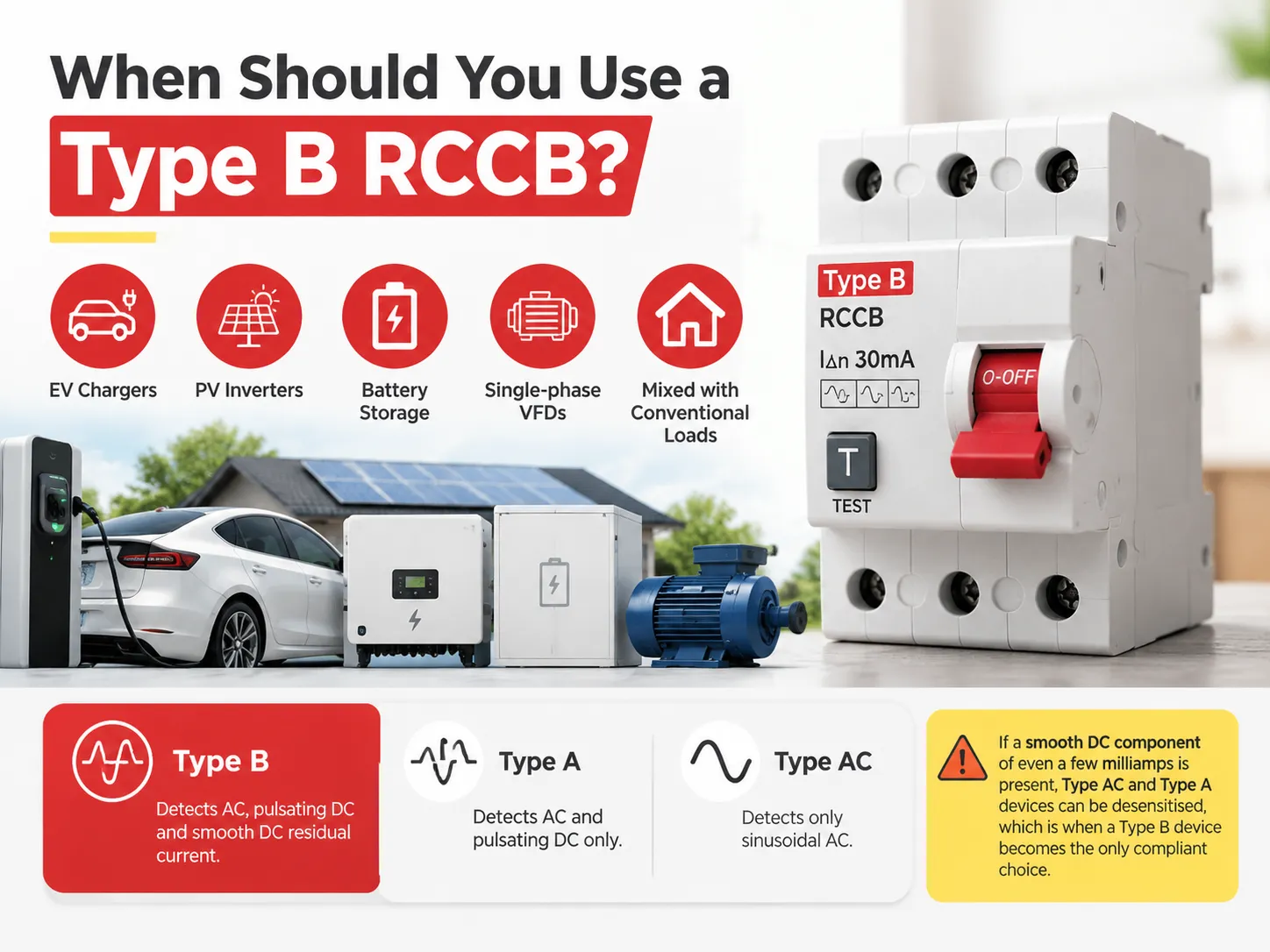
Briefly: To ensure proper function of an installation producing a steady-state DC residual current, such as EV chargers, PV inverters, battery storage, single-phase input variable frequency drives, and combinations of such devices with traditional load types, Type B RCCB should be used. This makes the RCCB capable of detecting AC and both steady state and pulsating DC residual current, while Type A RCCB will register only pulsating DC and Type AC only sinusoidal AC. The presence of steady-state DC (even at a low level of several mA) can cause types A and C to become non-operational, thus leaving type B as the only viable option.
The Standard That Defines the Types
| Type | Detects | Blind to | Typical use |
|---|---|---|---|
| AC | Sinusoidal AC residual current | Pulsating and smooth DC | Simple resistive and lighting circuits |
| A | AC plus pulsating DC | Smooth DC | General domestic and commercial circuits, electronics with rectifiers |
| F | AC, pulsating DC and mixed-frequency residual current | Smooth DC above the detection threshold | Single-phase inverters, some appliances |
| B | AC, pulsating DC and smooth DC | Nothing in the residual-current sense | EV charging, PV, VFDs, battery systems |
The definitions of types of devices follow the IEC 60755 standard. The difference between type B and other types of devices lies in the sensing element, which reacts to a direct current (DC) residual that doesn’t reverse, which an AC transformer doesn’t do, since direct current (DC) creates saturation of the core.
This saturation is the real operating mechanism. A residual current transformer in type AC devices should be understood as a magnetic core. It is subjected to a smooth DC component, which brings it to saturation, and once saturated, the core stops reacting to the AC residual current on top of it.
The Loads That Require It
Five applications include various Type B specifications, and they ensure smooth DC operation because of various reasons.
- EV charging. In this case, the on-board charger converts AC to DC, and any failures during the process can result in DC component in the source. Thus, the regulations for charging devices require the availability of Type B RCD or separate 6 mA DC detection mechanism (RDC-DD) in the device. Where the charger has no such device, the upstream RCD must be Type B, which is the case our Type B RCCB is built for.
- Photovoltaic inverters. The transformerless inverters are designed in a manner that ensures that they insert a small DC component in their output on the AC side since they do not have an isolation transformer. This means that there have to be specific standards set concerning the value of the DC components that PV can produce and why an RCD upstream needs to detect the DC to function properly.
- Battery storage hybrid inverter. The hybrid inverter in battery mode acts as a DC source since it is connected to the network on the AC side without isolation.
- Variable frequency drives. A single-phase input variable has to rectify before creating the output and the fault found in the DC link may have a smooth DC component value in the input of the inverters.
Some medical laboratory devices and some LED drivers as well as IT devices produce enough DC ripple that type A devices fail to activate on their own without external help.
The three-phase drive that has a six-pulse rectifier creates a pulsated dc and therefore, devices of the type A can cope with such DC type. The reason is that it is the single-phase input and the transformerless topologies that create a smooth DC component.
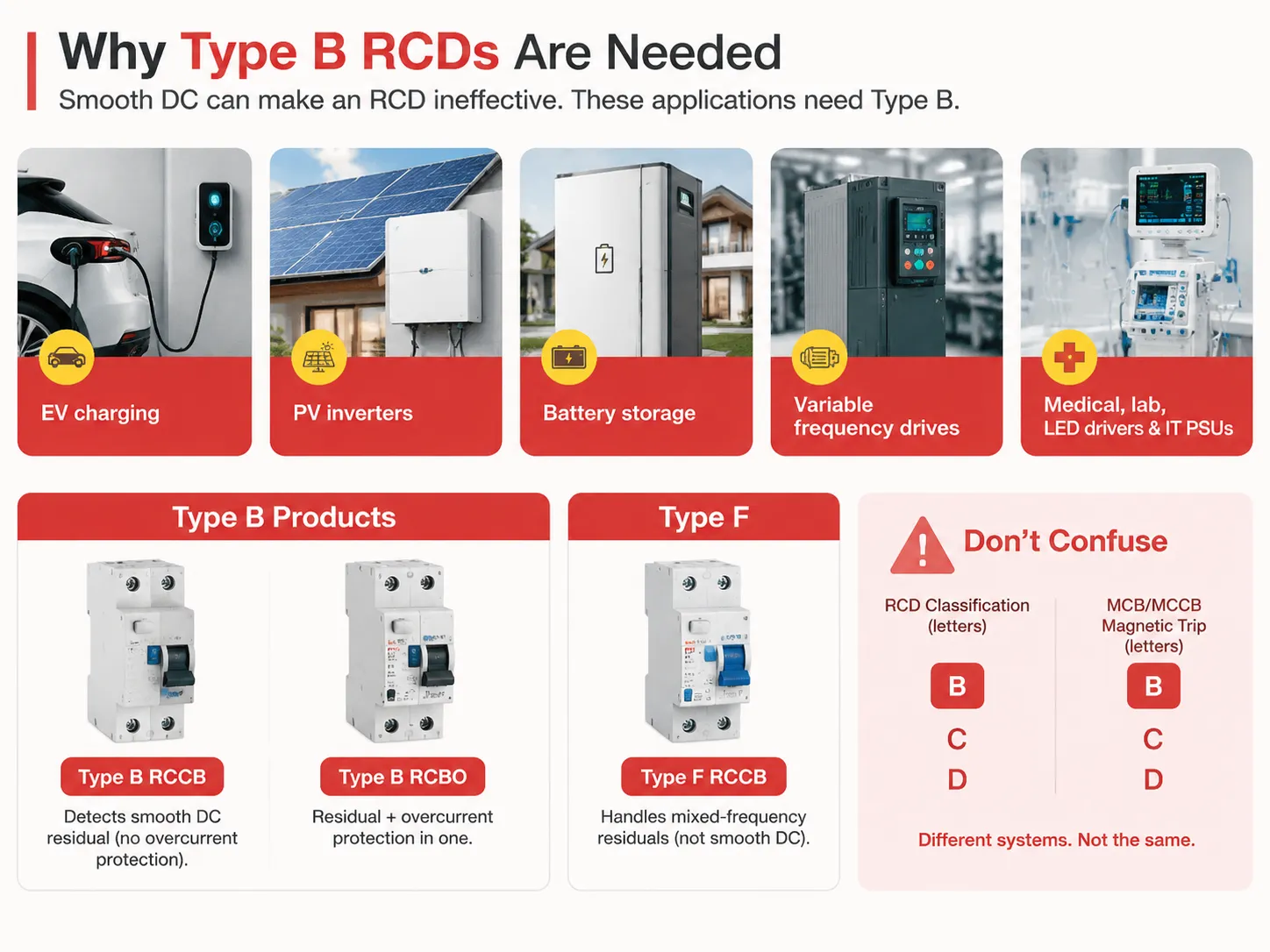
Type B RCCB, Type B RCBO and Type F
The occurrence of the letter B in two separate classification systems causes confusion with three products.
- A Type B RCCB detects smooth DC leakage current yet does not prevent overloads and shorts. Therefore, it needs to be installed with an MCB or MCCB on top for overload protection.
- A Type B RCBO integrates both leakage detection and overload protection in one device. Although it costs more and comes in fewer ratings, it is a more straightforward solution for a dedicated circuit such as EV charger.
- Type F adds to the confusion since it is capable of detecting complex-frequency leakage current that is generated by single-phase inverters and some devices. However, it is not an alternative to Type B since it does not react to smooth DC.Where the installation produces smooth DC, F is not enough, and where it produces only mixed frequency, the Type F RCCB is the cheaper correct answer.
In addition to this, there is a specific letter system for the overcurrent breakers, in which B, C, and D letters are used to denote magnetic trip point. That means “Type B MCB” and “Type B RCCB” have zero common elements other than their letters. Therefore, it is common and expensive mistake to confuse them in the specification.
Sizing and Selection
Five elements that define the device are given below.
- Poles – One pole for single-phase and two poles for three-phase thereof the neutral position is checked and ascertained.
- Rated current – At least the design current of the circuit the rated current is matched with the upstream overcurrent device so that both the devices have adequate protection.
- Sensitivity – 30 mA is for the safety of personnel, 100 and 300 mA are for the safety of fire or selectivity of the upstream devices fitted with 30 mA.
- Types – Type B is for circuits carrying smooth direct current, type A for typical circuits and type AC is for pure resistive load.
- Conditional and time delayed versions are used where selectivity is needed between two earth fault protection devices.
The best way to achieve selectivity in design is to avoid using two devices of 30 mA rating in series circuit without the time delay as the faulty trip will cause both the devices to trip together leading to total loss of supply and only one circuit gets shut down. The interaction between an RCD and the surge protection beside it is its own problem, and it is covered in our note on RCCB versus RCBO selection.
Testing a Type B Device
A common RCD device is not sufficient, as during commissioning the type AC and type A test is performed on most instruments, with only a few models featuring DC tests. However, in order to properly test a Type B device, a tester capable of injecting a stable direct current within its sensitivities along with a ramp test in order to establish the tripping current is required.
The process of testing should involve:
- Not tripping at half the IΔn value in order to eliminate the risk of false tripping.
- Tripping at the IΔn value with the duration of tension being recorded.
- Tripping at the value of 5 IΔn that indicates the progress of failure with its visible sign.
- Snap test that provides the tripping current and compares it with the recommended one.
- DC test distinguishing the working Type B unit from the working Type A.
Both phase angles must be examined as it will help determine whether the device trips at 0 degrees but does not trip at 180 degrees underlining the issue with half wave rectification crucial for catching faults.
Choosing a Brand and a Model
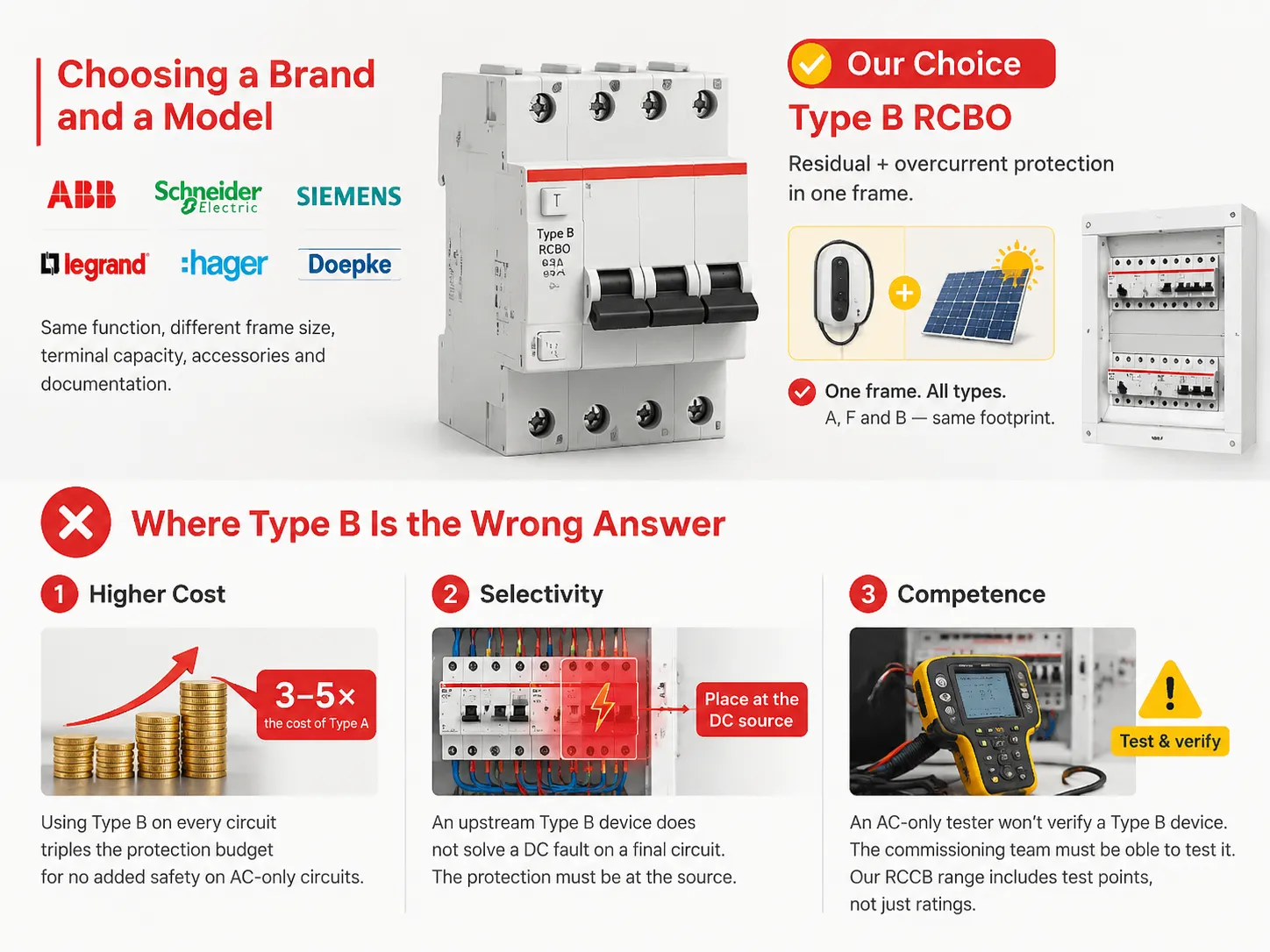
There are four main players in the specification market, which can be identified as: ABB, Schneider Electric, Siemens and Legrand while Hager and Doepke are other brands competing in Europe and several specialist manufacturers in Asia. Their Type B products are similar in purpose, with variations in the case dimensions, capacity of the terminals, types of accessories and the amount of information provided to the users.
The key difference between the manufacturers at the level of projects is the certificate documents and the availability of a required rating type. Thus, a 4-pole 63 A Type B device is available in stock with most of European companies, while a 125 A device that features 300 mA of specific rating and a time delay is a product that needs to be ordered and it can take up to six weeks for it to be assembled.
Our own answer for the dedicated-circuit case is the Type B RCBO, which puts residual and overcurrent protection in one frame so a charger or a single PV feed does not need a second device beside it. The purpose of having one versatile frame is a practical one: the technical family of boards accepts devices A, F and B within the same size, thus enabling the upgrade of one circuit without a need to construct a new case for the project.
Where Type B Is the Wrong Answer
Cost is the most direct reason, but it is not simple: a Type B device can be three to five times more expensive than a Type A device with the same parameters. In other words, using Type B devices for every circuit can increase the total cost of the equipment threefold with no safety benefit for circuits that are unable to provide a stable DC supply.
Another reason for using a Type B device is selectivity. Installation of a Type B device upstream does not eliminate the issue of DC in the downstream circuit because the protection device needs to be installed in the exact place where the DC load is connected, otherwise there will be no protection against faults in all installations.
The third reason is qualification. A type B device that is calibrated using an AC tester is installed but not verified, and the calibration documentation is incorrect.If the commissioning team cannot test it, the specification has a gap that no product choice can close, which is why our RCCB range is documented with the test points instead of just the ratings.
FAQ
What is the difference between type A and type B RCCB?
Type A RCCB is fitted to detect pulsating and alternating currents, while a Type B RCCB can detect smooth direct currents as well, something which a Type A RCCB cannot do, as steady DC saturates its sensing core. Type B devices are essential to detect residual currents produced by devices such as EV chargers, batteries, PV inverters, etc.
Should I use type A or type B RCBO?
Type A is suitable for general-purpose circuits, but Type B must be used in circuits where smooth DC is being used. For dedicated EV chargers, using Type B RCBO is the best solution as it provides overcurrent protection along with residual current protection.
What’s the difference between A type B and a type C breaker?
Type B RCCB is the type of the device indicating the type of current it is able to detect, while Type C MCB tells us about the magnetic trip current (which is five to ten times the rated current) of the device. Thus, one device can be an MCB Type C and RCCB Type A at the same time.
What is a type B RCCB?
It is a residual current circuit breaker allowing the detection of sinusoidal AC, pulsating DC and smooth DC currents, as prescribed by IEC 62423.
References
- Siemens — Residual Current Protective Devices and Type Selection
- BEAMA — RCD Types and Application Guidance
- ONCCY — Type B RCCBs for VFD, EV and Solar Systems
- Kuangya — Type A versus Type B RCCB Comparison
- Fluke — RCD and Type B Testing Instruments
Conclusion
Type B serves not as an upgrade but as a matching device. It was created owing to certain loads producing a direct current residual that blinds all other device types, and Type B is the only device that can detect that error.
Tell us what the load, supply and the required sensitivity are and we will tell you the type and pole configuration of the frame suitable for your PCB.