
Searching for a particular term yields two clearly different sets of information, which is the reason that many discussions over procurement get off to a wrong start. In the first case, a buyer looks to hire a cabling crew for a fit-out project of a tenant. In the second case, a contractor is required for the design and construction of a low-voltage distribution panel.
When this is done first, a week of time is saved. The next step involves discussing both fields – what kind of businesses use the industry and how much is earned in every trade while making purchases in both cases is presented.
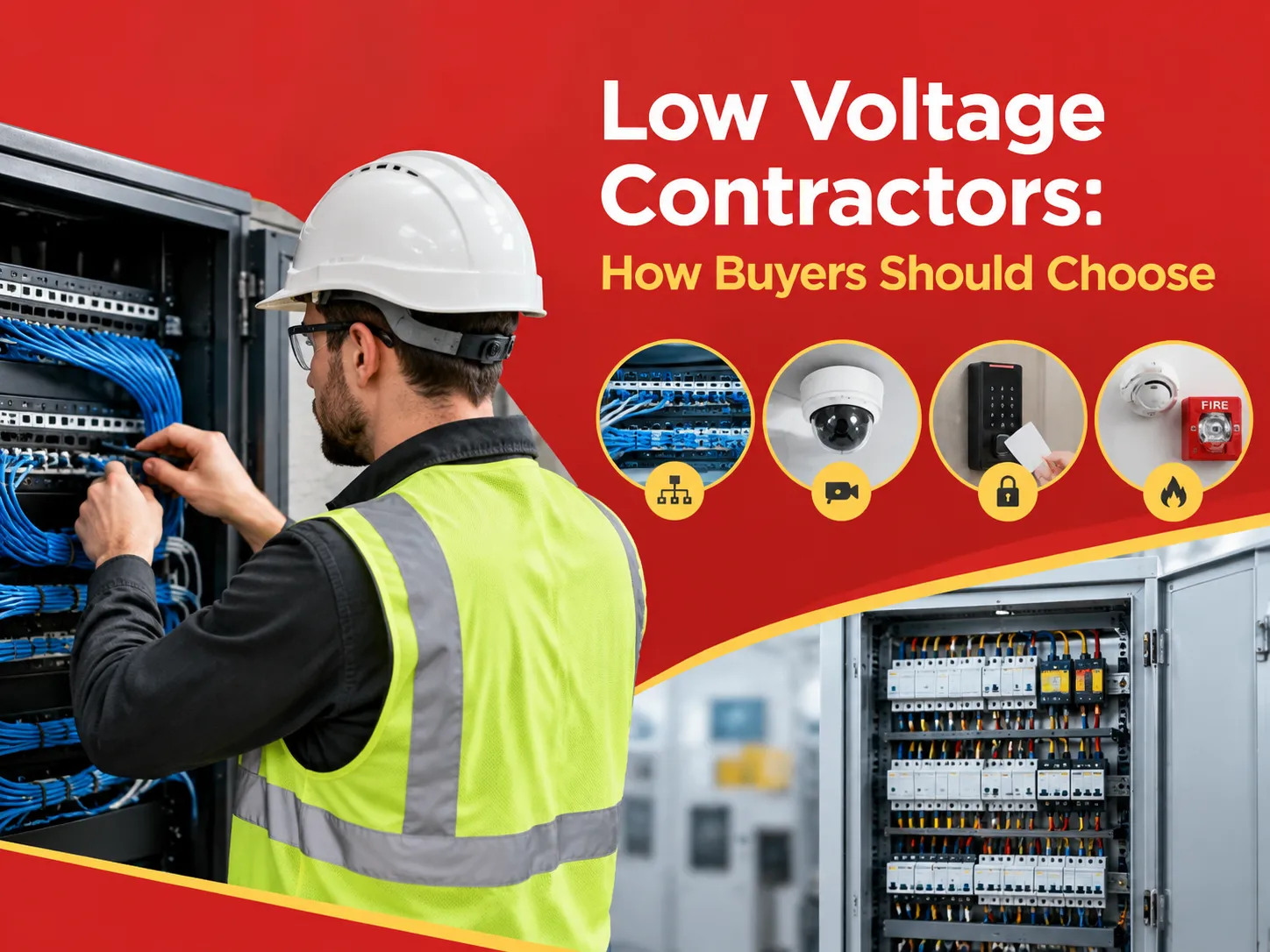
Stated simply, “low voltage contractor” is a term that has two meanings. In the construction industry, it describes the company installing various types of electronic equipment such as structured cabling, cameras, access control systems, fire alarms and other low voltage systems and devices that normally operate below 50 Volts and do not require an electrician’s supervision. In electrical engineering the term low voltage contractor refers to the contractor providing low voltage distribution solutions in the range from 0 to 1000 Volts and employing a variety of techniques including panels, switches, transformers etc.
Two Trades Share the Name, and the Difference Matters
The meaning of building services appears most of the times in search results. Low voltage means here voltage drop lower than approximately 50V AC, and the scope of work includes tasks in voice and data communication cabling, IP cameras, access control systems, intercoms, public address and audio-visual systems and sometimes fire alarm systems. It is also a licensed category in most of the states of the United States where building services are separate from electrician licensure because of the difference in skill requirements in termination and testing of networks, network design, and integration, on the one hand, and load calculation and raceway fill, on the other hand.
The meaning in electrical industry is older and broader because low voltage is here considered using IEC terminology where anything below 1,000 volts AC is referred to as low voltage. This is why the contractor in low voltage context installs distribution boards, motor control centers, electrical cabling, as well as earthing and protections systems for buildings and industrial sites. Electricians are employed by the companies that implement the above-mentioned works instead of cabling technicians.
Inevitably there is a very thin overlap between the two definitions of low voltage but it exists: they both touch distribution board, however, in different channels. But these complications are caused by misunderstandings on part of clients since they tend to assume that being referred to as LV company has enough knowledge and capability to do both tasks at once.
What a Systems Low Voltage Contractor Installs
The range is broader than what most customers assume, and it should be mentioned due to its requirement for knowing what to ask for in a tender.
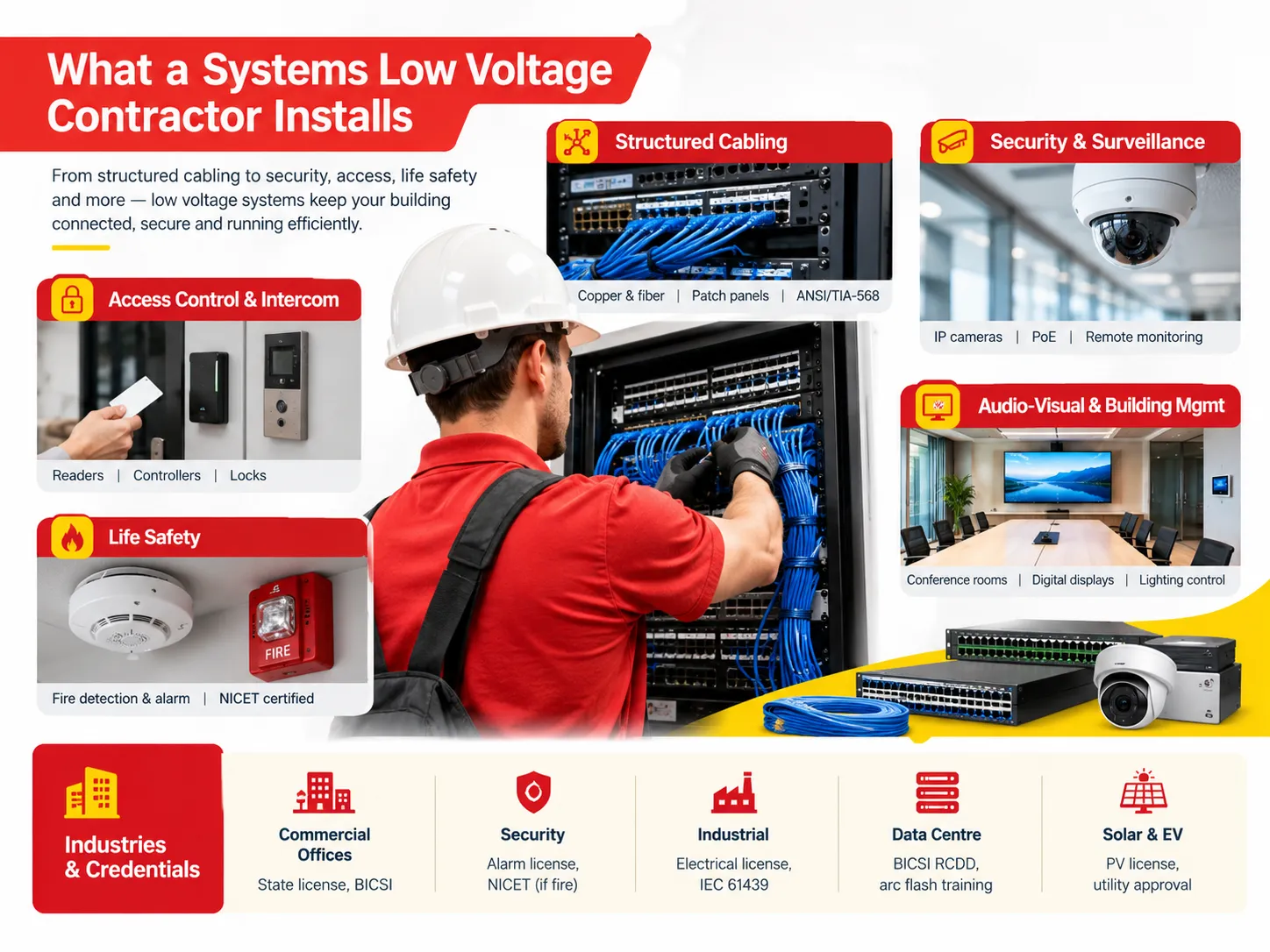
- Structured cabling. The use of copper and fiber from the telecom room to the outlet which is finalized on patch panels and marked as well. ANSI/TIA-568 is the standard that provides help in this case, and the major limitation is the 100 m channel which means 90 m of cable and up to 10 m of patch cords. It is this limit rather than wish that defines the location of distribution rooms in a giant building.
- Security and surveillance. Usage of IP cameras that go with PoE capability, as well as recording and storing, and remote observing and analysis. Labor is what should be considered as the most expensive part of money spent in this connection since time spent on getting access to the ceiling and organizing the cables is more than hardware issues.
- Access control and intercom. Installation of readers, controllers, locks, door position monitor and connection of all items with the help of the necessary software. Most issues with defects happen in the hardware interface between two fields.
- Life safety. Installation of fire detection and alarm system is usually carried out by a company that has a separate alarm contractor license and employs NICET-certified specialists since this test should be done under the watch of the agency.
- Audio-visua and building management. Anything that is connected to conference rooms, digital displays, background music, occupancy sensors and lighting control. The point where low voltage area and lighting area meet is at times when interface is a specification, not a secondary issue whether it has been treated.
Thus, one can conclude that low voltage systems do not contact anything that works with line voltage. Thus, if there is a camera that needs installing a power outlet with voltage of 120 V, a licensed electrician will do the work.The component side of the electrical half, meaning how breakers, RCDs and protective devices are chosen across a range of duty, is set out in this overview of brands and product families for electrical distribution.
By Industry: Five Verticals and the Contractor Each One Uses
The vertical determines the type of business and the necessary certifications; the table shows the regulations, with one example of every kind of document in the table.
| Vertical | What the LV scope is | Credentials to check | Example of the type |
|---|---|---|---|
| Commercial fit-out and offices | Structured cabling, Wi-Fi, AV, tenant demarcation | State low-voltage licence, BICSI certification, manufacturer accreditation | The Network Installers, US-wide, C-7 licence and BICSI, 20,000+ sites over 19 years |
| Security and access control | Cameras, intrusion, access control, intercom | Alarm contractor licence, NICET where fire is included | Seneca Security, New York, NYS DOL Class A low-voltage licence |
| Industrial plant and process | LV distribution, MCCs, instrumentation, earthing | Electrical contractor licence, IEC 61439 assembly practice, panel builder certification | Regional electrical contractors and panel builders, not cabling firms |
| Data centre and telecom | High-density fibre, containment, PDU circuits, monitoring | BICSI RCDD, manufacturer certifications, arc flash training | Specialist cabling and infrastructure contractors |
| Solar, storage and EV charging | DC strings to combiner, inverter AC side, protection and metering | Electrical licence with PV endorsement, utility interconnection approval | Solar EPCs and electrical contractors with renewable accreditation |
It is in the fourth and fifth rows that maximum expansion takes place. Data halls require electricity and fibre-optic lines in the same room, and it is for the contractor that has both jobs completed successfully to solve the coordination issue. In the case of solar power, it is necessary to hire highly qualified specialists with expertise in DC arc extinguishing and the AC protection system, which is a more specific area of expertise than electric engineering in general.
The price of such systems is influenced by local legislation as well. A contractor that is licensed in one particular state is not able to work in another state unless they get a license there, and this rule does not apply to all states. This is the sort of thing that state-level contractor licensing information is meant to settle, and a buyer who checks the licence number before the quotation avoids most of the risk in this category.
Price Bands You Can Budget Against
The units are distinct in both trades, which is why they are discussed separately. Numbers are specifically for 2026 US commercial ranges according to contractor pricing and differ based on location, ceiling access, and whether the building is occupied or not.
| Item | Typical installed range (USD) | Notes |
|---|---|---|
| Cat6 data drop | 150 to 325 | Terminated, tested, labelled; open ceiling assumed |
| Cat6A data drop | 250 to 450 | Required for 10G and high-power PoE devices |
| Camera drop | 225 to 425 | Exterior and conduit runs price higher |
| Camera installed, all-in | 300 to 800 per camera | 4-camera system with NVR typically 2,000 to 4,000 |
| MDF or IDF room build-out | 3,500 to 18,000 per room | Racks, ladder rack, grounding, labelling |
| Fibre backbone | 14 to 32 per linear foot | Termination adds 45 to 95 per strand |
| 40-drop office fit-out | 7,400 to 13,000 | Cabling only, before racks and hardware |
There is no pricing on the electrical side by drop. An LV distribution package is given a price based on the panel or project; the unit price is based on short circuit rating, busbar capacity, outgoing devices, and whether the assembly has passed type testing. A single 24 way distribution board with main breaker and RCDs and surge protection can be a four figure cost. Plant MCC with variable sped drives is a six-figure package and is designed rather than selected.
There are three aspects that increase cost in both industries of cable trade and building trade. The first one is access since fishing a cable through an already finished ceiling increases the cost many times in comparison to cable tray installation. The next aspect is the occupied space because in a situation of night and weekend work the costs greatly increase. The last one is that if in addition to the cost of fishing the cable the cost also increases due to the existing conditions such as the aged building and the peculiarity of its provision.
What the Contractor Buys From a Component Supplier
This is the portion of the procedure that a manufacturer sees, hence, it gives information about the unusual specifications in orders.
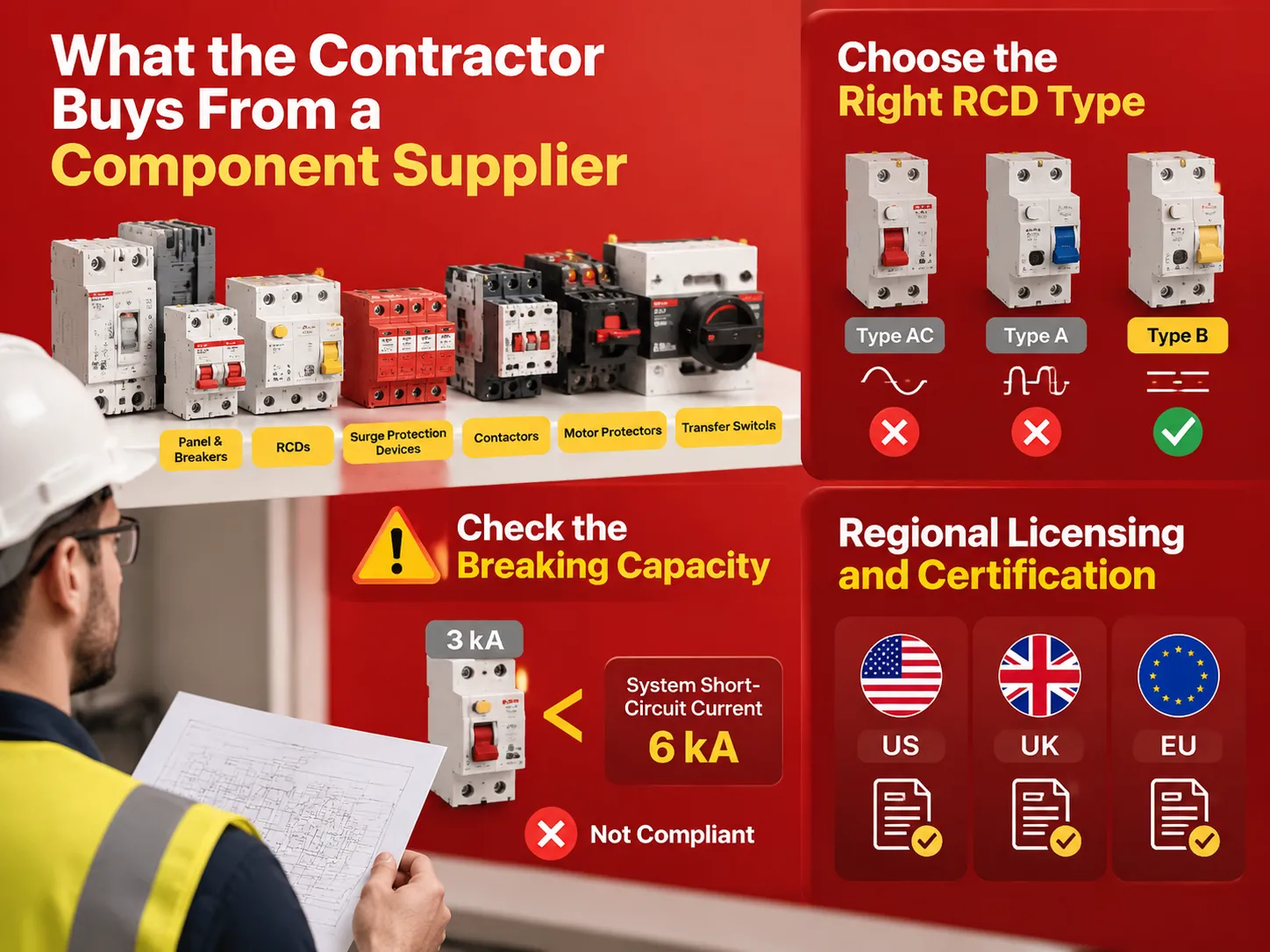
The systems contractor does not buy protective equipment themselves. Their electrical counterpart buys the panel, breakers, RCDs, surge protection devices, contactors, motor protectors and the transfer switch. A medium-sized commercial building can use a hundred pole-ways, dozens of RCDs, several contactors and at least one surge protection device.
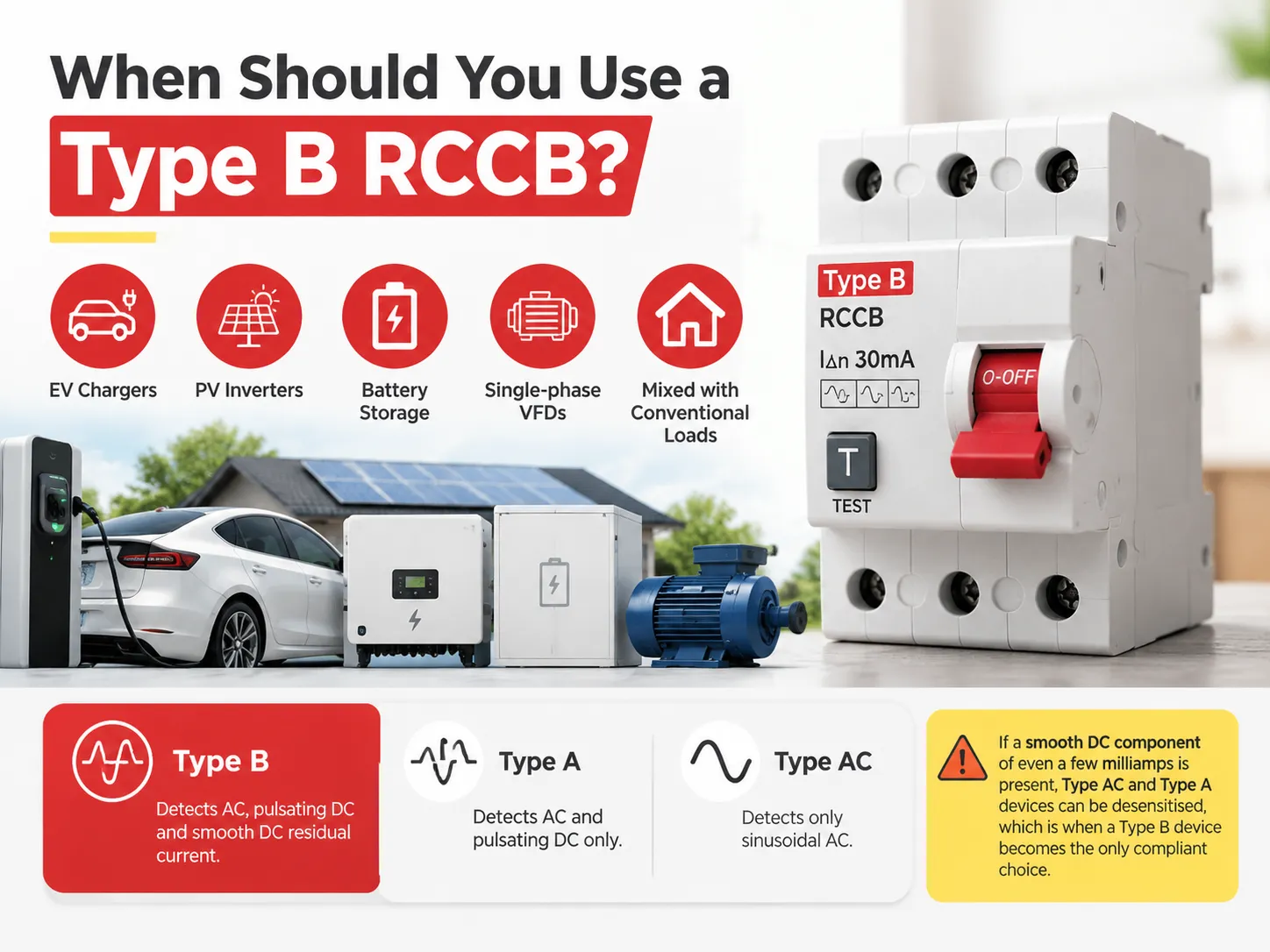
The specification that leads to majority of mistakes is the residual current device. A Type AC device does not detect a pulsating DC fault while Type A does not detect a smooth DC fault. Therefore, when building EV chargers, PV inverters or variable speed drives, it is necessary to use type B Rs for circuits where they are included. Using Type AC everywhere just because it is cheaper is the most common and most costly mistake made in this area.A standard miniature device for general distribution, such as this 63 A frame MCB, is a different product from a Type B residual device, and the two are often confused at the order desk.
The second aspect is the breaking capacity of the device. The breaking capacity should always be higher than the value of the prospective short-circuit current in the system. Thus, if a 3 kA rated device is situated in a system with a short-circuit current somewhat beyond 6 kA, it will not be a low-cost device, rather it will be a device causing noncompliance and the responsibility of the panel assembler. Hence, prior to ordering the device, ask what the fault current will be and select the device compliance rating based on this value instead of looking through the price list.
Licensing and Certification by Region
There are three rules that regulate the market of English-speaking countries, but they differ from each other.
- The United States. The licensing system operates at both state and often at the municipal level. In California, the licensing system includes C-7 Low Voltage Systems for the cabling industry and C-10 for the wiring one. Licensing requires testing, experience, and insurance. New York regulates low-voltage contractors by issuing Class A licenses via the Department of Labor for work in fire alarm, alarm systems, and for systems in integrated buildings, while New York City requires the contractors to submit filings to the Department of Buildings on certain commercial installations. A number of states assume that fire alarms or their public use also require an additional alarm contractor license and NICET certification for its technicians.
- The United Kingdom. The market is divided between electrical contractors accredited by a competent scheme and installers of technology according to BS 7671 for any line voltage operation and to the applicable regulation in other cases. The fire alarm operation must comply with the BS 5839 standard and the installation must be certified by the third party.
- The European Union and the export markets. The electrical contractor is responsible for the CE marking of the assembly according to the IEC 61439, which means that the assembly manufacturer must have design verification and document proof. This is a very important shift that entails change in legal records.
From a practical standpoint, a customer can do only one thing: obtain the number of the contractor and scope of the certificate and verify this information written. A contractor who fails to respond is not insured, and the insurance issue only arises after a trouble occurred. Technical documentation for the equipment side, including declarations and test reports, is what a technical download library exists to supply, and it is worth confirming that your supplier has one before the first order rather than after the first inspection.
A Selection Table for Buyers
Match the requirement to the trade, then to the evidence.
| If you need | Hire this trade | Ask for | Red flag |
|---|---|---|---|
| Cabling for a new office | Low-voltage systems contractor | Licence number, BICSI certification, test results per drop | Quote without a test and label line |
| Cameras and access control | Security integrator with LV licence | Equipment ownership terms, monitoring contract length | Leased equipment with no buy-out option |
| LV distribution for a plant | Electrical contractor or panel builder | IEC 61439 or UL 891 assembly certificate, type test reports | Component certificates offered as assembly proof |
| Solar or storage AC side | Electrical contractor with renewable accreditation | Interconnection approval, protection coordination study | No coordination study before energisation |
| Fire alarm | Alarm contractor | NICET-certified technicians, acceptance test plan | No witness test offered |
There are two universal questions that should be asked during every shortlist telephone conversation. Who, exactly, is going to be on site, and what is the anticipated response time for the first 90 days post-handover. A company that cannot answer these two questions is simply selling a price and not a service.
Where HUYU Sits in This Chain
We are not a low-voltage contractor nor are we engaged in installation operations. We specialize in the manufacture of protective and switching products used in the manufacture and servicing of electrical equipment: miniature circuit breakers, molded-case breakers, residual-current devices including Type B devices, contactors, thermal overload relays, transfer switches and surge suppressors.
Our position affords us opportunities in the industry. A panel producer must have a family of devices featuring the same size of construction throughout the range of ratings in order to enable board reconfiguration within the same enclosure. A contractor operating installed equipment requires replacement products that will fit in with the existing bus bar and respond in the same way as the existing trip characteristic. A distributor must have enough products in the basket to supply a specification with one order rather than six orders.
Our circuit breaker manufacturing operation is set up around those three needs, not around a single catalogue item, which is why the same frame appears across MCB, RCBO and RCCB variants. In case you are one of those involved in package specification and want to know the suitable device rating for a certain fault level, this is a technical discussion, which needs to happen before panel drawings are frozen rather than a price inquiry.
FAQ
What exactly does a low voltage contractor do?
People who work in the building services field work on a range of systems that involve structured cabling, video surveillance, access systems, door intercoms, audio-visual systems, and fire protection systems. In the electrical engineering branch, professionals design projects for the voltage of 50–1,000 V.
Do I need a licensed electrician for low voltage work?
Generally, the cabling industry requires a specific low-voltage license that is different from the electrician’s license. Whenever any line voltage work is required, for instance installing a new outlet for equipment, a licensed electrician must perform the work. Hence, in fact, almost all projects require both types of licenses.
How much does low voltage work cost?
The installation prices for a Cat6 drop is anywhere between $150 and $325 whereas the installation price for a Cat6A drop is between $250 and $450. The camera price varies from $300 to $800 including installation and mounting. Therefore for an office requiring 40 drops, the total cost of installation using cables would be around $7,400 to $13,000.
Is low voltage work safer than electrical work?
Although the chance of unexpected outcomes is smaller, yet the potential causes of failures still exist. Termination of a data cable that is performed incorrectly leads to failure of the certification, PoE budget that is not set properly results in camera outages, and if a fire alarm circuit is not monitored, it remains unobserved. The insurance claims concerning a low-voltage project are mostly related to the failure of a whole system rather than to the accidents that cause injuries.
Can one contractor handle both cabling and electrical?
Some large corporations work under one license and that makes the matter simple and calm. If this is not the case, you are required to manage the electric connections for your equipment, earthing and wiring, and the fire alarm system with damper and doors coordination. Include all of the three in a contract and make the risk vanish.
References
- BICSI — Structured Cabling and ICT Infrastructure Standards
- NEMA — Low Voltage Distribution Equipment
- NFPA — National Electrical Code and Life Safety Codes
- UL Solutions — Switchgear, Panelboard and Breaker Certification
- ABB — Low Voltage Products and Distribution
Conclusion
Ensure you have an understanding of the type of service that you will need before you request a quote. Different uses of the term lead to receiving quotes in completely different measures. While a cabling contractor determines the price based on the drop, a distribution contractor calculates his quote by the number of panels. The comparison of two quotes makes it possible to implement some projects using a circuit that is owned by nobody.
Then make sure you have checked the license number and the assembly certificate. These two papers will determine if the services can be insured and if they will pass the inspections. However, these documents will not appear in the estimate until it is no longer possible to replace the supplier.