
There is a little trick in this question. The molded case circuit breaker works rather like a circuit breaker working in the fashion of every other type of these devices; its comparison could be with small sized electrical devices like the miniature circuit breaker as well. To be honest, the inquiry concerns where exactly miniature circuit breakers stop being efficient and molded case circuit breakers become useful enough to obtain such price tag. The definition of this precise transition is provided by three figures as well as the design of the technology and when these figures are understood, it no longer remains a matter of choice for the customer.
A detailed analysis of the devices will be presented in the subsequent chapters of the paper, containing descriptions of the devices, their operation, scope of protection, use, price, and choice process.
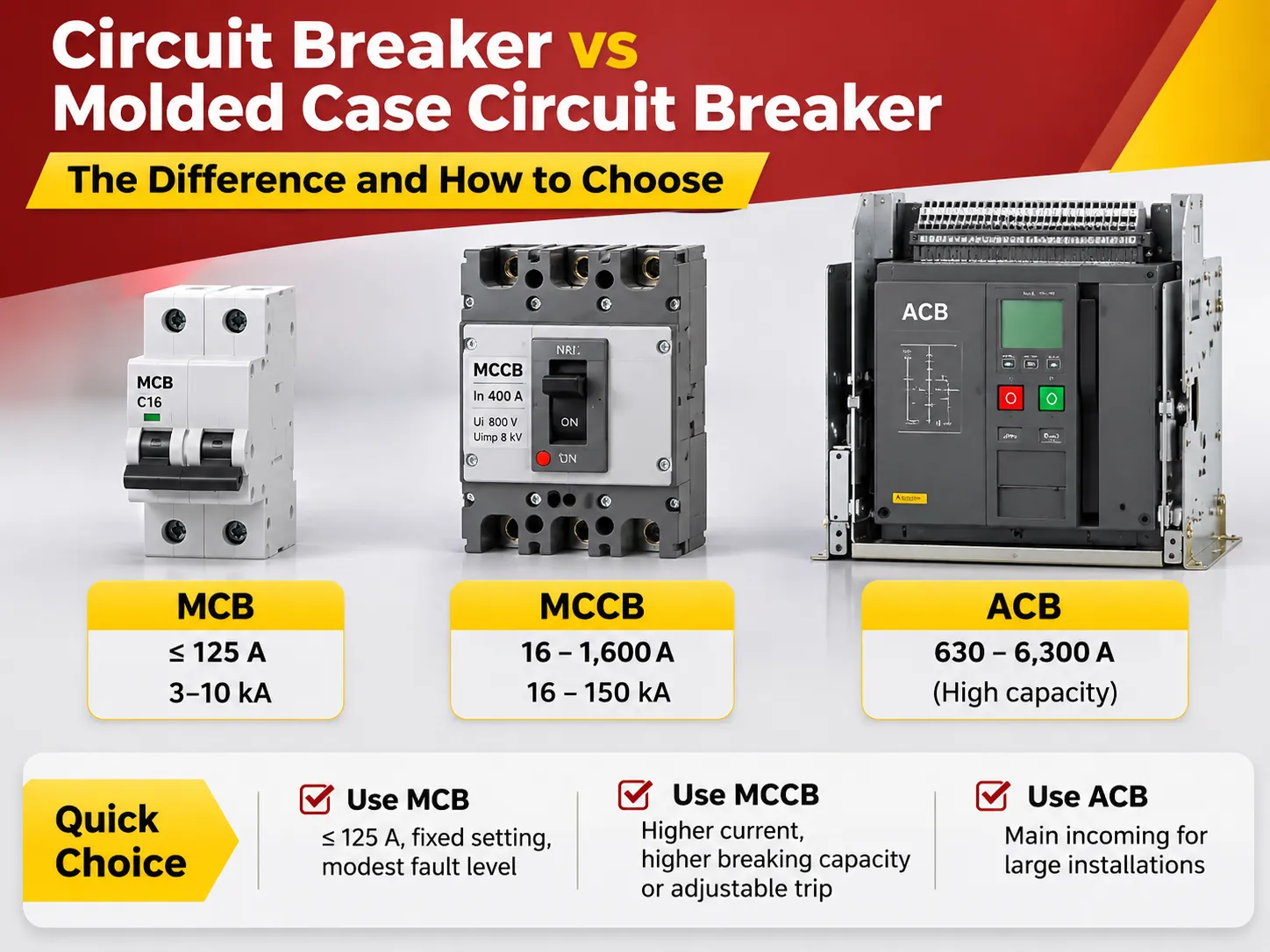
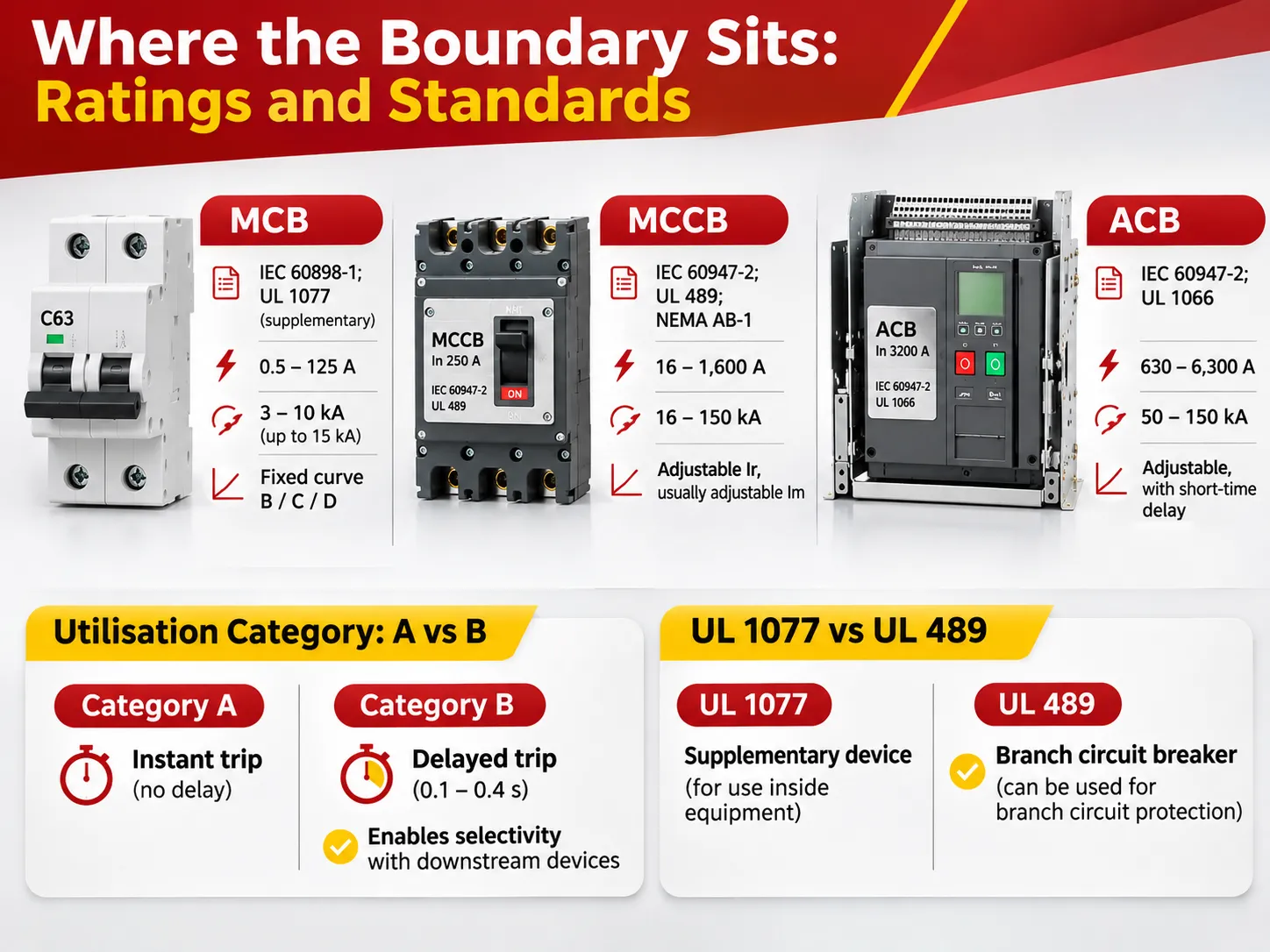
In conclusion, it can be said that the machine that can be classified as a circuit breaker must be capable of meeting the requirements of molded case circuit breaker (MCCB) which fulfills the condition of the IEC code standard as well as UL standard and includes the current values from 16 amps to 1600 amps and ensures breaking capacity of the device up to150,000 amperes at various trip settings. The device that is most widely used is the miniature circuit breaker (MCB) which can comply with the requirements of the IEC60898-1 and protect the device against a current load of 0.5 to 125 amps and provide breaking capacity between the limits of 3kA and 10 kA with fixed curve characteristics. The major differences in characteristics of these devices lie in their size, adjustment capabilities, breaking capacities, and their costs based on the cost of installation of the set.
The Short Answer: One Is a Type of the Other
Let’s break down the terminology. A circuit breaker can turn off a scheme automatically at certain moments, and after that, it can be reset but not replaced. The molded case circuit breaker is a term for circuit breakers having a construction and an internal mechanism placed in a molded case; it can be assumed that the second term describes a particular kind of the first one, so the only occasion when the comparison can be made is if the first expression refers to the smaller representatives of the first set of objects.
In the area of technical communication, the phrase “circuit breaker” refers to the small devices you can see in a distribution board while the mold “molded case” is used when discussing much bigger devices that can be met in machinery or panels. However, the spelling of the terms makes sense until the problem of specification occurs, as in this case, it is crucial to set the particular meanings of the terms in a proper way.
The usual comparison in this area does not take into account that the air circuit breaker is also a third type of device that should be considered. The air circuit breaker is a device with an open supporting device and an arc chamber applied as an incoming circuit breaker starting from about 630 A, and its breaking capacity is different from that of the same devices mentioned above. Consequently, it happens very often in the design sphere that the engineers transition from 125 MCBS to 1600 MCCB without including the air circuit breaker option, thus saving the costs and gaining superior results.
How They Look, and How They Are Built
The difference between an MCB and an MCCB can already be perceived upon placing both devices on a workbench. MCB is a slim modular device, which is 18mm wide per pole. It is designed so that it can be mounted on the DIN rail of either a consumer unit or a distribution board. However, an MCCB is a more solid block-like device that usually has cable lugs or busbar connections. It often contains a rotary handle or rotary operator as well.
- Construction of the MCB. It consists of a casing wherein there is a bimetallic stripe, solenoid coil, mechanism, and an arc chute, all sealed by the factory. The manufacturer sets the trip point which cannot be altered later. Most MCBs are installed in single pole to four pole configurations, rated from 0.5 to 125 A. The whole device needs to be replaced once it trips.
- Construction of the MCCB. It consists of a heavy case and a mechanism that allows resetting after tripping occurs, associated with a trip unit that may be thermal-magnetic or electronic. The terminals are meant for large conductors as well. The operating system functions are accomplished by means of multiple accessories which are installed on the same frame.
- Construction of the ACB. It is an open frame device, with contacts visible. It is characterized by a drawout mechanism that can be seen on bigger variants with a separate trip unit that can be programmed or, in some models, changed. It serves for maintenance, not for replacement, which is the commercial argument that supports devices above 2,000 A in capacity.
The physical difference entails some practical consequences in the application of both devices in the panel. Therefore, MCB takes up 18 mm per pole and can be installed on the board with a busbar in a couple of minutes. As for the MCCB, its installation implies using cable lugs, adjusting torque, and allowing for bend radius of cables, as well as possibly needing spreaders or busbars. Thus, despite being much smaller than the differences in the costs of devices might suggest, this factor can explain the differences in installation costs. It is also why the molded case breaker supply side of the business is organised by frame and accessory, not by current rating, since a panel builder buys the frame and then decides the trip unit.
How Each One Works
All kinds of protection in overloading or any short circuits of electrical loads are implemented by various mechanisms with different tunings.
- The MCB is thermal-magnetic. When current flows through a bimetal strip, it causes it to bend, and after escaping through the initial point of thermal response it will trigger the mechanism after a delay which is inversely proportional to the highness of current. The long-term (overload) protection works in the slowest way according to thermal behavior of cabling systems. Relatively to sudden surge occurrences, a solenoid as a kind of mechanism could react on currents from five to ten times higher than permissible.
- The MCCB can be either thermal magnetic or electronic. Thermal-magnetic MCCBs are based on the same operation principle with enlarged mechanisms, while electronic ones work based on the fact that current transformer is included in the device and it allows one to make the device analyze the current. The presence of the electronic system in the design of MCCB makes it possible to provide adjustments of constants and parameters such as long time setting (Ir), short time setting (Im), short time delay tsd as well as some models of this device provide ground fault protection and metering functions to be implemented.
- The ACB is almost always electronic and almost without any exception at modern ratings, main parts and devices included in trip unit may possess same features along with communication, zone selective interlocking and ability to preserve the detected waveforms.
The consequence for the buyer is that MCB functions as a separate element while MCCB being a small electro-mechanical system. MCB is chosen from the table while MCCB is issued to be put in operation based on some criteria.
What Each One Protects Against
Both types provide protection both for the conductors and for the equipment connected downstream, both types also enable isolation of equipment once opened. What differentiates them is the type of faults they can interrupt.
- Overload. Both types deal with overloads as well as with inverse time. The overload characteristic of an MCB is rigidly set to be either B, C, or D; and these letters indicate the value of the magnetic responsible current multiple. The overload curve of an MCCB can, however, be modified by the value of Ir. This means a single MCCB can be used for several cable sizes.
- Short circuit. Both devices can deal with short-circuits according to their rated capacities. In this case, the statistics differ: in case of an MCB, breaking currents are in the range of 3 to 10 kA, while in the case of an MCCB the range is already between 16 and 150 kA. If a facility is fed from a 2,000 kVA transformer, the fault current at the main distribution point may exceed 40 kA, which means that no MCB would be able to take it out.
- Earth fault. Neither of these devices is an RCD. An MCB or a MCCB is designed to perform protection of conductors but does not implement more complicated residual current protection functions, which are provided either by an RCBO, an RCCB, or a residual current release. This significant misconception results in installations passing the test but failing the first safety audit.
- Selectivity. Only MCCBs which are equipped with a short time delay, and only ACBs can be part of a time discrimination approach while MCBs do not allow for that. Therefore, systems with only MCBs installed will not provide more than just current discrimination.
Where They Are Used
The hierarchy is the most straightforward way to show the distinction. In the case of a properly designed low voltage system, the three devices create strata, where each stratum is present only because the one that comes before cannot perform that function.
- Final grids. Electrical sockets, lighting and an isolated application. MCB’s sphere of control is restricted to minors, low resistance at the terminal of a lengthy wire line and a device that an average man can reset by himself without difficulty. The standard MCB which has both 16 or 32 A and a C curve mostly suits this application, while the fixed curve eliminates the need of service personnel to install it.
- Sub mains and geared machine panels. MCCB zone which operates at high current, and current fault level that happens closer to transformers compared to the MCBs below. Additionally, it requires coordination between MCBs and downstream in case of failure when only one of them should stop working.
- Main supply points. ACB or powerful MCCB depending on distribution or ticket office accessibility for repairing. An ACB will be removed to allow maintenance and exchanged contact parts to be put in good shape while a heavy MCCB will be substituted with a new one.
The fourth case does not apply to the hierarchy – it is OEM equipment. In the case of machine builders, their circuit panels are usually equipped with any MCCB, which is due to the fact that it needs a customisable trip operation for adequate motor performance and a high breaking capacity for powered supply system.
Ratings Compared: Current, Breaking Capacity and Curves
| Property | MCB | MCCB | ACB |
|---|---|---|---|
| Standard | IEC 60898-1 | IEC 60947-2, UL 489 | IEC 60947-2, UL 1066 |
| Current range | 0.5 to 125 A | 16 to 1,600 A | 630 to 6,300 A |
| Breaking capacity | 3 to 10 kA | 16 to 150 kA | 50 to 150 kA |
| Trip setting | Fixed curve B, C or D | Adjustable thermal and magnetic | Adjustable with short time delay |
| Poles | 1 to 4, plus neutral | 2 to 4, fixed or draw-out | 3 to 4, draw-out |
| Typical price | $2 to $25 | $40 to $4,000 | $5,000 to $30,000 |
| Typical use | Final circuit | Sub-main, machine, OEM panel | Main incomer |
There are two numbers today in focus, which usually do not receive proper attention.
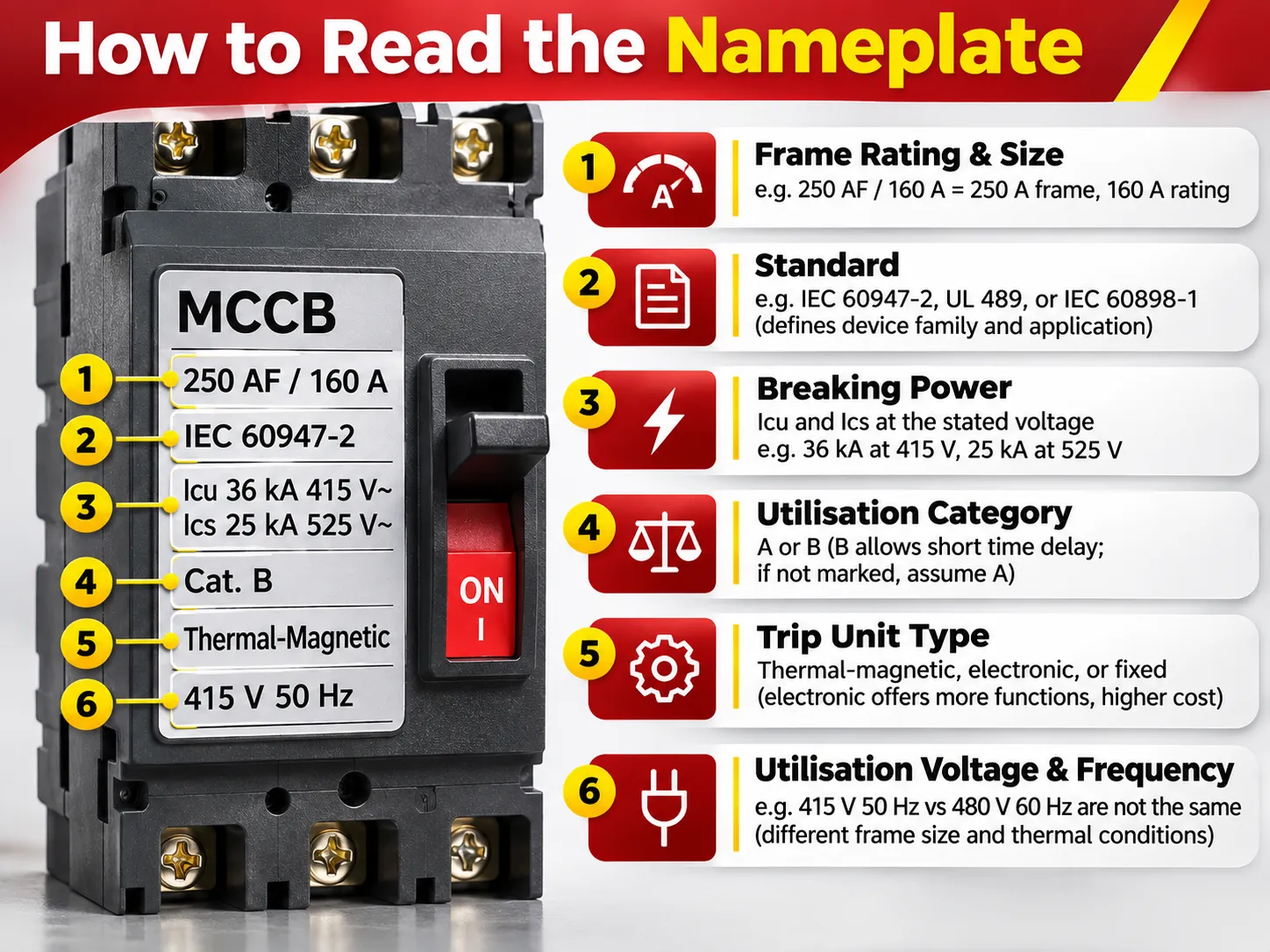
The first is the Ics measurement of the breaking capacity of the electrical device: the fault current that the device might manage to stop before resuming the normal functioning. In accordance with the Ics value, if a device possesses Icu of 50 kA and Ics of 25 kA, the latter might take the 50 kA fault but still should be replaced afterwards, while any device with Ics equal to Icu would still operate normally. The Icu value is mentioned in the front part of the catalogue, while the Ics value is given in the technical data at the end of the catalogue, which indicates that the marketing department is in favor of Icu.
The second important number is the category of utilization. There are two types of categories: category A, which does not have a short time delay and is to be used for final circuits, and category B equipment, which possesses the feature and can be used for time discrimination. As a result, a board does not have the possibility to ensure selectivity in case it is equipped with category A devices despite all the settings stated in the front portion.
Price: What Each One Costs and Why
The pricing given below refers to 2026 distributor pricing trends applicable to regular devices. The variance in prices among various bands arises from rating values, number of poles and different brands, rather than the current value.
| Device | Typical price | What drives the number |
|---|---|---|
| MCB, 6 to 32 A, 6 kA, 1 pole | $2 to $8 | Breaking capacity, curve, brand, certification |
| MCB, 63 to 125 A, 10 kA, 3 pole | $15 to $45 | Current, poles, breaking capacity |
| MCCB, 100 A frame, 25 kA, 3 pole | $40 to $120 | Frame size, Icu, thermal-magnetic vs electronic |
| MCCB, 250 A frame, 36 kA | $120 to $400 | Trip unit type, accessories, certification |
| MCCB, 630 A frame, 50 kA | $400 to $1,200 | Electronic trip, metering, communication |
| MCCB, 1,600 A frame | $1,500 to $4,000 | Breaking capacity, trip unit, accessories |
| ACB, 2,000 A, draw-out | $5,000 to $30,000 | Current, trip unit, communication, arc containment |
The price steps differ with current. For a 100 A MCCB, going to a 250 A MCCB nearly triples the price, and then going to 630 A MCCB does it again. This is due to the fact that with each price increase the frame, breaking capacity and probably trip unit also change. In some cases, using two feeders, which allows for smaller MCCBs, may be cheaper than having one large unit.
The importance of brand varies depending on the price levels. An MCB of a top brand may cost 2-3 times more than a similar unit made by an average Chinese manufacturer, but in most cases they will perform equally well. However, a 630 A MCCB will be more expensive due to superior trip unit quality, charts of discrimination, spare parts, etc.
The step that catches buyers is the trip unit, not the frame. A 250 A frame with a thermal-magnetic trip and the same frame with an electronic trip differ by more than the frame itself, and the molded case breaker range used on distribution boards is priced by frame and trip type separately for that reason.
Adjustment and Selectivity: The Practical Difference
A breaker that can be adjusted is far from merely being a convenience. This is the item that makes it possible for a single device to provide peripheral protection for the wire, coordinate with a device upstream, and still enable a motor to begin. None of these three characteristics can be satisfied with a fixed curve.
The thermal setting, written Ir, designates the threshold for long time trips as an aspect of frame rating and is typically within the range of 0.4 to 1.0 in increments. Set it proportionately to the cable’s carrying capacity, and not the connected load’s rated current, because the purpose of the breaker is to protect the cord. A 250 A frame changed at 0.6 relates to a cable with a 160 A rating while the same breaker set at 0.4 protects a 100 A cord. The frame is thus what makes it possible to protect several circuits effectively.
The magnetic setting, Im, refers to the level of instantaneous threshold that is estimated to be five to ten times the thermal setting. This is the value that determines whether a device would work or the breaker would trip. This setting is the reason why the direct online motor uses five to eight times its rated current for one or two seconds. A low value results in the breaker being tripped every time while high value means that short circuit protection is weakened.
The short time delay is a significant factor that provides a timing of tripping time. This delay can achieve an elaborate design of timing discrimination between the main breaker and the feeders below.A molded case breaker with adjustable trip settings is chosen for exactly this reason in plants where a trip at the main would stop production, not one machine.
The verification of selectivity takes place through the manufacturer tables and not the calculation based on the curves alone. The two circuit breakers made by different companies that have similar ratings may work together or might not according to the laboratory test results. In such cases, it is necessary to ask both companies to give information about the pair of circuit breakers being used in the system even if they are from different brands.
Choosing by Application: A Selection Table
The table below is the short version of the whole article, and it is where most specification conversations should start.
| Application | Device that fits | Why |
|---|---|---|
| Home consumer unit, lighting and socket circuits | MCB, 6 to 32 A, B or C curve, 6 kA | Fixed curve, DIN rail, resettable by the occupant |
| Small commercial board, single phase sub-circuits | MCB, 10 kA, or RCBO where earth leakage is required | Cost, footprint, no commissioning |
| Distribution board sub-main, 100 to 250 A | MCCB, thermal-magnetic, 25 to 36 kA | Adjustable Ir to match cable, higher fault rating |
| Machine control panel, motor feeder | MCCB with adjustable magnetic setting, or MPCB | Must ride through motor starting without nuisance trips |
| Plant main incomer, 630 to 1,600 A | MCCB with electronic trip and short time delay | Time discrimination with feeders below |
| Building main incomer above 2,000 A | ACB, draw-out | Serviceable, rack-out, metering and communication |
| Marine, mining or high-vibration installation | MCCB with tested shock and vibration ratings | Sealed mechanism, accessory range, certification |
To read the table, locate the row that is nearest to your installation. Check the fault level registered in your installation. If the fault current measured exceeds the breaking capacity provided in that row, you should move to a higher breaking capacity. Remember that this is the one number that cannot be corrected after installation.The comparison of MCB and MCCB behaviour goes through the same trade-offs from the application side, including how the two behave inside a panel, not on a bench.
Common Mistakes
Four mistakes account for the majority of failures in this area, and they are all specification mistakes rather than errors in the product itself.
- Some people confuse MCCB with RCD. They are not the same. In order to ensure earth leakage protection, a residual current device is needed, as an installation relying on MCCB for shock protection does not provide any shock protection. This mistake is common in retrofits when old fuse boards are replaced with circuit breakers but without adding RCD.
- Setting Ir equal to load instead of the cable. When a circuit breaker is set to the nameplate current of the load, this results in the cable being unprotected if the load is larger than the cable. The point of a circuit breaker is to protect the cable from burning.
- Using both category A and B devices in a time coordination scheme. A feeder with no short time delay would be impossible to time coordinate with the others, and the designer will have to rely on current discrimination, only to find out that it would not work once the first fault occurs.
- Focusing on Icu only. A 70 kA device that has a low Ics and that does not have any tested discrimination against the ones below is much worse than a 36 kA one with several devices. The number on the front of the catalog is the least useful number on the nameplate.
Where HUYU Fits
We manufacture miniature circuit breakers, moulded case circuit breakers and their accessories, ranging from 1A MCBs to 1,600A MCCBs. We offer designs that meet the requirements of IEC 60898-1 and IEC 60947-2 standards, along with UL 489 versions. Most of our production is supplied to distribution boards, machine panels, and OEM equipment, where an end-user needs a uniform product family and not just one outstanding item.
The miniature circuit breaker range covers the final circuit end: 6 kA and 10 kA devices from 1 to 125 A, B, C and D curves, in the 18 mm modular footprint that fits a standard DIN rail. For the sub-main end, the moulded case range starts at 16 A and runs to 1,600 A, with thermal-magnetic and electronic trip units depending on the frame.
The value we provide to a panel builder is in our consistency. A panel that uses the same family across MCBs, MCCBs, and accessories only needs one set of busbars, enclosure cut outs, and spare parts list; therefore, the molded case side of the line is built around that concept and not single device-style orders.
What we cannot do is manufacture air circuit breakers. For example, if the main incoming current is 2,500 A, the proper contact person would be one of the major switchgear manufacturers; it is much more beneficial to mention that in the first response, rather than trying to quote something related and praying about the difference not becoming an issue at the commissioning stage.
FAQ
What is the main difference between a circuit breaker and an MCCB?
The rotary circuit breaker is basically used for protecting the circuit and its main definition only lies in its size as well as the current ratings provided by it. The miniature circuit breaker conforms to standard IEC 60898-1 with maximum current rating of 125 A with fixed trip characteristic of a circuit breaker. The MCCB being compliant with either IEC 60947-2 or UL 489 is available in current rating range of 16 A to 1600 A with a very large breaking capacity of up to 150 kA.
What are the differences between an air circuit breaker and a molded case circuit breaker?
Structure and operation. An ACB has a clear casing, showing the arc chute, effective contacts and often has drawout option, serving as an incoming apparatus with amperage from 630 A to 6300 A. An MCCB is fitted into the case and is not serviceable, with amperage from 16 A to 1600 A. It is possible to maintain an ACB in operating condition without removing it, which is an important advantage in the sector despite its high price per amp.
What is the difference between a power circuit breaker and a molded case circuit breaker?
“Power circuit breaker” is a generic term rather than being a specific product category with precise definition. In North America, this is commonly understood to mean either a service entrance fitting or feeder-protection device which usually complies with UL 1066. However, an MCCB has a strict definition referring to appliances complying with UL 489 or IEC 60947-2 standards. Power circuit breakers have been specifically designed for selective studies and maintenance operations while an MCCB is a compact and simple electrical device that can be easily changed.
What is the difference between an ACB and an MCCB?
At this time, there are changes in the world of construction and maintenance philosophy. ACBs are made with the ability of being rated from 630 A to 6300 A with characteristics of having open contacts and being drawout equipment in the place of their installation. MCCBs can be made with the rating of 16 A to 1600 A and are delivered sealed, which means that when they break, they must be changed. The cost of an MCCB for the low ratings of below 1600 A is little but does not exceed 2000 A, which lets the existence and serviceability of the ACB justify its cost.
References
- UL Solutions — UL 489 Molded Case Circuit Breakers and UL 1077 Supplementary Protectors
- NEMA — Molded Case Circuit Breaker Standards and Application Data
- Hitachi Energy — Low Voltage Protection and Switchgear
- Legrand — Circuit Protection and Distribution Products
- Siemens Energy — Circuit Breakers and Protection Devices
Conclusion
Thus, all the MCCB types can be treated as circuit breakers. However, instead of determining the class of your MCCB, you should figure out three parameters characterizing your MCCB: current rating, short-circuit rating, and whether selective coordination features are needed. These parameters will help you find the type of your MCCB, while the name of the type will be based on the parameters.
When you choose the type of the MCCB device, you should learn the nameplate data of the MCCB. The size of the frame will tell you the capacity of the MCCB. Ics shows whether this MCCB can operate under the fault conditions or can just pass the tests of failure. The type of application of the MCCB will define whether you can use the principle of selectiveness when installing this MCCB. The standard will tell you the certification location of the MCCB.