

You connect a blow-dryer, and the bathroom outlet clicks, shutting off the power while the “TEST” button pops out. Or the refrigerator stops running, also due to a GFCI outlet in the kitchen. Or you even get a slight shock when touching your washing machine. These events are indicative of a ground fault, which is one of the most frequently encountered and dangerous electrical problems in household and working environment. Knowing what a ground fault is, how it happens, and how to be protected against it may even save your life.
In this guide, the author will explain ground faults in simple terminology: what they are; how they happen; what makes them dangerous; how GFCIs operate; how to identify them; and how to repair them.
In simple terms: A ground fault can be defined as an unintentional pathway for electricity to go from a live electrical conductor to ground — this can be a grounding metal surface of an appliance, pipes, or the earth. This can happen if the insulation fails; the current-carrying wire touches a metal body; or there is water that connects live electricity with the ground. As the body of a human can also serve as a way to the ground, this is why this kind of electrical fault is dangerous — it is because of the fact that, in case of a ground fault, electric current may pass through a person.
Ground Fault in Simple Terms
In a typical electrical circuit, the current flows through the wire, does its work, and returns back through the neutral wire without being messed up. A ground fault is where that current goes from where it was supposed to go and finds its way through some metal frame of an appliance, water or plumbing, or through a human being.
In other words, think of a garden hose where water usually flows from the faucet to the sprinkler. But when the hose is torn, the water spills out of the hose, and if you’re caught in that spray, you’re drenched. So in an electrical circuit, when the current is leaking, as was the case with a garden hose, if that current goes through a human, you will receive an electric shock.
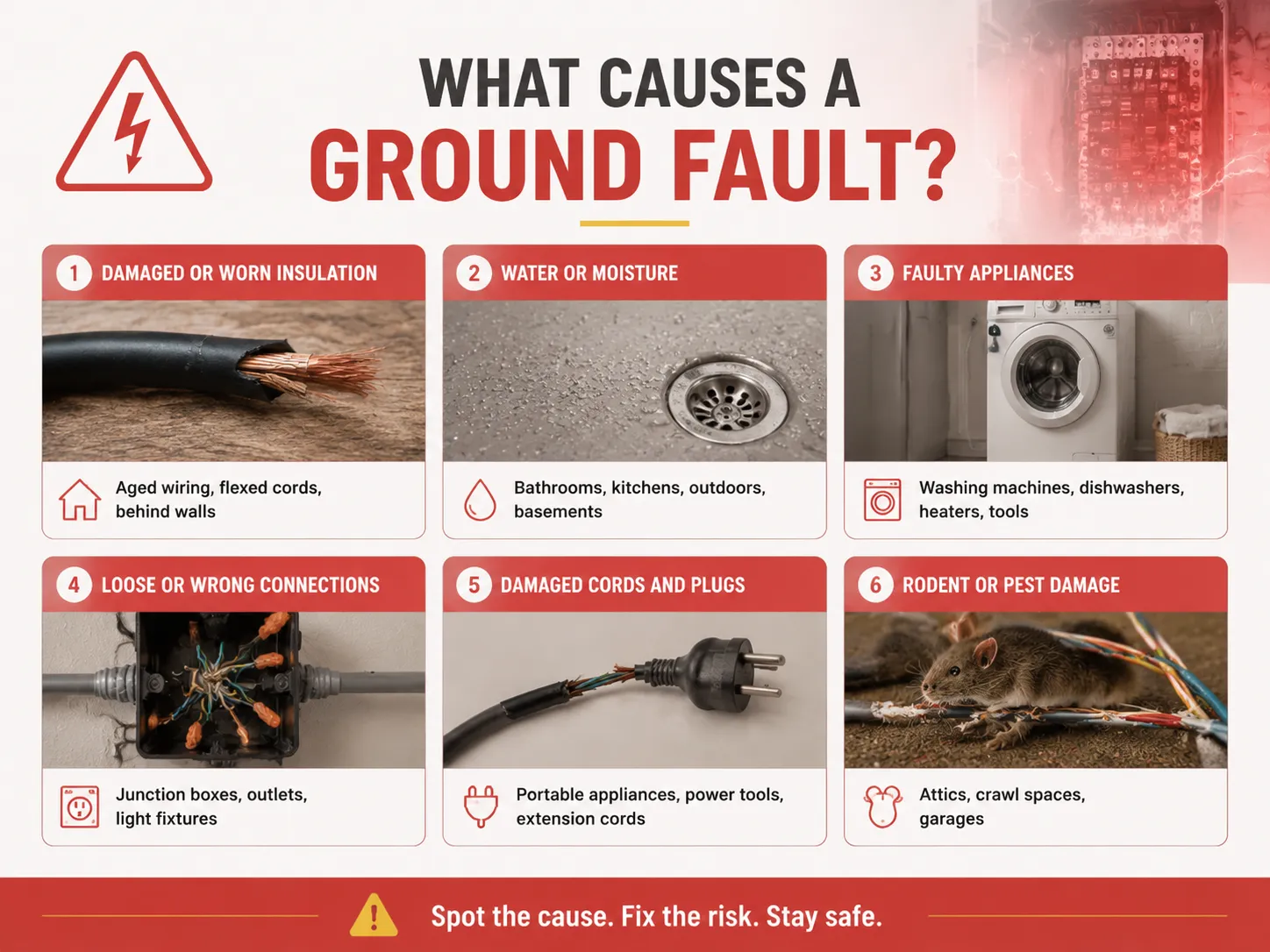
What Causes a Ground Fault?
Ground faults usually come from one of these situations:
| Cause | How It Happens | Typical Location |
|---|---|---|
| Damaged or worn insulation | Cable insulation cracks, abrades, or is chewed by rodents, exposing live wire to metal | Aged wiring, flexed cords, behind walls |
| Water or moisture | Water bridges between live parts and ground; even small amounts conduct enough to leak current | Bathrooms, kitchens, outdoors, basements |
| Faulty appliances | Internal wiring fails and touches the metal chassis of an appliance | Washing machines, dishwashers, heaters, tools |
| Loose or wrong connections | A hot wire contacts a ground wire, conduit, or metal box | Junction boxes, outlets, light fixtures |
| Damaged cords and plugs | Cut, pinched, or melted cords expose live conductors | Portable appliances, power tools, extension cords |
| Rodent or pest damage | Mice chew through wire insulation in attics and walls | Attics, crawl spaces, garages |
Why Is a Ground Fault Dangerous?
Ground faults present a threat for two reasons – shock and fire.
- Shock Danger: The human body is an excellent conductor. If you are in contact with any appliance experiencing a ground fault and you are in contact with the ground through wet conditions, then current will pass through you. The current may be as small as 10-20 mA which will cause muscle contractions making you unable to release your grip. The current may be 100 mA which will be lethal. GFCIs are designed to detect ground faults as low as 4-6 mA.
- Fire Danger: If the current leaks through high-resistance material, heat will be produced. The continued ground fault will keep heating the material and may cause a fire in a spot where there is no proper grounding connection.
The sad part is that a ground fault may not set off a circuit breaker. A standard circuit breaker activates only during overload or short-circuit.
Ground Fault vs Short Circuit vs Arc Fault
These three terms get mixed up, but they mean different things:
| Term | What Happens | Example | Protection |
|---|---|---|---|
| Ground fault | Current leaks from hot to ground (earth, metal, water) | Hot wire touches appliance frame | GFCI (outlet or breaker) |
| Short circuit | Current goes from hot directly to neutral with no load | Hot and neutral wires touch | Circuit breaker / fuse (high current) |
| Arc fault | Spark/arcing along damaged wiring (often intermittent) | Nicked cable in a wall arcing across a gap | AFCI (arc fault circuit interrupter) |
A ground fault refers to the scenario where current makes contact and flows to the ground. A short circuit occurs when hot comes into contact with neutral. If there is the arcing of electricity, you create an arc fault. Currently, GFCIs, AFCIs and circuit breakers are all being used as protection devices.
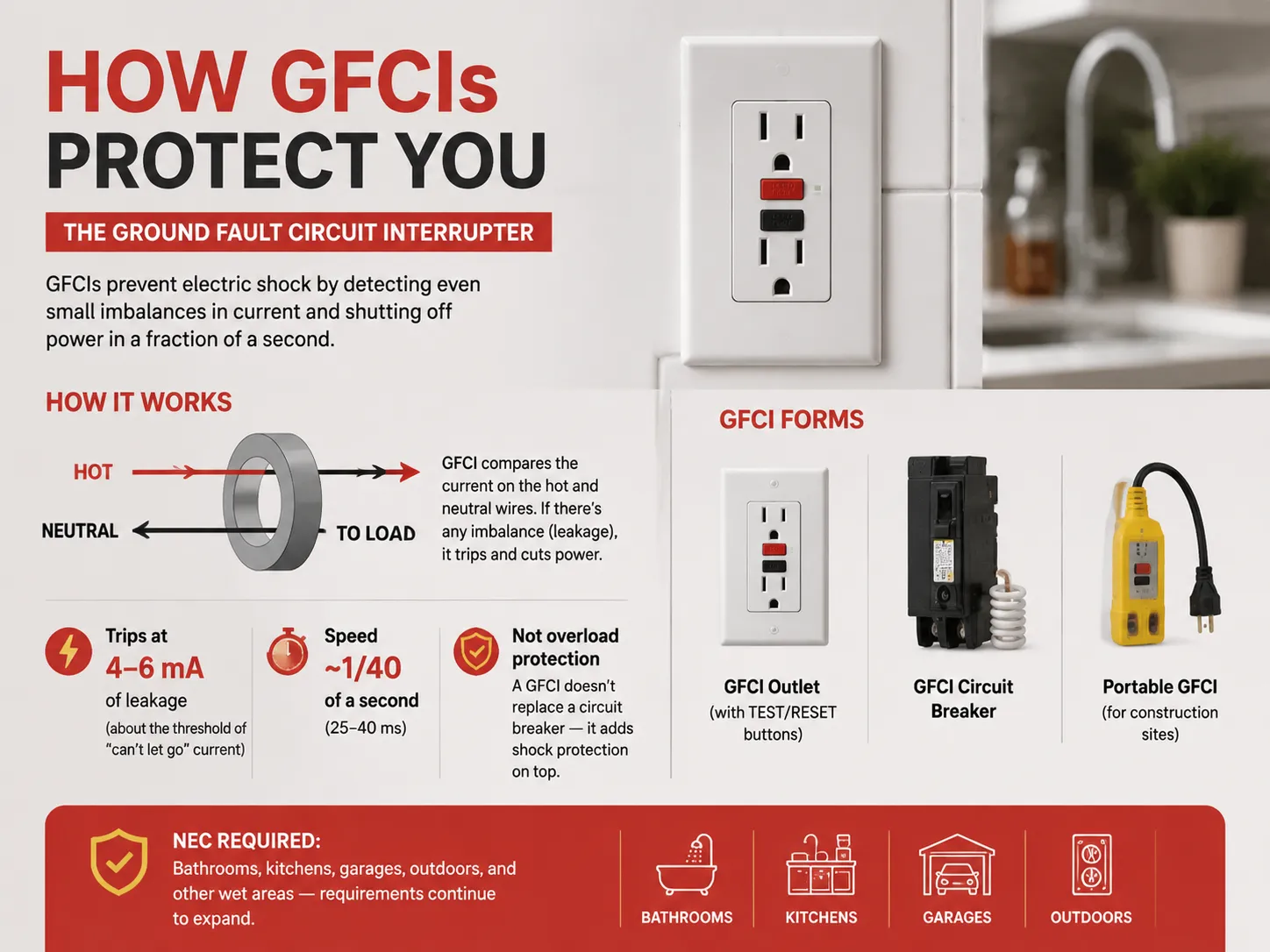
How GFCIs Protect You: The Ground Fault Circuit Interrupter
A Ground Fault Circuit Interrupter (GFCI) is a device that prevents fatal electrical shocks caused by ground fault hazards. The operation principle is quite simple: current flowing into the hot wire equals to that returning through the neutral. The GFCI uses its internal current transformer to compare both currents and, should there be an imbalance, to detect that there is a leakage somewhere in the circuit.
- Trips at: 4–6 mA of leakage (the critical threshold where people get shocked)
- Speed: ~1/40 of a second (25 to 40 milliseconds)
- Forms: GFCI outlet, circuit breaker and portable GFCIs for sites
- Not overload protection: The GFCI does not take over the function of a circuit breaker
Hence, following the standards for ground fault protection is so important because the National Electrical Code (NEC) has been requiring ground fault protection for years.To understand the standards and how GFCIs are engineered, our deep dive on the GFCI full form and how it works covers the device in detail, our comparison of circuit breakers vs GFCIs shows where each one belongs in your system, and if you’re sourcing protection hardware, the VR-11 RCCB series is a typical example of how residual-current protection is built into modern breaker form factors.
Where GFCIs Are Required
Ground fault protection is necessary whenever there is a risk for shocks, which occurs mainly when close to water, outdoors, or when people are in contact with ground surfaces. Common areas mandated by the modern electrical code include:
- Bathrooms (all outlets)
- Kitchen countertop outlets (within 6 ft of the sink)
- Garage and unfinished basement
- Outside outlets
- Crawl space and unfinished areas
- Laundry Room / utility sink
- Pool, spa and hot tub area
- Certain appliances (circuit for dishwasher and garbage disposal)
It is possible to install GFCIs in older houses without Ground Fault Circuit Interrupters (GFCI) and it only requires that the first receptacle on the current circuit be replaced with GFCI receptacle — thus protecting all the devices connected to that circuit from a possible shock.
How to Know If You Have a Ground Fault
Ground faults can manifest in several ways, and therefore, it is important to be cognizant of these signs.When evaluating ground faults, pay attention to the following:
- If the GFCI keeps tripping: If a GFCI will not reset or continues to trip, this normally indicates that there is a ground fault down the line.
- If you receive a shock: If there is any form of shock from either machines or metal frames, this is an indication of danger.
- If a circuit breaker trips: If the circuit breaker trips for no obvious reason, this is mainly a concern (especially with GFCI).
- If there is a buzzing sound coming near outlets: Happiness and equipment associated with peace and quiet.
- If there is a smell of burnt wiring close to an outlet, switch, or machine: This is indicative of current heating due to leaking current.
- If you find that the exterior of the machine feels hot: You will feel vibrations or shocks while working on equipment.
If any of the above occurs, quickly cease using this device and look into it instantly.
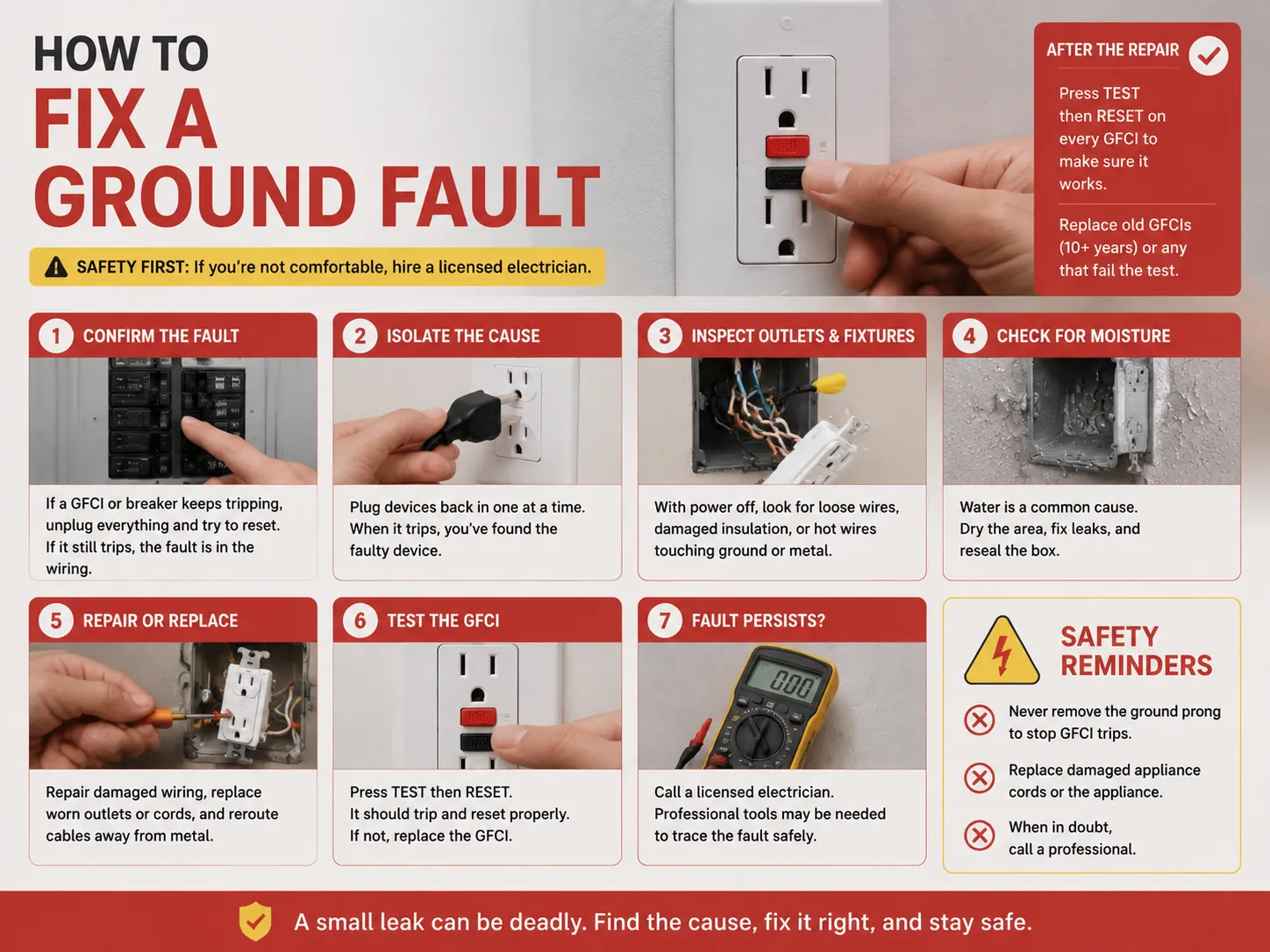
How to Fix a Ground Fault
Correcting a ground fault is a methodical process, and electrical work can be hazardous—if you’re unsure of yourself, call a qualified electrician. The general steps are as follows:
- Determine the fault: If the GFCI or breaker keeps tripping, the problem lies with that circuit. Unplug everything from the circuit and reset it to see if it still trips. If it does not trip, then there is a problem within the circuit itself; if it does trip, the fault lies within the fixed wiring.
- Find the fault through deductive reasoning: Plug in the devices one at a time to see which device causes the GFCI to trip.
- Examine the receptacles and fixtures: Shut off the power to the panel, open the outlet box, and inspect it for any loose wiring, damaged insulation, hot wires, grounding wires or moisture damage.
- Look for moisture: Water is the leading cause of ground faults in bathrooms, kitchens, basements, and outdoors. Dry out the box, repair the leak, and reseal it.
- Make the fix: Address the problem itself, whether it be repairing the tape, replacing receptacles, or replacing frayed wires.
- Test the GFCI: The GFCI should now be working. Press TEST and RESET on each GFCI unit to make sure they are working properly. If you have an older GFCI (over 10 years old) or one that won’t test properly, then it is time to install a new one.
- Contact a qualified electrician if the problem persists. A constant ground fault somewhere in the fixed wiring may require using a multimeter or megger to trace the problem—highly technical tools that require a professional to operate correctly.
If the problem is caused by a faulty appliance, do not attempt to just repair the wire—replace the appliance. Do not ever cut off the grounding prong from an appliance as a means of fixing a GFCI problem, as this will remove your margin of safety.
How to Prevent Ground Faults
Install GFCIs in every wet or outdoor area — this simple step is the best protection you’ll ever get.
- Keep water away from electricity: Don’t use machines by the sinks or bathtubs; don’t allow wires to lie on wet floors; and use only appropriate outdoor receptacles and covers outdoors.
- Check regularly the cords: Replace the wires as soon as you notice cracks or they have been bitten by pets.
- Avoid overloading the circuits: Overheating causes damaging of insulation and other faults.
- Use the suitable devices for outdoor use: weatherproof equipment, GFCI-protected outdoor outlets, portable GFCI for tools.
- Secure wiring from the pests and any physical damage: seal all holes rodents might enter from, and do not run wires through rugs and door openings.
- Test GFCIs each month: press TEST – it should trip; press RESET – it should restore.
Frequently Asked Questions
How do you fix a ground fault?
The first thing to do is confirm that everything on the circuit is unplugged, and then try resetting the ground fault circuit interrupter (GFCI) or circuit breaker. If the circuit is still live, plug in the appliances one at a time — when it trips, you will know which appliance is causing the problem. If even with everything unplugged the circuit trips, the problem lies in the fixed wiring: turn off power supply to the circuit, open the switches and/or outlet boxes, and check for faulty connections or any wires that are allowing electricity to touch any other wire or metal box. Fix the issue and test the circuit. If problems persist, call an electrician.
What is a ground fault in simple terms?
To put it simply, a ground fault is when electricity goes off course and ends up in the ground. Normally, the flow of electricity goes from the power line to the neutral line. A ground fault occurs when the electricity finds another way to the ground through a broken wire touching a metal device, through water, or through a person. This is dangerous because a person can conduct the electricity. A GFCI device detects such leak at a very low level of 4 to 6 milliamperes and cuts off the current immediately before a serious shock happens.
How do you know if you have a ground fault?
The indications of a ground fault are as follows: a GFCI socket does trip time and again or cannot be reset; a circuit breaker is activated without visible cause; an appliance causes you to feel a tingling or minor shock; humming or crackling can be heard from an outlet; an offensive odor is detected; or the surface of an appliance makes you feel uncomfortable. If your appliance has GFIC protection, it will be the first indicator.
What causes a ground fault?
The reasons that this occurs most often are: wire insulation that has broken or been damaged (for example, cracked, worn, or eaten by rodents), water touching live wires and grounding them (for instance, in bathrooms, kitchens, open air), wrong wiring in appliances and metal bodies touching their wires, loose or incorrect connections, or damaged wiring or plugs. In other words: any situation in which live wires may come into contact with the ground.
References
- NFPA 70 — National Electrical Code (NEC), Article 210.8: GFCI requirements
- UL 943 — Standard for Ground-Fault Circuit-Interrupters
- OSHA — electrical safety and ground fault protection requirements (29 CFR 1926.404)
- U.S. Consumer Product Safety Commission — electrical safety guidance
- Electrical Safety Foundation International — GFCI and ground fault safety resources
- Siemens — ground fault protection technical documentation
Conclusion
Ground fault is an undesirable current flow from a live wire to the ground and is one of the most serious electrical problems. This situation occurs when there is faulty insulation, water, a malfunctioning appliance, or loose connection. This situation is dangerous because even a small leak of 30 mA can kill a person and is not detected by a regular circuit breaker.
GFCIs are used to solve the issue here since these devices can detect leaks in a range of 4 to 6 mA and interrupt the flow of electricity in just 1/40 of a second. Thus GFCIs are required by the building codes everywhere where people and water interact.
It is important to learn the symptoms of the ground fault and test the GFCIs every month. Make sure the cables and wires are inspected regularly as well.And when you’re building or upgrading a system, choose protection devices from manufacturers that meet the relevant standards. HUYU Global manufactures certified RCCBs, RCBOs, and MCBs built to IEC standards — the kind of residual-current and overcurrent protection that works alongside GFCIs to keep circuits safe. For the difference between residual current devices and breakers, our RCCB vs RCBO guide is a good next read.