
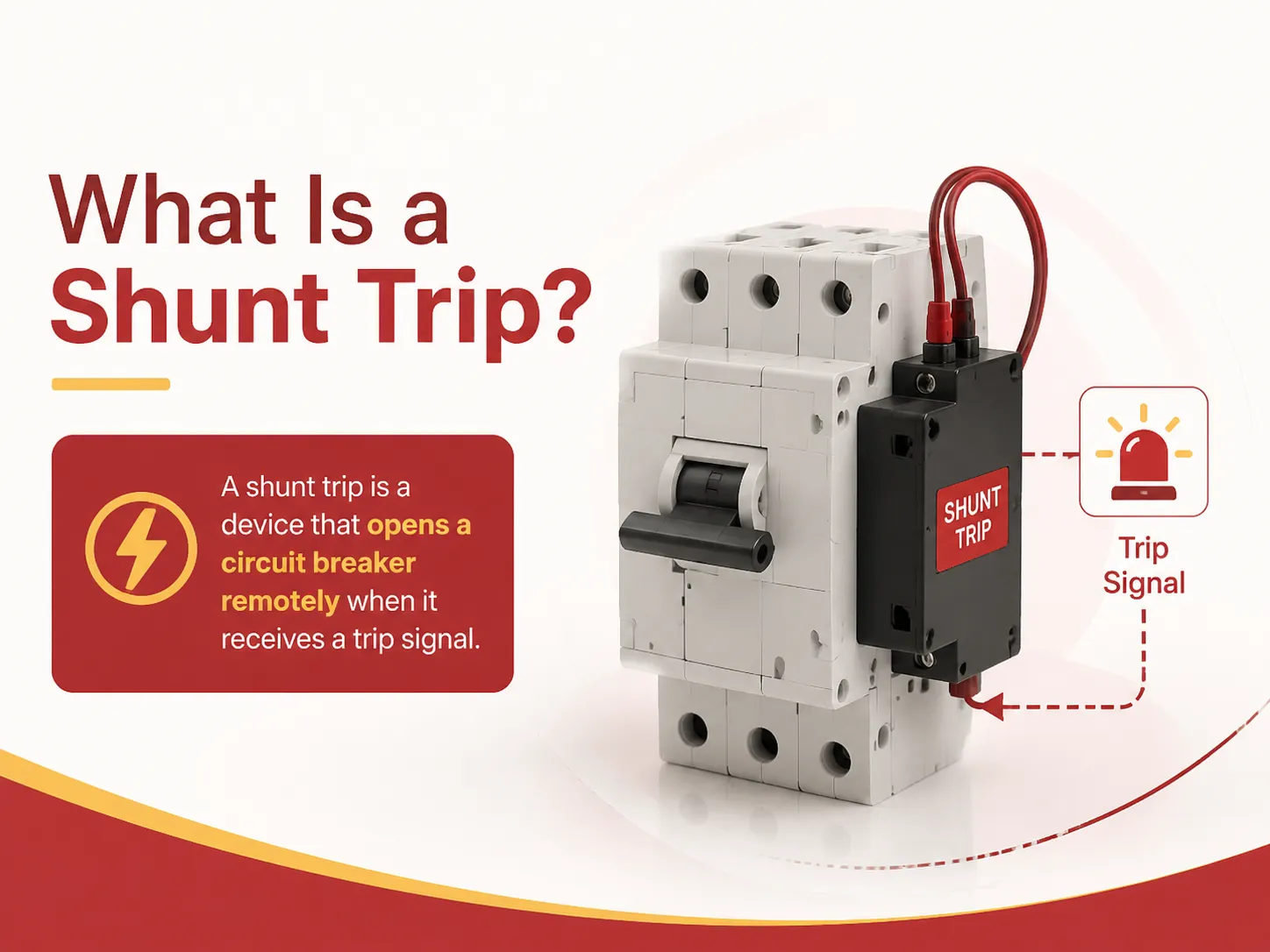
When the fire alarm goes off in a hotel kitchen, several processes need to take place at the same time. The alarm goes off, and the lights flash, the fire suppression system sprays the extinguishing chemical on cooking equipment, and, most importantly of all, all the electric power to cooking equipment is cut off immediately, automatically, without manual interference. How does that happen? With the help of a shunt trip. A shunt trip is part of a circuit breaker, and represents a small electromagnetic solenoid that trips the circuit breaker as a response to a remote signal. Many people, including electricians, facility managers, and inspectors of the buildings, ask themselves the question what is a shunt trip.
What a Shunt Trip Is and What It Does
A shunt trip refers to an electromagnetic accessory connected to a circuit breaker that allows for a remote trip to occur through an external signal. The meaning of the term “shunt” is associated with the electrical connection. The trip solenoid is connected in a parallel way, and once voltage is applied to it, the solenoid would turn on and operate its plunger on the internal trip device. It is similar to the case when there is an overload or short circuit in the breaker. It is a safety integration device: it connects the overcurrent protection world of the electrical panel to the life‑safety world of the fire alarm system, the emergency stop button, or the toxic gas sensor. For a deeper understanding of how the breaker itself functions before the shunt trip is added, our article on how a shunt trip breaker works explains the internal mechanism and the electrical sequence in detail.
How a Shunt Trip Works: The Electrical and Mechanical Sequence
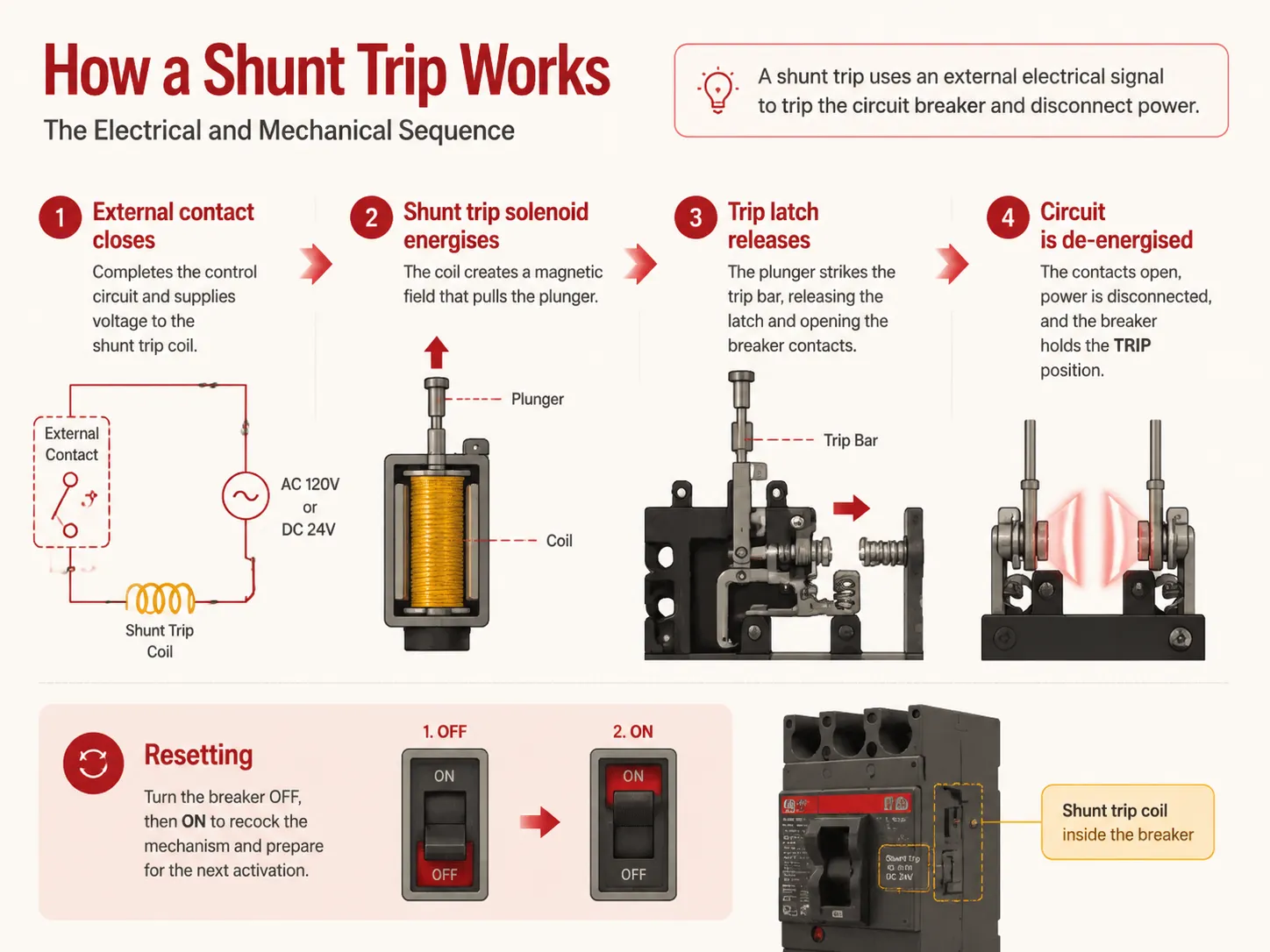
A circuit breaker works internally when it is tripped for an overload. The bimetallic part bends or the electromagnetic coil loosens, and thus the latch gets released. The workings of a shunt circuit breaker are a little different since the activation happens internally but the conclusion is the same. The process is as follows:
- A normally open contact closes in the external control circuit. This contact could belong to a fire alarm panel, an emergency shutoff switch, a microswitch for an Ansul fire prevention system, a sensor for poisonous gases, or an output of the facility management system. It connects the shunt trip coil with the voltage source controlling it, which is commonly either 120 volts of alternating current or 24 volts of direct current.
- The shunt trip solenoid energises. When electricity passes through the coil, the magnetic field pulls a small part called plunger. The plunger then makes a mechanical connection with the circuit breaker’s internal trip bar. This is the same latch mechanism that is acted upon by thermal and magnetic elements.
- The trip latch releases. The plunger hits the trip bar, resulting in the latch opening and the stored energy within the breaker mechanism acting to separate the main contacts. The book now moves into the TRIP position. Auxiliary switch may open the solenoid circuit at this stage to avoid the coil being energized for an extended period.
- The circuit is de‑energised. The supply is separated from the load, and the circuit breaker holds its TRIP position until manual resetting is performed. The shunt trip coil is in a de-energised state as a result of the reopening of the control contact or action of the internal cut-off mechanism.
Resetting a shunt trip breaker takes place in a manner identical to that of a typical breaker; you have to turn the switch first to the OFF position and then to the ON position. The reset action serves to recock the shunt mechanism automatically and prepare the breaker for the next activation. The principal distinction between a shunt trip and a standard breaker, however, does not lie in the resetting methods but in the manner of trip initiation.
How a Shunt Trip Breaker Differs from a Standard Breaker
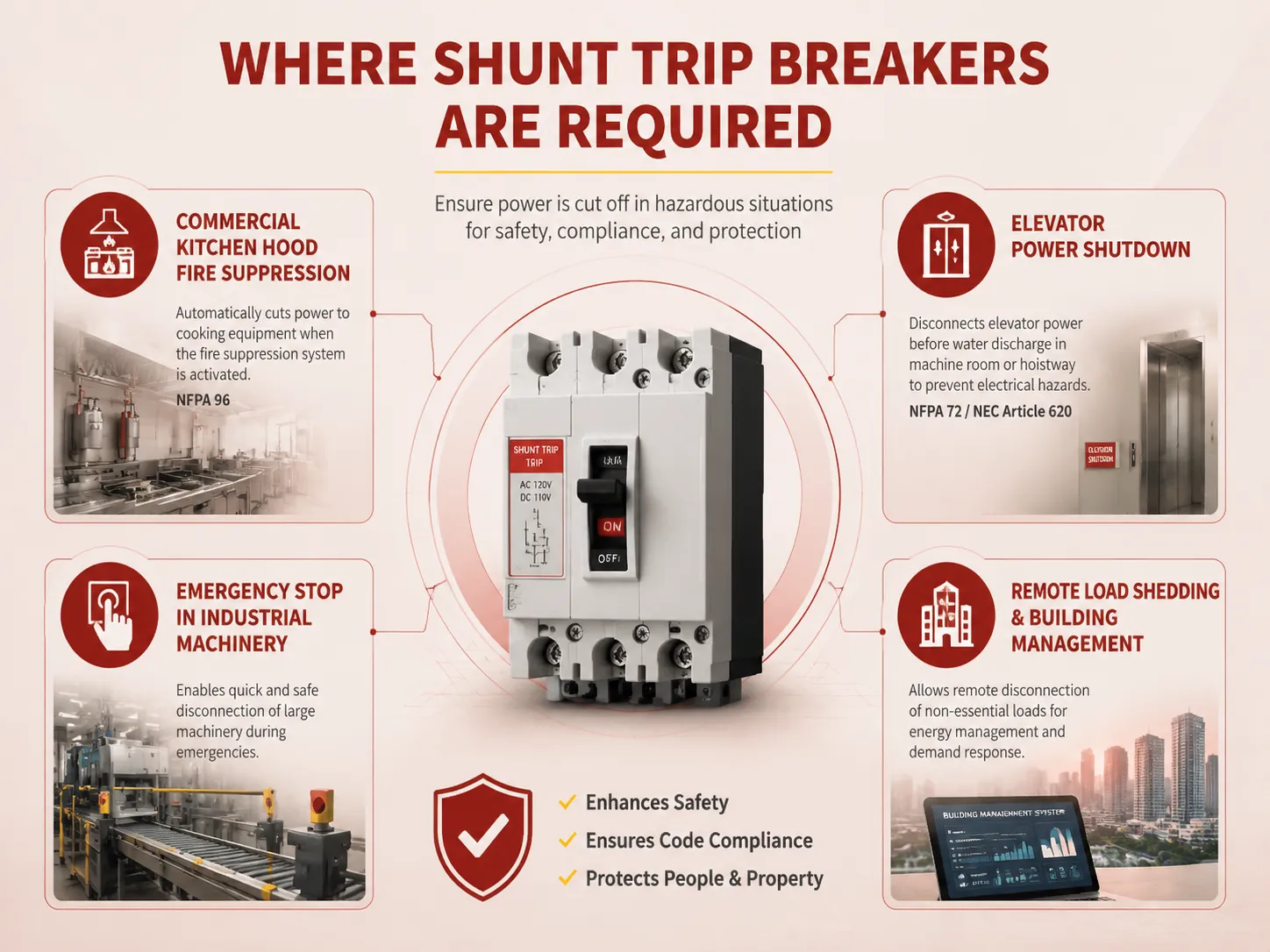
| Characteristic | Standard Circuit Breaker | Shunt Trip Breaker |
|---|---|---|
| Tripping methods | Thermal overload and magnetic short circuit only | Thermal, magnetic, plus remote electrical tripping via an internal solenoid |
| External control | None — the breaker responds only to the current on its own circuit | Tripped by an external voltage applied to a pair of control terminals or pigtail leads |
| Control voltage | N/A | Typically 120 VAC or 24 VDC; must be specified when ordering and must match the available control power |
| Typical applications | Standard branch circuit protection in residential and commercial panels | Fire safety shutdown, emergency stop circuits, remote load isolation, elevator power disconnect, kitchen hood suppression |
| Physical appearance | Standard breaker body with a single handle | Standard breaker body with two additional low‑voltage control wires or terminals; otherwise visually identical |
Where Shunt Trip Breakers Are Required
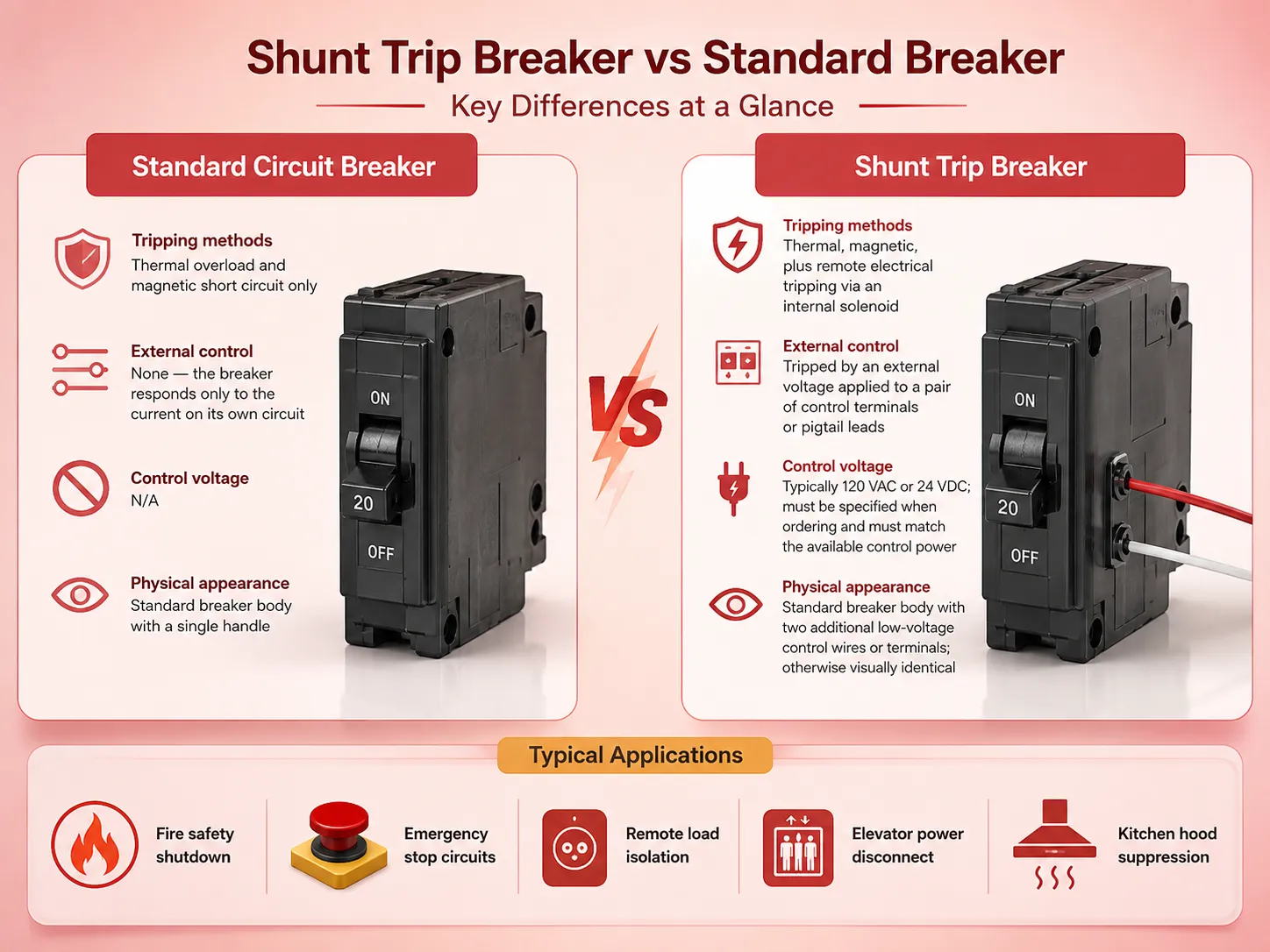
The shunt trip feature is not merely an optional add-on. Rather, it is required by the electrical codes in many installations, thereby ensuring electricity supply is cut-off in hazardous areas when fire occurs, a gas leak is detected or an emergency stop signal is given. The main applications, which are based on the National Electric Code (NEC) and also the standards of the National Fire Protection Association (NFPA), cover the following instances.
- Commercial kitchen hood fire suppression. In case of activation of an Ansul, Range Guard or any wet chemical method of extinguishing fire, all fire fighting devices situated beneath the hood must have their electrical circuits interrupted. The occasion when an automatic breaker is used for this purpose is the most common in practice. The requirement for this application follows from NFPA 96 code and from the listing for each fire extinguishing system by the manufacturer. The microswitch mounted in the control head of the fire extinguishing system closes one of its contacts and the current starts flowing to the shunt trip coil thus opening the circuit for the breakers and disallowing fryers, griddles and induction stovetops from operating while the exhaust ventilation system is still functioning to get rid of the fumes.
- Elevator power shutdown. Disconnection of the main power supply to the elevator is essential before initiating the discharge of water from the fire suppression system located in an elevator’s machine room or hoistway so as to prevent water from causing an electric shock in firefighters by energising electrical equipment. The standard method for achieving this disconnect involves installing a shunt trip breaker operated by the heat or smoke detector in the elevator’s hoistway. This complies with NFPA 72 and NEC Article 620.
- Emergency stop circuits in industrial machinery. In order to accomplish a complete disconnection of substantial machinery such as conveyor systems or production cells, an emergency stop button is usually designed to operate via a shunt trip breaker, enabling an easy and secure way of effectively disconnecting large pieces of equipment without the need for a contactor coil to keep the current flowing. This is especially common in several industries, including timber and heavy manufacturing.
- Remote load shedding and building management. In the commercial buildings, you can utilize shunt-trip breakers for disconnecting non-essential loads at the command of a building management system or demand-response controller, helping with peak demand management and avoiding penalty charges.
What Triggers a Shunt Trip, and How the Control Circuit Is Wired
An open contact is used to activate the shunt trip, which can include equipment such as a fire alarm relay, a suppression system microswitch, or a programmable controller relay. The way in which the shunt trip function is designed means the circuit should only be energized for a very short period of time only for the length of time it takes for the breaker to trip. In some circumstances, the control contact may remain latched, which means a separate relay or switch must have the ability to deenergize the coil of the shunt trip when a break trip occurs; if this is not done the coil will be burned out and the safety function will not work. The control voltage used should correspond to the voltage rating of the shunt trip coil. Using a different voltage will damage the circuit.
Installation and Maintenance Considerations
The procedure of installing a shunt trip breaker is almost similar to putting in place any standard breaker of the same frame size, but there is one significant factor to consider – two wires used in the shunt trip mechanism must be interconnected with the external operational circuit. These wires usually are connected so that their ends which are called pigtails are visible outside the case of the breaker. But when connecting them, it is also important to ensure the correct orientation if it is required, since the coil operates on direct current after the procedure of installation is complete, there is no need for any special maintenance activities for shunt trip breaker. It means that generally required maintenance of any breaker will be sufficient for shunt trip too – the breaker has to be exercised regularly, visually checked for overheating and corrosion, as well as tested once in a while. Regular testing of the shunt trip should be performed at least once a year as suggested by the NFPA and the manufacturers of the equipment which suggests simulating the emergency and ensuring that the breaker works properly when required.
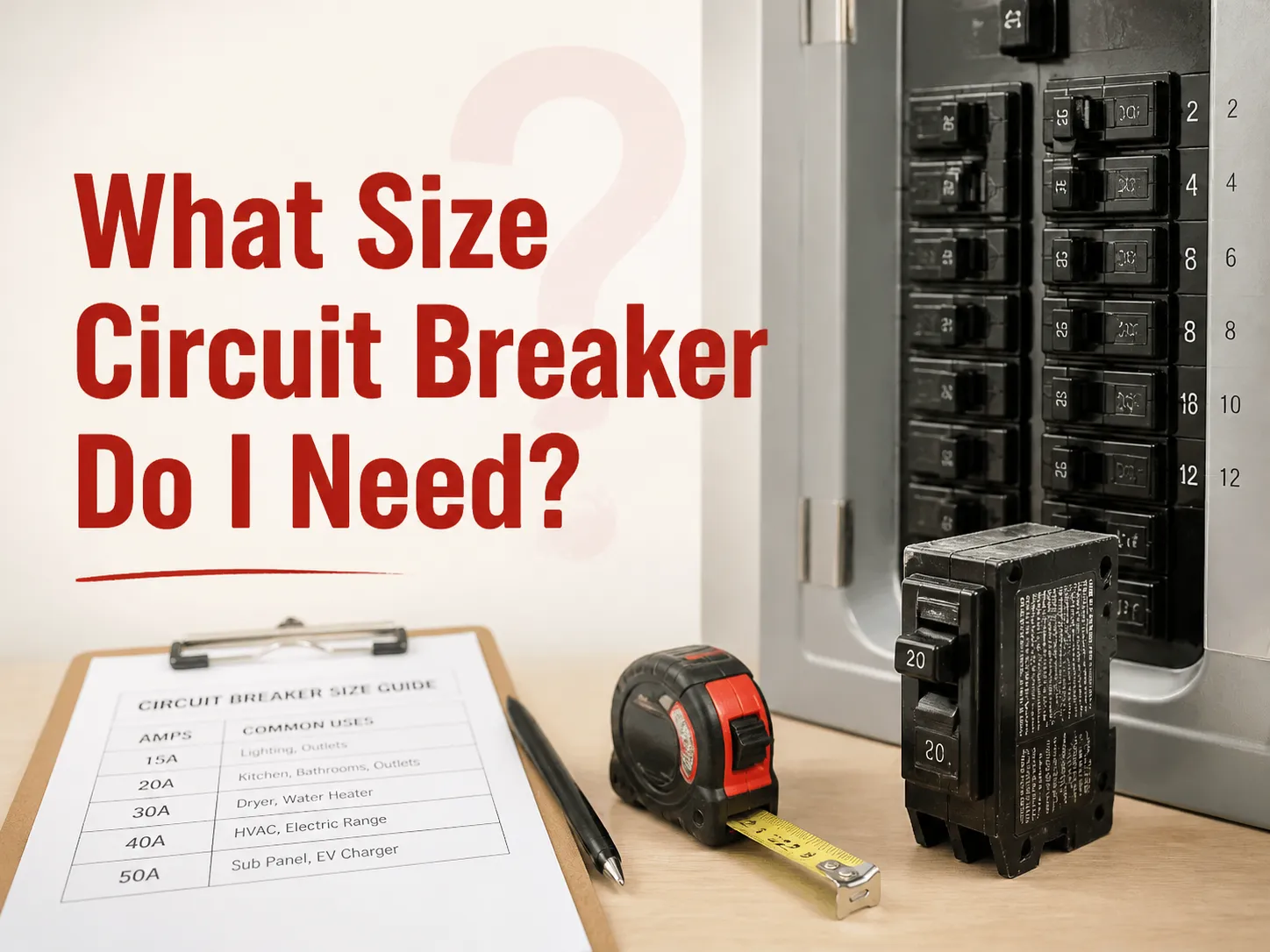
For the electrical protection devices that sit alongside shunt trip breakers in a modern panel — the standard MCBs, the GFCI breakers, the RCBOs, and the DC‑rated breakers for solar and battery applications — HUYU manufactures a full range of certified protective devices. A circuit that requires a shunt trip for fire safety integration may also require ground‑fault protection for the receptacles it serves, and an RCBO such as the HUM18LE‑63 RCBO combines overcurrent and residual current protection in a single DIN‑rail device. For help selecting the correct breaker for any circuit, our guide on what size circuit breaker you need explains the NEC‑based sizing process for both standard and specialty applications.
Frequently Asked Questions
What triggers a shunt trip?
The shunt trip mechanism is activated when an external contact that is generally in the open position closes due to a safety incident. The contact can be a fire alarm control panel relay, switch, heat or smoke detector, fire suppression unit microswitch, toxic gas detector, emergency stop button, or a result generated by the building monitoring system. Once the contact is closed, the control voltage, which is usually within the range of 120 VAC or 24 VDC, triggers the shunt trip coil, resulting in the tripping of the breaker.
What is the purpose of a shunt trip?
A shunt trip is designed to enable the remote tripping of a circuit breaker via an external safety signal, which cuts off electrical power from a dangerous site without the need for any one to turn it off manually. This technology allows the combination of the breaker’s overcurrent protection function with life-safety functions presented by fire alarm systems, stop emergency devices, and gas detectors.
Where are shunt trip breakers required?
Shunt trip breakers Most required in commercial kitchens for turning off cooking equipment in case of an activation of a fire suppression system, in elevator machine rooms for disconnecting power to the elevator before a water-based fire suppression system is activated, and in industrial machines for implementing emergency stop circuits with a guarantee of safe disconnection. These requirements are regulated by NFPA 96, NFPA 72, and NEC.
Is a shunt trip normally open or closed?
The circuit for the shunt trip coil is typically open. In normal functioning of the circuit, the contacts of the control remain open and no power is supplied to the coil. When a safety incidence takes place, the contacts become closed, thus power is applied to the coil, which becomes energized leading to the tripping of the electrical breaker. When the breaker being discussed is ON, its main power contacts are closed, while when tripped or switched OFF its contacts are opened. The expression “normally open” is related to the control circuit that triggers the shunt trip.
References
- National Fire Protection Association (NFPA) — NFPA 96 and NFPA 72. Standards governing commercial kitchen fire suppression and elevator power shutdown, including the requirements for automatic electrical disconnect via shunt trip breakers.
- Eaton — Shunt Trip Circuit Breakers and Accessories. Manufacturer of residential and commercial shunt trip breakers, with application guidance and wiring diagrams for common control configurations.
- Schneider Electric — Shunt Trip and Undervoltage Release Accessories. Manufacturer information on shunt trip units for Square D and other breaker families, including control voltage options and installation requirements.
- Electrical Safety Foundation International (ESFI) — Commercial Kitchen Electrical Safety. Guidance on the integration of electrical protection and fire suppression systems in commercial cooking environments.
A shunt trip is the electrical link between a circuit breaker and the safety systems that protect a building and its occupants. It is a simple electromagnetic solenoid that, when energised by a fire alarm, a suppression system, or an emergency stop, mechanically trips a breaker and removes power from a hazardous area. It is required by code in commercial kitchens, elevator machine rooms, and industrial emergency stop circuits, and it must be tested annually to confirm that it will work when the event it was designed for actually occurs. A standard breaker protects the wire. A shunt trip breaker protects the wire and responds when the fire alarm tells it to open — and that dual function is what makes it an essential safety device in any building where a fire, a gas leak, or an emergency stop must automatically and immediately disconnect the power.