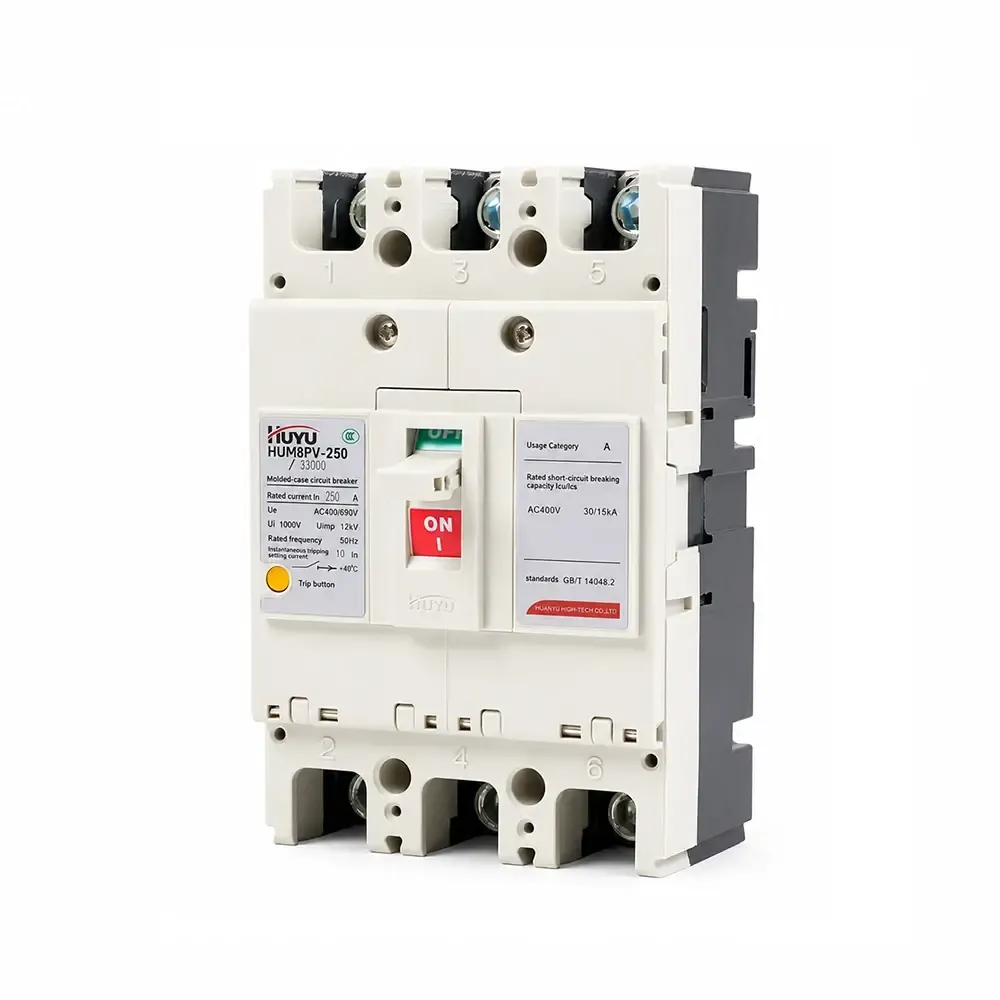

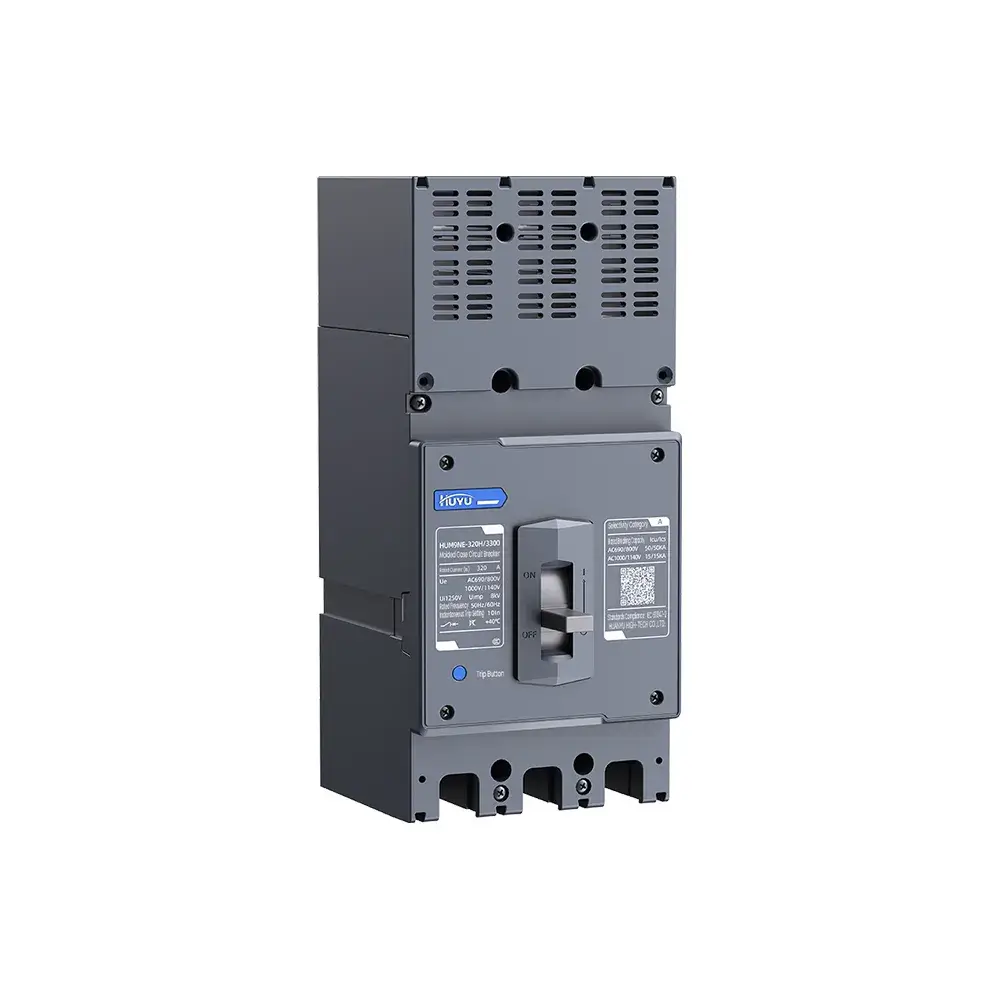
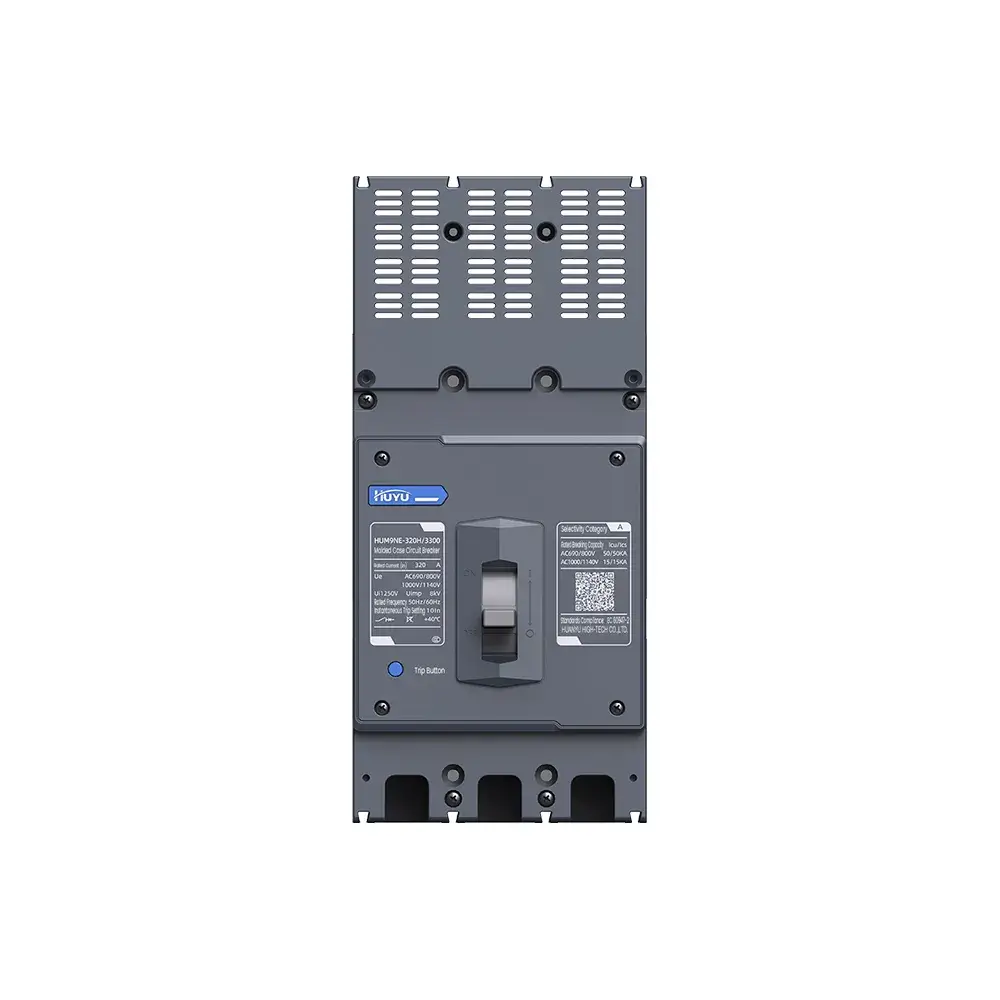
HUM9NE DC MCCB – 3P,63A to 630A
The HUM9NE is a high-voltage MCCB circuit breaker rated 63A–630A at AC 400V–1140V. Designed for wind power, PV, and energy storage. Available in popular ratings: 100A, 250A, 400A, 630A. 3P. Icu up to 100kA at 400V. Reverse input line compatible. For demanding new energy applications.
Standard: IEC 60947-2
Rated Current: 63A – 630A
Rated Voltage: AC 400V / 415V / 690V / 800V / 1000V / 1140V
Poles: 3P
Breaking Capacity: Up to 100kA Icu at 400V
Applications: Wind power, PV systems, energy storage, AC distribution
Product Information
HUM9NE MCCB Circuit Breaker for Wind, Solar, and Storage
The HUM9NE MCCB circuit breaker is designed for high voltage applications typically found in modern AC renewable energy systems. The HUM9NE series has an operating range of 63A to 630A at voltages up to AC 1140V and provides reliable electrical protection to the AC side of wind turbines, photovoltaic inverters, and battery energy storage systems, where existing low voltage (400V) MCCB circuit breakers are unable to provide sufficient protection to meet your project’s needs.
Available in a variety of popular frame styles, such as the 100A MCCB for branch circuit protection and 630A MCCB for main incoming service protector applications, the HUM9NE provides consistent protection across your renewable energy project.
Featuring reverse input compatibility, the HUM9NE allows power to be fed from either the top or bottom of the circuit breaker without derating — a helpful feature especially for compact wind turbine nacelles and containerized energy storage systems.
Rated as an Icu MCCB with up to 100kA at 400V and 50kA at 690V/800V, the HUM9NE delivers the high-capacity breaking protection required for circuits close to transformers or generators. HUYU Electric offers factory-direct OEM/ODM MCCB breakers, providing complete project documentation for EPC contractors and panel builders sourcing MCCB breakers for wind and solar projects.
Technical Data & Performance
| Parameter | HUM9NE-250 | HUM9NE-320 | HUM9NE-400 | HUM9NE-630 |
|---|---|---|---|---|
| Rated Current In | 63A–250A | 280A, 315A | 250A, 315A | 500A, 630A |
| Rated Voltage Ue | AC 400V / 415V / 690V / 800V / 1000V / 1140V | |||
| Poles | 3P | |||
| Insulation Voltage Ui | 1250V | |||
| Impulse Withstand Uimp | 12kV | |||
| Icu/Ics at AC 400/415V | S: 75kA / H: 100kA | S: 75kA / H: 100kA | H: 100kA | H: 100kA |
| Icu/Ics at AC 690/800V | S: 36.5kA / H: 50kA | S: 36.5kA / H: 50kA | H: 50kA | H: 50kA |
| On-load / Off-load Life | 1,500 / 15,000 | 1,500 / 15,000 | 1,500 / 15,000 | 1,500 / 10,000 |
| Mounting | Fixed | |||
The HUM9NE breaking capacity scales with voltage: at 400V, the H type delivers 100kA Icu — suitable for main incomers and circuits close to transformers. At 690V and 800V, the H type maintains 50kA, providing robust protection for wind turbine generator outputs and inverter AC connections. At 1000V and 1140V, Icu is 15kA, covering the highest AC voltage levels in the product’s range.
Wind Power and High Voltage PV Systems
Wind turbines and large PV systems operate at voltages beyond the standard industrial level of 400V AC. Turbine generators often operate at 690V, while AC collection grids range up to 800V or 1140V. The HUM9NE MCCB was specifically designed for these high-voltage environments. Its reverse input line compatibility allows power to feed through either top or bottom terminals, eliminating the need for complex cable routing in tight spaces, such as wind turbine nacelles. This ensures efficient installation, even for the 250A and 400A MCCB variants that are ideal for use in turbines.
Specifiers can choose MCCB models based on fault levels at different system points. For a branch circuit, a 100A MCCB may be required, while for the main incomer, a 630A MCCB would fit the project design.
HUM9NE High Voltage MCCBs – Request a Quotation – Factory Direct
63A-630A, AC 400V-1140V. 100kA Icu at 400V. Reverse input line compatible. Designed for wind turbines, PV systems, and energy storage solutions. Full documentation provided for all OEM/ODM orders.
Project-Based Quotation • IEC 60947-2 • Worldwide Shipping
OEM/ODM Supply for Renewable Energy MCCBs
HUM9NE – Designed for the AC Side of Wind, Solar, and Storage
The HUM9NE series offers high-voltage protection, extending up to 1140V for medium-voltage AC collection grids at large renewable energy plants. Its reverse input line compatibility and S/H breaking codes make it an ideal choice for OEM manufacturers, PV inverter producers, and energy storage integrators.
How to Select a High Voltage MCCB for Wind and Solar Projects
Key criteria for selecting the HUM9NE for AC distribution in renewable energy projects.
1. Voltage Rating: Matching the System
For 400V industrial systems, any frame size applies. For 690V (standard wind turbine generators), the HUM9NE operates at 50kA Icu in the H type. For 800V, 1000V, and 1140V collection grids, the H type offers 15kA Icu protection for branch and feeder circuits. Ensure the MCCB’s rated voltage equals or exceeds your system’s maximum operating voltage.
2. S or H Breaking Capacity?
The S code (75kA at 400V) is suitable for branch circuits with limited fault current due to cable impedance, whereas the H code (100kA at 400V) is used for main incomers and circuits near transformers or generators, where fault levels are higher. For instance, a generator output breaker for a wind turbine typically requires the H code; a nacelle auxiliary circuit can use the S code.
3. Frame Size and Current Selection
The 250A frame covers 63A–250A and is the preferred choice for branch protection. Choose a 100A MCCB or 250A MCCB for wind turbine auxiliary circuits and photovoltaic inverter AC outputs. The 400A frame is suited for mid-current range applications, while the 630A frame is best for main incomer or generator output breakers rated up to 630A.
4. Reverse Input Line Advantage
The HUM9NE’s reverse input line compatibility makes installation efficient by allowing flexible connections to the most accessible terminal, saving time and reducing cable stress. This is ideal for compact installations, such as wind turbine nacelles with tight spaces.

Frequently Asked Questions
What is the difference between AC MCCB and DC MCCB?
An AC MCCB and a DC MCCB serve the same function — overcurrent and short-circuit protection — but they are engineered differently to handle their respective current types. An AC MCCB circuit breaker relies on the alternating current’s natural zero-crossing to assist arc extinction; its arc chute is optimized for this cyclical interruption. A DC MCCB must extinguish a continuous arc with no zero-crossing, requiring magnetic blowout coils and larger arc chambers. The HUM9NE is an AC high voltage MCCB designed for 400V–1140V AC circuits in wind and solar applications. For DC circuits, a purpose-built DC MCCB — such as those in HUYU Electric’s DC product range — is required. AC and DC MCCBs are not interchangeable.
What is a DC MCB breaker?
A DC MCB (Miniature Circuit Breaker) is a compact overcurrent protection device specifically designed for DC circuits. Unlike an AC MCB, it uses magnetic blowout technology to force the DC arc — which has no natural zero-crossing — into a segmented arc chute where it is stretched and cooled until it extinguishes. DC MCBs are commonly used in photovoltaic string protection, battery storage DC circuits, and DC distribution. The HUM9NE is an MCCB breaker, not an MCB — it handles higher currents (up to 630A) and higher voltages (up to 1140V AC) for feeder and main incomer protection in renewable energy AC systems. For DC applications, HUYU Electric’s DC MCB range provides the appropriate protection.
How to install DC MCCB breaker?
Installing a DC MCCB requires careful attention to polarity markings, cable sizing, and torque specifications. DC MCCBs are typically marked with “+” and “−” terminals that must be connected correctly to ensure proper arc extinguishing during a fault. Cable sizing must account for the DC continuous current rating and voltage drop over the circuit length. All terminal connections must be torqued to the manufacturer’s specification to prevent hot spots. While the HUM9NE is an AC MCCB with reverse input line compatibility (line and load terminals are interchangeable), DC MCCB installation has different requirements. Installation must be performed by a licensed electrician in compliance with local codes. Always consult the specific product manual for wiring diagrams, torque values, and polarity requirements.
What does MCCB mean in electrical terms?
MCCB stands for Molded Case Circuit Breaker. In electrical terms, an MCCB is a protection device that combines overcurrent (overload) and short-circuit protection in a single molded insulating case. MCCBs are rated from approximately 16A to 1600A, with breaking capacities that can exceed 100kA depending on the model. They sit between miniature circuit breakers (MCBs, up to 63A) and air circuit breakers (ACBs, above 630A) in the protection hierarchy. The HUM9NE is an MCCB circuit breaker specifically rated for high AC voltages up to 1140V, making it a “high voltage” MCCB in the context of low-voltage power distribution. Its molded case construction, 3-pole configuration, and S/H breaking capacity codes are characteristic of the MCCB product category.
No documents available for download at this moment.