
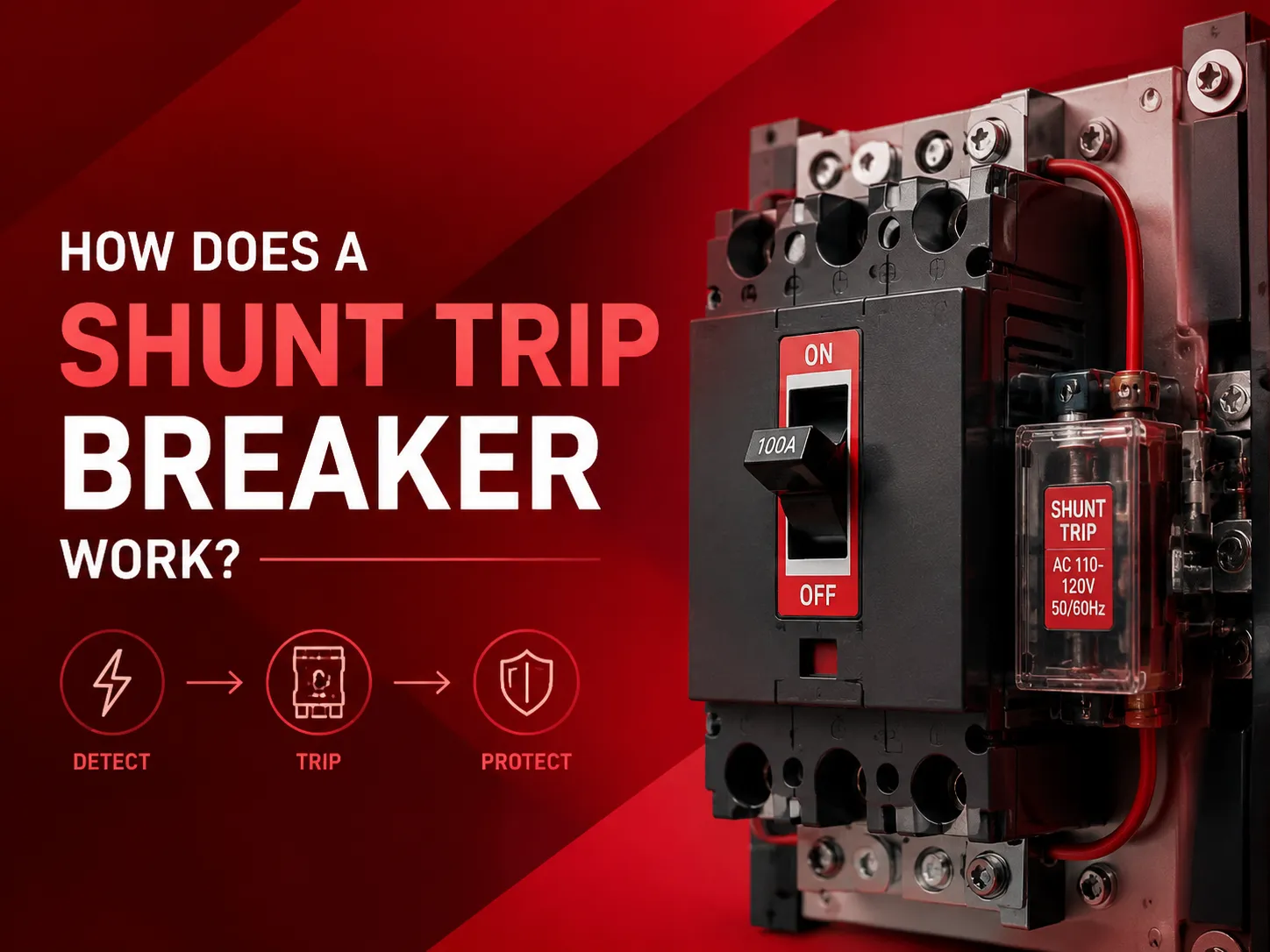
In the event that a fire alarm activates in a commercial kitchen, not only must the bells and strobes be activated but also the gas valve under the range needs to close; in addition to this, electrical power to the cooking appliances (fryers, griddles and induction tops) will need to be cut off immediately via some type of automatic means which doesn’t involve human contact with a switch. The device which is capable of performing this function is called a shunt trip circuit breaker (or trip breaker).
While a shunt trip circuit breaker appears to be a standard circuit breaker, it provides protection against overload (due to equipment failure or lightning strikes) and short circuits (due to wires touching each other) in the same manner as would any other type of breaker. In addition to the overload and short circuit function, a shunt trip breaker has the ability to be tripped on demand via a remote signal; as such, when there’s a fire in the premises protected by the breaker, the breaker will disable the flow of electricity to the equipment it protects and will continue to provide this protection until another remote signal instructs the shunt trip circuit breakers to restore power to their respective electrical circuits. For anyone involved in the commercial design of electrical systems, industrial safety and building code compliance, understanding how a shunt trip circuit breaker operates and differentiates itself from a standard circuit breaker is an important topic for your education or professional development.
The Basic Principle: A Breaker That Trips on an External Command
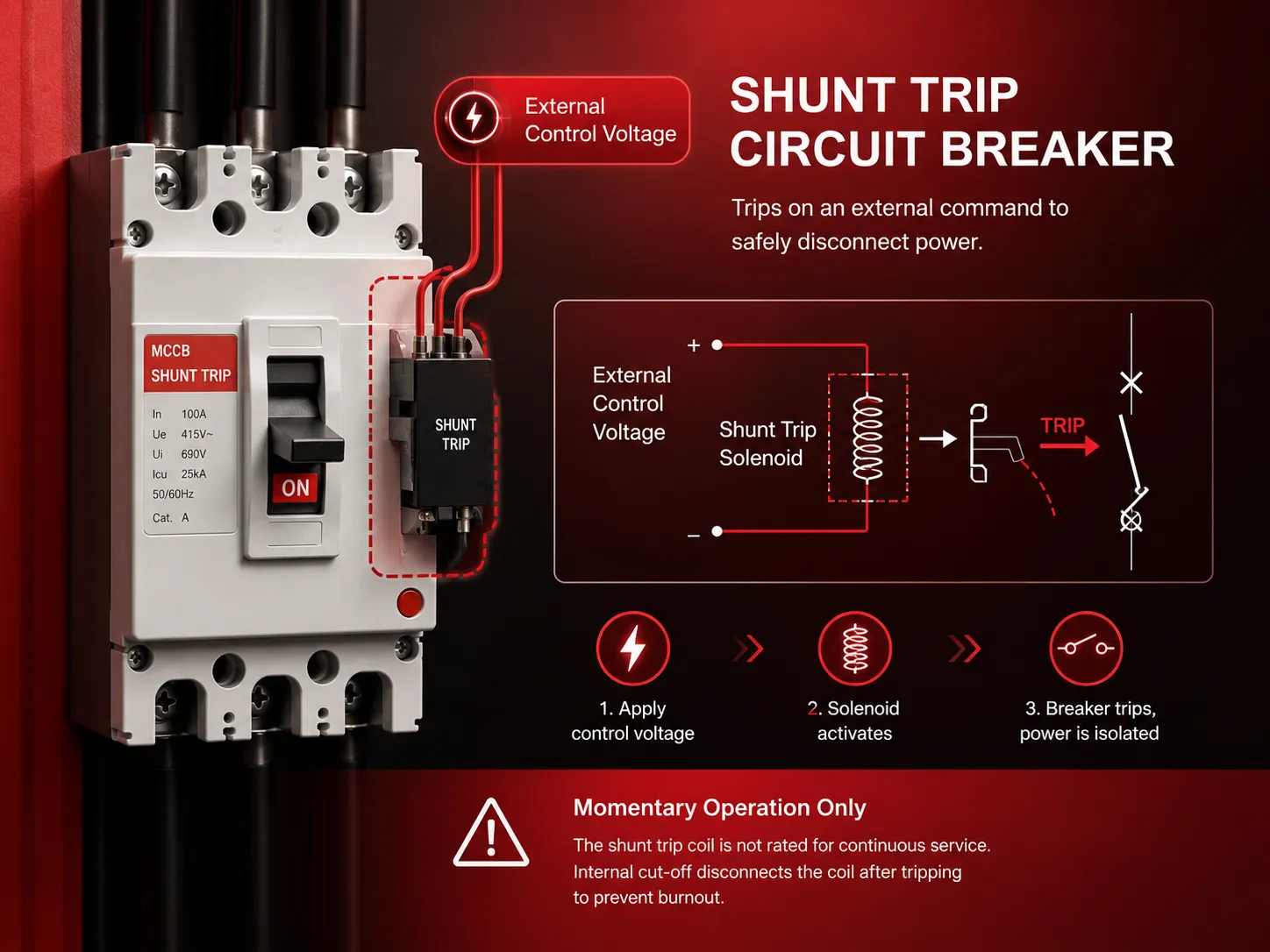
A standard circuit breaker will trip out when it has exceeded its rated current either gradually through the thermal overload function or suddenly through the magnetic short-circuit function. The opening (or tripping) occurs internally based upon electrical conditions occurring within the circuit. A shunt trip circuit breaker has an independent external method of tripping out the circuit breaker by applying an external voltage across its control terminals. When the applied voltage is present, the solenoid within the circuit breaker will activate and mechanically release the trip latch just as if the circuit breaker had tripped due to an overload condition. The circuit breaker will then open isolating all power to the load, thereby de-energising that circuit.
The shunt trip mechanism functions as a momentary device, not a continuous actuator, and is intended to be energised for a short time period — the few seconds it takes to energise the coil, trip the breaker, and disconnect the supply control power. Many shunt trip breakers are manufactured with an internal cut‑off switch that will disconnect the solenoid circuit from the energised coil as the breaker mechanism reaches the TRIP position; thereby preventing the coil from being left energised, which could cause the coil to burn out. This is a critical design consideration; the shunt trip coil is not rated for continuous service. Numerous references within the industry — including manufacturers’ and distributors’ technical documentation, such as Eandisales — provide further information regarding the internal wiring and application issues that should be considered when using shunt trip breakers.
How It Works: The Electrical and Mechanical Sequence
A standard circuit breaker trips due to an overload caused by an excess current flow through the breaker. This occurs in a series of steps where the bi-metallic strip bends and or the magnetic coil pull causing the release of the trip latch. At this point, the circuit breaker handle moves from the position of ON to the position of TRIP, opening the contacts of the circuit breaker. To reset a tripped circuit breaker, it is first turned fully OFF and then turned back ON.
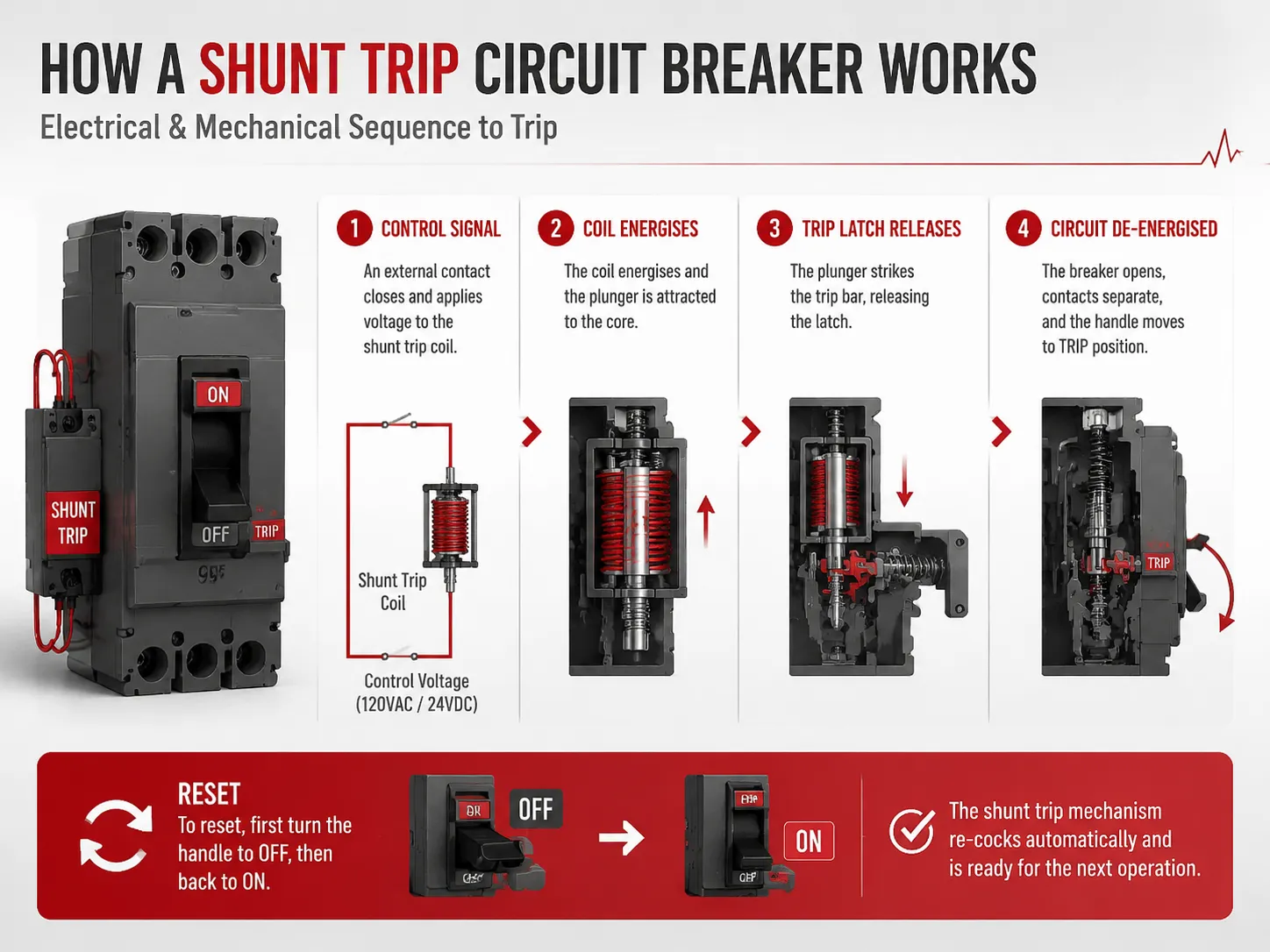
The electrical & mechanical sequenses to trip a shunt trip breaker differ in how they start, but are sufficient and finish at the same result (tripped).
- A normally open contact closes in the external control circuit. This contact may represent either a fire alarm panel relay, an emergency stop button, a toxic gas detector, or an output from a building management system. It will connect the shunt trip coil with its control voltage source; usually 120VAC or 24 VDC depending upon the coil rating used.
- The shunt trip solenoid energises. When electricity travels through the coil of wire, it generates a magnetism that attracts a little plunger or striker pin to the coil’s core. This plunger has a physical connection to the internal mechanism of the circuit breaker that trips the circuit (the mechanical latch that the thermal and magnetic devices will trip out on).
- The trip latch releases. When the plunger strikes the trip bar, the latch releases and stored spring energy in the circuit breaker mechanism separates the main contacts. The handle of the circuit breaker then returns to TRIP position. At this point, if there is an internal auxiliary switch then it may open the solenoid circuit to provide coil protection.
- The circuit is de‑energised. The disconnected load (to the supply) will cause the breaker to stay (in position TRIP), until it has been manually reset. The shunt trip coil will be de-energised either because of the opening of the control contact or through the operation of the internal cut-off switch.
The method to reset a shunt trip breaker is identical to that used for resetting any other type of breaker – that is, rotate the handle from the “OFF” position to the “ON” position. When you perform this action, the shunt trip mechanism will automatically re-cock itself as part of resetting and be prepared for operation again.
How a Shunt Trip Breaker Differs from a Standard Breaker
| Feature | Standard Circuit Breaker | Shunt Trip Breaker |
|---|---|---|
| Tripping methods | Thermal overload and magnetic short‑circuit only | Thermal, magnetic, plus remote electrical tripping via solenoid |
| External control | None | Tripped by an external voltage applied to control terminals |
| Control voltage | N/A | Typically 120 VAC or 24 VDC; must be specified when ordering |
| Typical applications | Standard branch circuit protection | Fire safety shutdown, emergency stop circuits, remote load isolation |
| Reset procedure | Move handle from TRIP to OFF, then ON | Same; shunt trip mechanism resets with the handle |
Why a Shunt Trip Breaker Is Specified
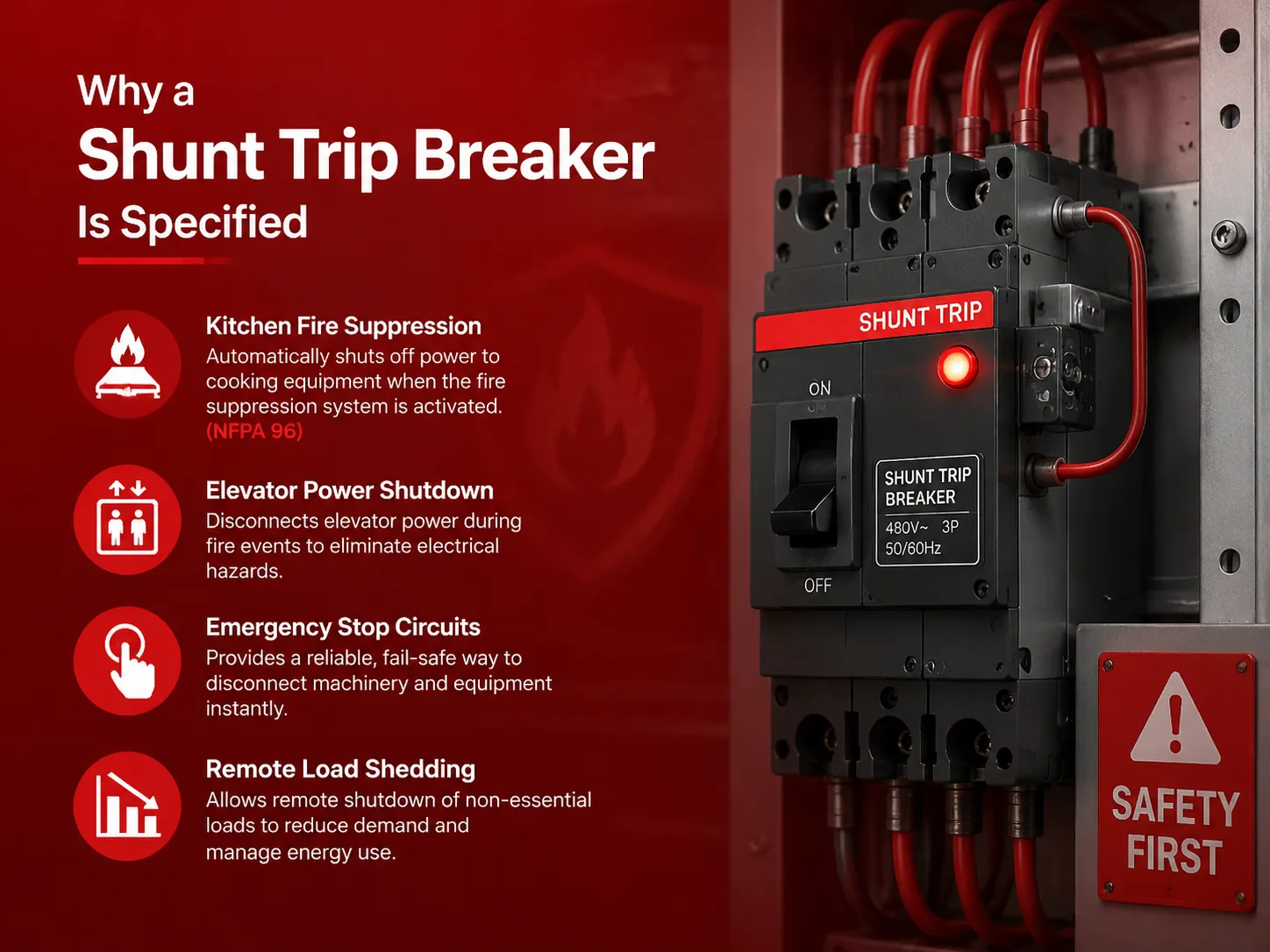
The shunt trip function is not a luxury. In many installations, it is a code requirement. The National Electrical Code (NEC) and NFPA standards, enforced by authorities such as the National Fire Protection Association (NFPA), mandate the automatic disconnection of electrical power in specific hazardous situations:
- Commercial kitchen hood fire suppression. At the time that either the Ansul or Range Guard systems are activated by either the presence of smoke, heat or flame detection, electricity to the cooking appliances under the hood shall be shut off. Shunt trip breakers are the most frequently applied and required types of breakers for this purpose and mandated by NFPA 96, the suppressants’ manufacturer’s listing.
- Elevator power shutdown. In order to utilize the fire suppression system in the hoistway or elevator machine room, the main electrical source powering the elevator must be shut off to avoid electricity supplying the fire (thus causing an increased fire hazard) and/or creating an electrical hazard to firefighters while they work. Shunt trip breakers are the accepted method of accomplishing this electrical disconnection.
- Emergency stop circuits in industrial machinery. Connecting an emergency stop button that must shut down a large motor or other process equipment via a shunt trip breaker provides a positive and fail-safe way to disconnect them. The shunt trip will provide a reliable way to disconnect the equipment regardless of whether the contactor coil remains energized or de-energized.
- Remote load shedding. A building manager can control a shunt trip breaker in a commercial facility remotely through their management system to shut off load that is not essential to the operation of the facility. This will help reduce peak demand charges that may be assessed.
Frequently Asked Questions
How does a 120V shunt trip breaker work?
The shunt trip circuit breaker is a 120 volt AC solenoid operated device with two control terminals from which it can be actuated. When the fire alarm, emergency stop or any other safety contact closes, then 120 volts will be fed to the coil which will then activate a solenoid plunger striking a trip mechanism that will discconect the electrical supply to the load (i.e., trip). It should also be noted that the coil is a momentary duty device only.
What causes a shunt trip breaker to trip?
By applying an external control voltage — from a gas detector (or other similar devices) or from a fire suppression system, for example — the coils of a shunt trip circuit can be activated and will result in the circuit breaker being energized and causing it to trip. The shunt trip breaker will trip for reasons other than just being overloaded & under short circuit, just as an ordinary circuit breaker would.
Why would you need a shunt trip breaker?
Whenever an automatic safety system requires power to be disconnected from a circuit, you need a ‘shunt trip’ breaker (for example, to turn off a cooking appliance when the kitchen hood fire system is activated, or stop the power to an elevator lift before the sprinkler system discharges into the stack). This is usually required by code, not just an option, so check local building codes and regulations before proceeding.
Is a shunt trip normally open or closed?
Normally, the shunt trip coil’s circuit (assembly) is “open” due to the control contacts being “open” (fire alarm relay or emergency stop) during normal operation. The control contacts will then “close” to energise the coil and trip the breaker. The main power contacts of the breaker are “normally closed” when the breaker is “ON” and “open” when tripped (due to the coil being energised) or manually turned “OFF”.
References
- National Fire Protection Association (NFPA) — NFPA 96 and NFPA 70 — Standards governing commercial kitchen fire suppression and the National Electrical Code, including shunt trip requirements.
- Eandisales — What Is a Shunt Trip Breaker? — Technical overview of shunt trip breaker function, wiring, and applications.
- Eaton — Shunt Trip Circuit Breakers — Manufacturer of residential and commercial shunt trip breakers, with application and wiring guides.
- Schneider Electric — Shunt Trip Accessories for Square D Breakers — Product information and installation guidance for shunt trip units on QO and Homeline breakers.
A shunt trip breaker adds a single, critical function to the standard thermal‑magnetic breaker: the ability to be tripped on command from a safety system, a fire alarm, or an emergency stop. It is a simple mechanism — a solenoid, a plunger, a trip latch — but it bridges the gap between overcurrent protection and life safety. When the fire hits the hood, the breaker trips before the flames spread. That is what it is there to do.