
When he was assigned on the same day to pull cable for the lighting circuits of a new office and for the building’s main switchgear for the inexperienced electrician on the construction site, he asked one simple question to his supervisor: “Why does the cable for the lighting seem to be like the wire for the extension cord on my desk while the one used for the switchgear is as thick as my wrist?” The reply was voltage, which is the most fundamental factor in electrical system designing. High and low voltage differentiates conductor size, thickness of insulation, type of device we install for protection, kind of PPE we have to wear, and so on. It is important for every participant in the electrical installation process to know the boundaries of high and low voltage.
What Is Voltage? The Potential That Drives Current
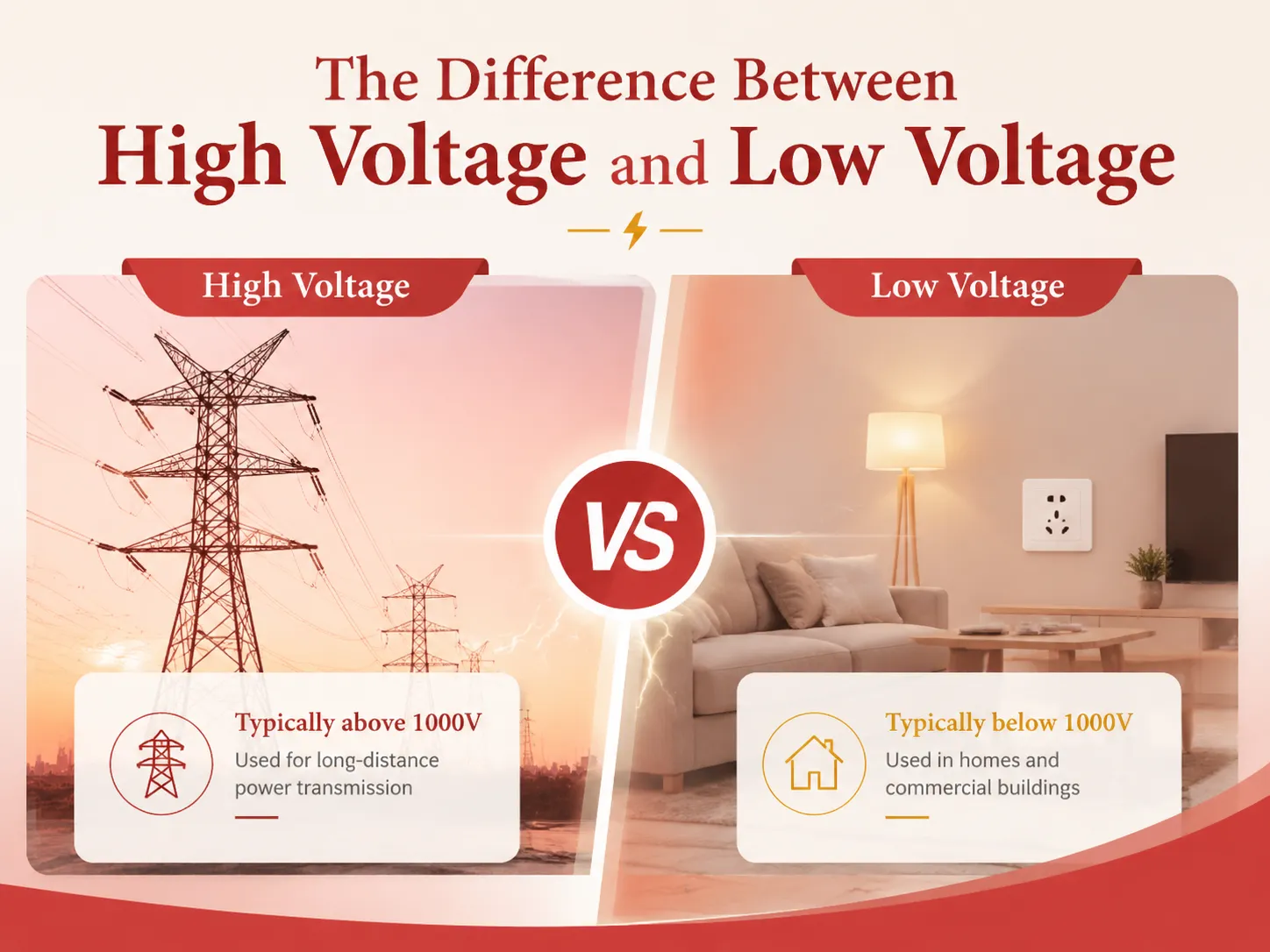
Before explaining high voltage and low voltage, one should clarify what voltage is in itself. Voltage (measured in volts, V) is the potential difference in electricity between two points; this is the “pressure” that forces electricity to flow through a conducting medium, just like water pressure “forces” the water to flow through a pipe. The greater the voltage is, the stronger the drive potential is, meaning that the power is delivered through the conductor in a more efficient manner or that the same amount of power can be transmitted through a narrower and lighter conductor. This is why high voltage is used for long-distance power transmission: at 345,000 volts, just one overhead wire can transmit the energy generated by a power plant; at 120 volts, however, the same conductor can power several households. The risk of working with high voltage is the possibility to electrocute someone because higher voltage can break air resistance and even deliver electric current to a person from some distance.
How Standards Define High Voltage, Low Voltage, and Everything in Between
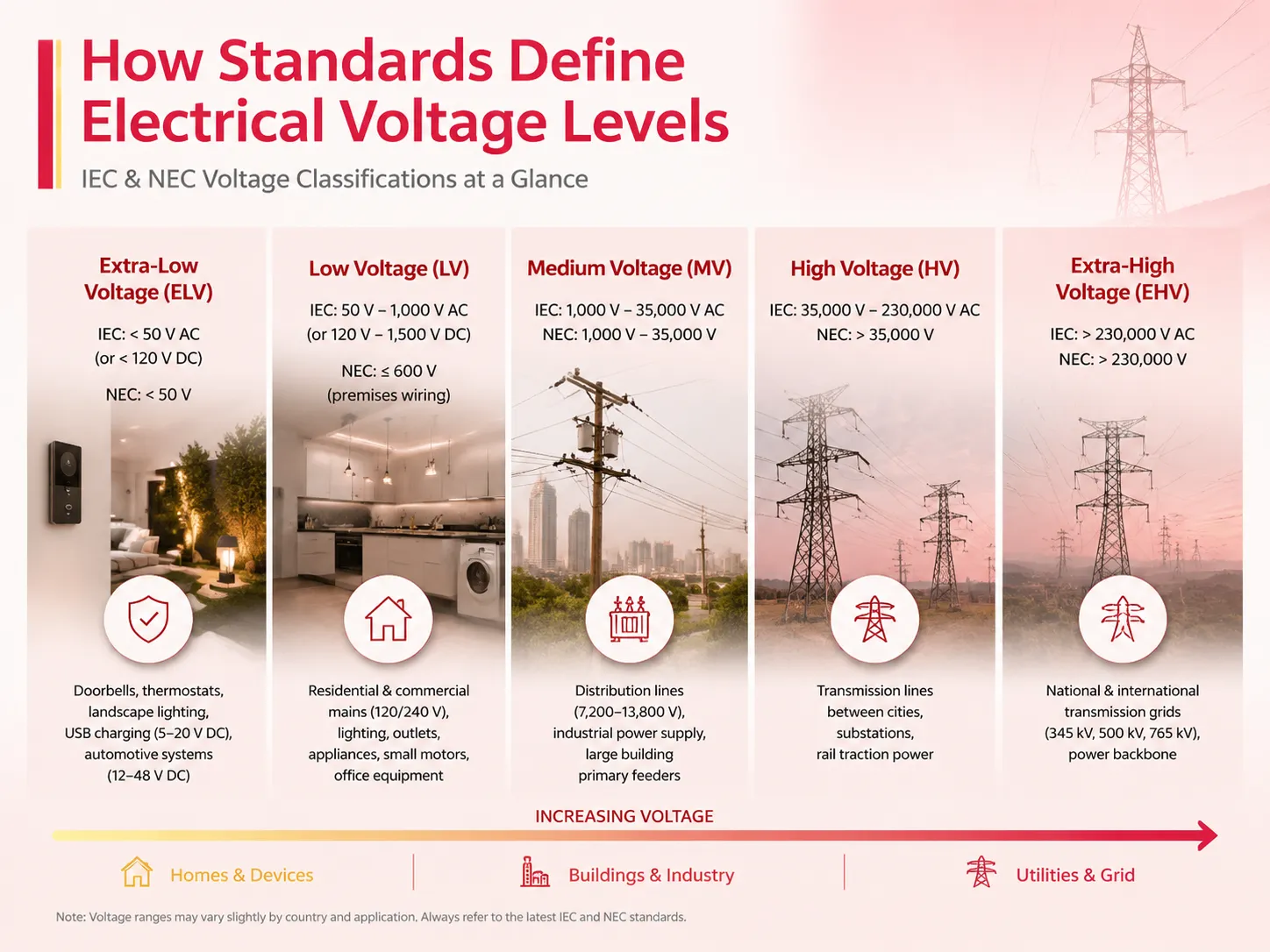
There is no one clear-cut definition of high voltage and low voltage. The definitions are determined by a set of standards created for certain purposes such as electrical installation secure and safe or designing a power system or testing products. The next table provides an overview of the most commonly referred to voltage classifications of the International Electrotechnical Commission and the National Electrical Code, which are two norms that cover the majority of electrical installations in the world.
| Classification | IEC 60038 / IEC 61140 (AC Voltage Range) | NEC / North American Practice (AC Voltage Range) | Typical Applications |
|---|---|---|---|
| Extra‑Low Voltage (ELV) | Below 50 V AC (or 120 V DC ripple‑free) | Below 50 V (commonly referenced; not a single NEC class) | Doorbells, thermostats, landscape lighting, telephone circuits, USB charging (5–20 V DC), automotive electrical systems (12–48 V DC) |
| Low Voltage (LV) | 50 V to 1,000 V AC (or 120 V to 1,500 V DC) | Typically 600 V and below (the NEC covers “premises wiring” up to 600 V; “low voltage” in NEC context often refers to circuits below 50 V or to Class 2 and Class 3 circuits) | Residential and commercial mains (120/240 V in North America, 230 V in the UK and Europe), lighting circuits, socket outlets, small motors, household appliances, office equipment |
| Medium Voltage (MV) | 1,000 V to 35,000 V AC | 1,000 V to 35,000 V (commonly used by utilities and in industrial power distribution; not a defined NEC class but widely recognised) | Distribution lines on suburban streets (7,200–13,800 V), industrial motor supply, large commercial building primary feeders |
| High Voltage (HV) | 35,000 V to 230,000 V AC | Above 35,000 V (utility transmission practice) | Transmission lines between cities and regions, large industrial substation primaries, rail traction power |
| Extra‑High Voltage (EHV) | Above 230,000 V AC | Above 230,000 V | National and international transmission grids (345 kV, 500 kV, 765 kV), the backbone of the electrical supply network |
In ordinary words, the distinction between low voltage and high voltage is often perceived as the low-voltage supply that gets into the house (by 120/240V in North America) and high-voltage overhead transmission lines. A household 240V supply is considered low voltage according to both the IEC and the North American system. A 400V three-phase electric supply to either a restaurant kitchen or a workshop is low voltage. A 7,200V line on a suburban street is medium voltage. A 132,000V line is high voltage. Lastly, a 400,000V interconnector is explained in the extra-high voltage category. The definitions and standards are provided in the literature published by the International Electrotechnical Commission (IEC).
Is 240 Volts High or Low Voltage? Answering the Most Common Question
The inquiry “Is 240V high or low voltage?” is often raised, and this query depends on the kind of measure that is quoted for this case. According to IEC standards, 240V falls under the category of low voltage as it can be considered to lie within the range of voltage from 50V to 1,000V AC. When it comes to the practices of residential use in North America, 240V – as it is the voltage used in large appliances such as cooktops and washing machines – is supplied by an appliance by way of a double pole switch and can be provided by the standard domestic electrical board using the same escalating and protective means as in the case of 120 volts circuit that provides lighting and wiring. When an electrician works with a 240V electric grid, he/she uses the same equipment, insulated devices, and works according to the same safety measures used with 120V circuits as both types of voltage are considered to be low voltage types of electricity and fall within the limits of domestic and business electrical engineering. The 400V voltage is treated the same way: according to the IEC standards, 400V represents low voltage electricity.
The highest voltage level that an electrician recognizes in a completely different light is voltage greater than 1000 volts AC — medium voltage and high voltage installation which requires specialised training, PPE suitable for named incident energy, insulated tools and gloves suited for voltage, exclusion zones for untrained personnel. In the eyes of a household owner, building manager, or a regular electrician the realm of low voltage (120, 230, 240 and 400 V) is what surrounds them in their daily work hence the principles of safety remain the same in all cases. For a deeper look at how the UK and US supply voltages differ and what that means for appliances and safety, our guide on UK voltage vs US voltage explains the historical reasons for the different standards and how to manage the transition when equipment crosses borders.
Where High Voltage and Low Voltage Are Used
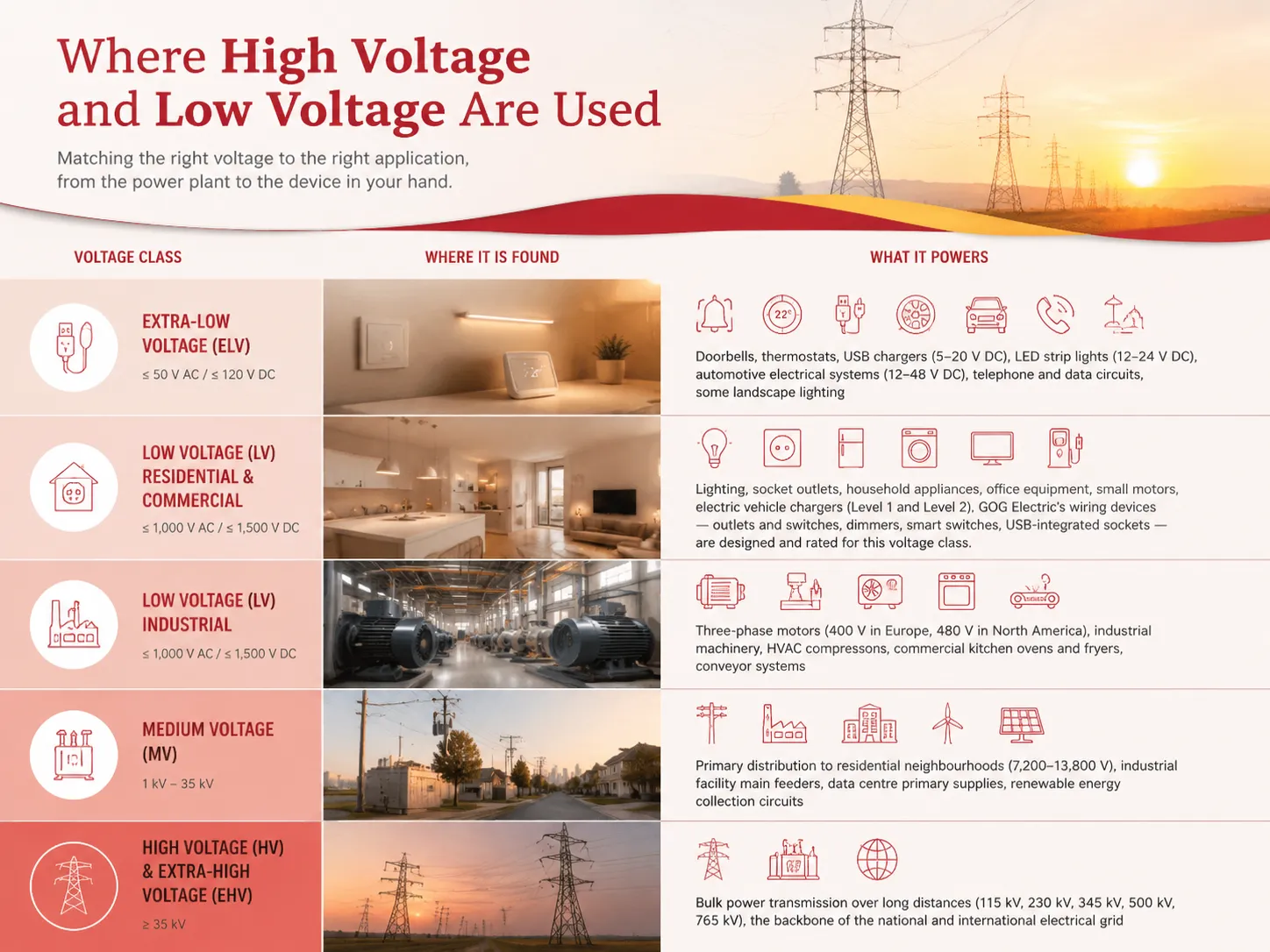
The application of high voltage and low voltage is determined by the amount of power that must be delivered and the distance it must travel. The table below summarises where each voltage class is found in practice, from the generation plant to the device in your hand.
| Voltage Class | Where It Is Found | What It Powers |
|---|---|---|
| Extra‑Low Voltage (ELV) | Inside buildings, in consumer electronics, in automotive systems | Doorbells, thermostats, USB chargers (5–20 V DC), LED strip lights (12–24 V DC), automotive electrical systems (12–48 V DC), telephone and data circuits, some landscape lighting |
| Low Voltage (LV) — Residential and Commercial | Inside every home and commercial building, from the consumer unit or panel to every socket and switch | Lighting, socket outlets, household appliances (refrigerators, washing machines, televisions), office equipment, small motors, electric vehicle chargers (Level 1 and Level 2). GOG Electric’s wiring devices — outlets and switches, dimmers, smart switches, USB‑integrated sockets — are designed and rated for this voltage class. |
| Low Voltage (LV) — Industrial | Factories, workshops, commercial kitchens, large retail premises | Three‑phase motors (400 V in Europe, 480 V in North America), industrial machinery, HVAC compressors, commercial kitchen ovens and fryers, conveyor systems |
| Medium Voltage (MV) | Suburban streets (pole‑mounted transformers), industrial parks, large commercial campuses, wind and solar farms | Primary distribution to residential neighbourhoods (7,200–13,800 V), industrial facility main feeders, data centre primary supplies, renewable energy collection circuits |
| High Voltage (HV) and Extra‑High Voltage (EHV) | Transmission corridors, substations, interconnectors between regions and countries | Bulk power transmission over long distances (115 kV, 230 kV, 345 kV, 500 kV, 765 kV), the backbone of the national and international electrical grid |
Safety, Hazards, and the Arc Flash Risk
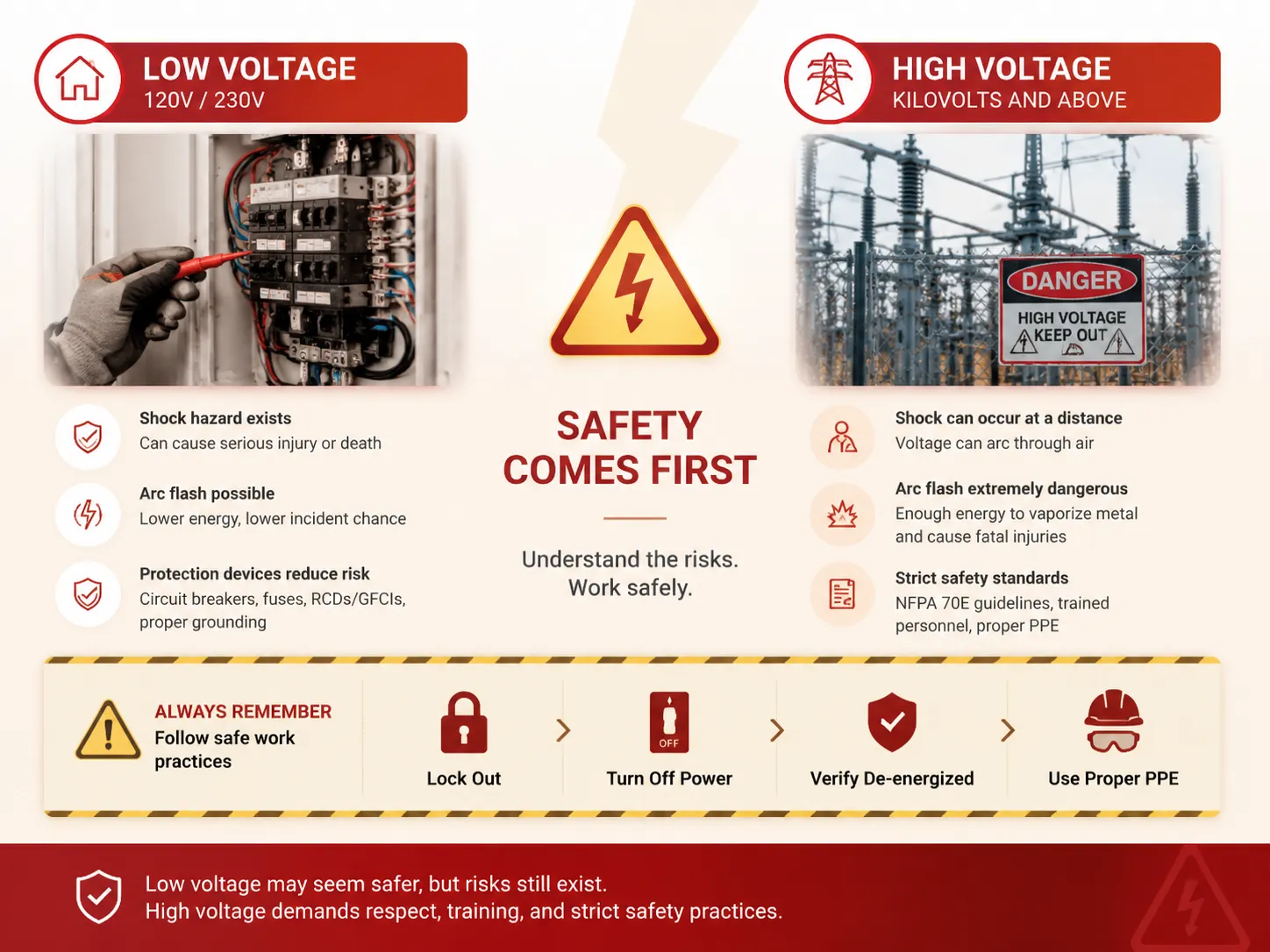
High voltage shows high level of safety risk when comparing with low voltage. Although, low voltage can also cause shock that can kill you, as both 120 V and 230 V circuits can pass enough electricity through a human being that he/she may die of ventricular fibrillation. The ways to counter this risk can be the use of circuit breakers, fuses, RCDs/GFCIs, and proper earths (grounding) that have been creating the safety system for modern electrical equipment. Low voltage can also give rise to arc flash that is the discharge of current at short circuit; the maximum current can reach several thousands of amps in the case with low voltage in a residential electrical panel, while the danger of the arc flash is not huge due to small amount of available current.
High voltage brings in dangers that are absent with low voltage. At high voltage, even without coming in contact with an energized line, an individual can suffer electric shock — voltage can destroy the air gap and create an arc to the person from a distance. That is the reason when working with high voltage it is specified where people can approach and why only competent workers with appropriate qualifications are allowed to work in this area. An arc flash in a high voltage network can generate power which can be measured in calories per square centimeter enough to vaporize metal and inflict fatal injuries. The National Fire Protection Association (NFPA), in its NFPA 70E regulation on electrical safety in the workplace, has set standards on electrical accidents risk assessment and requirements for personal protective equipment and safety working practices for each level of voltage. In a dwelling or light commercial operation, where low voltage and moderate fault current are used, there are limited chances of an arc flash accident happening, but this does not mean that it cannot happen, therefore the panel cover has to be fixed and the main breaker needs to be turned off before working with any switches.
Cables and Equipment: How Voltage Dictates the Physical Design
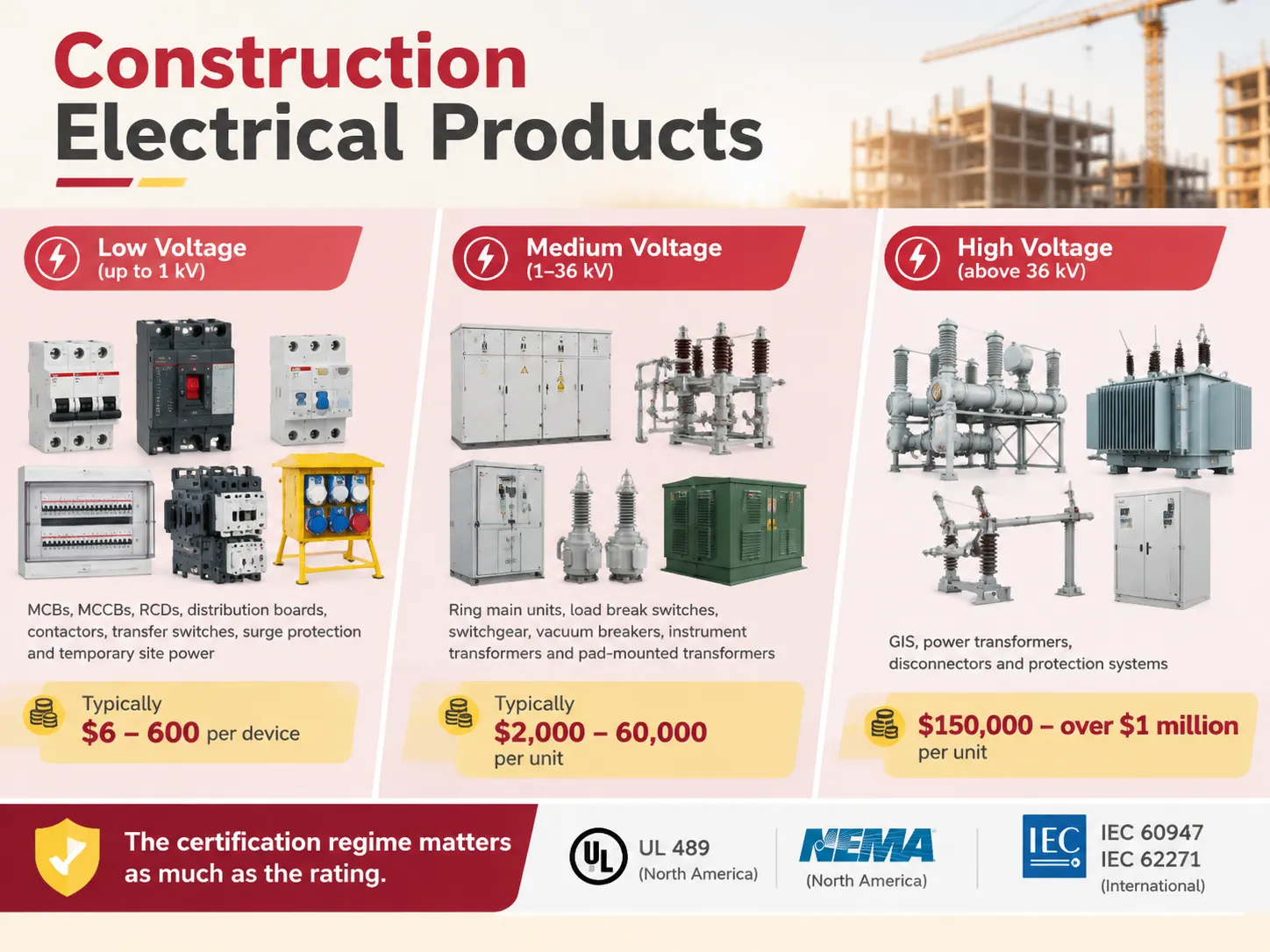
The voltage parameter of the circuit determines its physical characteristics along with its cabling and equipment. For example, the low-voltage cable installed inside a residential wall like, 14/2 or 12/2 NM-B in North America, and 1.5 mm² or 2.5 mm² twin and earth in the UK, contains a thin layer of PVC insulation or XLPE because 230 volts or 120 volts will not need a thick insulating layer. The conductors are designed according to the current needed and not on the voltage being used. In case of high-voltage cables, when compared, it uses a thicker insulation system comprising several semi-conductive or insulating layers in addition to a metal shield for controlling the electric field and conducting any faulty current flowing through it. The cable conductor might well be large enough to supply higher power, but it is the insulation used for the cable that makes it a high-voltage cable. The same principle can be observed in switchgears and protective devices as well; low-voltage circuit breakers (like the miniature circuit breakers used by HUYU) are capable of clearing faults at 230/400 volts AC using small contact gap. On the contrary, a high-voltage circuit breaker will interrupt a fault at voltages varying from tens to hundreds of volts and its contacts can operate in either a vacuum or in SF₆ gas or in oil bath in order to successfully extinguish the arc produced over a large distance.
Cost Differences: Why High Voltage Is More Expensive
High voltage At all stages of the process, namely generation, transmission, distribution, and installation, the price of high-voltage equipment is higher than the price of low-voltage equipment. High-voltage equipment is more costly than low-voltage equipment because of its construction. For example, a high-voltage wire is more costly per metre than a low-voltage wire with the same capacity since its insulation is made of more sophisticated materials and requires more precision in its manufacturing. A high-voltage circuit breaker costs significantly more than a low-voltage circuit breaker due to the need to interrupt high fault currents as well as withstand high voltage when tripped. In addition, installation of high-voltage equipment requires specially trained workforce, complex safety planning, and a large clearance zone contributing to higher civil costs. Thus, the economic rationale of using high voltage consists in the fact that due to high voltage distances can be covered and therefore the high cost of high-voltage equipment can be justified. For more detail on how these devices are selected and priced, our guide on how many watts an outlet can handle explains the relationship between circuit capacity and the receptacles and switches that deliver the power.
Frequently Asked Questions
Is 240V high or low voltage?
According to the IEC and North American terms, 240 volts is classified as low voltage. It is commonly used in homes so that it is considered standard voltage for larger appliances in North America. Consequently, it falls into the category of low-voltage; i.e. 50-1,000 V AC according to the IEC principle. The safety measures followed by the electrician when dealing with a circuit of 240 volts will be similar to the ones used in a 120-volt circuit.
What is the difference between high and low voltage?
The distinction between high voltage and low voltage lies in the voltage levels. The low voltage range corresponds to voltages between 50 and 1,000 volts (as per the IEC definition), which are typically used in homes, offices, and small factories. On the contrary, high voltage refers to voltages above 35,000 volts, which are used in long distance electricity transmission. High voltage systems are dangerous and require special equipment and training for the usage in addition to being relatively costly to install and maintain.
Is 220 low or high voltage?
220 volts According to both the IEC and North American classifications – the historical European and the new Chinese standard – it is regarded as low voltage ranking between the AC voltage of 50 and 1,000 volts, and is equivalent to the 230 volts currently used in the UK and Europe. As a common household supply voltage, this standard voltage is supplied and utilized in accordance with low voltage regulations.
Is 400 volts high or low voltage?
400 volts is low voltage according to the IEC classification. It is the conventional three phase power supply voltage in Britain and Europe. This voltage is applied in commercial kitchens, workshops and light industrial machinery. The voltage comes under the low voltage category at 50-1,000V AC. The installation and maintenance work is done by trained electricians.
References
- International Electrotechnical Commission (IEC) — IEC 60038 and IEC 61140. The international standards defining standard voltages and the classification of low, medium, and high voltage.
- National Fire Protection Association (NFPA) — NFPA 70 (NEC) and NFPA 70E. The North American electrical installation code and the standard for electrical safety in the workplace, defining voltage classes and safe working practices.
- Eaton — Voltage Classification and Electrical Safety Guidance. Manufacturer guidance on the selection, installation, and safe operation of electrical equipment across voltage classes.
- Electrical Safety Foundation International (ESFI) — Electrical Safety by Voltage Class. Consumer and professional guidance on the hazards associated with low, medium, and high voltage.
The difference between high voltage and low voltage is not a single number. It is a framework of standards that defines how electricity is generated, transmitted, distributed, and used — and, most importantly, how safely it is handled. Low voltage (defined as 120, 230, and 240 and 400 volts) can be found in homes, offices, and factories, where standard wiring systems, standard circuit breakers, and standard regulations ensure reliability and safety. High voltage (including 35,000 volts and above), on the other hand, refers to the high-voltage power transmission grid associated with long distances, high power, and the strict safety conditions.
For electricians, engineers, and homeowners, it is essential to understand what the distinction is, as well as the reasons for its existence in the world of electric current. Because all the GOG Electric wiring products (switches, wall outlets, dimmers) are made from appropriate materials and using relevant manufacturing technologies, it is possible to ensure reliable operation at low voltage.