
Upon getting an electrical panel upgrade in Sydney, the homeowner was advised by the electrician to do away with the traditional ceramic fuses in favor of modern protection devices. There were two unexpected abbreviations on the quote provided to the homeowner. The homeowner asked a valid question: “What do these terms mean, and which ones should I choose?” The answer from the electrician was easy: RCCB refers to the protection against earth leakage, but it would not work against overload or short circuit, thus needing a separate circuit breaker. The RCBO includes both functions, which makes it a perfect solution, covering all types of fault — earth leakage, overload, and short circuit. The homeowner decided to opt for RCBOs throughout the final circuits, and the installation was approved after inspection. The clarification of the difference between RCCB and RCBO is an important issue that every electrician, facility manager, and knowledgeable homeowner should know to make the right decision for circuit protection features, distribution board space, and troubleshooting difficulties.
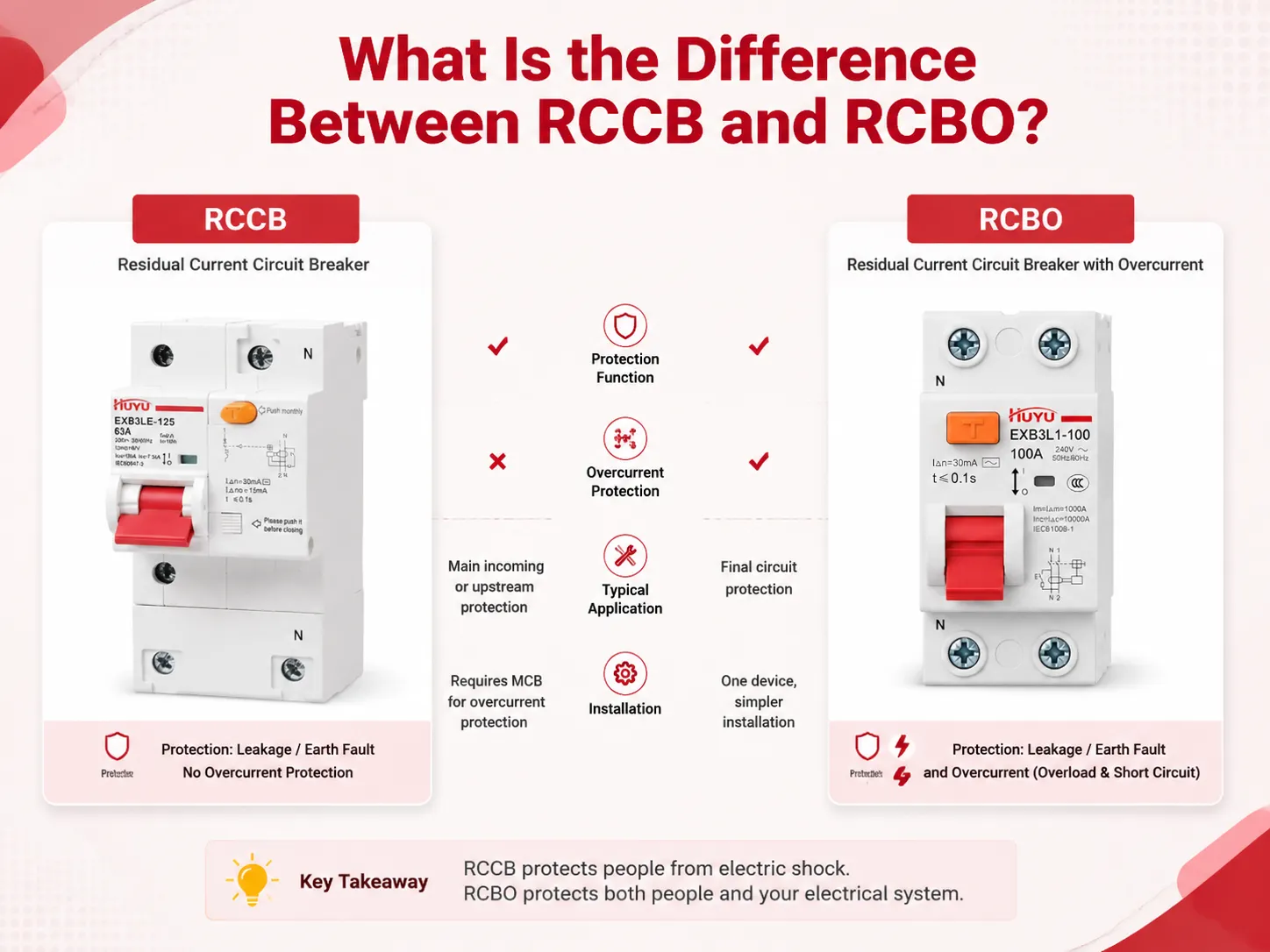
Summary: An RCCB is responsible for detecting earth faults (i.e., excessive leakage currents), which are defined as currents that may flow into the earth via individuals or conductive liquids, and for cutting off the circuit in which the fault has occurred; however, it does not provide any form of protection against the short-circuiting of the circuit or damage through overload. Therefore, it needs to be installed in line with a fuse or MCB. An RCBO is capable of combining the earth fault detection feature of an RCCB with an overload protection feature of an MCB into a single device. That said, an RCBO can function independently as the sole safety device for a circuit; conversely, an RCCB is not capable of carrying out that function. The main attributes that distinguish the RCCB and RCBO from each other are the size and price; the RCCB, being less complex in nature, has a less complicated design, is cheaper compared to an RCBO, but it must operate in conjunction with an MCB.
What Is an RCCB? Earth Leakage Protection Only
A Residual Current Circuit Breaker (RCCB) is known to be one of the electrotechnical devices that are aimed at the detection of an earth fault current. An RCCB is designed to break an electric circuit in case the above-mentioned fault current is higher than a specific value, which accounts for 30 mA for human protection or 100 mA or 300 mA for equipment protection. Technically, the RCCB constantly compares the amount of current coming out of the circuit via live conductor with the amount of current returning to the circuit through neutral conductor. In a normal circuit, the amounts of these currents are equal. However, when a person touches someone or something live, part of the current goes to the ground instead of returning via neutral. An RCCB can detect such imbalance of currents and react on it almost immediately as well; hence, it ensures electrocuted people avoid death.
One of the main limitations of an RCCB is that it does not detect overloading or short circuit. If a circuit draws a large amount of current due to the connected devices or a short between the live and neutral wire occurs, the RCCB will not activate because the capital of the current is the same and remains in balance. The RCCB will see a huge current in the circuit while the circuit is still balanced, so there is no need to do anything. This is why an RCCB must always be placed in series with an MCB (Miniature Circuit Breaker) or a fuse which offers protection for overload and short circuit. Normally, there is one RCCB in the house electrical cabinet which protects several circuits, each of which has an MCB. This is a profit-generating solution, but poses a serious disadvantage as when the fault occurs in one circuit, the RCCB will switch off all circuits of the system instead of just the faulty one.
What Is an RCBO? Earth Leakage, Overload, and Short Circuit Protection in One Device
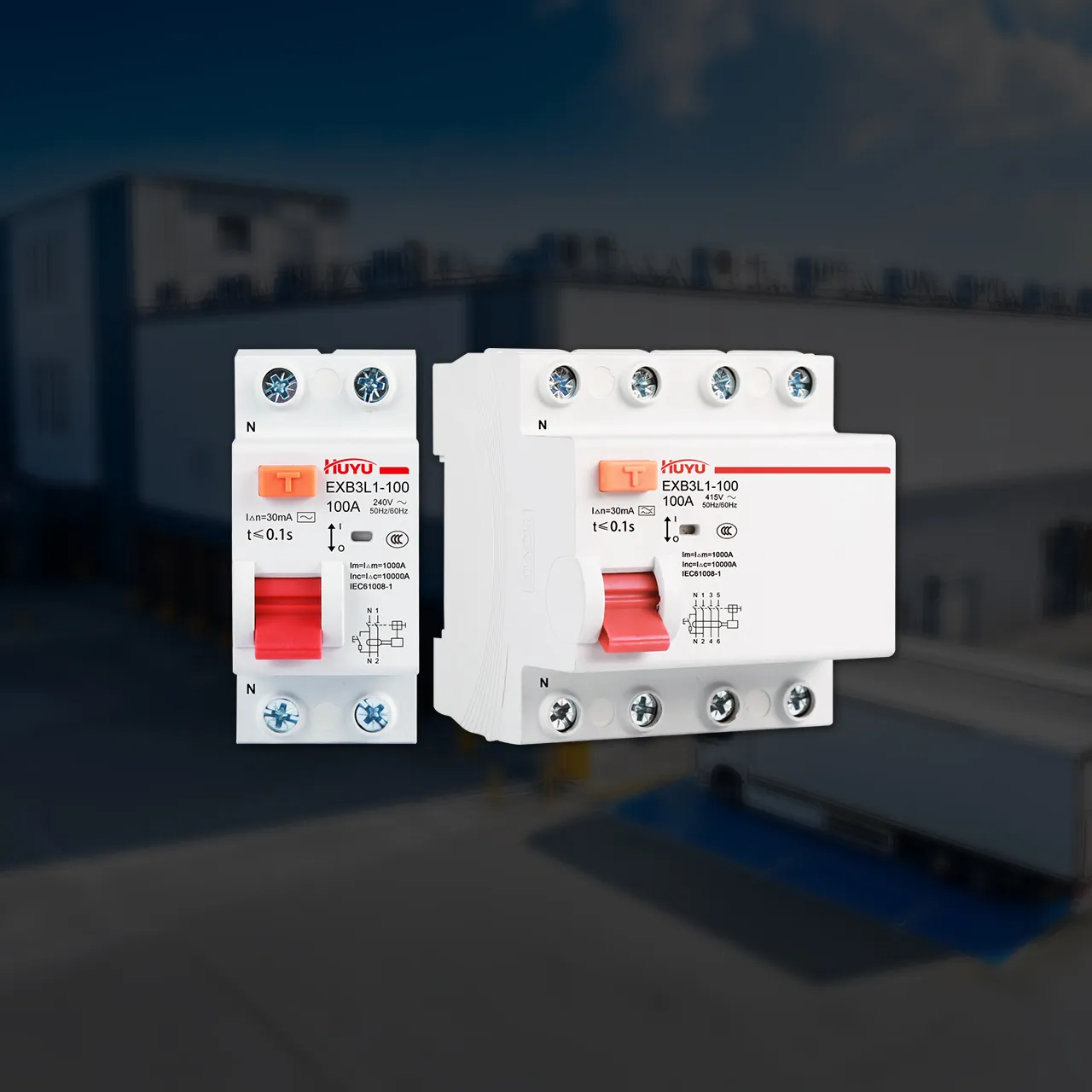
An RCBO (Residual Current Breaker with Overcurrent) combines the earth-leakage function of an RCCB with the overload and short-circuit protection of an MCB in one compact unit that fits into the same DIN rail space as one to two standard modules. An RCBO gives complete protection to one final circuit, as it operates on earth leakage (usually a fault current of 30 mA for human protection), on persistent overload (using a thermal part that is a bimetallic strip that bends when heated and tripping at a current of between 1.13 and 1.45 of the rated value), and on short circuit (using a magnetic device that is an electromagnetic coil, capable of instant response to the overload fault). When the earth fault occurs in the circuit protected by RCBO, it will trip only this RCBO. The other circuits—the other appliances and lights—will remain powered. This is the major operational advantage of RCBO in comparison with a common RCCB: fault isolation.Troubleshooting is faster, and the disruption is limited to a single circuit. For a deeper understanding of the broader landscape of protective devices and how they are tested and certified, our article on what UL 489 breakers are explains the standards that govern both MCBs and RCBOs in the North American and international markets.
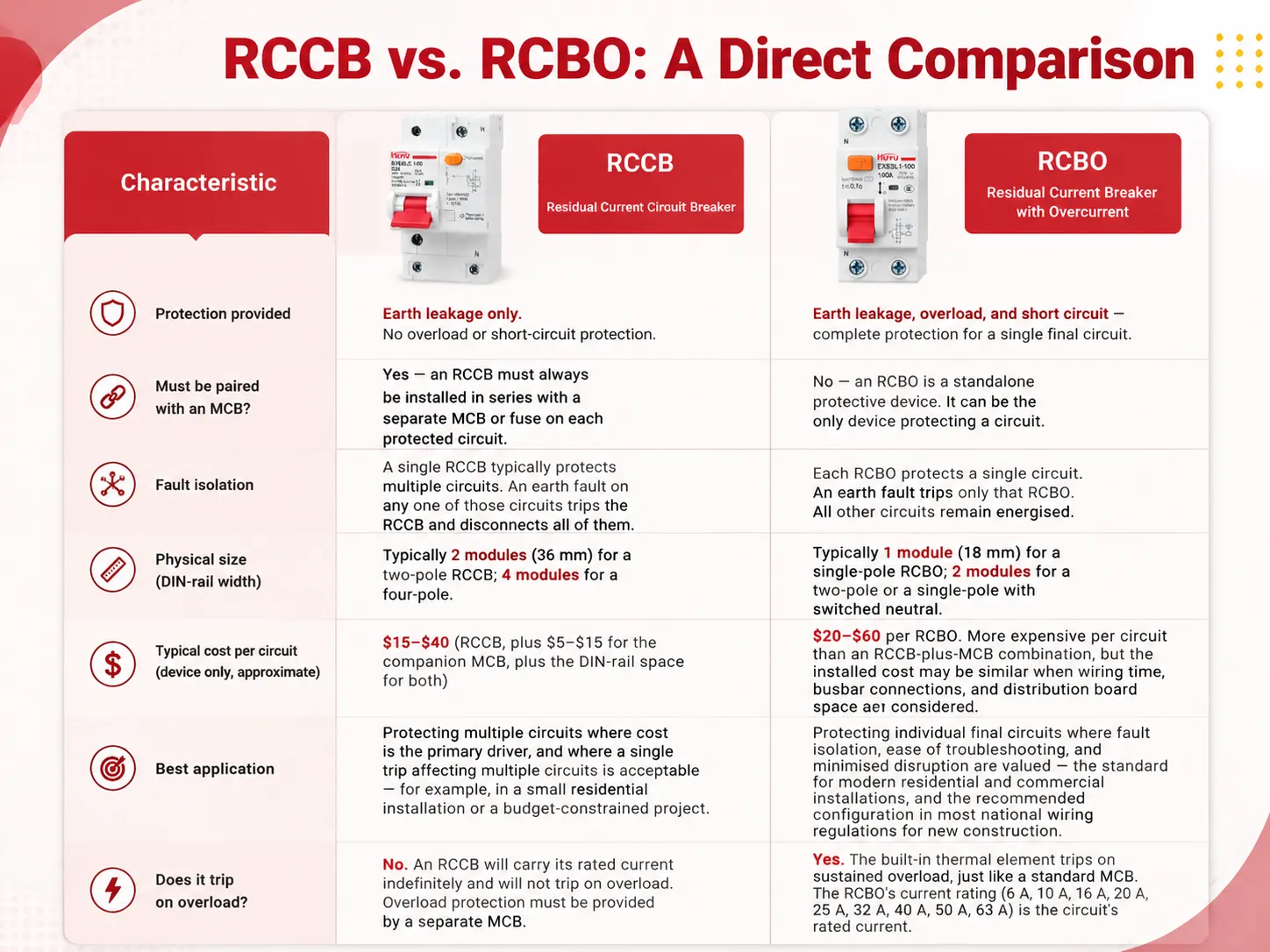
RCCB vs. RCBO: A Direct Comparison
| Characteristic | RCCB (Residual Current Circuit Breaker) | RCBO (Residual Current Breaker with Overcurrent) |
|---|---|---|
| Protection provided | Earth leakage only. No overload or short‑circuit protection. | Earth leakage, overload, and short circuit — complete protection for a single final circuit. |
| Must be paired with an MCB? | Yes — an RCCB must always be installed in series with a separate MCB or fuse on each protected circuit. | No — an RCBO is a standalone protective device. It can be the only device protecting a circuit. |
| Fault isolation | A single RCCB typically protects multiple circuits. An earth fault on any one of those circuits trips the RCCB and disconnects all of them. | Each RCBO protects a single circuit. An earth fault trips only that RCBO. All other circuits remain energised. |
| Physical size (DIN‑rail width) | Typically 2 modules (36 mm) for a two‑pole RCCB; 4 modules for a four‑pole. | Typically 1 module (18 mm) for a single‑pole RCBO; 2 modules for a two‑pole or a single‑pole with switched neutral. |
| Typical cost per circuit (device only, approximate) | $15–$40 (RCCB, plus $5–$15 for the companion MCB, plus the DIN‑rail space for both) | $20–$60 per RCBO. More expensive per circuit than an RCCB‑plus‑MCB combination, but the installed cost may be similar when wiring time, busbar connections, and distribution board space are considered. |
| Best application | Protecting multiple circuits where cost is the primary driver, and where a single trip affecting multiple circuits is acceptable — for example, in a small residential installation or a budget‑constrained project. | Protecting individual final circuits where fault isolation, ease of troubleshooting, and minimised disruption are valued — the standard for modern residential and commercial installations, and the recommended configuration in most national wiring regulations for new construction. |
| Does it trip on overload? | No. An RCCB will carry its rated current indefinitely and will not trip on overload. Overload protection must be provided by a separate MCB. | Yes. The built‑in thermal element trips on sustained overload, just like a standard MCB. The RCBO’s current rating (6 A, 10 A, 16 A, 20 A, 25 A, 32 A, 40 A, 50 A, 63 A) is the circuit’s rated current. |
When to Use an RCCB vs. When to Use an RCBO
When it comes to choosing between an RCCB and an RCBO, most factors come into play including the size of the installation, the degree of fault isolation needed, the budget and the electrical standards applicable in a particular region. In a small residential unit like an apartment or a small house, it is fairly common to have a configuration where an RCCB safeguards multiple circuits, each having its own MCB. With such a configuration the costs incurred would be less than having an RCBO for every circuit. Moreover, in case of an RCCB nuisance trip, the person living in a small apartment would find it bearable, as the distribution board is readily accessible. With larger residential projects and commercial enterprises, one fails to understand how using only an RCCB could be a good solution; it is obvious that the RCBOs on all final circuits should be utilized. RCBOs are certainly costlier than the combination of an RCCB plus MCB, but this amount is ranging from $ 10 to $ 30 per circuit that the owner can recover from the very first fault that occurs in the installation.
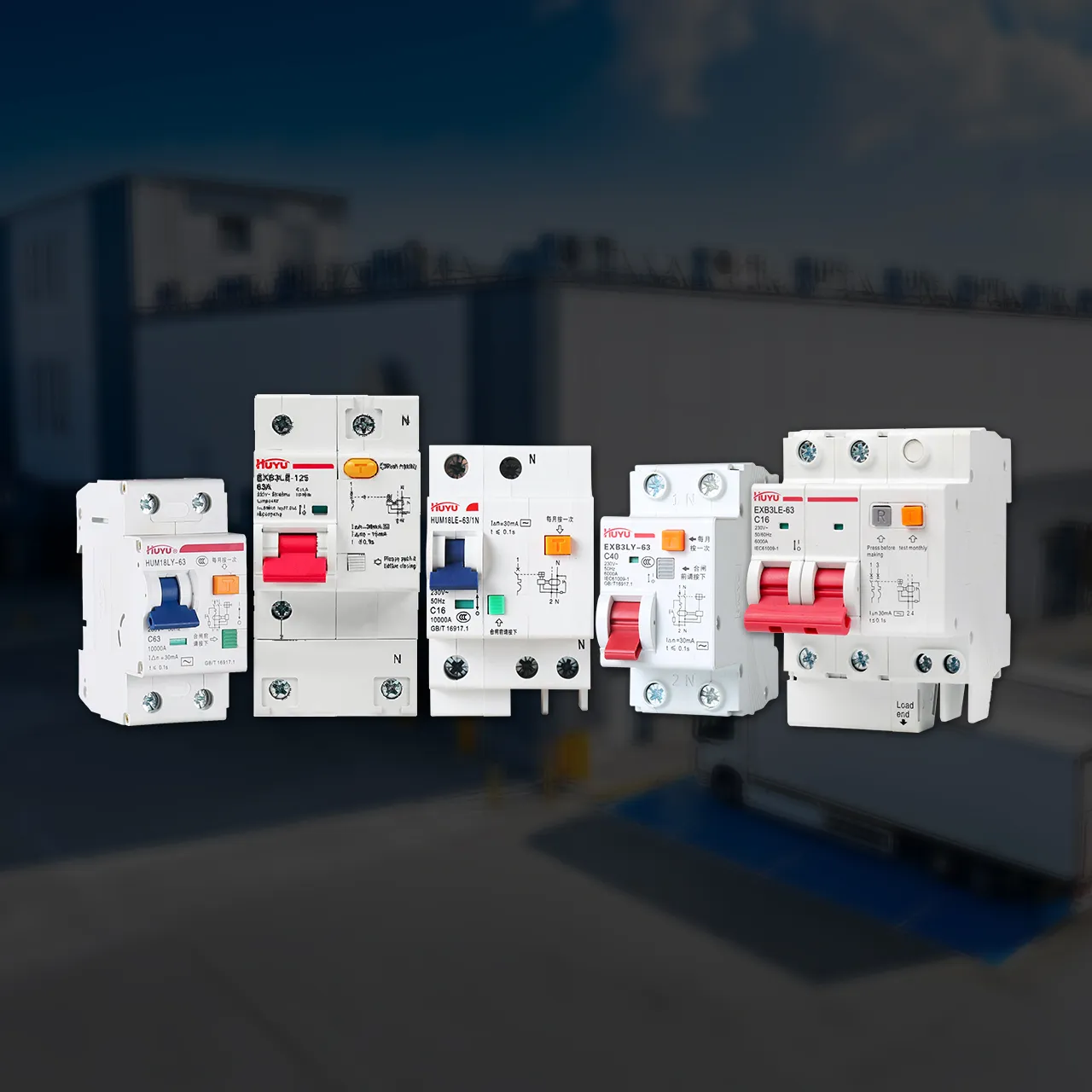
To meet the need for electrical contractors and panel makers who use protective equipment, HUYU produces a wide selection of RCCBs and RCBOs with various current ratings, sensitivity to residual current with options of 10 mA, 30 mA, 100 mA or 300 mA and trip curves like B, C and D for meeting the criteria in case of any application related to domestic, commercial and light industrial use. HUYU’s RCBOs, such as the HUM18LE‑63 RCBO, combine earth leakage, overload, and short‑circuit protection in a single compact device, with the certifications (CE, TUV, CB) and the documented performance that a professional installation requires. For circuits that may experience DC leakage — such as those serving EV chargers, solar inverters, or variable‑speed drives — a Type B RCCB or RCBO, such as HUYU’s VRL22B Type B RCBO, provides the appropriate residual current detection for the mixed AC/DC fault currents that these applications can produce. For help selecting the correct device rating for a specific circuit, our guide on what size circuit breaker you need covers the NEC‑based sizing process for both general and motor loads.
Frequently Asked Questions
Which is better RCBO or RCCB?
In most cases, the RCBO provides better protection for independent final circuits than the RCCB, because RCBO combines earth leakage protection, overload, and short-circuit protection in one unit and isolates failures to one circuit. The RCCB represents a cheaper alternative to provide earth leakage protection to several circuits simultaneously, but it has to be integrated with a separate MCB in order to protect each circuit, and unlike the RCBO, it does not act on a basis of circuit isolation, which means that in case of any failure, the RCCB disconnects all protected circuits.
Can an RCBO replace an RCCB?
Certainly. An RCBO can be used in place of an RCCB for final circuit protection and it provides far more safety options — earth leakage, overload, and short circuit — in one box. An RCBO can’t work as a multi-circuit RCCB because it protects only one final circuit. When it is the case that some system uses one RCCB for multiple circuits, replacing that RCCB with single RCBOs on each circuit might provide better protection against failures and improve troubleshooting accuracy, but it also requires that distribution board be rewired.
Does RCCB trip on overload?
No. An RCCB does not trip in the event of overloading. It only detects earth leakage which is an imbalance between live and neutral currents. In the case of an overloaded circuit, the RCCB will still continue to conduct the current until the circuit wiring is damaged due to overheating unless it has a separate fuse or MCB to protect it against overloading. Therefore, it is necessary for an RCCB to always be connected together with an MCB or a fuse to every circuit.
What is better, RCD or RCBO?
The term RCD (Residual Current Device) refers to a more general category that includes RCCB and RCBO. People often confuse RCD and RCBO with RCCB and RCBO. An RCBO is better at the protection of a single final circuit because it combines earth fault protection, overload protection, short-circuit protection, and the ability to isolate the event on the circuit. An RCCB (or shared RCD) is a cheaper way to provide earth fault protection on multiple circuits, although it has to be used with separate MCBs and does not include isolating the fault itself.
References
- Electrical Safety Foundation International (ESFI) — RCD and RCBO Protection. Consumer and professional guidance on the role of residual current devices in preventing electrocution and the differences between RCCBs, RCBOs, and MCBs.
- Siemens — RCCB and RCBO Selection and Application Guide. Manufacturer of both RCCBs and RCBOs, with technical documentation on trip characteristics, residual current sensitivities, and installation requirements.
- Schneider Electric — RCD, RCCB, and RCBO Product Range. Manufacturer of protective devices for residential, commercial, and industrial applications, with selection guides and wiring diagrams for all configurations.
- Eaton — Residual Current Protection for Final Circuits. Manufacturer guidance on the selection and coordination of RCCBs, RCBOs, and MCBs in residential and commercial distribution boards.
The difference between an RCCB and an RCBO is a single additional function — overcurrent protection — that transforms the device from a shared safety net into a complete, independent circuit protector. An RCCB can protect against shocks caused by either a short circuit in a damaged cord or a wet appliance but is unable to protect against overloads that can occur because of an older electric heater or a blocked motor. An RCBO provides protection against all three issues—earth leakage, overload, and short circuit—and it does so on a single circuit, so other circuits continue working in the event of a failure. For an electrician, facilities manager, or homeowner, having an RCBO installed for every final circuit is a gold standard. It may be more costly than RCCBs in initial investment, but it is definitely cheaper in the long run than having to deal with issues that shared RCCBs create. HUYU produces both RCCBs and RCBOs and ensures that it has the appropriate certifications and current ratings as well as residual currents in born with modern electrical installations.