
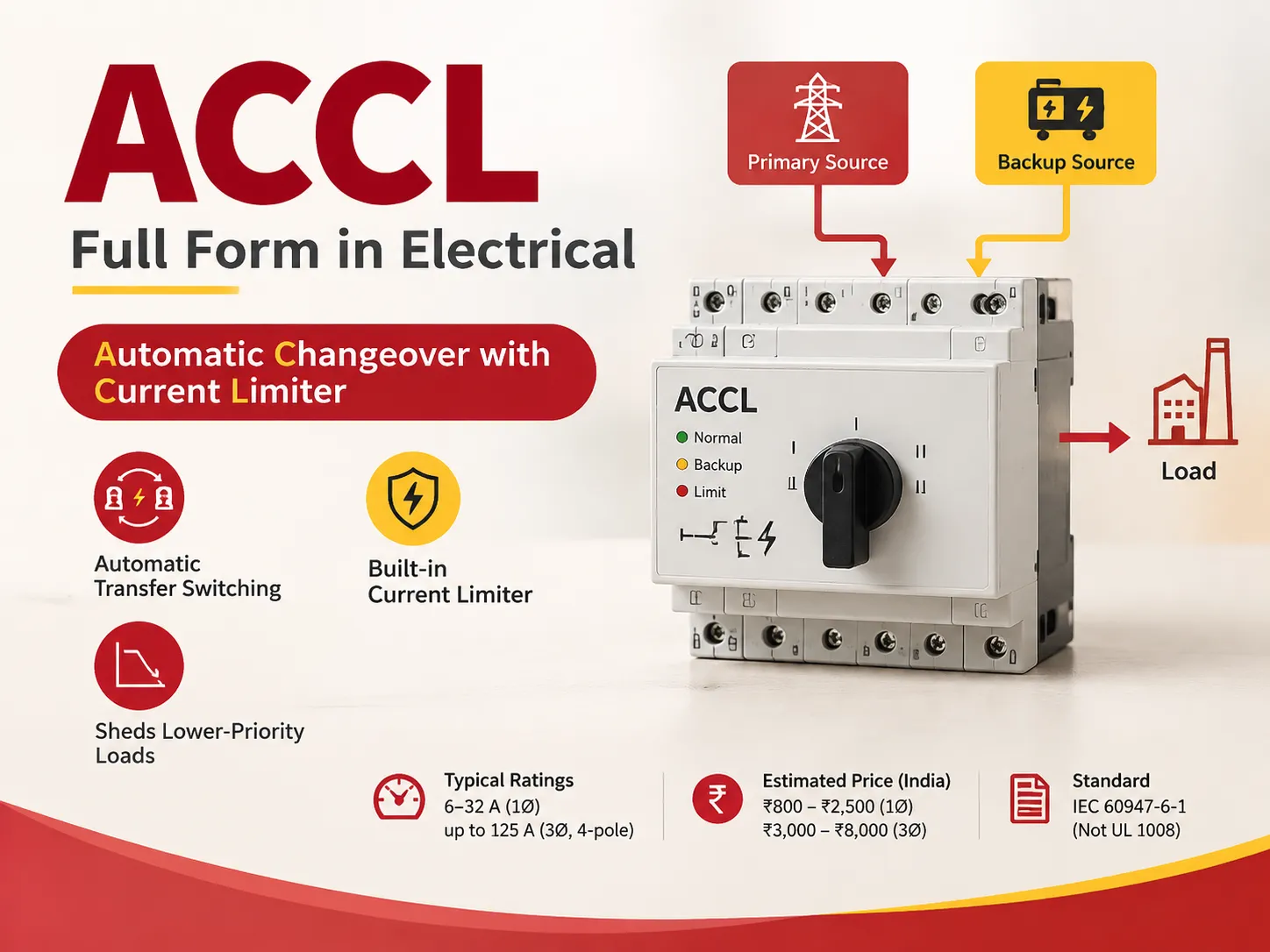
Should you see the term “ACCL” in any kind of schematic, quote or specification about a project involving load shedding, you may wonder why this term does not appear in the NEC codes. The reason why this term will not be mentioned in the codes is that ACCL is an actual product according to the definition by the U.S. but it can be sourced only from manufacturers located outside of the United States. In brief, ACCL is a device allowing one to consolidate the functions of two products that would otherwise be bought separately. Specifically speaking, ACCL allows one to switch power from one source to another and to limit the current at the same time.
We will start by explaining the ACCL concept and then provide the details of its functioning. More specifically, we will describe load shedding itself and the connection between ACCL and ATSs as well as standard transfer switches, its cost and obstacles for installation and/or usage. The concluding part of the article will be devoted to giving some tips to those who are considering buying ACCLs.
ACCL stands for Automatic Changeover-cum-Current Limiter in India, and the interesting thing about this technology is that it serves the purpose of the automatic switch and the current limiter. Tо give an example of its functioning, when power from the primary source of supply is interrupted, the ACCL automatically connects itself with a standby power source. Also, if there is excess load on the circuit, then the ACCL will disconnect the additional load from the electrical system. In India, ACCLs are used for applications with the current ratings range of 6 A-32 A for simple applications and up to 125 A for 4 pole 3-phase applications. Price ranges for these devices vary from INR 800-2500 for single phase devices to INR 3000-8000 for three phase applications. The IEC 60947-6-1 standard governs the ACCL devices while UL 1008 is the first consideration while using the technology in the USA.
What Does ACCL Stand For in Electrical?
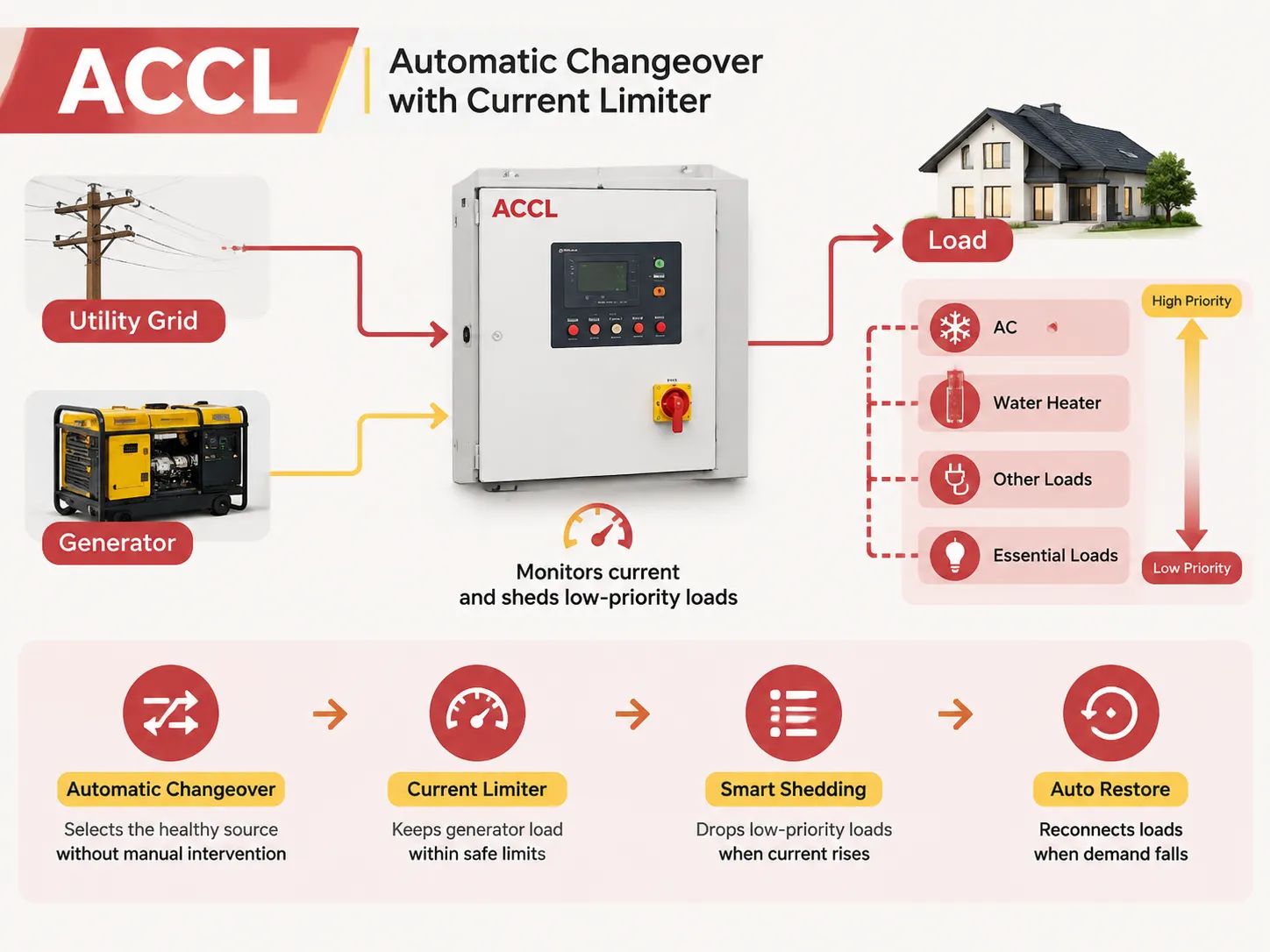
The term ACCL stands for Automatic Changeover with Current Limiter. The name says it all. “Automatic changeover” refers to transfer switch part while “current limiter” represents load management. ACCL is the result of an engineer realizing that a transfer switch which simply connects thousands of watts worth of load to a generator may not be a solution to one’s problem.
That is right. A transfer switch only does one thing and that is connecting load to an available power source regardless of whether the load is 12 A or 90 A. Connect a generator of 30 kVA to a service of 100 A and watch the transfer switch doing its job. The generator will immediately trip on overload once the air conditioners are turned on. The tenant will phone you up, you will tell them to turn off the load, and everybody will just wait.
ACCL can be viewed as a case of an ATSE with an ammeter and some sort of smart brain added on. The ammeter is monitoring load current on the backup side. The brain contains a list of load groups organized according to their rank. Once the current goes up to a certain level the brain will disconnect the group that has the lowest rank first then the next group and so on until the load is back to normal.
One important thing to mention is that in India and South Asia ACCLs are often called Automatic Changeover cum Current Limiter or Automatic Changeover Contactor with Limiter. These are different names for the same block of functionality. Make sure to use the right name format in your specifications.
Why ACCL Is a Regional Product Category, Not a Universal One
The part that most articles overlook is, in fact, the part that is crucial if your reading it in the United States. There is no ACCL (automatic customer consumption limiter) heading in the National Electrical Code or a UL listing for ACCL. Search for it in a catalogue of a US distributor and you will not find anything with it. The reason for this is simple: ACCL exists because of a regulatory and billing environment that does not exist in North America.
There are two factors at play when it comes to the demand for ACCL. First is sanctioned load, which is the maximum demand that the distribution company allows you to draw through your connection agreement with that company. If you exceed that limit, then you may be penalized and charged for demand, and in certain states you may be at risk of losing the connectivity. The second factor is the load-shedding, which consists of planned outages that are common in some parts of South Asia, Africa and Middle East. In this case, if there is a device that is able to transfer load, then it is not just a luxury but an absolute must-have that allows the device owner to avoid being left without back-up during the evening hours.
North America solved the same problem using its own methods. In case with US commercial buildings, there is an automatic transfer switch that conforms to UL 1008 standards and, along with that, there is an energy management system and a load-shedding controller (it is seen more often now). As a result, in case with US electricians searching for the ACCL full form, it is impossible to find anything similar due to the fact that American electricians perceive ACCL as a stock item.
As a result, the practical implication of the above is that if you are dealing with US market, then there is no need in trying to purchase ACCL and then argue that it is supposed to replace UL 1008 compliant ATS. In case with India, the Gulf countries or some parts of Africa, ACCL represents a viable and and often much cheaper alternative as opposed to ATS plus load-shedding relay – in this case the comparison needs to be made against ATS plus load-shedding relay and not ATS.
How the Current Limiter Inside an ACCL Actually Works
If we set aside the advertising hype, what’s left over is that half of an ACCL simply operates by containing a measuring circuit and an array of relays. A current transformer on the incoming supply generates a signal proportional to the load current. This signal is compared by the controller with some preset level, given either in amps (the generator rating) or as a percentage of the approved load. If the measured value is over the limit for a duration longer than a given period, the controller will open the output relays for the least important loads.
And this is where misunderstandings begin. In fact, most types of ACCL, particularly the single-phase residential one, do not just disconnect the loads progressively. Instead, they trip everything once and try reconnection after that. Usually, the published cycle is of 8, 10, or 12 seconds, where the tripping is followed by reconnection. If the current is still above the threshold, it will trip again and restart the cycle. This method is intentional as it allows people time to do something, however, it also means that this ACCL will go through the cycle endlessly installed on the load bigger than what it can manage. It only limits, it cannot assist.
Meanwhile, the larger three-phase or four-pole devices work more like a real load manager. Such devices can control multiple outputs independently and it enables controlling some group while letting others continue functioning. In these models, you also get the true RMS sensing technology, adjustable thresholds from the control panel, and the screen providing current, voltage, and the status of the output. Some connected versions can also have Modbus or cloud data transfer feature to document the number of times the ACCL operated, which is a useful piece of information in case some tenant is complaining.
In fact, it boils down to two features of the ACCL device. The first is how quickly it reacts: if a limiter is too aggressive in its settings, it may switch both heaters and motors off as soon as the current exceeds the limit due to the launch of an electromotor; one must understand that the compressor initiation is a regular 6-8 times spike of current but lasting for a very short time. If a confirmation period is a few hundred milliseconds, it will eliminate the majority of such unnecessary disconnections. The second one is the location of the current transformer must be correct. If attached to a wrong wire in a three-phase device, the ACCL will measure only a third of the actual total current and will not operate properly.If you want the wider context on how circuit breakers and protective devices divide up the fault-versus-overload job, our write-up on why breakers trip and what each trip signature tells you is a useful companion to this section.
Load Priority Shedding: The Four-Tier Logic Most ACCLs Use
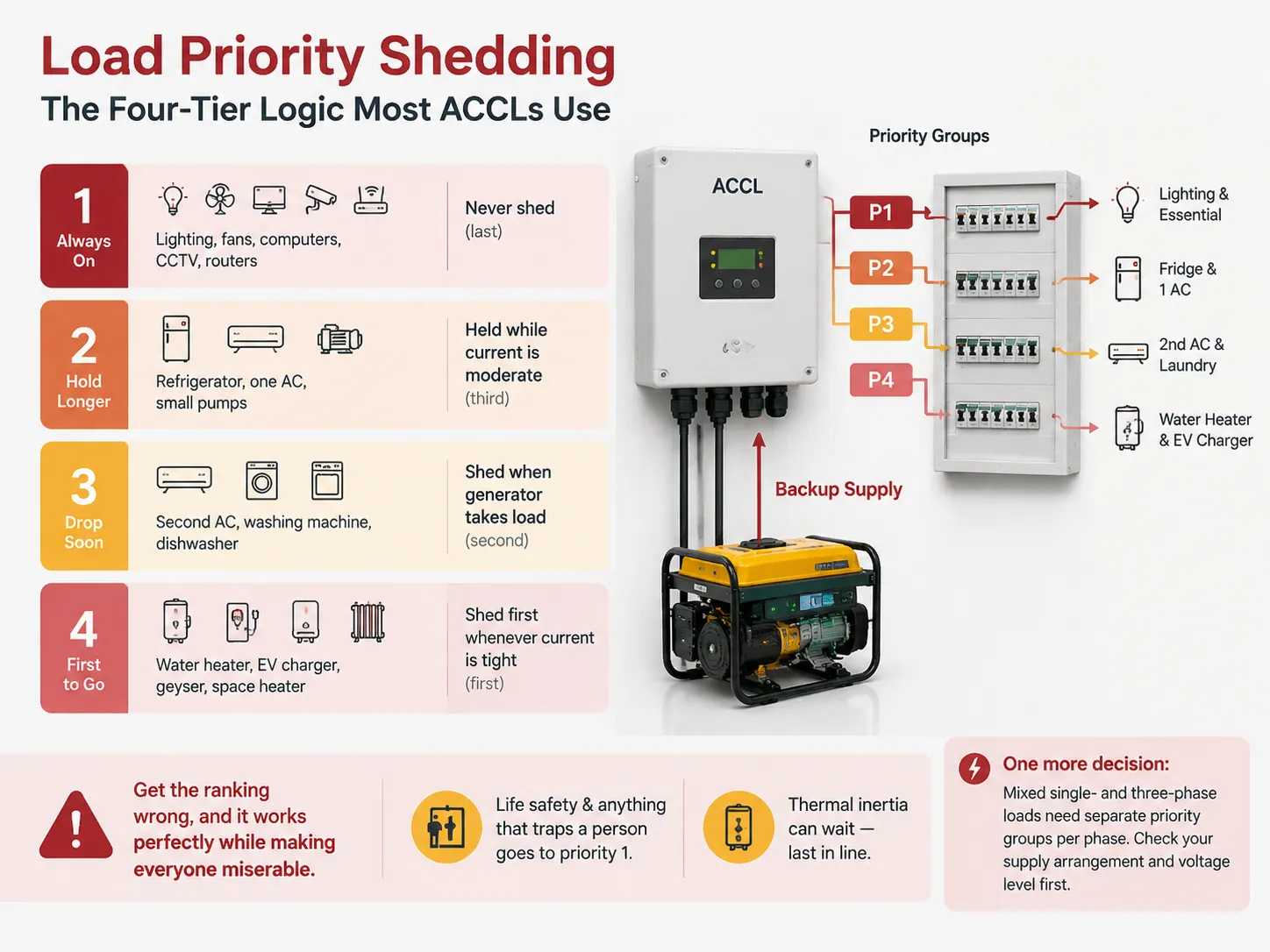
Priority ranking is where the ACCL has made its mark, and the concept behind it is quite simple. All you need to do is create a list of required priorities in the order of importance. Most of the time, brands give a list of four. Using this list, the output of each priority is then connected to the contactor or breaker that is responsible for this particular load. Basically, all the work is done by the ACCL automatically every cycle, and no humans are involved.
The 4-priority model that most brands in India use looks something like this. The first priority is always on, as this mainly covers lighting, ventilation, and electronics that are in use. It is recognized as priority 2 because it operates only when the load in moderate—like refrigerators and single air conditioner. Priority 3 goes off as soon as the generator comes on load, since this usually consists of second AC or washing machine. In priority 4, you’ll find water heaters, EV chargers, and any other load with thermal mass that can be switched off for an hour or so without causing any problem.
| Priority | Typical Loads | Behaviour on Backup Supply | Shed Order |
|---|---|---|---|
| 1 | Lighting, fans, computers, CCTV, routers | Never shed | Last (effectively never) |
| 2 | Refrigerator, one AC, small pumps | Held while current is moderate | Third |
| 3 | Second AC, washing machine, dishwasher | Shed when generator takes load | Second |
| 4 | Water heater, EV charger, geyser, space heater | Shed first whenever current is tight | First |
When you make the wrong decision about hierarchy, you can encounter a situation where the load functions normally but causes considerable disruptions. I have seen one residential housing block where the lift motor belongs to the second priority category, while the corridor lights to the third priority category. As a result, a person may stay stuck in a lift that cannot move, while at the same time the lights are functioning normally. Priority is given according to the consequences of the interruption and not according to the difficulty of carrying out the cabling. Life safety and any issue that prevents a person from getting out of a dangerous situation has the highest priority. All that stuff with considerable thermal inertia ranks low, because the heating system that is out of order for twenty minutes is not considered a major problem.
This section hides one more decision, which is voltage-related. The possibility of connecting any group of loads behind the changeover switch will depend not only on the current load. Moreover, if we have both single-phase and three-phase loads in one building, their priority groups will have to be established for every individual phase; otherwise, the average value of power consumption will give us a hidden imbalance. Working out which distribution level you are actually dealing with — and what changes once you cross from one to the other — is the same question we unpack in our explanation of where high voltage ends and low voltage begins in a real installation, and it is worth five minutes before you commit to a panel layout.
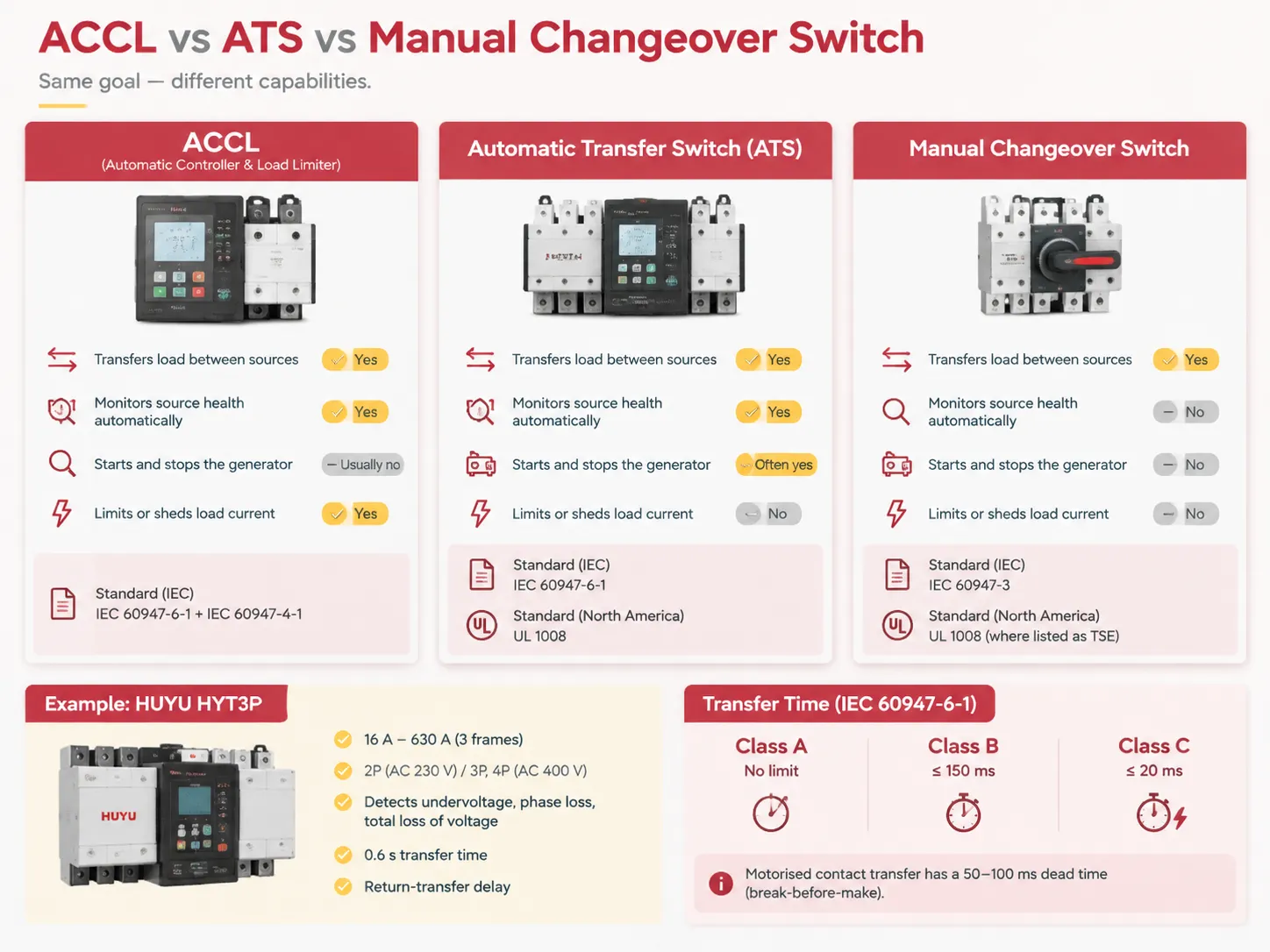
ACCL vs ATS vs a Plain Changeover Switch
They are used in common interchangeably but they actually refer to distinguishing tools. The best way to distinguish them is to see what decisions they can make on their own.
| Function | ACCL | Automatic Transfer Switch (ATS) | Manual Changeover Switch |
|---|---|---|---|
| Transfers load between sources | Yes | Yes | Yes, by hand |
| Monitors source health automatically | Yes | Yes | No |
| Starts and stops the generator | Usually no | Often yes (with AMF logic) | No |
| Limits or sheds load current | Yes, core function | No, needs a separate controller | No |
| Standard, international | IEC 60947-6-1 + IEC 60947-4-1 | IEC 60947-6-1 | IEC 60947-3 |
| Standard, North America | Not a listed category | UL 1008 | UL 1008 where listed as TSE |
| Typical transfer time | 1–3 s contactor-based | Class B ≤150 ms, Class C ≤20 ms | Operator dependent |
| Relative cost | Between the two | Highest | 30–50% below ATS |
The difference in standards is significant, not mere pedantry. As identified in standard IEC 60947-6-1 which classifies automatic transfer switching equipment (or ATSE) based on the duration of interruption, i.e. Class A has no restriction on the interruption duration, Class B guarantees that the interruption is in the medium category, i.e. not exceeding 150 ms, whereas, Class C guarantees interrupters a short time of 20 ms or less through the stored energy mechanism in place. For the case of contacting transfer in a motorised unit, there is a built-in dead time of around 50-100 ms, as the operation is performed in the break-before-make way so that the switching of one source is completed prior to switching of the other source being initiated with an interlock mechanism installed that ensures both are not switched simultaneously.
For reference on the transfer half of the job, HUYU’s own PC-class range shows what the specification sheet should look like: the HYT3P automatic transfer switch is rated 16 A to 630 A across three frames, offers 2P for AC 230 V single-phase and 3P or 4P for AC 400 V three-phase, detects undervoltage, phase loss and total loss of voltage, and completes contact transfer in 0.6 s with a documented return-transfer delay to stop nuisance cycling.It was developed according to GB/T 14048.11, which is the Chinese national standard equivalent to IEC 60947-6-1. This type of appliance can either be joined with a load-curtailment controller in North American configuration or substituted with ACCL, which is essential in markets that favor ACCL.
Where ACCLs Are Used, and Where They Are Not
An accurate response is that ACCLs excel in a particular range of settings but are inadequate outside of that range.
They work well in apartments and residential complexes served by a common diesel generator, where the problem of fairness is indeed the entire point of the device. In this case, all the tenants receive power from the same generator, which means that the first tenant who turns on the electric kettle tends to spoil it for everyone else. This is where a networked ACCL with the meter installed for each apartment can turn the whole process into equitable rationing, and in some models, even into prepaid electricity supply. ACCLs also work fine in the case of small commercial establishments such as retail shops, outpatient clinics, boarding houses, etc., where the total connected load is within the limits of 20 A to 60 A, and one three-phase device will be sufficient.
There is also a variety of the dual source principle that you may need to know about, because it often happens that the two supplies are not a utility and a genset but two utility feeds or a utility feed and a big inverter. In that arrangement you still want automatic source selection, but the risk profile is voltage quality rather than engine start, so the sensible device is one that bundles source transfer with overvoltage and undervoltage monitoring — HUYU builds exactly that as an ATS with integrated overvoltage and undervoltage protection, and it is the configuration I would reach for on a dual-grid site before adding a separate load limiter.
They are not suitable for situations where an interruption is hazardous. For example, if you use an ACCL that turns off its output and goes through a 10-second wait period, the ACCL cannot be used for surgical suites, data halls, or lift controllers. These applications require Class C stored energy transfer facilities with uninterruptible power supplies, and it would be incorrect to install an ACCL system instead. Likewise, ACCLs are also not used for feeding applications for large industries, where load management needs to be installed by a proper PLC or an energy-management system with written sequences and trails.
However, there is one case that should be pointed out because it can surprise people: buying and using an ACCL without any generators is possible. The current-limiting section of an ACCL operates independently of the converter section. It is quite common for many businesses to use it purely as a demand controller in order to stay within a regulated value of energy consumption and avoid high demand charges. If such installation will be profit-making or not depends on the type of tariff: in case of demand-charge it will definitely pay back within a year, while with flat energy tariff it will never pay back. Therefore, one should know the tariff before making a decision on buying.
What an ACCL Costs
Pricing may be more straightforward than you might think, but it differs widely depending on the market. However, the retail rates in India provide us with the clearest idea of how pricing works, making them to be a great point of reference for budgeting in the entire region.
| Type | Rating | Indicative Price (India) | Roughly in USD | Typical Use |
|---|---|---|---|---|
| Single-phase ACCL, basic | 6–32 A | ₹800–₹1,500 | $10–$18 | One flat, small shop |
| Single-phase ACCL, metered | 16–32 A | ₹1,500–₹2,500 | $18–$30 | Retail unit, clinic |
| Three-phase ACCL | 30–125 A | ₹3,000–₹8,000 | $36–$95 | Apartment block, commercial |
| Networked / prepaid ACCL | 63–125 A | Quoted per project | Project quoted | Complex-wide billing |
The sticker price leaves out three factors. Firstly, the enclosure alone contributes to the price. A bare DIN-Rail unit is relatively cheap but a similar unit encased in an IP65 compliant cabinet may cost more than the electronics contained within. Secondly, in order to get a true Class 1.0 meter with a display, additional money is spent. If you are using ACCL for managing billing for tenants, you will want to invest in Class 1.0 regardless of the fact that only the current readout is needed. Thirdly, the use of Modbus or cloud gateways will impact the price significantly.
On the other hand, don’t forget what you are replacing. Compared to the ACCL in a residential builidng with 20 flats, the installation cost savings of the ACCL are very considerable. Budgeting for the electrical panel as a whole rather than for the device is the right way to compare — the same logic we laid out in our breakdown of what a panel change actually costs and which line items dominate.
Installation and Maintenance Details That Bite Later
The majority of failures of ACCLs in the field are installation-related failures that lead to warranty claims. The five reasons for these failures can be summarized in the following lines.
- Being neutral handled for the 4-pole equipment. If the neutral of the generator (source) is independently bonded, then a 4-pole equipment with switched neutral should be selected. If conventionally a 3-pole piece of equipment is used in the given installation, then the parallel neutral path is created which leads to circulating current and possible hazardous touch potential for some earthing schemes. This should be decided at the ordering stage, not during the commissioning.
- Current transformer location. The location of CT should be behind the contacts. The CT should be positioned on the circuit that carries the total load. In case it is mounted on one phase of three-phase equipment, than the limiter will show only one third of the real current. If it is mounted before the transfer, it will measure the primary source while the generator supplies the building.
- Clamping. Insufficient torques on the terminals are the main reason for nuisance tripping that seems to be due to the fault of controllers. In HUYU HYT3P, the figures are 3.5 Nm, 8 Nm, and 12Nm for 125, 250, and 630 frames respectively, and the use of torque wrench (and not the touch) is advisable to check them each year. Impulse withstand voltage is 8kV for smaller models and 12kV for 630 frame, so it reminds that the unit is positioned close to the fault path and necessitates an appropriately rated upstream device.
- Discipline. Set the undervoltage threshold according to your supply, not factory’s default settings. For instance, HUYU’s controller changes at 160V ± 10% at 230 V nominal supply, and that default setting applicable to weak rural lines will transfer at undesired times. In addition, one need to increase return after transfer, 5 to 30 minutes is a standard period.
- Annual test. An ACCL which has never been operated will not operate when needed. One deliberate operation of the device should be carried out each year with appropriate logging.
Frequently Asked Questions
What is a current limiter and what does it do?
Current limiters are a type of device which are designed to limit the current flowing through a circuit to that which is required for correct functioning of any electric device(s). They are designed to constantly check the amount of current flowing through a circuit, and automatically take action when the current exceeds a preset limit. There are a number of ways that the current flow is limited within a circuit, but the most common is by controlling the amount of electrical energy being provided to the fan(s), or by completely disconnecting power to the fan(s). In fact, current limiting devices fall into the second group of devices, and we will go into detail about how they work. The primary difference between current limiters and the other types of circuit protection devices, such as fuses and circuit breakers, is that a current limiter only monitors the current, while other devices will disconnect the circuit when it is damaged.
What is an automatic changeover?
Automatic transfer switches help to identify if the primary energy source is down, and also automatically switch power from one energy source to another, with no manual involvement. The automatic switch is controlled by controllers which control the voltage and frequency of the automatic switch. When switching power sources, the voltage must drop between 80-90% before switching power is made to the second energy source or when power is completely disconnected from the first energy source. Break-Before-Make is the principle on which the switch is based – power is disconnected from the first energy source before being connected to the second energy source; however, there are some automatic transfer switches that have safeguards to prevent the second energy source from being connected.
Why is ACCL used?
There are three things that make this technology attractive to so many people. The first thing is how safe they make generators. The ACCLs allow you to not shut down your generator when it becomes overloaded due to its relatively low size compared to the energy output. Second is the tariff regulations. With maximum demand charges being almost equal to the connection point, you can use restrictors to decrease your maximum demand charges below true maximum demand charges, with little cost, regardless of whether or not you are receiving electricity from your generator. Finally, there is equitable distribution of electricity where multiple customers share the output of a single generator. With ACCL technology, you are able to separate the energy that is provided to each individual customer based on how much energy that individual customer used, which keeps one individual customer from using more than their fair share of electricity.
References
- International Electrotechnical Commission — IEC 60947-6-1, Multiple function equipment: Transfer switching equipment
- IEC Webstore — IEC 60947-6-1:2026, transfer switching equipment (TSE) scope and ATSE classification
- UL Solutions — UL 1008, Standard for Transfer Switch Equipment
- NFPA — NFPA 70 National Electrical Code, Article 700 and 702 emergency and optional standby systems
- Subtech — ACCL Panel: Automatic Changeover with Current Limiter, load priority levels and pricing
- Electron — Automatic Changeover-cum-Current Limiter, operating sequence and self-reset timing
Conclusion
The Automatic Changeover with Current Limiter is a system that automatically sizes itself up. Once the main energy supply is disconnected, it automatically disconnects and reconnects the load. This leads to its popularity in countries like India and some countries in Africa while the USA is still taking its baby steps in this field, as far as the Automatic Transfer Switch (ATS) and Energy Management Systems (EMS) are concerned.
Before you investigate the costs and finalize your decision regarding ACCL systems for your needs, make sure that the product can actually comply with the required standards. For example, although both IEC 60947-6-1 and UL 1008 refer to the standards relevant in the design and testing of ACCL devices, they are completely different standards depending on the country of your building. Before you begin calculating the generator size in accordance with the priority load, remember that if your priority load exceeds the capacity of your generator, you are going to face the problem that is simply beyond the reach of whatever type of controller you have and will be unable to get rid of it.If you plan to charge someone for using the common meter, be prepared to pay more, because it will not clarify who paid what.