
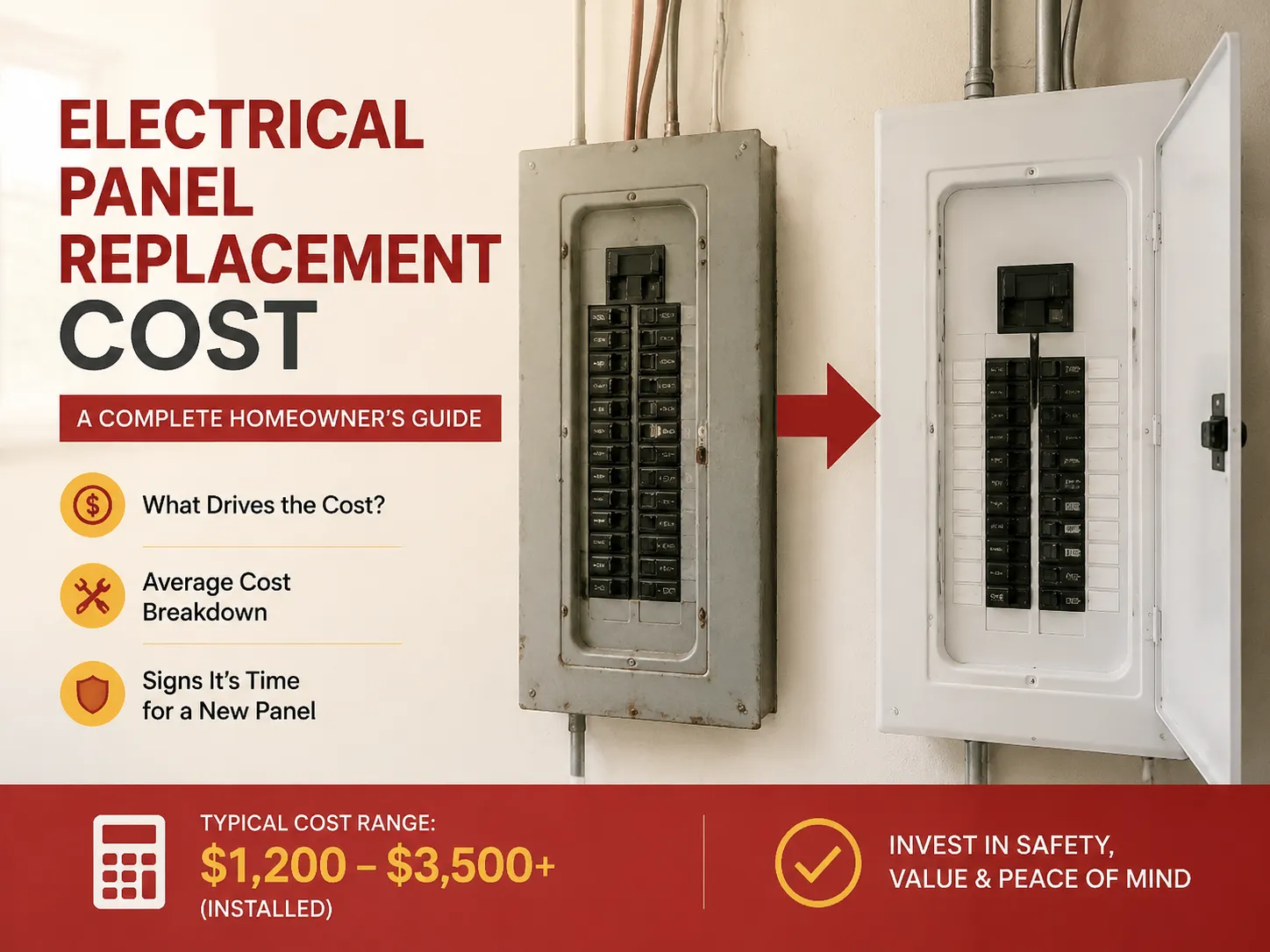
When a homeowner in Chicago used her new electric vehicle charger, the lights in her 1950s bungalow flickered, causing the original mains breaker to trip. After resetting it, the breaker tripped again the next night. An electrician said that the 100‑amp panel was too full, the bus bars were rusty, and the panel itself was a Federal Pacific Electric Stab‑Lok — a name safety experts and insurance companies have warned against for years. The verdict was a complete replacement of the electrical panel, upgraded to a modern 200‑amp service. The estimated cost was $4,200. Was it fair? Could it be done cheaper? And what does this fee comprise? While the average cost of electrical panel replacement will provide a single figure — generally ranging from $1,500 to $6,500 — this figure does not explain the various factors affecting the project cost, including the amperage, condition of the service entry, breaker type, and local salary rates. To make sense of what affects the price, what the job consists in, and how to evaluate the quote, the homeowner has to take the right first steps toward a safe, code-compliant, and fairly priced panel upgrade.
Summary: The cost of electrical panel replacement varies considerably. Costs can begin at approximately $1,500 for a replacement of a panel that does not necessitate changes to other repairs up to $3,500 to $4,500 for a service upgrade from 100 amp to 200 amp service. Full replacement costs can cause the price to soar even higher depending upon the added services of changing the meter socket, the service entrance cable and mast and other equipment.
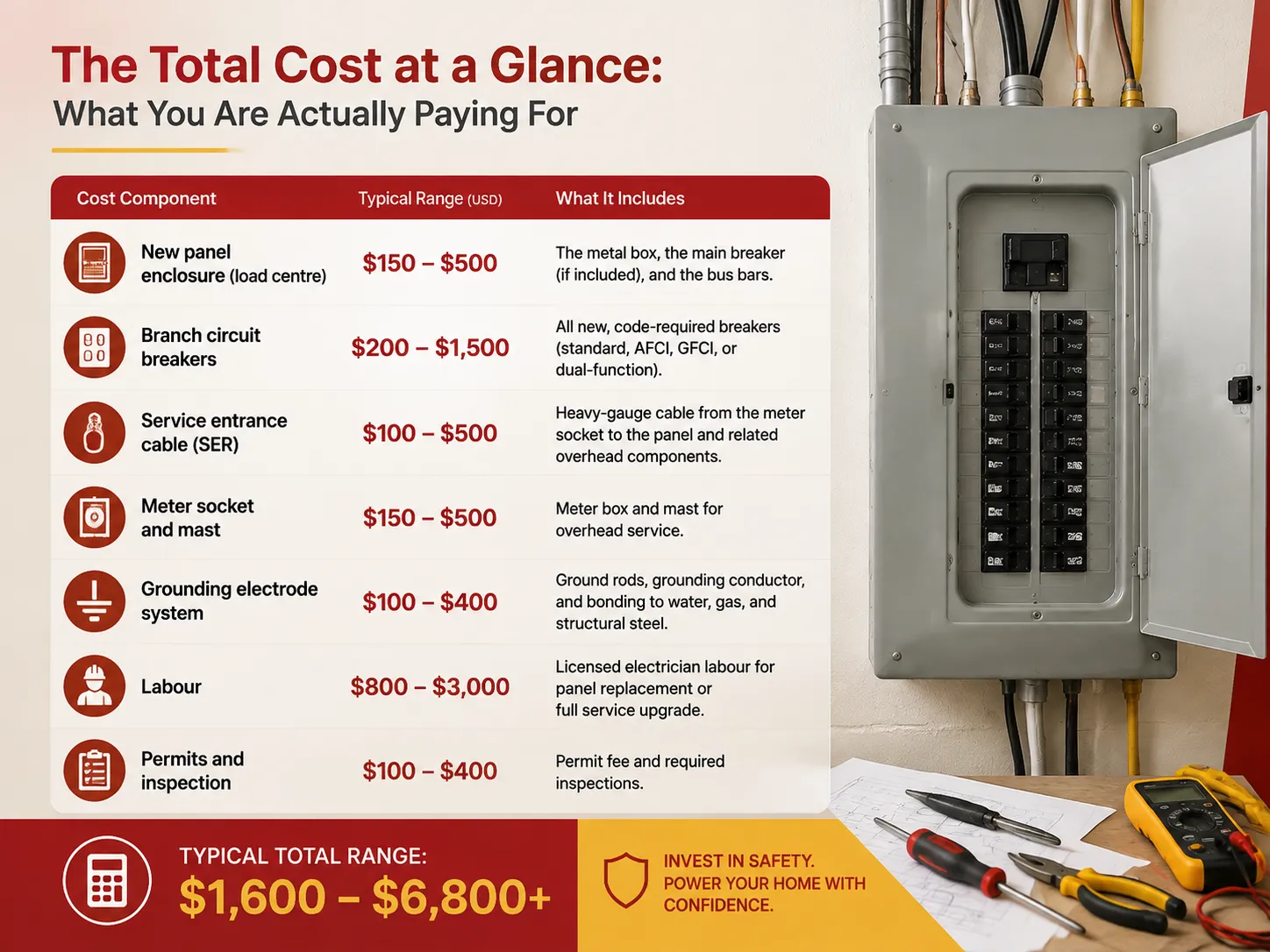
The Total Cost at a Glance: What You Are Actually Paying For
The table listed below shows the main cost factors for replacing an electrical panel in the USA using price data for a typical single-family house as of mid-2025. Prices of labor differ in various areas of the U.S., as urban areas tend to charge more, but costs of panels are similar across the country.
| Cost Component | Typical Range (USD) | What It Includes |
|---|---|---|
| New panel enclosure (load centre) | $150 – $500 | The metal box, the main breaker (if included), and the bus bars. A 200‑amp, 40‑space panel is the standard for modern homes. Brands include Eaton, Siemens, Square D, and Leviton. An outdoor‑rated (NEMA 3R) enclosure costs more than an indoor one. |
| Branch circuit breakers | $200 – $1,500 | Every circuit in the home must be protected by a new, listed breaker that matches the panel type. Standard single‑pole breakers cost $5–$15 each. AFCI breakers (required in most living areas) cost $35–$60 each. GFCI breakers cost $40–$70 each. Dual‑function (AFCI/GFCI) breakers cost $50–$90 each. A typical home with 20–30 circuits can have $300–$800 in breakers alone, and the cost rises significantly if the local code requires AFCI or dual‑function breakers on most circuits. |
| Service entrance cable (SER) | $100 – $500 | The heavy‑gauge cable that runs from the meter socket to the panel. For a 200‑amp service, this is typically 4/0 AWG aluminium or 2/0 AWG copper. If the existing cable is undersized (which it will be if the previous service was 100 amps), it must be replaced. For an overhead service, the mast and the weatherhead are included in this cost. |
| Meter socket and mast | $150 – $500 | The box that holds the utility meter and the mast that rises up to the weatherhead on an overhead service. The utility company may require a specific meter socket model. A corroded or cracked meter socket is a safety hazard and must be replaced. |
| Grounding electrode system | $100 – $400 | Two ground rods, the grounding electrode conductor, and the bonding to the water pipe, gas pipe, and structural steel. The current NEC requires two ground rods, spaced at least six feet apart. An older home may have only a single rod, or a corroded ground wire, and must be brought up to code. |
| Labour | $800 – $3,000 | The largest single cost component. A panel‑only replacement takes a two‑person crew 4–8 hours. A full service upgrade takes 8–16 hours. Labour rates for a licensed electrical contractor range from $75 to $200 per hour, depending on the region. |
| Permits and inspection | $100 – $400 | The electrical permit fee and the required rough‑in and final inspections. The utility company will not reconnect the service until the inspection has passed. |
Three Replacement Scenarios: From Economical to Comprehensive
Not all panel replacements necessitate all the parts being replaced. The range—and price—varies with the condition of the existing installation and the homeowner’s vision regarding capacity, safety, and future-ready. Below are the three most common scenarios.
Scenario 1: The Economical Replacement ($1,500–$3,000)
This is a panel-only replacement, whereby the electrician simply removes the old panel and installs a new one of the same amperage, installs new branch breakers, and reconnects the existing service entrance cable and meter socket. This is the case when existing service entrance components are found in good condition, rated for the panel’s amperage, and the homeowner is not looking to upsize the service capacity. The price in this case depends on the panel, new breakers, and a day of labor. This is the best option when the panel is outdated, broken, or a recalled brand—regardless of availability for service needs.
Scenario 2: The Standard Upgrade ($3,500–$6,500)
This is the most frequently traveled road for the homes when the upgrade involves changing the previous service from 100 to 200 amperes. The electrician replaces everything starting from the weatherhead/ underground riser – mast, meter socket, service entrance cable, panel, main breaker, branch breakers, and grounding electrode system. All circuits will be reconnected and marked. It is advisable to install a whole-house surge protector (Type 2 SPD) as part of the upgrade costing an additional $80–$200. This is an upgrade scenario when a homeowner is ready to install an EV charger, heat pump or modern kitchen while conforming to modern safety and code requirements.
Scenario 3: The Comprehensive Upgrade ($6,000–$8,500 and more)
This assumption presumes adding capacity, intelligence, and future-proofing. The panel will be of 200 amps, with 42 spaces and copper busbars, allowing for easier installation of AFCI/GFCI devices. Note that several dedicated circuits will be added such as 50 amps for EV charger, 30 amps for future heat pump, and 20 amps for home office. Outdoor circuits will be included for a future hot tub or workshop as well. Smarter energy monitor and automatic transfer switch for future generator or battery backup may be available in the panel. Additional expenses compared to the basic upgrade will be covered with these new circuits, modern panel and breakers, and wiring costs incurred when running the new wires.
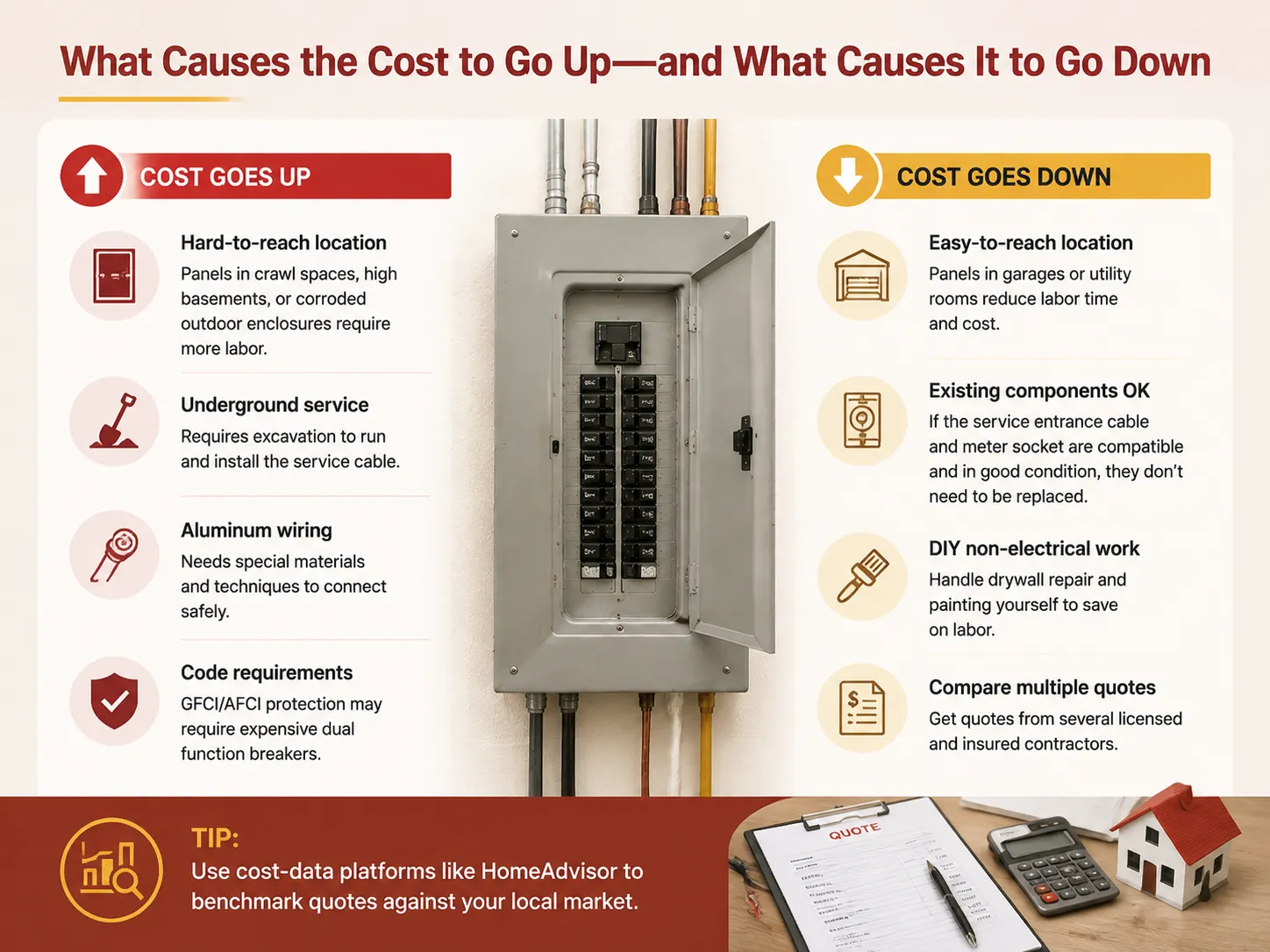
What Causes the Cost to Go Up—and What Causes It to Go Down
The price of replacing an electrical panel can vary widely, and understanding how the price gets pushed up or down can help homeowners evaluate their quotes and possibly lower costs without sacrificing safety. Among the factors that tend to increase costs is the location of the panel; for instance, if the panel is found in a small space such as a crawl space, high basement wall, or even an outdoor enclosure that has corroded closed, then installing a new panel becomes a more labor-intensive endeavor. Other reasons why costs can increase include a service that is underground rather than above ground and which would require excavation to install the cable; the presence of aluminum wiring because it requires the use of different materials and techniques in order to be safely connected to the new circuit breakers; and local electrical code requirements for GFCI and AFCI protection, which may necessitate the use of expensive dual function breakers for some circuits.
There are factors that can bring down the cost, such as when the panel is located in relatively easy-to-reach area, such as a utility room or garage, and thus helps reduce labor costs; a service entrance cable and meter socket that are still fine and compatible with the new amperage of the panel and which do not need to be replaced; doing the non-electrical jobs, such as repairing damaged drywall, by oneself instead of paying the electrician to do it; and comparing quotes from several licensed and insured contractors. Cost‑data platforms such as HomeAdvisor provide aggregated pricing information that can help a homeowner benchmark a quote against the local market.
Can You Upgrade an Electrical Panel Without Rewiring the House?
Of course! This is definitely one of the more common questions asked by homeowners. However, a panel upgrade only replaces the enclosure, main breaker, and branch circuit breakers; therefore, the wiring behind your walls does not have to be replaced. The licensed electrician will disconnect the current branch circuit wires from the old panel, label them properly, then connect the wires to the new panel breakers. As long as the wires behind the walls are in good shape and are copper wires and not aluminum, they do not have to be replaced. If, however, during the process of upgrading the electrical panel, it has been discovered that any of the wiring is faulty or not the right gauge, then the wires have to be replaced, but this is considered to be extra work and not part of the upgrade.
Anyone who wants to change their panel strictly for functionality, increase in capacity, or because of the recall is advised to keep in mind that as long as their wiring is in good shape, there is no need for rewiring the connections. The only types of wiring that always gets replaced during any panel upgrade is the service entrance cable which is often not enough for higher amperage services and has to be replaced for safety reasons.
Should a 50-year-old electrical panel be replaced?
If the electrical panel has been installed around 1970, it is definitely about to reach its maximum life expectancy of 30 to 40 years. However, despite the fact that the panel appears to be working just fine, the licensed electrician is supposed to inspect it as there might be problems with its bus bars, main breaker contact, or branch circuit breakers. If it turns out that the panel is made by a company that has a bad reputation in the industry, then the electrician would have to replace the panel right away. Even if the electrician realizes that the panel is made by a reputable manufacturer and has been maintained, he still has to take a closer look since he must check if it is okay to leave the panel in service.
The cost of an inspection ($150–$300) is a fraction of the cost of a fire or an emergency replacement. Resources from the U.S. Consumer Product Safety Commission (CPSC) provide information on the known hazards of legacy panel brands, and the National Fire Protection Association (NFPA) publishes the electrical safety standards that a replacement panel must meet.
Does homeowners insurance pay for a new electrical panel?
Homeowners insurance policies usually do not pay for the installation of a new electrical panel if it is being done as part of a suggested upgrade, preventive procedure, or as a result of aging. Insurance typically covers losses caused by accidents that happen quickly and unexpectedly, such as fires, lightning strikes, or electrical surges, but it does not cover slow deterioration. Recently, some insurance providers reported that they required replacing some dangerous electrical panels (i.e., those by FPE Stab Lok or Zinsco) in order not to lose their coverage. If you plan to change your electrical panel, it is highly recommended that you check with your provider and see what he or she can do for you in terms of discount or other help free of charge. A panel that is replaced without a permit and an inspection may not be accepted by the insurer, regardless of the quality of the work. For guidance on the insurance implications of electrical upgrades, the Insurance Information Institute provides consumer resources on home electrical safety and coverage.
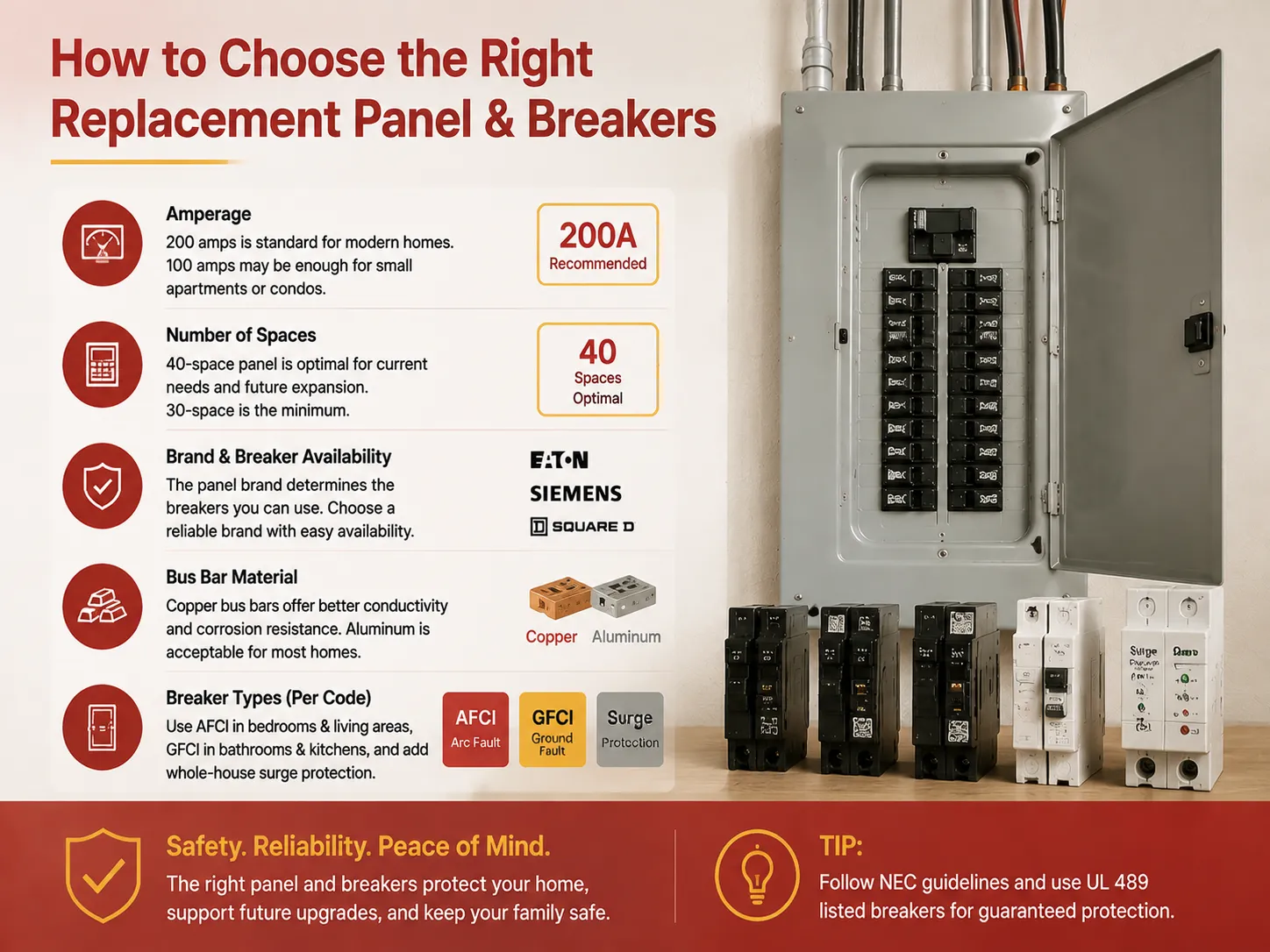
How to Choose the Right Replacement Panel and Breakers
Properly choosing the right electrical panel and the right breakers is vital since this is essential for the safety of the property, its ability to be extended and code compliance for a long period of time. Main points to consider in making a choice include amperage (in modern single-family households 200 amps are usually chosen; in some cases 100 amps will be enough for a small apartment or a condo having gas appliances, but it will meaning that it will not be possible to add such devices as EVE charger, heat pump or workshop circuit into wiring), number of spaces (40 space panel is an optimal one because it has enough space for existing circuits and for possible expansion; 30 space panel is the minimum and once the panel is installation and its space is full, there will be no ability to add something in the future), the chosen electrician brand and breaker availability (the brand of the panel determines the brand of the circuit breakers that can be used, whilst circuit breakers have to be easily accessible from the hometown suppliers or online; the panel produced by some unknown brand can be problematic in terms of installation and expansion), bus bar material (copper bus bars are preferred as they have high conductivity and are resistant to corrosive factors; aluminum bus bars are used in many electrical panels and can be used for most houses), and types of breakers that must be used according to the electrical code.
For help identifying the correct breaker type and amperage for each circuit, our guide on what size circuit breaker you need walks through the NEC‑based sizing process for standard, motor, and appliance circuits. And for a complete understanding of the certification that every breaker in the new panel must carry, our article on what UL 489 breakers are explains the testing and listing framework that ensures a breaker will trip when it must.
With respect to the breakers which are installed in this new panel, HUYU produces all kinds of protective devices – regular MCBs, RCBOs, AFDDs, and DC-rated breakers that comply with given international and North American standards. The presence of a new panel means the opportunity to receive better protection for each home circuit like introducing AFCIs in bedrooms and living rooms, applying GFCI to bathrooms and kitchens, and installing whole-house surge protection. Costs of these improvements are not high in comparison to total expenses related to panel replacement and the benefits one gets from safety measures – ability to prevent fires due to arc detection, avoid electrocution due to ground fault detection, and prevent surges that might ruin all electronic devices at home.
Frequently Asked Questions
How much does it cost to replace an existing electrical panel?
The cost of replacing an electrical panel can cost you somewhere between $1,500 for a like-for-like panel to $3,500 to $6,500 for complete service upgrades from 100 amps to 200 amps. The cost depends on the area you are located in, accessibility of the panel, the condition of the service entrance and the type of breakers you require.
Can I upgrade my electrical panel without rewiring my house?
Yes. During a panel upgrade, the enclosure, the main breaker and the branch breakers are replaced but the existing wiring stays intact and is connected to the new breakers as it is either copper, in good condition and correctly sized according to the circuit amperage. Generally, when the amperage increases, the service entrance cable or the heavy gauge conductors running from the electrical meter to the panel are replaced but the branch circuit wiring is not.
Should a 50 year old electrical panel be replaced?
A 50-year-old electrical panel must be checked out by a licensed electrician as it reaches or exceeds its expected lifespan. If the panel is a known hazardous one (Federal Pacific Electric Stab-Lok, Zinsco) its replacement should be done regardless of its condition. A licensed electrician can perform a professional check of the electrical panel to determine whether it needs to be replaced.
Does homeowners insurance cover electrical panels?
The average home insurance does not cover the cost of the regular electrical panel replacement or from obsolescence and preventive upgrade. However, it does cover accidents caused by electrical issues like fires or lightning. There are also some insurance companies that will provide coverage if you replace the electrical panel with a new electrical panel of an unsafe brand. It may be advisable to contact the insurance company before beginning the work to confirm their terms.
References
- U.S. Consumer Product Safety Commission (CPSC) — Federal Pacific Electric and Zinsco Panel Safety. Government documentation on the known failure modes and fire risks of legacy hazardous electrical panel brands.
- National Fire Protection Association (NFPA) — National Electrical Code (NEC). The foundational standard for electrical installation in the United States, including Articles 230, 250, and 408 that govern panel installation, grounding, and overcurrent protection.
- Insurance Information Institute — Home Electrical Safety and Insurance Coverage. Consumer guidance on the insurance implications of electrical panel replacement, hazardous panel brands, and the documentation that insurers require.
- HomeAdvisor — Electrical Panel Replacement Cost Guide. Aggregated pricing data from electrical contractors across the United States, providing benchmark costs for panel‑only replacements and full service upgrades.
An electrical panel replacement is one of the most significant investments a homeowner can make in the safety, the capacity, and the future‑readiness of their home’s electrical system. Cost will depend on the amount of work done and code requirements. A simple panel swap will cost $1,500, while a full service upgrade is estimated between $3,500 and $6,500. The panel that you will put in use the latest technology will last for at least 30 years. The MCB, the RCBO, and the AFDD are the elements responsible for the protection of each circuit in your house from overload, short circuit, ground fault, and arc fault. HUYU manufactures these protective devices according to requirements.