It is often said that during each commercial construction project, the same question recurrently comes up – who was responsible for making the electrical muscle of the project? Usually, five different companies are responsible for making the electrical muscle, but one has to know the essential details about those companies in order to understand the difference on the level of the distribution board, not from brochures.
Here you will find a comparative analysis of the top 5 commercial electric firms, along with a detailed buyer decision-making process offered in case buyers do not know which of these companies is the best choice for their construction project.
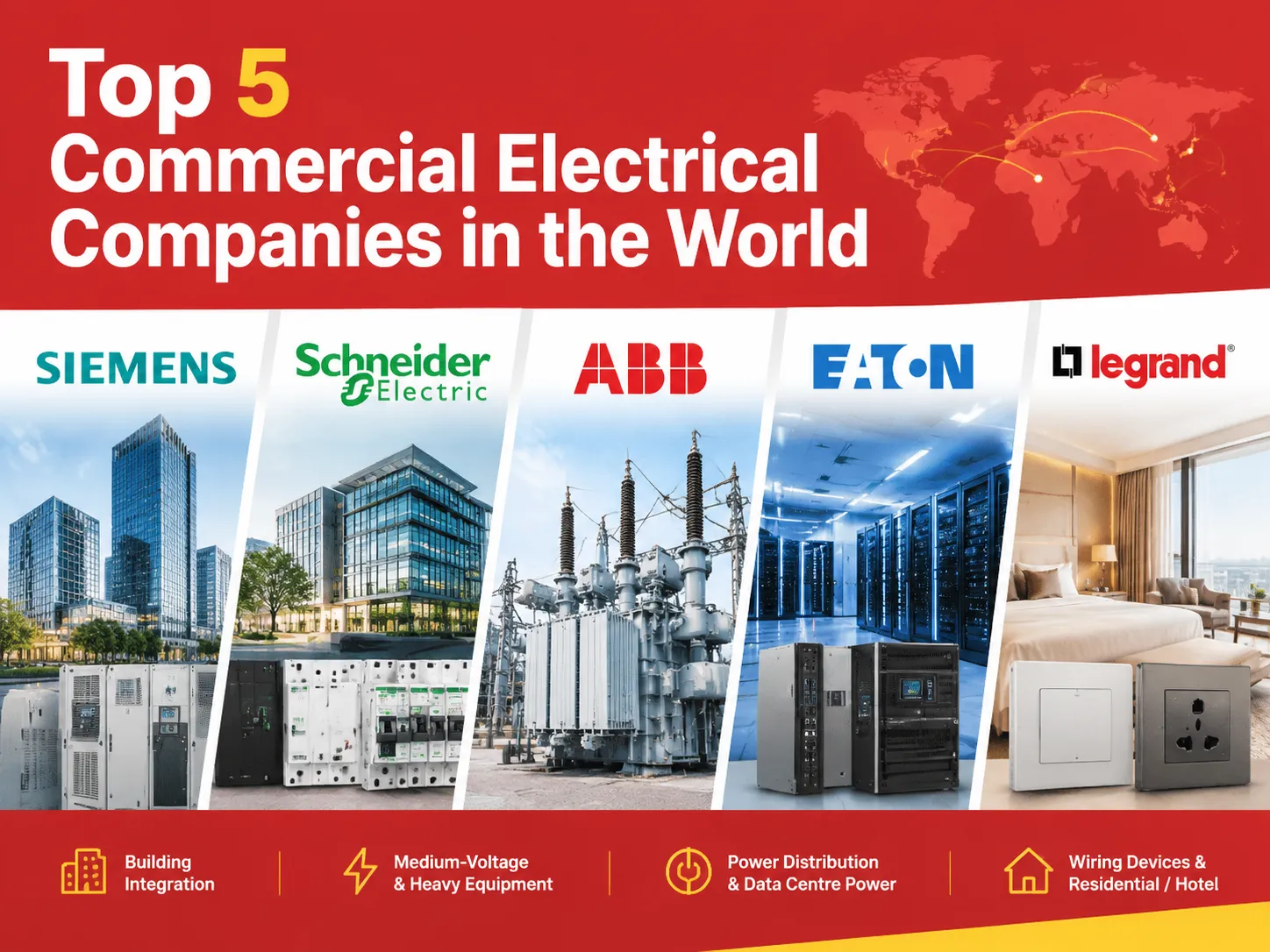
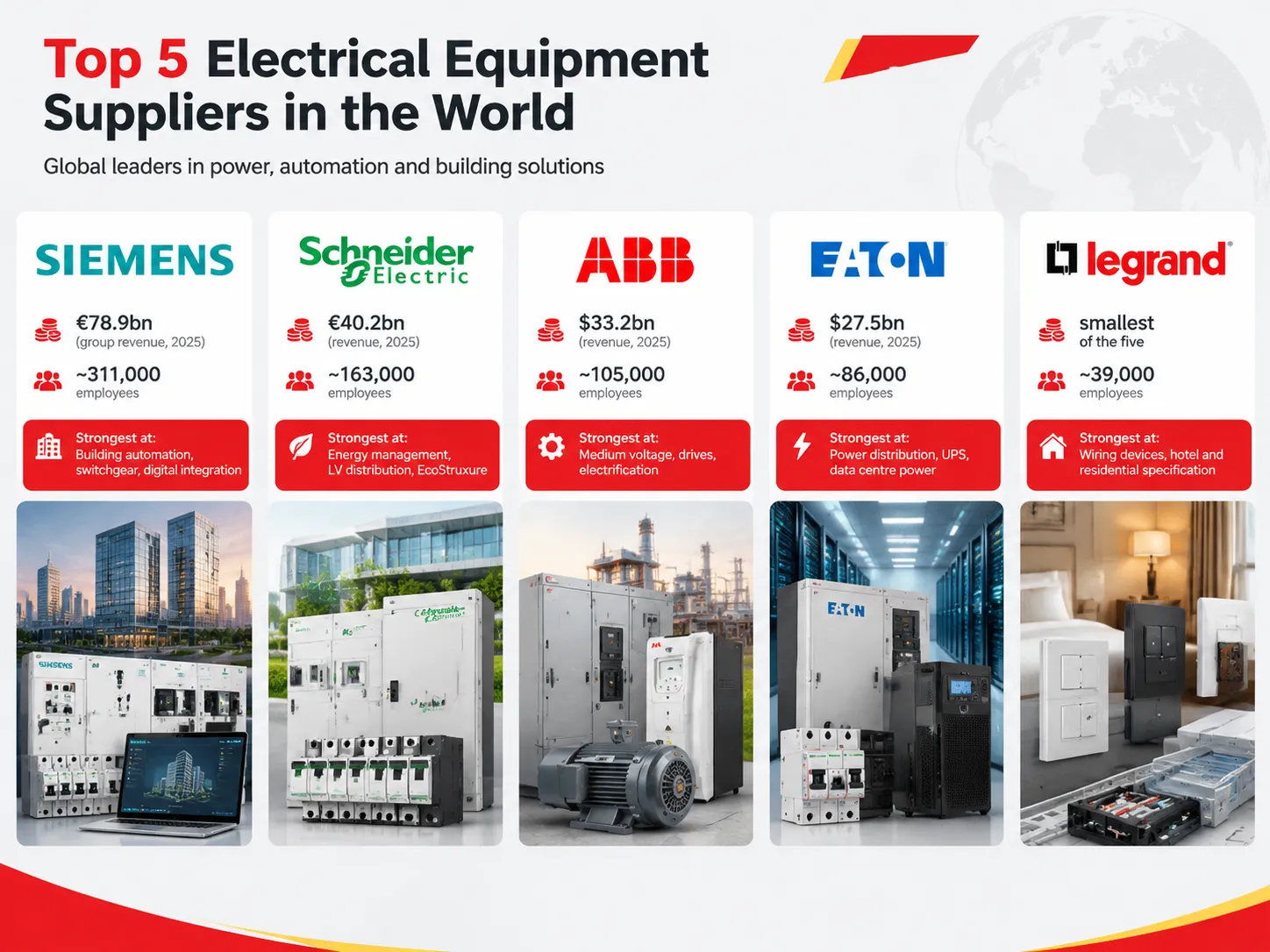
To summarize, Siemens, Schneider Electric, ABB, Eaton, and Legrand receive the highest revenue in the list of five largest commercial electrical companies. Siemens and Schneider take the lead in the area of building systems integration, ABB is leading in medium-voltage and heavy electrical systems, Eaton is in front of in the sphere of power distribution and data center power, and Legrand is good at wiring devices and hotel/residential specification. It is better to choose the provider based on its functions than size: hotel and steel factory can hardly share the same suppliers’ list.
At a Glance
| Company | Founded | 2025 revenue | Employees | Strongest at |
|---|---|---|---|---|
| Siemens | 1847, Germany | €78.9bn group | ~311,000 | Building automation, switchgear, digital integration |
| Schneider Electric | 1836, France | €40.2bn | ~163,000 | Energy management, LV distribution, EcoStruxure |
| ABB | 1988, Switzerland/Sweden | $33.2bn | ~105,000 | Medium voltage, drives, electrification |
| Eaton | 1911, Ireland/US | $27.5bn | ~86,000 | Power distribution, UPS, data centre power |
| Legrand | 1865, France | smallest of the five | ~39,000 | Wiring devices, hotel and residential specification |
Revenue numbers are FY2025 as declared in form and also converted when it is needed. Siemens is placed at the level of the group as its electrical works are situated inside Smart Infrastructure and Digital Industries that altogether comprise a significant component of the total.
1. Siemens
Siemens is by far the biggest of the five suppliers in this sector, as well as the most vertically integrated. The relevant divisions for commercial buildings include Smart Infrastructure—covering switchgear, busway, building automation, and fire safety—and the Digital Industries division responsible for the lower levels of control system architecture.
This means that the entire package (medium voltage intake, LV distribution, building management system, and room automation) can be supplied by one supplier through a single engineering interface. In large buildings, such as hospitals or universities, this integration pays off significantly, as it is the interfaces between different suppliers that are the source of delays.
Certifications are considered to be standard in this sector: ISO 9001, ISO 14001, ISO 45001, and product certification for assemblies according to IEC 61439 for assembly and IEC 60947 for components, plus national certification. The key limitation is cost/inertia: a Siemens specification is not warranted in the case of small-scale installation, while the change process in the course of a large project is much slower than in the case of a company providing the relevant niche services.
Where Siemens is effective: airports, hospitals, campuses, and any project where the owner is already using Siemens systems, as well as large-scale industrial enterprises that need automation services. Siemens has one of the best documentation packages for consultants, with all the data sheets, type test reports, and declarations already available.
2. Schneider Electric
Schneider is Siemens’ nearest rival in the electricity industry with respect to work done on a large scale and is also better than Siemens on the low-voltage distribution and energy management fronts. The Acti 9 and Compact categories manage the low voltage level electronic boards, while EcoStruxure serves the monitoring and control part of the work.
The strength of Schneider is the existence of a large range of channels. This means the existence of certified builders and system integrators worldwide, which helps to create the assembly using local resources even in the case of selecting a Schneider product by the project.
Considering the financial results of the company for the year 2025, Schneider reached revenue of approximately 40.2 billion euro and employed around 163 000 people. The company’s statistics indicate that the software and services segments are developing faster than hardware components.
Schneider is especially good at commercial offices, retail chains, hotels, data-centers, etc. where the owner wants to use a single platform for all the metering, monitoring and control processes.Their global service footprint is the reason a chain can standardise across countries, and the reach behind that is described in our own global network page, because the same logistics problem applies to any supplier working across borders.
3. ABB
Among the five players in the medium voltage switchgear segment, ABB is the technical leader. It has the least inclination towards small commercial installations. The electrification unit takes care of equipment that ranges from 12 kV switchgear suites to the main electrical box at the LV of a building. Also, it is the reference company in the field of drive systems.
In commercial buildings, ABB is usually present at the beginning, meaning medium voltage switchgear, ring main units, transformers and associated protection equipment. In case of industrial plants, ABB is present with all types of products as its drive and protection equipment covers all types of electrical motors.
The company’s revenue in 2025 was $33.2 billion. ABB has around 105,000 employees. The corporation is the most active in robotics, however, this segment of the business is changing fundamentally the way how commercial building buyers purchase their equipment.
ABB is the winner in such aspects as industrial plants, utility substations or projects with heavy power supply, provided that the design specifications are written by engineering company quoting IEC 62271 standards.
4. Eaton
Eaton is the group’s expert in power distribution equipment, including circuit breakers, panelboards, switchboards, busway, emergency power supply systems and devices for ensuring the quality of power provided to the data centre. As of 2025, revenue is reported at $27.5 billion, with the number of employees reaching 86,000. The data centres are the most rapidly growing sector for the company.
Eaton’s area of expertise when it comes to commercial buildings is low voltage distribution and the backup power supply. If the building is in need of a main switchboard, a generator transfer scheme and an uninterruptible power supply, all three can be purchased from the same catalogue, which makes the coordination study easier.
The products involved are all the usual products for commercial projects: miniature circuit breakers, moulded case circuit breakers, residual current devices and contactors.The MCB end of that range is a good illustration of how similar the five companies’ product lines actually are at component level, and this 63 A AC miniature circuit breaker shows the same 1P to 4P, B/C/D curve structure that the majors build.
The markets where Eaton wins include data centres, health care sector and industrial installations with backup power supply as well as projects where electrical contractors prefer to have a single supplier of electrical equipment.
5. Legrand
Though Legrand is the smallest in terms of revenue, it has the edge in the final phase of construction as it is specializing in wiring devices and floor boxes. The company is known for its famous brands such as Legrand, Pass & Seymour, Wattstopper and Cablofil; and its offer is mainly focused on the final stage of fittings.
In this case, the focus for Legrand is important, as a hotel room is equipped with different devices such as a card switch, a bedside control plate, a shaver socket, a data outlet, and a floor box; thus all devices should go with the same look, which Legrand has managed to do.
Here, Legrand’s strength lays in providing its services for hotels, residential buildings, hospitals, and offices where design issues and finishings are as important as the electrical rating of devices provided.
What All Five Have in Common
There are many similarities between these five companies in regard to four criteria that should be expected of any reputable supplier.
- Certified quality systems. These include ISO 9001 for quality, ISO 14001 for environmental management systems, and ISO 45001 for health and safety certification. All certified systems can be audited and certification numbers can be checked.
- Tested products. Products are tested to IEC 61439, circuit breakers to IEC 60947 or IEC 60898, and residual current devices to IEC 61008 or IEC 61009. There are test reports for every tested product that can be obtained when a specific serial number is provided.
- Global support and spare parts. Agreements to supply spare parts for ten years, local technical support, and documented discontinuation of old models.
- Reference projects. Projects tested using certified quality management systems.
Certificate set is the easiest element to verify by buyers. Therefore, all bidders should be requested to provide the same four documents instead of just accepting a general brochure.Our own certificate library exists because that request is universal.
Where HUYU Fits
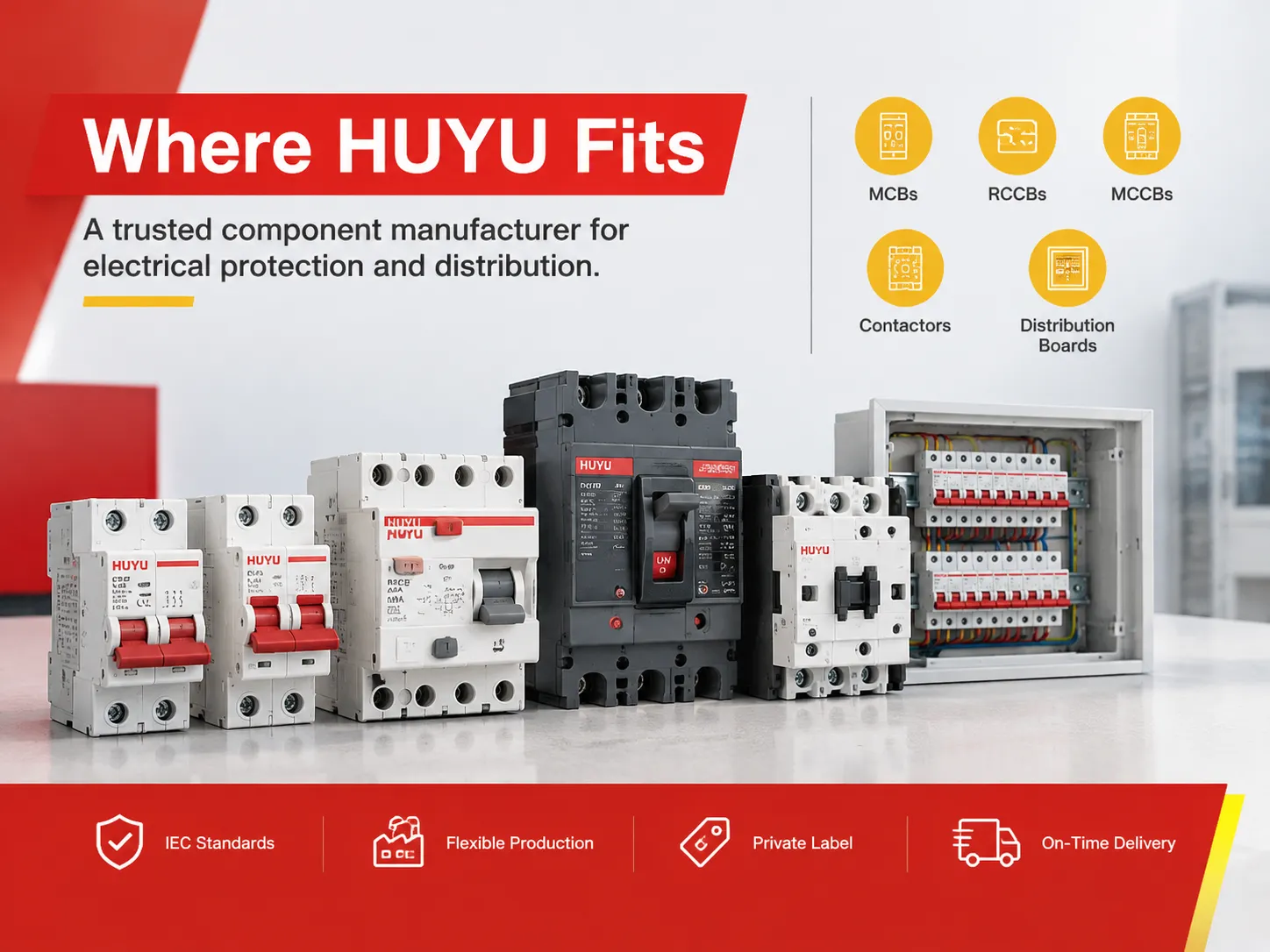
We’re not expecting to be one of the big five – we manufacture products like miniature circuit breakers, residual current devices, molded case circuit breakers, air circuit breakers, contactors, and distribution boards that comply with IEC standards and thus are offered to panel builders, distributors, and customers using it for their projects.
The comments above apply to the genuine answer to a proper connotation of the question. If you want to put a global brand on your building, then you’ve got to choose one of the big five options. If a panel builder needs 3,000 MCBs and 400 RCCBs at a competitive landed cost, with a certificate pack and a delivery date, a factory is the right supplier, and the range is described on our MCB manufacturing page.
What we can do that multinationals usually cannot is designed solutions: a specific number of poles, a specific breaking capacity, a customer-specific label on the equipment, and a production run designed to fit the project instead of a world-wide forecast.
Choosing by Buyer Type
The buyer profiles are four in number:
- The builder of hotel or housing tower collects the items for room application from a vendor like Legrand, obtains products for distribution from a supplier like Schneider, and needs a local panel builder for installation. Finishing products are crucial for him, while reliability is much more critical for the next buyer.
- The industrial production facility is looking for the vendors, like ABB or Siemens for receiving medium voltage and Eaton for low voltage distribution. It would choose a manufacturing plant for the parts and get the other items from somewhere else. The company purchasing 200 contactors does not need to pay for them at brand prices.
- The electrical contractor in commercial construction purchases the products of the same brand, which has been listed by the consultant, and is going to buy them from a distributor or an alternative supplier for the long lead articles.
- The supplier or the panel maker has a manufacturer’s contract for the product lines and one global brand for the specific projects. They earn money from the first type of buyer and gain credibility from the second one.
The case of industrial buyer shows clearly the difference because it simply buys a large number of contactors, overload relays, and switches that do not require the global quality. This AC contactor range is the kind of product that fills that gap: standard frame sizes, standard coil voltages, and a price that reflects the absence of three tiers of distribution.
FAQ
Who are the largest commercial electrical companies in the world?
In the order of revenue: Siemens, Schneider Electric, ABB, Eaton and Legrand. Siemens and Schneider are leaders in building-level integration, ABB is a leader in medium voltage and heavy electrification, Eaton in power distribution and backup power, and Legrand in wiring devices.
What is the difference between a commercial electrical company and an electrical contractor?
Manufacturers are responsible for supplying the goods and systems; contractors are responsible for their installation. These five companies are examples of manufacturers even if they mainly sell their products via distributors and accredited panel builders. Therefore, a project requires both manufacturer and contractor, the former providing the equipment and the latter taking care of its installation.
Which brand is best for a commercial building?
There is no one best brand. You match the brand to the risk of the one type: continuity of the supply for data centres, finishes for hotels, motor overloads for plants and integration for campuses. For many of projects the right answers are two brands plus local assembler and not a single brand.
Do I need a global brand for a small commercial fit-out?
It is not common. The standard demands compliance to the local standards and to provide a documentation pack accepted by the inspector. An IEC certified component manufacturer meets this requirement, provided that the panel assembler is capable and the documentation is in order.
References
- Siemens — Smart Infrastructure and Electrification
- ABB — Electrification and Medium Voltage Products
- Legrand — Wiring Devices and Building Infrastructure
- Fortune — Global 500 Company Profiles
- Statista — Electrical Equipment Market Data
Conclusion
Five companies are out there, each having its area of specialisation. Siemens has joined forces with Schneider, ABB is well represented in the midvoltage section, Eaton works with power products, and Legrand works with wall-mounted devices.
Should we need a supplier, we would not hesitate to name it, but in case the frequency deals with components, we would have to indicate the standards of quality requirements.