
You have just purchased a little factory in an industrial zone, and the owner tells you that you could choose between either single-phase power or three-phase power. Three-phase installation is almost three times more expensive than simple installation; however, you have no idea whether you really need it. At the same time, your newly ordered CNC machine has “three-phase only” written on itself. This is a question that many purchasers of machines and companies’ owners face on a regular basis — and if the choice is wrong, the user will either overpay for unnecessary power or find out that he cannot use his equipment.
This guide provides a clear understanding of the differences between single- and three-phase power systems, what they imply, how much they cost, and when they are used. You will find all the necessary information to make the right choice without a higher education in engineering.
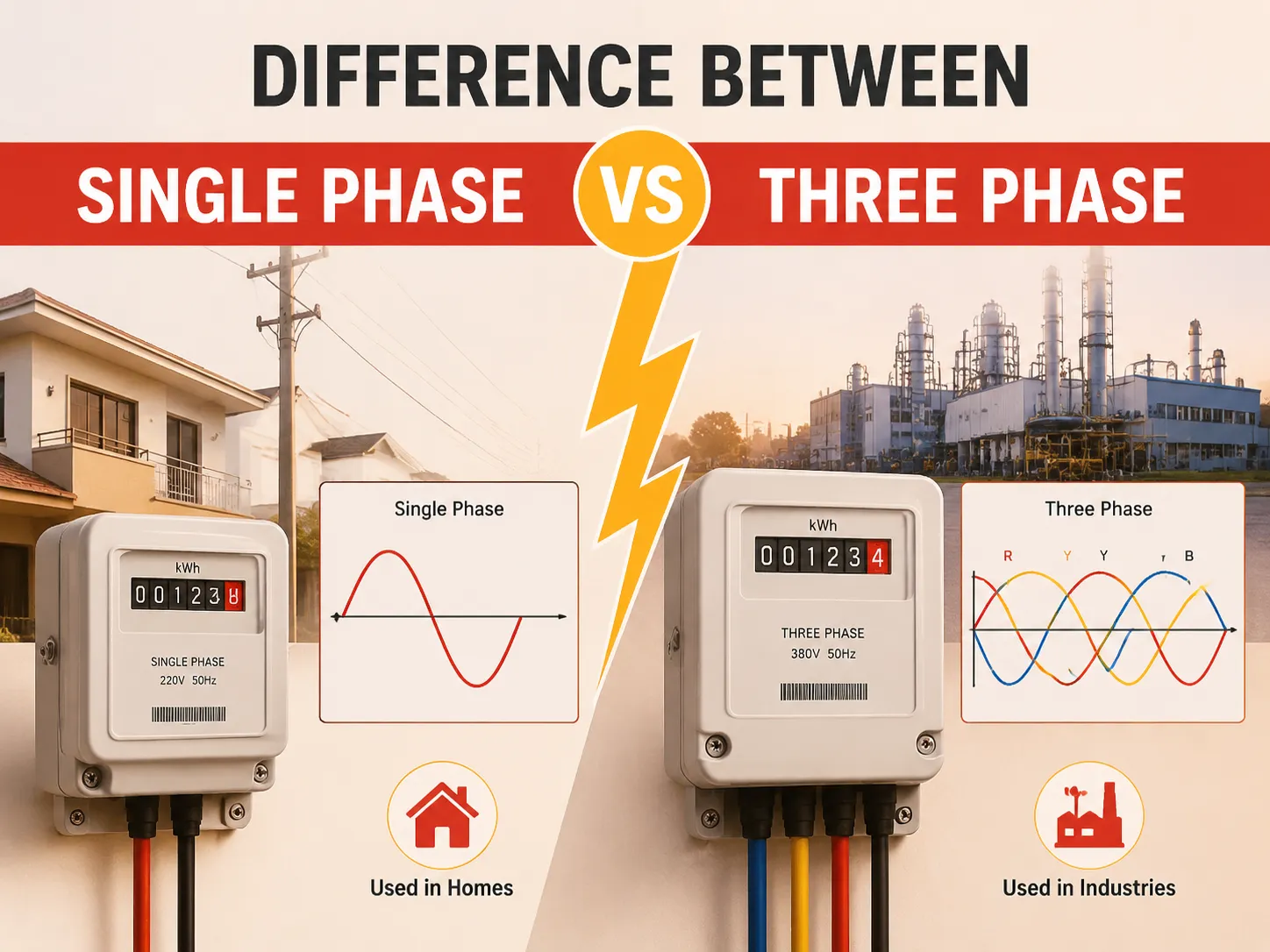
Quick answer: Single-phase power uses one AC waveform (plus neutral), giving it the ability to provide power that rises and falls 50 to 60 times every second. It supplies power to residential homes and small load devices of about 15-20 kW. In contrast, three-phase uses as a source of power 3 AC waveforms that are offset by 120 degrees from each other, generating uninterrupted, very stable power that does not go to zero. It is the most common type of energy utilized in factories, large commercial properties, big motors, and other heavy machinery.
What Is Single-Phase Power?
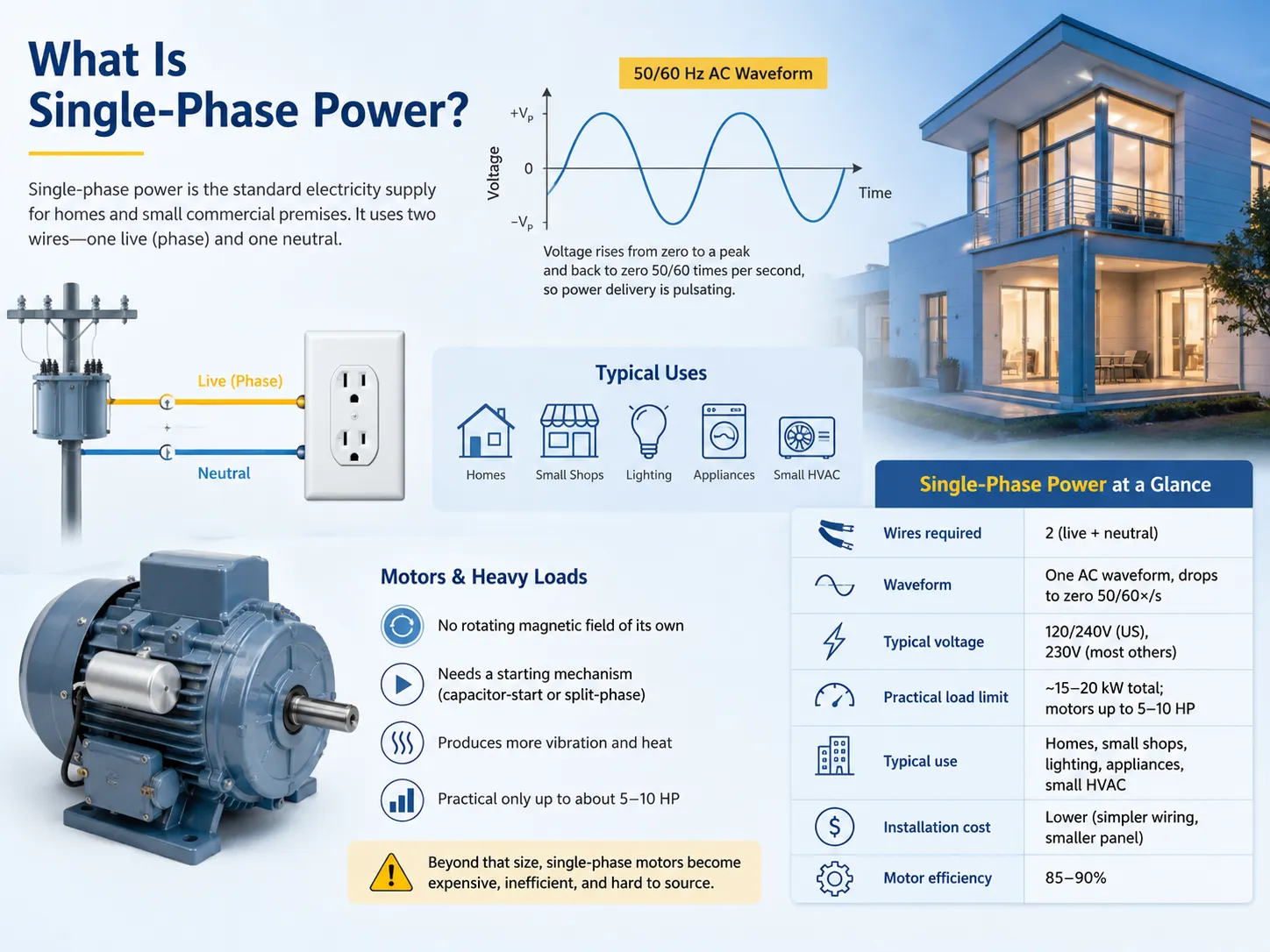
Residential and small business facilities rely on single-phase electricity as the conventional option for power supply. The mechanism is based on two types of conductors – one live and one neutral, with the electrical energy alternating from nil to maximum voltage with the 50 or 60 cycles every second. Unlike direct current with permanent voltage, single-phase electricity fluctuates throughout time, which is of huge importance when it comes to motors and heavy loads.
When it comes to motors, the absence of rotating electromagnetic field in a single-phase motor means that such motors have to be started with auxiliary equipment. It is known that single-phase motors produce more vibrations and generate more heat when compared with three-phase ones. These electrical machines can be used for specific applications having output not exceeding 5-10 HP because they become uneconomical above this threshold.
| Characteristic | Single-Phase Power |
|---|---|
| Wires required | 2 (live + neutral) |
| Waveform | One AC waveform, drops to zero 50/60×/s |
| Typical voltage | 120/240V (US), 230V (most others) |
| Practical load limit | ~15–20 kW total; motors up to 5–10 HP |
| Typical use | Homes, small shops, lighting, appliances, small HVAC |
| Installation cost | Lower (simpler wiring, smaller panel) |
| Motor efficiency | 85–90% |
What Is Three-Phase Power?
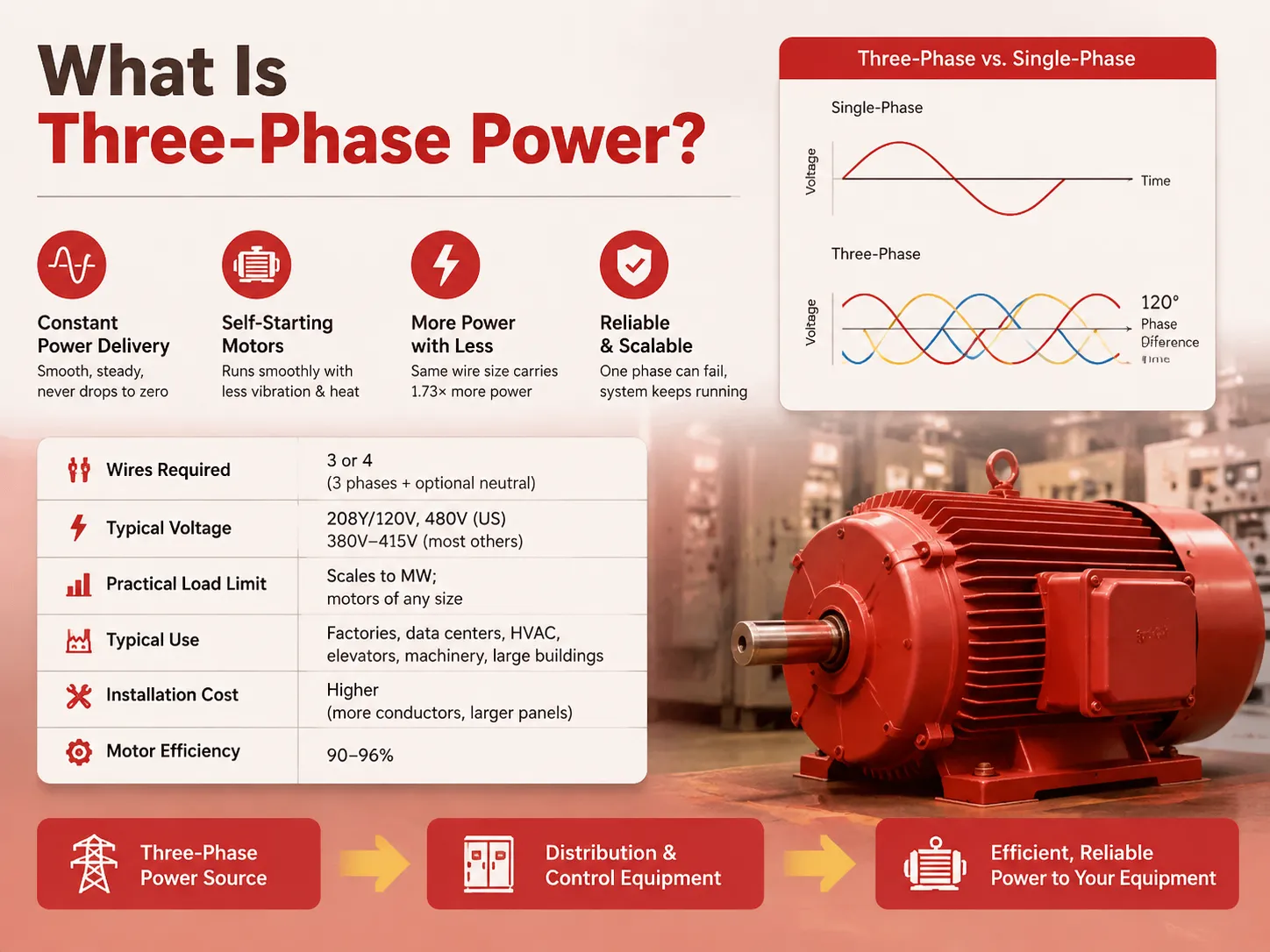
Three-phase electricity involves three alternating current signals that are present in three conductors (plus neutral, if needed), and they appear with an offset of 120 degrees. Since each phase reaches peak value at a different time, it results in continuous energy supply, meaning that the energy does not go down to zero. Thanks to this, three-phase electric motors do not require any additional starting means since they are already powered by rotating magnetic field.
Also, the same wire thickness applied in three-phase systems supplies approximately 1.73 times more electricity in a three-phase system than in a single-phase one, which justifies its use beyond household requirements by different companies. In addition, three-phase systems are capable of resisting the shutdown of one phase without making the circuit meaningless and enable much heavier load from several horsepower to 10,000 hp.
| Characteristic | Three-Phase Power |
|---|---|
| Wires required | 3 or 4 (3 phases + optional neutral) |
| Waveform | Three waveforms offset 120°, constant delivery |
| Typical voltage | 208Y/120V, 480V (US); 380V–415V (most others) |
| Practical load limit | Scales to MW; motors of any size |
| Typical use | Factories, data centers, HVAC, elevators, machinery, large buildings |
| Installation cost | Higher (more conductors, larger panels, switchgear) |
| Motor efficiency | 90–96% |
Key Differences at a Glance
| Aspect | Single-Phase | Three-Phase |
|---|---|---|
| Number of phases | One | Three (120° apart) |
| Power delivery | Pulsating, drops to zero | Constant, smooth |
| Power at same current | Baseline | 1.73× more |
| Conductor size for same load | Larger | Smaller (~25% less copper) |
| Motor starting | Needs capacitor/start winding | Self-starting (rotating field) |
| Motor efficiency | 85–90% | 90–96% |
| Vibration & heat | Higher | Lower (smoother torque) |
| Typical limit | ~15–20 kW / 5–10 HP motors | No practical limit |
| Fault tolerance | One fault = whole circuit fails | Other phases keep running |
| Installation cost | Lower | 20–40% higher upfront |
| Running cost (high loads) | Higher per kW | Lower per kW |
Voltage Levels & Wiring Configurations
To read voltage ratings from your device is the primary decision in choosing the correct power supply. Below is how single-phase and three-phase voltages exist in many parts of the world.
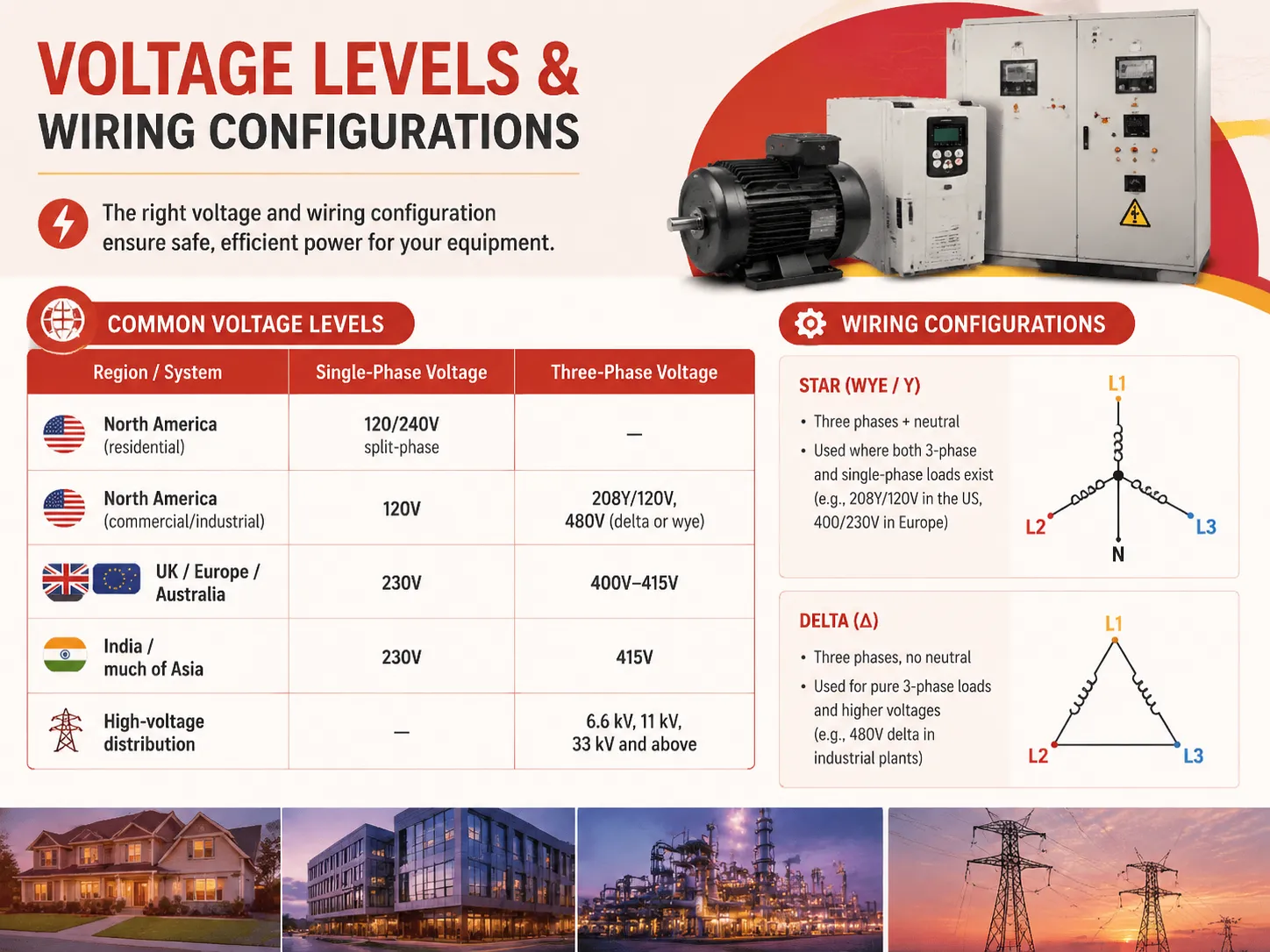
| Region / System | Single-Phase Voltage | Three-Phase Voltage |
|---|---|---|
| North America (residential) | 120/240V split-phase | — |
| North America (commercial/industrial) | 120V | 208Y/120V, 480V (delta or wye) |
| UK / Europe / Australia | 230V | 400V–415V |
| India / much of Asia | 230V | 415V |
| High-voltage distribution | — | 6.6 kV, 11 kV, 33 kV and above |
There are two well-known arrangements of the three-phase systems:
- Star (Y or Wye): Three phases together with a neutral. Suitable for applications with both, three-phase loads and single-phase loads (for example 208Y/120V in the USA and 400/230V in Europe).
- Delta: Three phases without the neutral. Applied for the cases of pure three-phase loads and when there are high voltages (for example 480V delta in manufacturing industry).
If you are working out which breakers and poles your service needs, our guide on 1-pole vs 2-pole circuit breakers explains how pole count maps to voltage and phase configuration in practice.
Efficiency: Why Three-Phase Wins for Motors
In terms of working applications, the main difference between motors depends on the notion of three-phase motors.The three-phase motor has properties like:
- It generates a constant rotating magnetic field, allowing for a smooth and non-jerky torque operation.
- It works approximately 3%–5% more efficiently (with efficiency rates of about 90%-96% compared with 85%-90%).
- It operates at lower temperatures and is considerably quieter.
- It has a self-starting capability.
- It can be designed in various sizes: from small (fraction of horsepower) to extremely high (over 10,000 horsepower).
The cost of the installation of such type is high but it pays off in the long run for factories.
Where Each System Is Used
Single-phase is suitable for:
- Houses and flats
- Grocery stores, small businesses, and restaurants not having heavy motors.
- Lighting circuits and basic home appliances.
- Small HVAC items which can manage up to 5 tons or less.
- Any site with less than 15-20kW of total load.
Three-phase is suitable for:
- Factories and manufacturing companies.
- Data centers and commercial buildings.
- Motors exceeding 5 HP, pumps, compressors, conveyors, and CNC tools.
- Elevators, huge HVAC systems, and industrial kitchens.
- Solar farms, charging centers for electric vehicles, and energy storage facilities.
- Any organization which might require more electricity in the future.
Cost Comparison: Installation & Running Costs
Cost is where most buyers get confused, so let’s be specific. Three-phase costs more upfront but can cost less per unit of energy delivered at high loads.
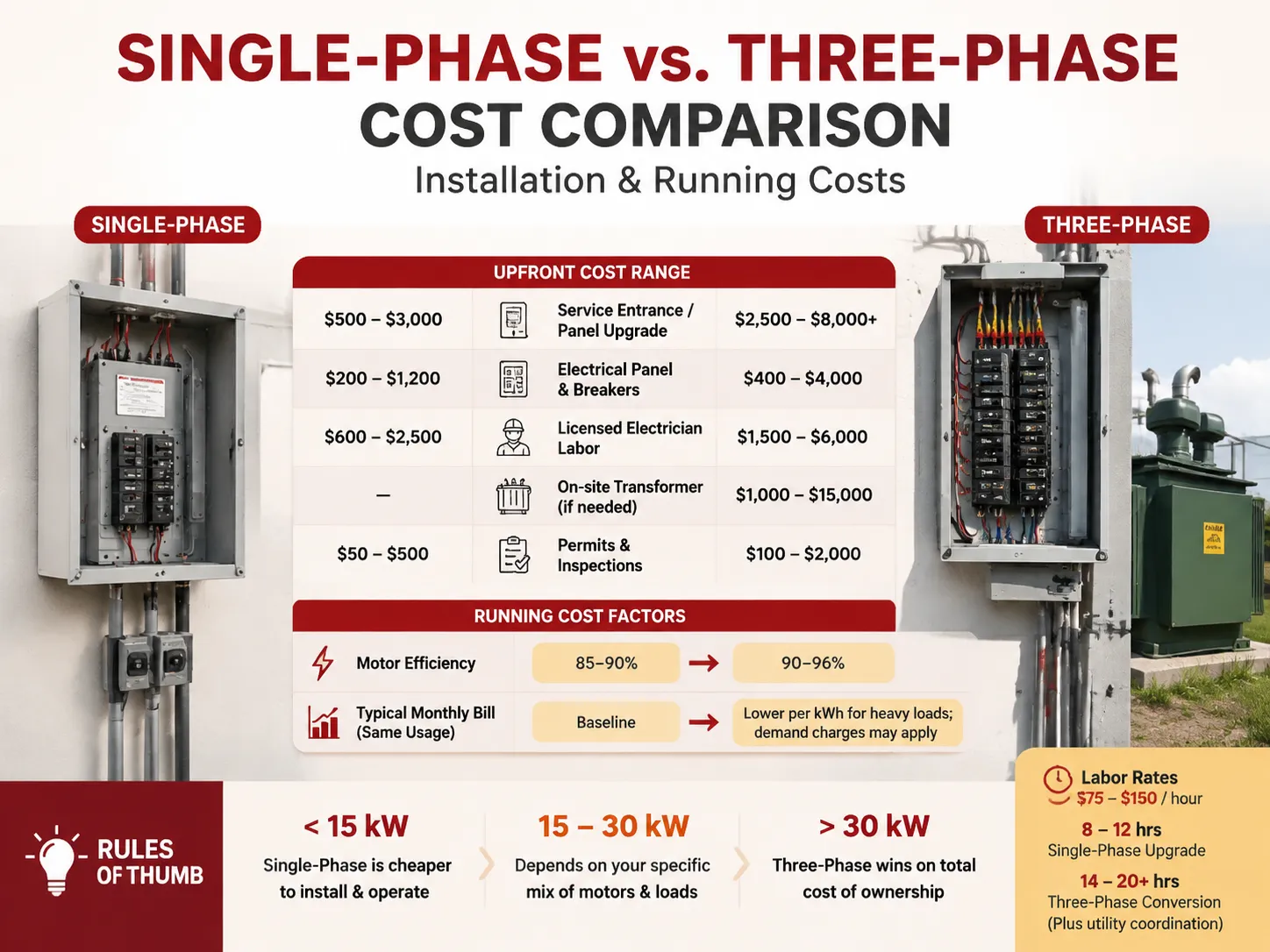
| Cost Item | Single-Phase | Three-Phase |
|---|---|---|
| Service entrance / panel upgrade | $500–$3,000 | $2,500–$8,000+ |
| Full conversion from single to three-phase | — | $3,500–$25,000 (includes transformer, panel, labor) |
| Electrical panel & breakers | $200–$1,200 | $400–$4,000 |
| Licensed electrician labor | $600–$2,500 | $1,500–$6,000 |
| On-site transformer (if needed) | — | $1,000–$15,000 |
| Permits & inspections | $50–$500 | $100–$2,000 |
| Motor efficiency | 85–90% | 90–96% |
| Typical monthly bill (same usage pattern) | Baseline | Lower per kWh delivered for heavy loads; demand charges may apply |
The outcome of the cost analysis may help some useful estimates: between 15 kW and 30 kW, it may make sense to opt for three-phase technology, and for loads below 15 kW use single phase. If we need to compare electric service cost, we find out that it varies from $75 an hour up to $150 for the most expensive labor rates. Replacement of single-phase service usually takes 8–12 hours, while the process of replacing three-phase service requires 14–20 hours; besides, one more thing that is often needed is the cooperation with the utility company for preparation of an appropriate model for power supply.
How to Decide Which One You Need
The following steps can guide you to reach the right conclusion:
- Consult the nameplate of the motor or the machine. In case it shows “3-phase only” you need to have three-phase supply without arguing, meaning that having a phase converter is a good but not ecconomically viable long-term alternative.
- Sum up the total load. If the load is under 15-20 kW and the motors are not over 5 HP, the single phase is acceptable, but in case the total load is over 30 kW or several high-power motors have to be powered then three-phase supply should be used.
- Ask what motor you are going to install. Be ready to implement three-phase electric supply if the motor is over 5-10 HP due to efficiency, availability, and price.
- Analyze the possibilities for further development. If the company thinks about purchasing new equipment such as machines, chargers, and HVAC systems in the nearest future, having three-phase supply may save a lot of money in comparison to installation of full electric supply.
- Investigate electric supply possibilities. It is necessary to check the available options offered by the electric utility in the district before budgeting and decide on the project.
Can You Convert from Single-Phase to Three-Phase?
There exist two ways:
- Upgrading the utility service involves contacting your utility company to establish three-phase service to your property. The cost can vary between $3,500 and $25,000 depending on the distance of the nearest three-phase line, your service sizes, transformers that have to be installed, and the rules of your area. This method is the right long-term choice for heavy industrial loads.
- Phase converters include rotary and static converters, which allow the use of three-phase machines from a single-phase power source. This method applies to some cases and is less efficient, though sizable motors may require some downgrading.
Choosing Breakers & Switchgear for Each System
When you determine your type of supply, your protect equipment must correspond with it. The equipment for three-phase connections will have to be equipped with breakers either of three or four pole type, so there should be three-phase automatic switches and the proper panels by volts rating. You shouldn’t just reuse equipment meant for single-phase systems. The following points are important to remember:
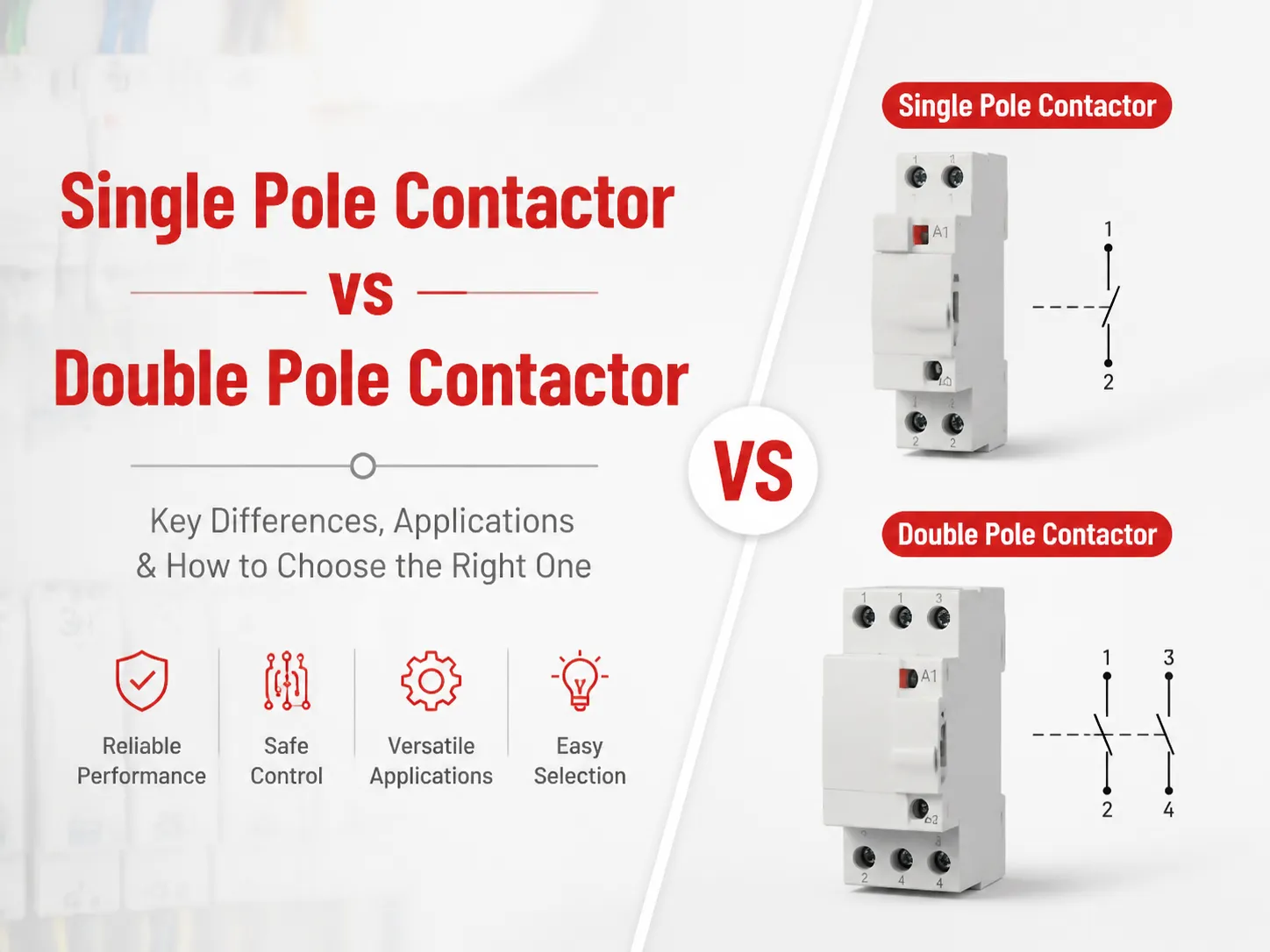
- In case of single-phase devices, 1-pole breakers are used (120 volts) and 2-pole breakers (240 volts).
- Three-phase equipment will have to use 3-pole breakers (with a 4th pole in case of neutral systems) rated according to the system voltage.
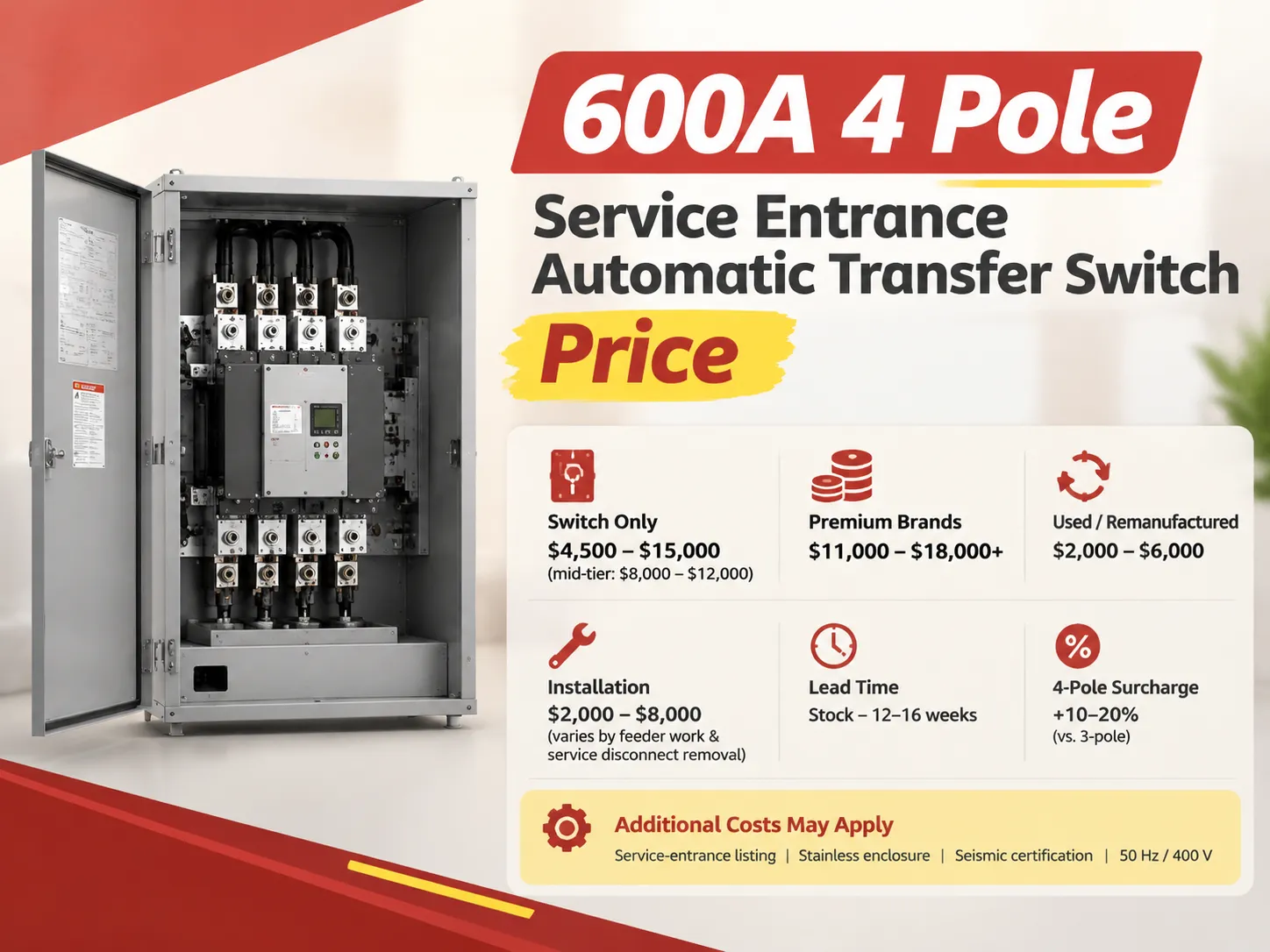
- Generars and automatic switches have to match, you cannot use single-phase ATS to switch three-phase supply and vice versa. There are different types of phases-separating equipment.
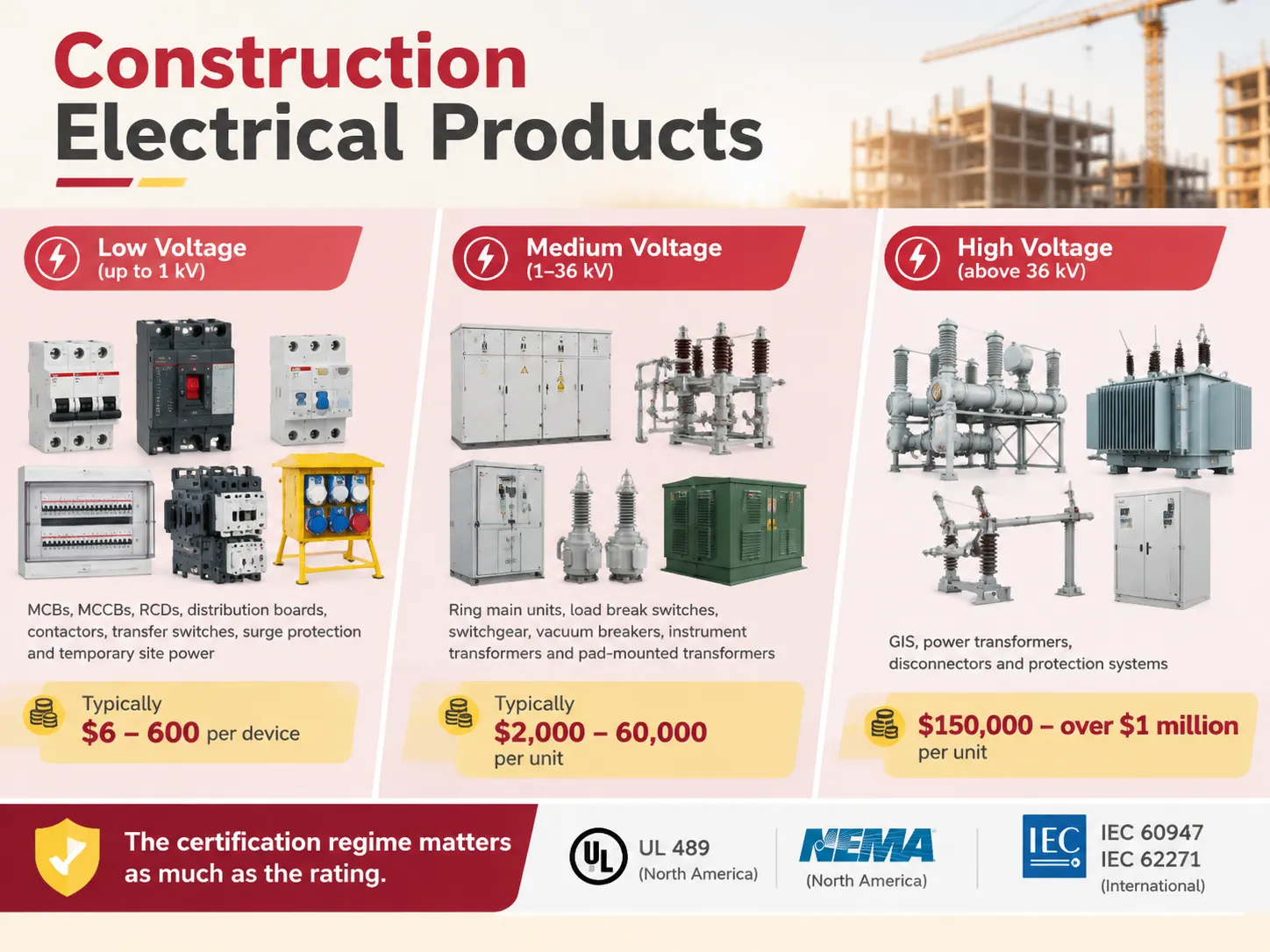
- Switchgear has to be certified according to the requirements by IEC and UL standards.
When you construct a power distribution system, providing the right circuit breaking and switching equipment from the very beginning will prevent mistakes in the process.A good starting point is our MCB vs MCCB guide, which explains how different breaker classes protect different load levels across single- and three-phase systems.
Frequently Asked Questions
Is 220V single or 3 phase?
When we talk about the term 220V, we can mean either one of two voltages. First of all, in most nations other than North America the standard phase voltage is 220-230V between live and neutral. However, phase A is often regarded simply as the voltage between phases of a three-phase system; for instance, in the case of delta type voltage available in older installations at 220V, and in the case of wye connection with a typical voltage of 380/220V, where the current phase is equal to the phase-neutral voltage. In order to define the type of the voltage simply count the number of conductors – 2 wires (live and neutral) indicates single-phase configuration, while 3 or 4 wires (3 phases + optional neutral) means that the system is three-phase.
Is 3 phase or single-phase better?
It actually depends on your usage. For homes and small stores of 15-20kW, a single-phase system is easier and cheaper to operate and is perfectly sufficient. However, for factories, workshops, and commercial buildings, as well as data centers, and for installations with motors larger than 5 HP or a total load higher than 30kW, a three-phase system is preferable because it is much more energy-efficient (90-96% vs 85-90% for motors) and also ensures stable power delivery and smoother operation with less vibration and at lower prices.
Is 240V single-phase or 3 phase?
In North American households, 240V is mostly a single-phase power supply (i.e., the well-known 120/240V split-phase power supply with its center-tapped transformer). However, 240V can also be a three-phase power supply in certain systems (for instance, 240V delta three-phase supply employed with various industrial components, or 240V phase-to-phase voltage of the 415/240V wye supply). To find out which type of 240V system you are working with, count the number of wires at the terminals of the equipment and examine the panel setup.
What are the disadvantages of three-phase power?
Cost and difficulty are the two major drawbacks: three-phase services cost significantly more to set up (service upgrade costs are from $3,500 to $25,000, which includes charges for transformers and workers), and require more wires, a bigger panel, three-pole breakers, and more complicated installation. Not all regions have three-phase electricity supplies, meaning that you are effectively paying for power you will not be using if your loads are small. Some energy providers can charge fees for the supply of three-phase electricity; also, the fault current level is much higher so your protection devices must be rated appropriately, namely according to their AIC rating.
References
- NFPA 70 — National Electrical Code (NEC), Articles 220 & 430: Branch circuit, feeder, and motor calculations
- IEEE Std 141 — IEEE Recommended Practice for Electric Power Distribution for Industrial Plants
- NEMA MG 1 — Motors and Generators: efficiency and application standards
- IEC 60038 — IEC standard voltages
- Universal Technical Institute — Single vs. Three-Phase Power: Key Differences and Best Uses
- Enginist — Single-Phase vs Three-Phase: Engineering Comparison & Cost Analysis
- LatestCost — Three-Phase vs Single-Phase Electricity Cost Comparison 2026
Conclusion
Single-phase power and three-phase power are not simply two ways of using electricity; each one is useful for different applications. Single-phase power is inexpensive, easy to use, and adequate for homes and light commercial activities with up to 15-20 kilowatts of electricity. Three-phase power is a source of constant energy, which is 1.73 times more power at the same level of current than single-phase electricity, requires little energy to run motors, runs engines smoothly, and has no limits in the amount of energy it distributes; due to that, it is widely used in power-intensive enterprises like factories or data centers, although they have to invest more initially.
Just choose a way to figure this out based on checking the nameplates of your equipment and determining your real load requirements and expected expansion. And when it’s time to choose your protective gear such as breakers, panels or transfer switches depending on the power supply you decide to use, HUYU Global offers you controlled MCB, MCCB, and RCCB devices as well as single-phase and three-phase automatic transfer switches depending on the IEC standards.