
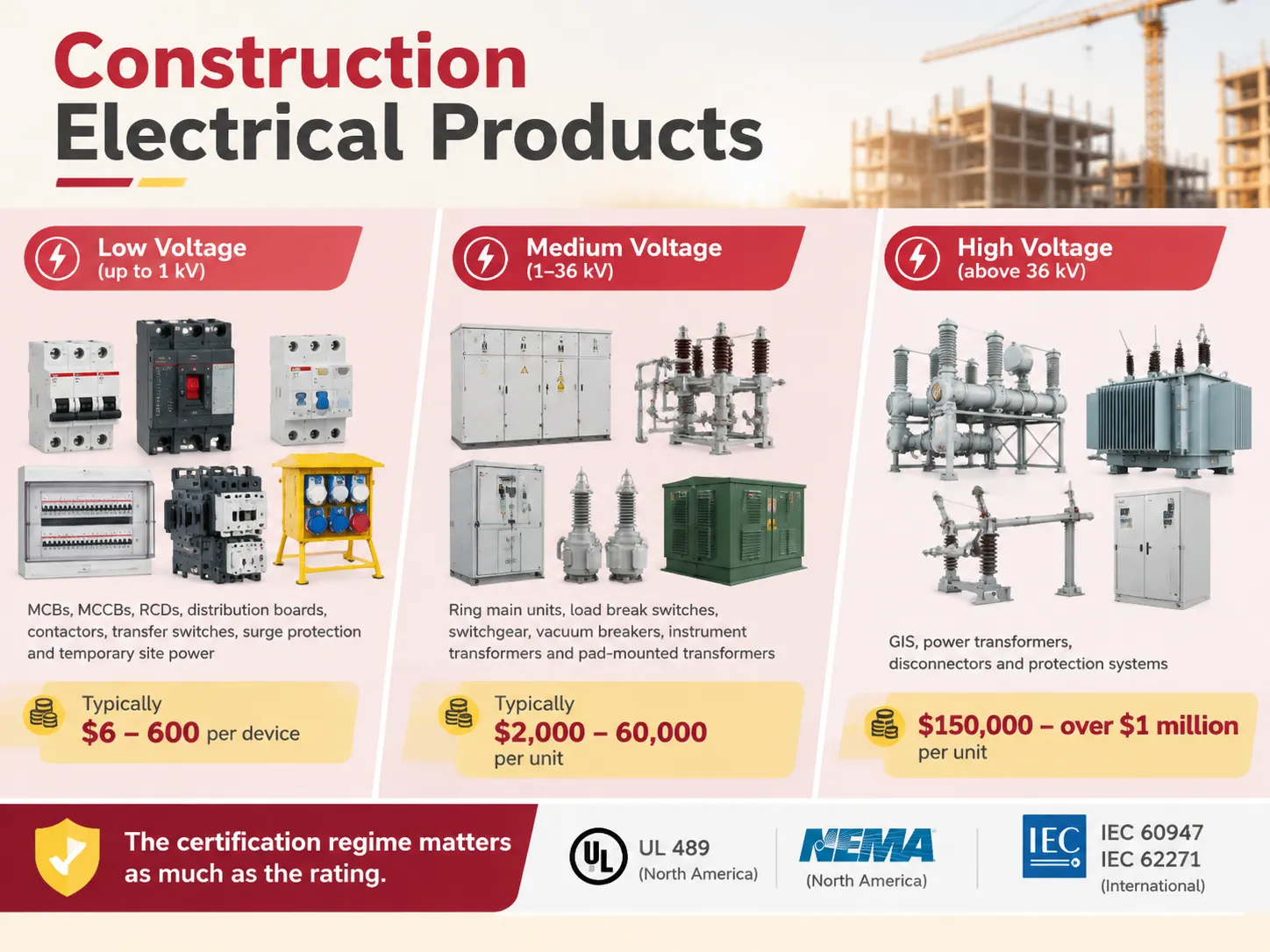
“Construction Electrical Products” refers to many types of electrical technologies. These include all types of electrical equipment, including electric protection devices and equipment to be utilized on the work site prior to the customer receiving power and having their first electric connection. The variety of products is extensive, ranging from low cost electric protection devices to very high cost transformers that may be worth tens of thousands of dollars. The most common mistake made by purchasers of construction electrical products is to identify the product by function alone without also taking into consideration technical specifications such as class of voltage, the capacity of short circuit protection and if the product is certified. This manual is created to provide an overview of construction electrical products, beginning with low voltage products.
In summary, electrical construction tools can fall into three categories based on their voltage: low voltage tools, medium voltage tools and high voltage tools. Low voltage tools will typically cost around $600 and will contain devices that include: circuit breakers, electrical panels, motor starters, transfer switches, surge suppressors, etc. Medium Voltage tools can be found in the range of $2,000-$60,000 and are also known as Ring Main units, Load Break Switches, Circuit Breakers and transformers. High Voltage Tools consist of Gas Insulated Switchgear, Transformer Substations, and Disconnectors, and generally have a price point of $150,000 or greater. Remember too that, depending on where you are located, the certification for these devices is different: UL 489 and NEMAN in North America; IEC 60947-5-1 and 62271 internationally.
What the phrase covers — and one company that shares the name
The term category has two meanings, and the buyer should know which one applies to the search. In its general sense, construction electrical products refers to devices used for a building or a location: protective devices, varying power distribution equipment, control equipment, transformers, switchgear, cables and temporary supply devices. In a particular sense, it is the name of a company: Construction Electrical Products (CEP) from Livermore, California, produced temporary power distribution and portable lighting for construction purposes for 27 years – spider boxes, temporary power stations, light sets, extension cables and electrical devices made according to UL 1640 standards and suitable for use in wet areas.
The meaning is important because it alters the answer, changing the first search from “What to specify for a project?” to “Who produces a spider box?” This guide accepts the first meaning and concerns temporary power as a part of it only, as the equipment is used since the main electrical installations come last in the process, while the work starts either way.

Low voltage: the products that do the everyday work
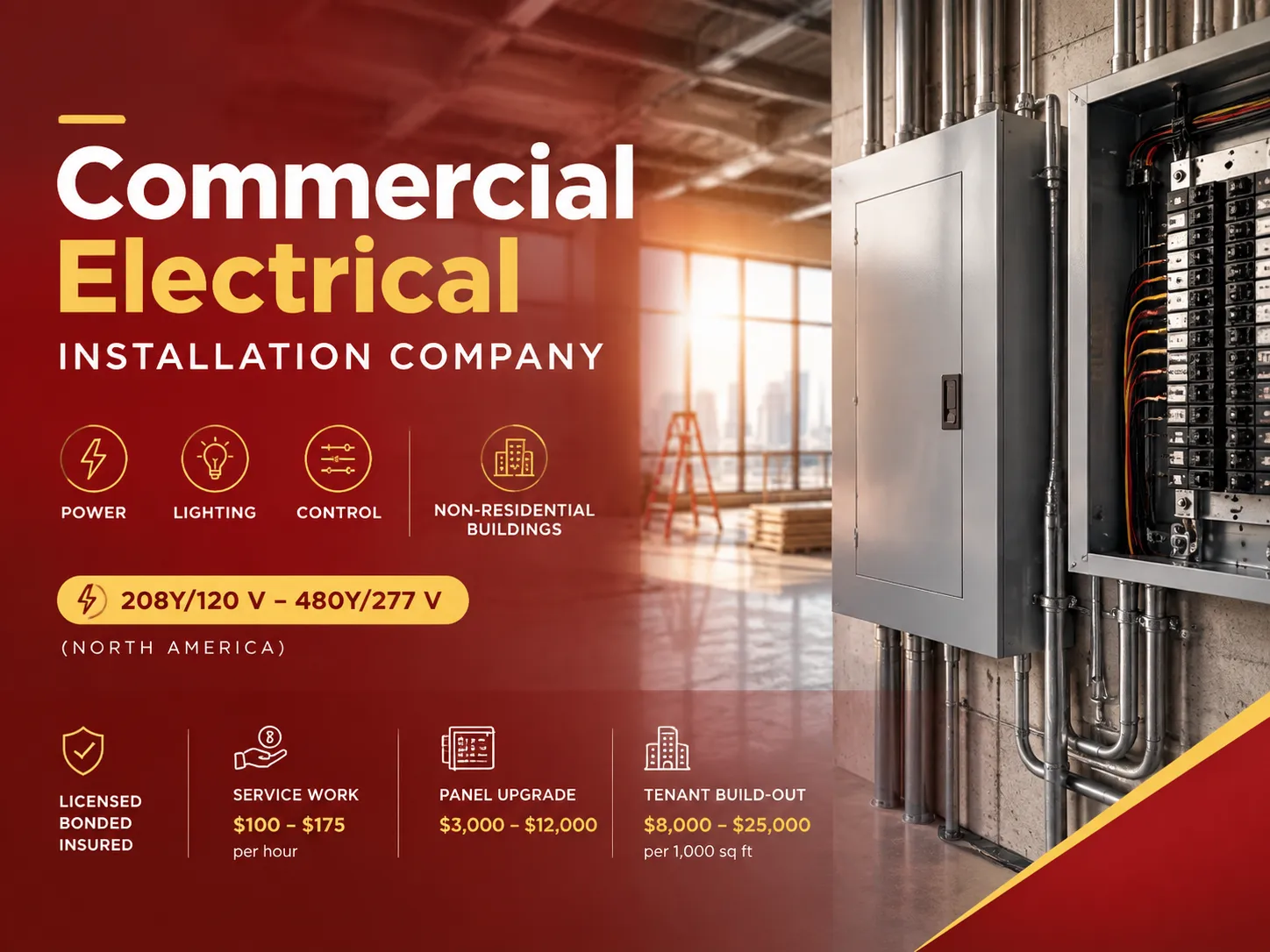
Low voltage is defined as a voltage equal to or below 1 kV or as voltage in North America at 120/240/480 V and Internationally at 230/400 V. Among all electrical systems, low voltage is the system most commonly encountered in any project. The core families are protection, distribution and control.
| Family | Typical products | Where it is used |
|---|---|---|
| Final-circuit protection | Miniature circuit breakers (MCB), residual current devices (RCD/RCCB), RCBOs, GFCIs, AFCIs | Every branch circuit in residential, commercial and industrial buildings |
| Distribution protection | Moulded case circuit breakers (MCCB), air circuit breakers (ACB) | Sub-mains, main incomers, generator and transformer outgoing circuits |
| Distribution assemblies | Load centres, panelboards, switchboards, busbar trunking, distribution boards | Floor distribution, risers, plant rooms, data halls |
| Switching and control | Contactors, motor starters, overload relays, control relays, pushbuttons and indicators | Motor control, HVAC, pumps, process equipment |
| Power quality and protection | Surge protection devices (SPD), power factor correction capacitors, harmonic filters | Service entrances, sensitive loads, plants with VFDs |
| Transfer and backup | Automatic transfer switches (ATS), manual transfer switches, generator interface panels | Standby power, life safety, data centres, hospitals |
| Site power | Temporary distribution boxes, portable lighting, GFCI-protected site outlets, industrial extension cords | Construction sites, events, maintenance shutdowns |
The most consequential decision inside low voltage is not the brand but the certification regime, because it determines which devices are legally installable where. A breaker certified to UL 489 — the standard that separates a branch-circuit breaker from a lookalike — is a branch-circuit protection device in North America; a supplementary protector certified to UL 1077 looks similar on a shelf but cannot serve that role, and confusing the two is a common and expensive mistake. Appliances created using IEC 60898-1 or IEC 60947-2 are doing the same thing in IEC markets, just using different trip curve conventions and markings. If an inspector requests proof of certification from the supplier, it translates to asking for the number of the standard and the file, not the name of the brand.
Medium voltage: where distribution actually happens
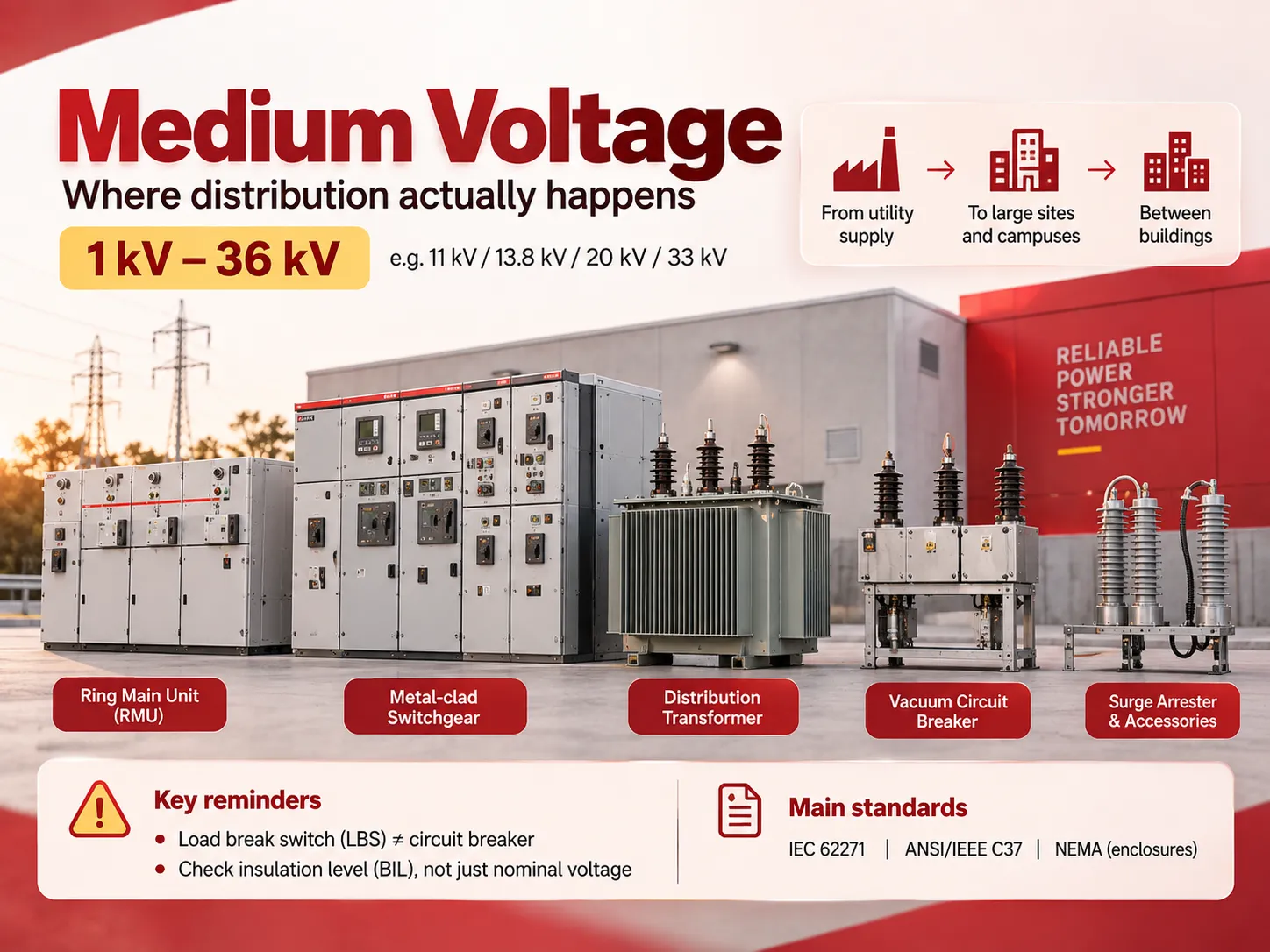
The range of medium voltage is approximately between 1 kV and 36 kV (usually with values 11 kV, 13.8 kV, 20 kV, and 33 kV), and the place where utility supply is combined with large site or campus where power flows among buildings. The equipment in this case is heavier, more likely being tailor-made for the specific project, and falls under a different set of standards — IEC 62271 for switchgear and control gear, ANSI/IEEE C37 for North American experience, and NEMA sequestration for enclosures.
| Product | Function | Typical rating range |
|---|---|---|
| Ring main unit (RMU) | Compact switchgear for ring distribution; frequently SF6-insulated | 11-36 kV, 630 A, 16-25 kA |
| Load break switch (LBS) | Interrupts load current; cannot interrupt fault current — hence switch-fuse combinations | 11-36 kV, 630-1,250 A |
| Vacuum circuit breaker | Full fault-current interruption for incomers and feeders | 11-36 kV, 16-40 kA |
| Metal-clad / metal-enclosed switchgear | Assemblies of breakers, busbars, CTs and relays in withdrawable compartments | Per section or panel |
| Instrument transformers | Current and voltage transformers for metering and protection | Ratio- and burden-specific |
| Distribution transformers | 11 kV/400 V, 13.8 kV/480 V and equivalent step-down duty | 50 kVA to 5 MVA |
| Surge arresters and cable accessories | Overvoltage protection, terminations, joints | Matched to system voltage and insulation level |
Two specification traps are particularly notable, and these traps are structural, not related to the devices. First is confusing load break switch and circuit breakers: in case of the load break switch, the device safely interrupts the normal load current; however, the fault current must be cleared using a fuse or breaker because of the fact that load break switch and fuse combination is mainly used in medium voltage distribution. The second trap is insulation level. The devices are defined according to their basic impulse level (BIL) and nominal voltage; therefore the unit, which is correct at the level of 11 kV at a low lightning site, may not be sufficient for a high-exposure overhead fed site.The boundary between low-voltage and high-voltage equipment is never just a number on a nameplate; it is a change of standard family, test regime and enclosure philosophy, and it is fixed before any product is selected.
High voltage: transmission-side equipment
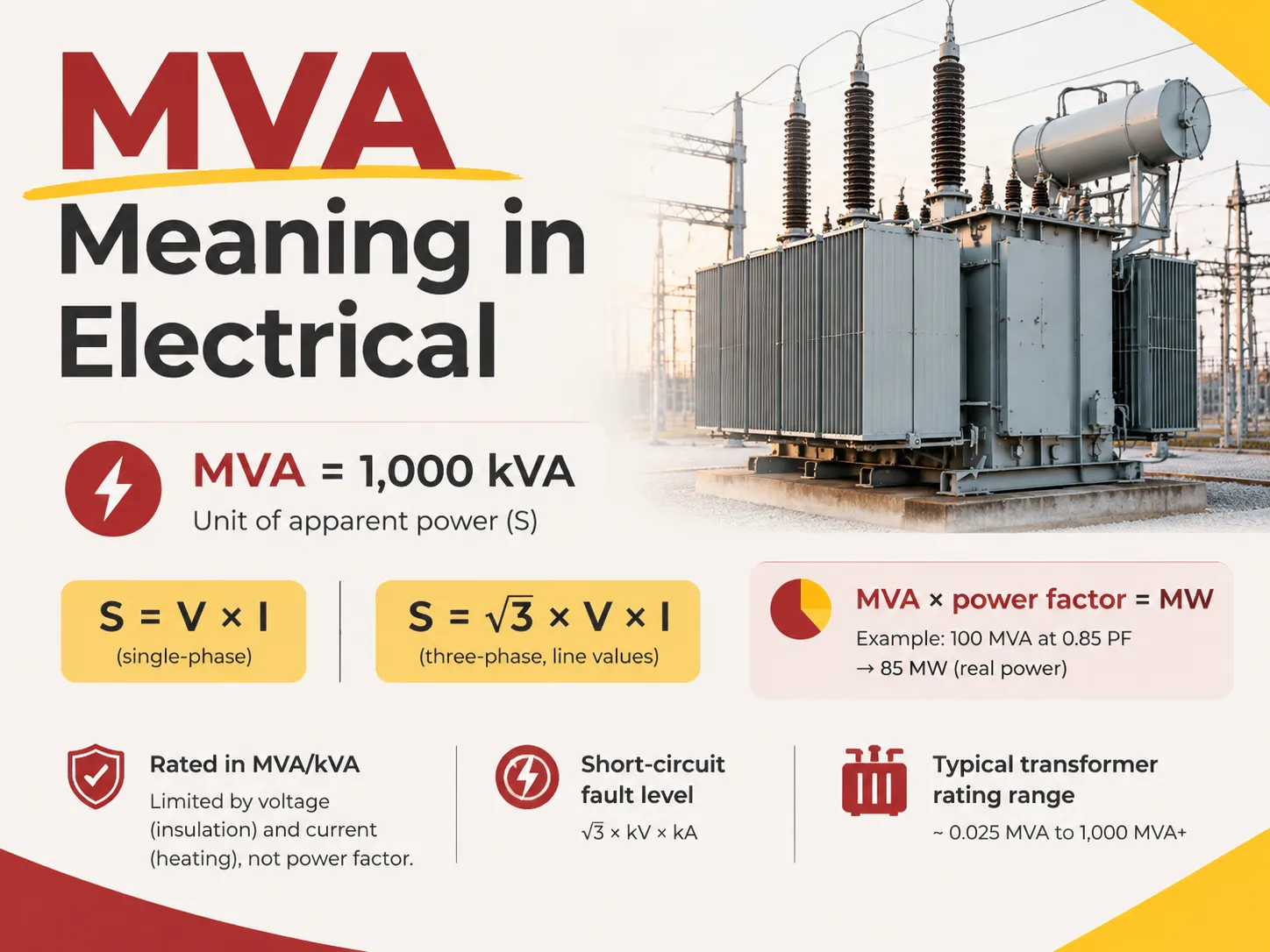
Everything above 36 kV remains determined almost exclusively by either the utility or consulting engineer, order sizes tend to be small, lead times are measured in quarters and not in weeks, and testing is done with witnesses present. Main families are gas-insulated switchgear (GIS) — used where space is at a premium or where environmental factors play a role — live-tank and dead-tank circuit breakers, disconnectors and earthing switches, power transformers of tens or hundreds of MVA capacity, instrument transformers, surge arresters and protection and control systems transforming ordinary power equipment into a coordinated grid asset.
The regulatory direction for this class could not be clearer. The SF6 gas — not only an insulator but also an important medium for breaking arc — has a global warming potential thousands of times higher than CO2 and is being phased out of the new equipment in the EU for lower voltage ranges from 2026 onwards, while similarly minded utilities across the globe are preferring procurement solutions accordingly. Hence, manufacturers have switched to SF6-free alternatives for so called 145 kV and higher, with every specification on the HV level drafted today having to state gas use policy explicitly instead of inheriting it.
Price ranges by product family
This refers to budgeting numbers for jobs’ starting planning stages in United States funds. Custom-built systems, high fault ratings, certified arc resistant construction, and quick turnaround help to increase the number. At the same time, volume and typical setups bring that number down.
| Product | Typical price range | Notes |
|---|---|---|
| MCB, 1-pole to 4-pole, 6-63 A | $6-18 (residential) to $15-60 (industrial) | Higher for DC ratings, high breaking capacity and certified industrial grades |
| MCCB, 100-630 A | $60-600 | Adjustable trip units and higher kA ratings raise cost sharply |
| Air circuit breaker, 630-6,300 A | $1,200-8,000 | Draw-out construction and intelligent trip units at the top of the range |
| Residential load centre / panelboard | $200-800 (residential); $1,500-8,000 (commercial) | Panelboard cost scales with bus rating and branch-circuit count |
| Busbar trunking | $80-250 per metre | Saves labour on risers and high-density floor distribution |
| Automatic transfer switch | $800-25,000+ | Residential whole-house units at the bottom; three-phase industrial service-duty units at the top |
| Surge protection device | $60-600 | Type 1 at the service, Type 2 at distribution boards |
| MV ring main unit | $3,000-15,000 | SF6 or SF6-free, 2-4 way, with or without remote operation |
| MV switchgear section | $8,000-60,000 | Driven by fault rating, metering class and protection package |
| Pad-mounted distribution transformer, 500 kVA | $10,000-25,000 | Copper versus aluminium and loss class change the number materially |
| GIS bay, 145 kV | $150,000-450,000 | Compactness and SF6-free construction command a premium |
| Power transformer, 20-60 MVA | $250,000-1,200,000 | Lead times and loss specification dominate total cost of ownership |
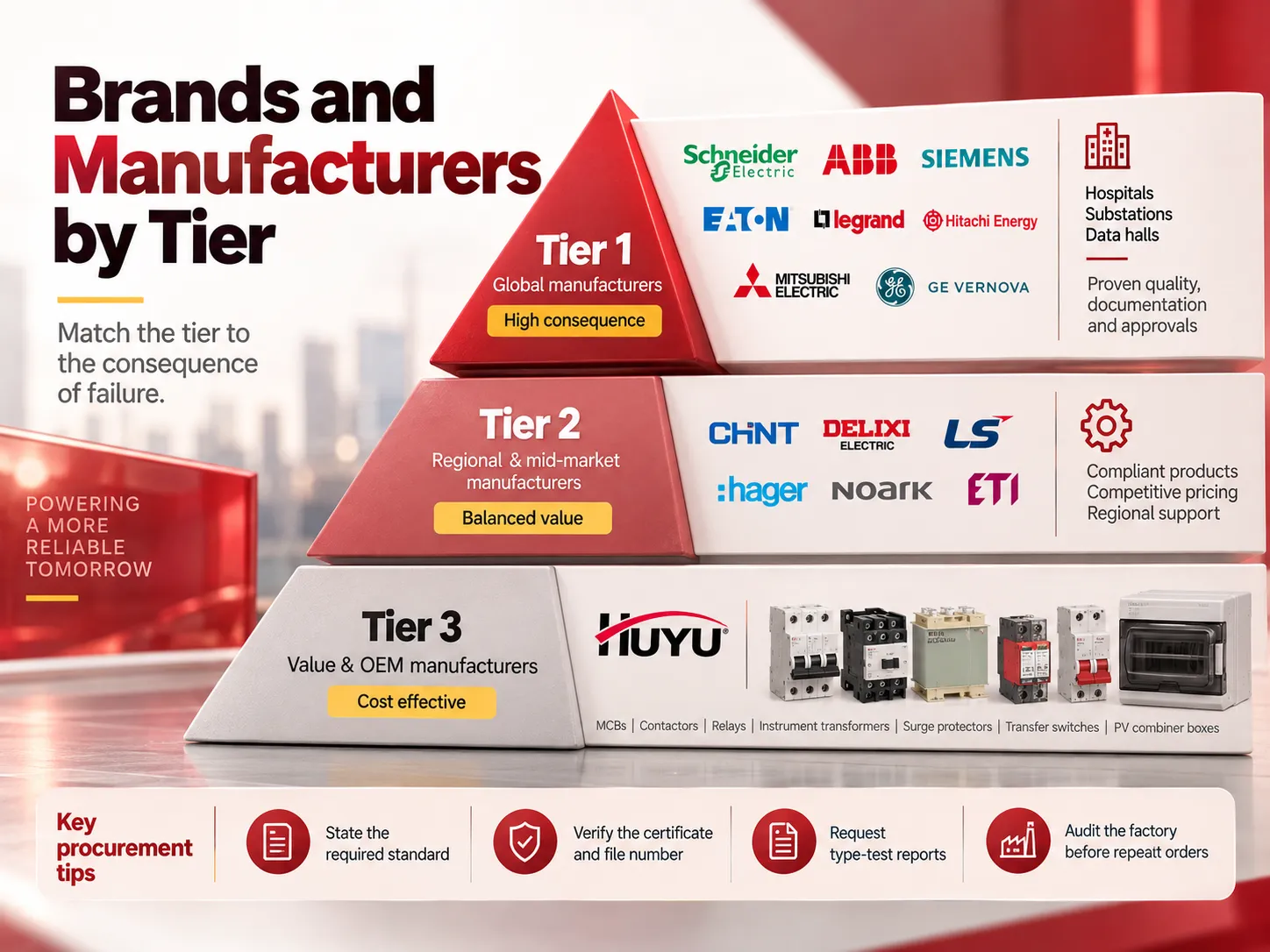
Brands and manufacturers by tier
The supplier landscape consists of several tiers, and the truth when it comes to purchasing from it is that it is necessary to align the tier with the outcome of failure. Top global manufacturers identify the reference standards, make available various type-test data, obtain numerous utility approvals and charge premium price. The key to their success in not only the product itself but also the quality of documentation as well as the installed capacity, which plays an important role for industries such as hospitals, substations and data halls, thus becoming a decisive factor irrespective of the price per unit.
Next goes a group of medium-level manufacturers, who work according to the same IEC and UL standards, but do that cheaper. The difference is usually seen in the depth of test-report documentation and consistency of the lead time. Below them is a budget tier where product quality depends more on the particular manufacturer than on the country of origin. HUYU belongs to this tier and is a good example of the things to pay attention at. Established in 1989, it is supported technically by one of the Eaton joint ventures and best specializing on creating protective and distribution equipment of low voltage, such as mini circuit breakers, contractors, relays, instrument transformers, surge protectors, transfer switches and solar panels combining devices.
The procurement principle that allows to secure a value-tier supplier is the same in each of the cases: mention the required certification standard for the device, require a certificate and file number instead of a datasheet and the type-test document along with a factory audit conducted before the second order instead of after the first failure.
Standby and temporary power on site
There are two sources of electricity supply which do not fall under the normal methods of distribution and they are, in general, late specifications. The first source is temporary site power. While installation of permanent service is being done, a construction site utilizes distribution boxes and portable lighting in the interim. Once those distribution boxes are connected to the circuits — this is a frequent error — they are treated in the same manner as standard distribution equipment, while construction site temporary power has its own good practices regarding GFCI protection of all outlets on site, waterproof cases and durability.
The second power supply is standby power. Mainly, the transfer switch, rather than the electricity generator, is inputted incorrectly into the specifications. An electricity generator for residential needs and for industrial appliances, with the same voltage, is not known to be equivalent. A transfer switch must always be equipped, labeled and certified for service entrance duty and withstand short circuits in the current of the system. The specification is important because a transfer switch operates under the worst-case scenario: that is a fault, loss of electrical power, load that is about to be switched on.What that demands in practice, from pole configuration to service-duty rating, is visible in a three-phase automatic transfer switch specification.
How to specify: eight parameters that must be right
- Voltage and frequency characteristics of the power supply, including whether the system operates at 50Hz or 60Hz; being incompatible with many other devices.
- Fault level at the point of installation; suitable interrupting or withstand ratings should be at least equal to the fault current; a device incapable to break that amount of fault current may destroy itself instead of tripping.
- Suitable certification; UL 489 corresponds to UL 1077; IEC 60898-1 corresponds to IEC 60947-2, and there is IEC 61439 standard for switchboards; the standard should be mentioned along with the purchase order.
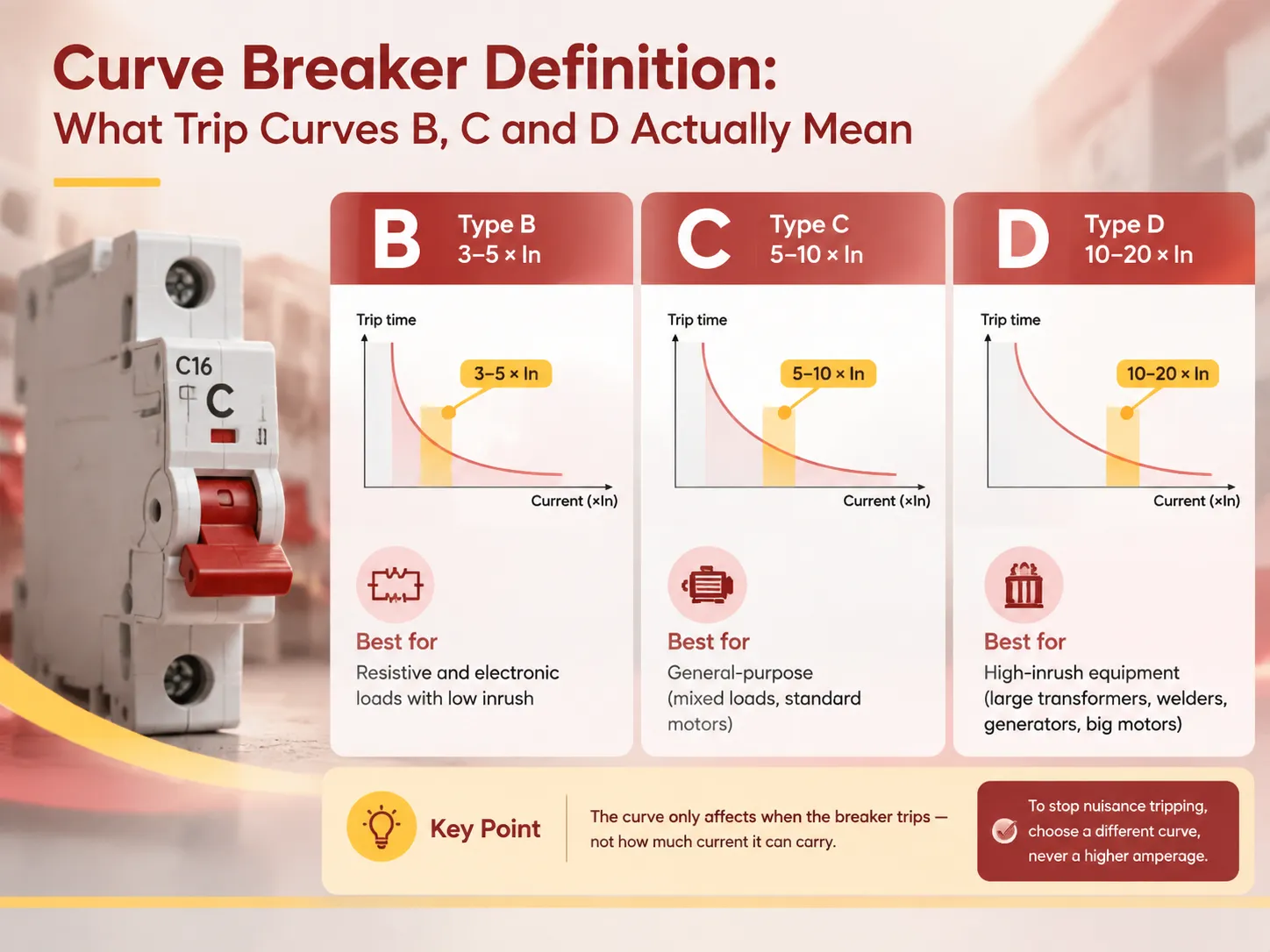
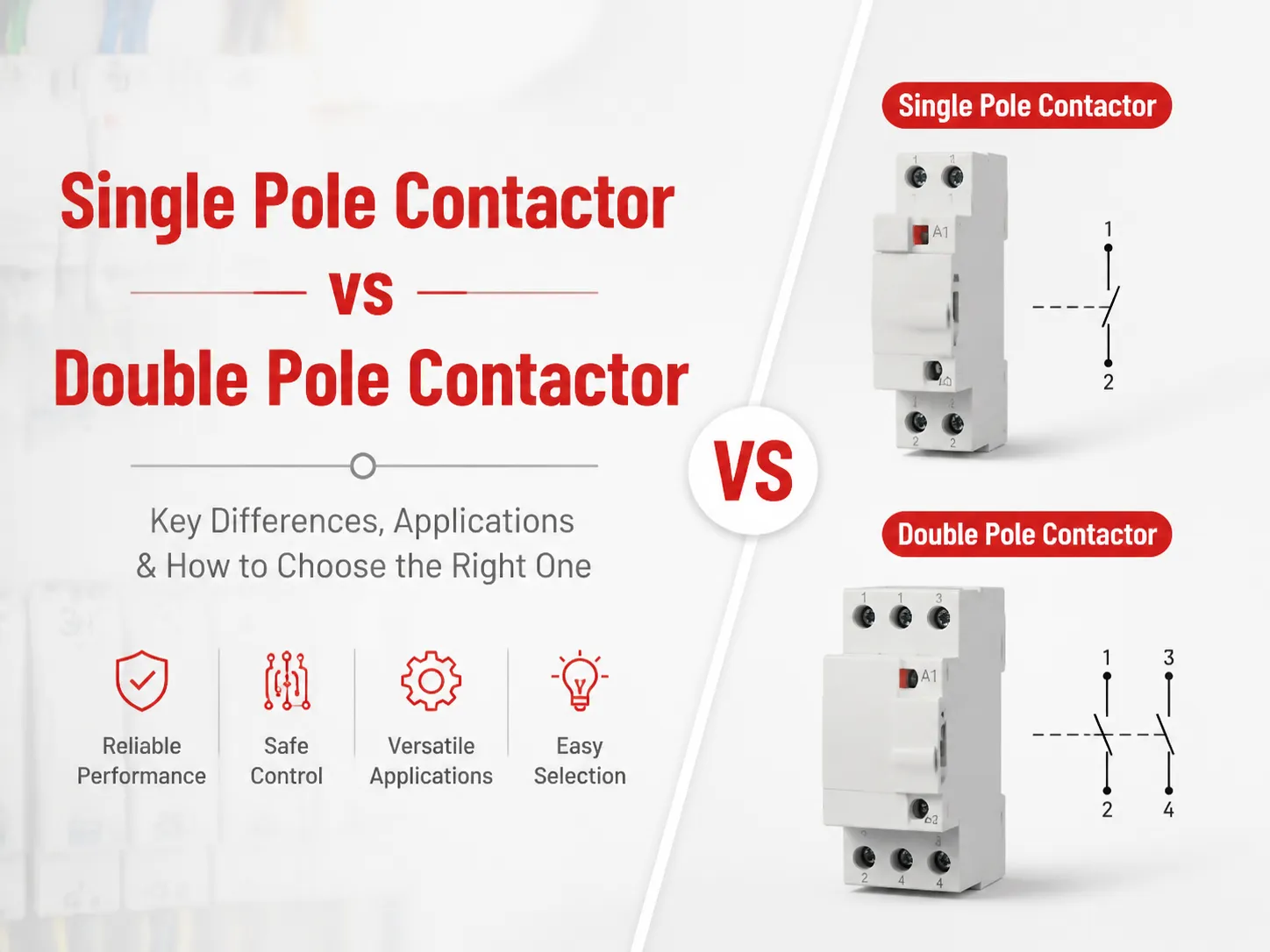
- Number of poles, interruptions and trip characteristics; whether the switch has single or double poles and whether the trip curve corresponds to the load; Type B switch will send the circuit into the nuisance tripping mode, while Type D switch may allow overheating the wire.
- Environmental rating; which means IP or NEMA enclosure code, temperature operation range, resistance to corrosion, UV exposure etc.
- Operating duty compared to cycling; number of working cycles; is the device supposed to disconnect or switch on the load?
- Shape, installation method and interchangeability; panel case and dimension, expansion option in terms of dimensions.
- The formal documentation package: tests, certificates, schemes or drawings, calibration records and country of origin declared for customs and compliance purposes.
Industrial and mission-critical projects
If an installation provides ongoing services or if a facility is essential, three additional criteria need to be considered. The factor of redundancy alters the topology of the installation, implying the use of two power supplies, systematic coordination, and design of the bus so that the maintenance can be implemented without any power outage. Condition monitoring implies changes in equipment, as the need for temperature measurement, partial discharge detection, and breaker travel analysis is growing. Finally, documentation becomes a compliance element rather than just a formality.
What unites these changes in the process of designing installations is the logic of commercialization that considers the total cost of ownership rather than merely prices. A device that costs double yet serves twenty years has a better cost in the long term than a device that costs half the price and has to be replaced. We’re talking about the considerable losses that occur due to downtime. This is also the reason why the tiers of suppliers are not as important as documentation: an engineer with good test certificates, evidence of production testing, and standards will be able to complete a project successfully regardless of the chosen level of supplier. That documentation discipline, rather than any single product choice, is what industrial electrical engineering actually consists of.
FAQ
What are the main categories of construction electrical products?
3 types of installation equipment: low-colored voltage equipment (up to 1 kV) including a wide range of equipment and devices such as circuit breakers and distribution boards, medium-colored voltage equipment (1-36 kV) such as transformers and various types of switchgear and high-colored voltage equipment (above 36 kV) such as systems of gas-insulated switchgear, power transformers, disconnections, surge protectors and protective devices.
Is “Construction Electrical Products” a brand as well as a category?
Certainly! Construction Electrical Products (CEP) is a company located in Livermore, California, that manufactures makeshift power distribution objects and portable lighting items such as spider boxes, power stations, light strings, and cable cords, which hold UL 1640 approval for usage in construction zones and wet places.
How much do construction electrical products cost?
The cost of the equipment depends almost entirely on the voltage levels for which they are used. Low-voltage devices can be very cheap, with the miniature circuit breaker costing only about $6 and the large moulded case breaker going for around $600. The price of low-voltage switchboards varies from $200 to $8000. The price of medium-voltage devices ranges between $2000 and $60000, whereas that of the distribution transformers is between $10000 and $25000 for a 500 kVA transformer. The pricing of high-voltage technologies can cost around $150000 for a GIS bay and go up to more than $1 million for the large power transformers.
What does UL 489 mean for a circuit breaker?
UL 489 is the standard applied in North America for low-voltage and moulded case circuit breakers designed for branch-circuit and service protection purposes and required to clear fault currents. This standard is often confused with UL 1077, which applies to supplementary protectors which provide extra protection inside an appliance or an assembly but cannot be employed as branch-circuit protectors. There are two significantly similar devices that belong to different groups of circuit breakers, given that they can only be used one way with respect to the standard designations.
References
- UL Solutions — UL 489: Molded-Case Circuit Breakers, Molded-Case Switches and Circuit-Breaker Enclosures
- UL Solutions — UL 1640: Portable Power-Distribution Equipment
- International Electrotechnical Commission — IEC 60947 and IEC 62271 Switchgear and Controlgear Standards
- International Electrotechnical Commission — IEC 61439: Low-Voltage Switchgear and Controlgear Assemblies
- OSHA — 29 CFR 1926 Subpart K: Electrical Safety Requirements for Construction
- US EPA — Sulfur Hexafluoride (SF6) Emissions and Regulation
Conclusion
In general, Electrical Equipment fall into three general classifications. First, Low voltage electrical equipment is typically mass manufactured and purchased in standard configurations, including some of the most expensive devices, such as Circuit Breakers, which have varying price ranges from a few dollars to several hundred dollars, for example: Molded Case technology is a low voltage device (generic term for Medium Voltage Technology), but medium low voltage designs are engineered specifically for individual projects. Second, High Voltage Electrical Equipment is among the most challenging to manufacture for Utility Connection Build due to long lead times, rigorous testing requirements, substantial costs, and the need to function under extreme environmental conditions, all while attempting to reduce reliance on SF6 technology. Third, there are three key components that are common to all three (3) tiers: Knowledge of Standards, Certified Status and Awareness of Current Documentation.