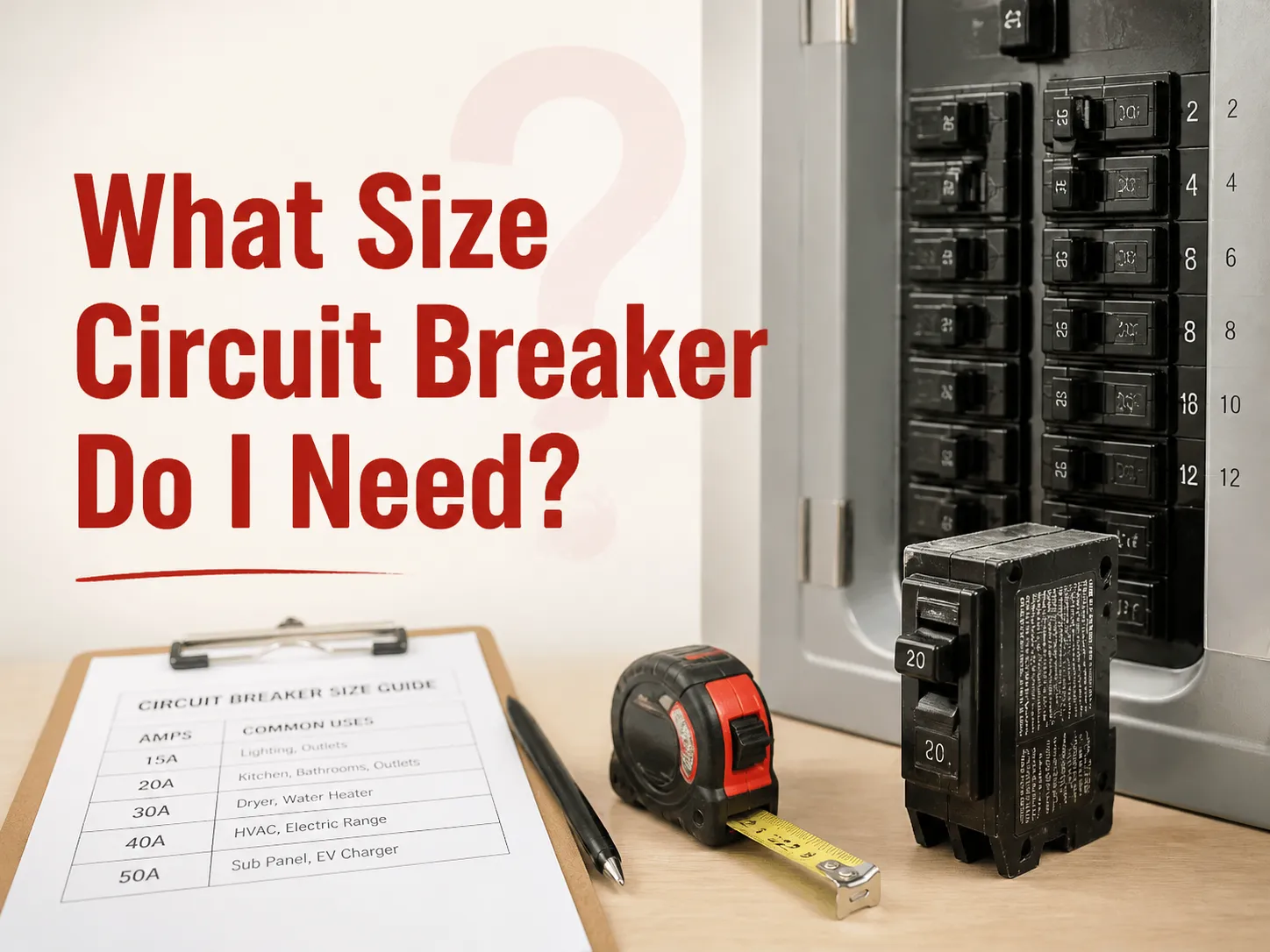

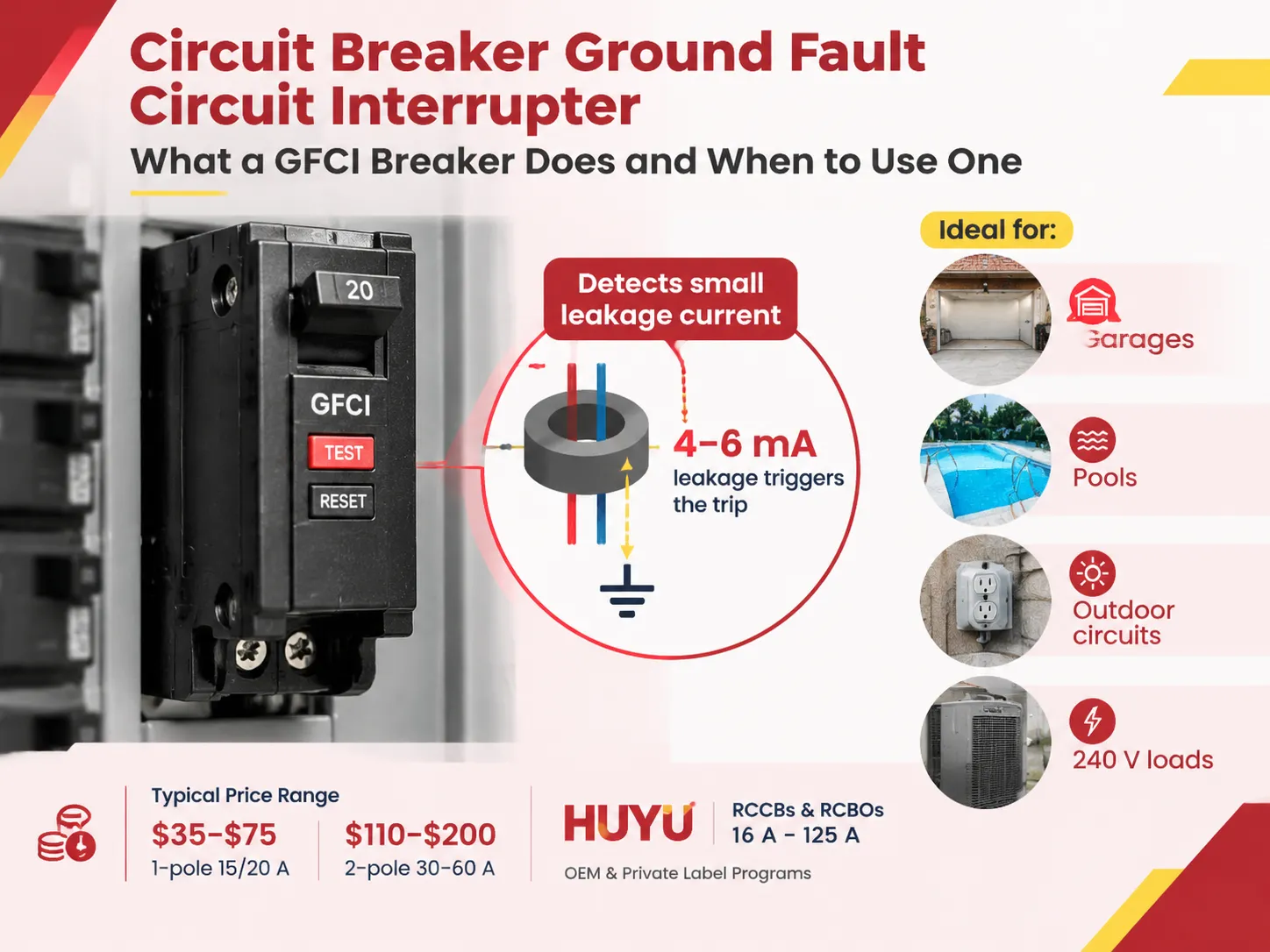
The ground fault circuit interrupter is an outstanding device within the panel as it is meant to protect people rather than electronic equipment. In contrast to the standard circuit breaker, this kind of device will come into operation when it detects an electric current bigger than 4 – 6 milliamps. The conventional breaker will stop the flow of electricity only when the current exceeds 15 – 20 amps, which is much greater than the amount of current which people can endure. This article describes how exactly GFCI operates as well as the way it detects the malfunction, what amperages exist, and how to change them after tripping.
A GFCI breaker is explained in simple terms as a power breaker in addition to a ground fault detector. Any flowing current above 4 to 6 mA, which is a usual current amount will cause the device to trip. In general terms, these circuit breakers protect whole branch circuits and hence are utilized where high voltage power is involved like in cases of swimming pools and garages and also in circuits utilizing 240V power. The usual cost for the 15 or 20 A types is $35 to $75, while the two pole types with the 30-60 A configuration range from approximately $110 to $200.
What a GFCI Breaker Actually Is
The shape of a GFCI breaker is not different from that of other types of breakers in an electrical panel. Inside the GFCI breaker is the thermal-magnetic mechanism alongside a small toroidal current transformer.
This is all that is behind the working principle of GFCI breakers. When electric current travels through “hot” and “neutral” wires, it produces opposing magnetic fields. When these two magnetic fields are equal, i.e., they cancel each other, the sensor doesn’t register it. If the operation of the device is disturbed by even a slight error, for example, from a few milliamps passing through a person, wet junction box, or faulty cord, the fields will no longer cancel and the mechanism will trip.That principle is worth understanding before shopping for a device, because it explains why a GFCI works even on a two-wire circuit with no equipment ground; it is measuring the leak, not the ground path. We cover the physics separately in what actually happens during a ground fault, which is the mechanism a GFCI is built to catch.
The main distinction between a GFCI breaker and a GFCI receptacle is that the former protects a full circuit whereas the latter only protects its own LOAD terminals and, therefore, devices that are connected and plugged into them. This is the reasoning that is shared by most of the following criteria for making a choice.
How the Sensing Circuit Meets UL 943
In North America, the GFCI items that retailers offer to protect the public comply with UL 943 standards. The information that manufacturers publish is not a hype; they indeed tell you how well the GFCIs work.
As for Class A devices, the device must trip in case of a ground-fault current of more than 6 mA. Although the alarm activation level is set at the range of 4-6 mA, the activations of the breaker usually happen without any delay even with 30 mA leakage. Unlike a 15 A breaker that cannot respond unless there it 15.000 mA leakage.
Starting from June 2015, the UL 943 certification has obliged GFCIs to carry out the self-checks regularly. The device detects faults in its sensing element. If the problem is identified, the device indicates it with a red light that shows that it cannot be reset.
| Parameter | Class A GFCI | Ordinary 15 A breaker |
|---|---|---|
| Trip threshold | 4–6 mA imbalance | ~15,000 mA (15 A) |
| Typical clearing time at 30 mA | Under 25 ms | Does not trip |
| Protects against | Electric shock | Overcurrent and short circuit |
| Standard | UL 943 | UL 489 |
| Self-test | Required since June 2015 | Not applicable |
Where GFCI Protection Is Required
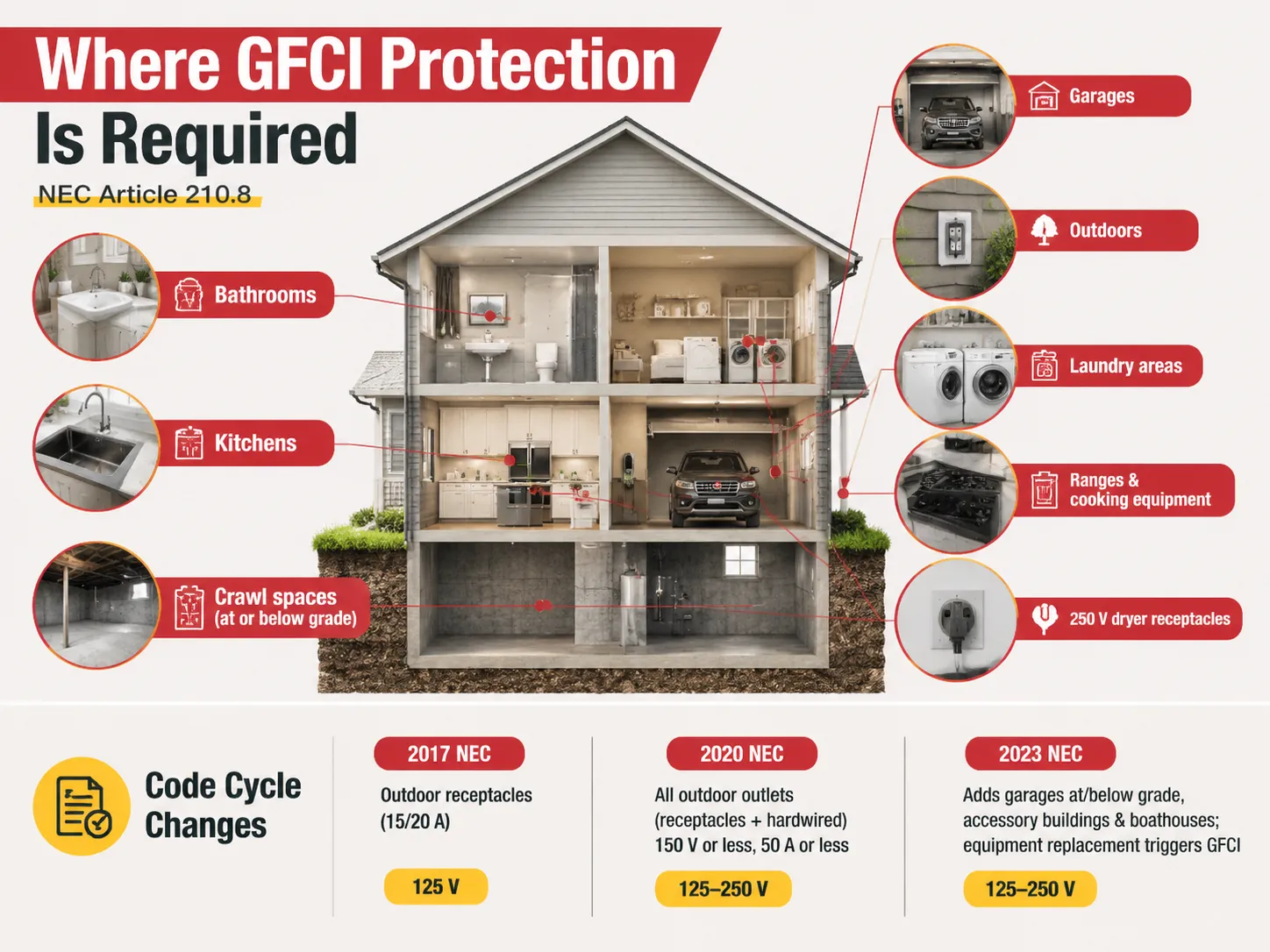
The National Electrical Code, in Article 210.8, states that GFCI installation locations in 2020 and 2023 edition updates now render many older buildings obsolete in terms of violation of insulation regulations.
As far as the living areas are concerned, it is essential to install GFCI devices whenever there is a 125 V or 250 V receptacle in the following areas: garages, bathrooms, outdoors, and inside the buildings at ground level and underground such as crawl spaces, unfinished basements, kitchens, laundry rooms, and for the very first time per the Code 2023, installation inside the ranges and 250 V receptacles was suggested. The Code also states that the outdoor devices cannot be limited to only the outlets as shown in Section 210.8(F) where it provides information on all outdoor devices with single-phase circuits.
| Code cycle | Outdoor GFCI scope | Voltage covered in dwelling units |
|---|---|---|
| 2017 NEC | Outdoor receptacles, 15/20 A | 125 V |
| 2020 NEC | All outdoor outlets of a dwelling, receptacles and hardwired, 150 V to ground or less, 50 A or less | 125–250 V in listed locations |
| 2023 NEC | Adds garages at or below grade, accessory buildings and boathouses; equipment replacement triggers GFCI | 125–250 V in listed locations |
Inside the Interrupter Family
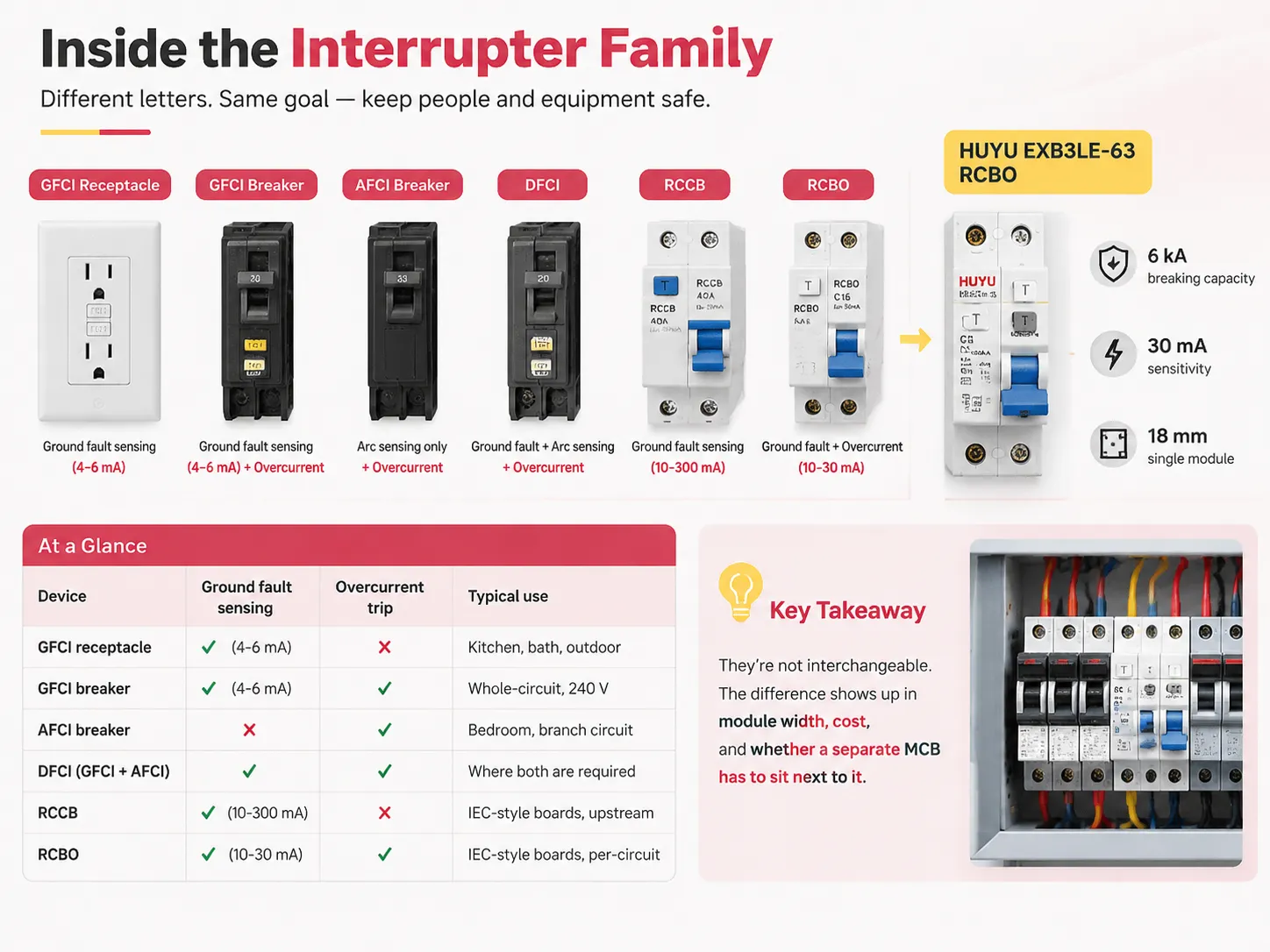
GFCI falls under the category of residual-current devices; this category can be confusing as some devices provide the same safety from electric shock as GFCI but are named differently. GFCIs can prevent ground faults. Residual Current Circuit Breakers (RCCBs) only protect from residual currents but do not have protection against overcurrent and must be used with separate MCB. RCBO combines the two functions in one device.
In case one is designing or specifying the equipment rather than wiring a residence then the last device is the ideal solution.HUYU’s EXB3LE-63 series RCBO packs a 6 kA breaking capacity and 30 mA sensitivity into a single 18 mm module, which is the modern replacement for the old RCCB-plus-MCB pair in a distribution board.
The full family, as it is normally specified:
| Device | Ground fault sensing | Overcurrent trip | Typical use |
|---|---|---|---|
| GFCI receptacle | Yes, 4–6 mA | No | Kitchen, bath, outdoor outlet |
| GFCI breaker | Yes, 4–6 mA | Yes | Whole-circuit protection, 240 V loads |
| AFCI breaker | No (arc sensing only) | Yes | Bedroom and branch-circuit arc protection |
| DFCI (GFCI + AFCI) | Yes | Yes | Where both are required on one circuit |
| RCCB | Yes, 10–300 mA | No | IEC-style boards, upstream device |
| RCBO | Yes, 10–30 mA | Yes | IEC-style boards, per-circuit protection |
The two are not interchangeable, and the difference shows up in module width, cost and whether a separate MCB has to sit next to it in the board.
Amp Ratings and Pole Configurations
The voltage ratings of North American GFCI circuit breakers have some limitations compared to other devices in the same class. The device operating on a single-phase will be rated at 15–30 A at 120 V, while the two-phase type will have a broader rating ranging from 15 A to 60 A.
The two-pole GFCI is not created by simply taking two single-pole units. It is a circuit breaker for single-phase 120/240 V three-wire circuits that may also function in three-phase 240/120 V four-wire circuits and in 208Y/120 V three-phase four-wire power supply structures. The two-pole GFCI does not require the load neutral; therefore, the white line neutral pigtail must be connected to the neutral bus in the box.
The approach towards voltage ratings in other countries is different. RCBO and RCCB voltage ratings in compliance with IEC standards are based on their sensitivity. The minimum sensitivity for human protection is usually 30 mA, while 100 and 300 mA sensitivity levels are used for fire protection and upstream selectivity. For anyone weighing those two options on a project board, the practical differences are unpacked in this comparison of RCCB and RCBO devices — mainly module width, cost and whether a separate MCB is needed alongside.
How to Reset a Tripped GFCI Breaker
The outline of the procedures that are to be followed to resolve the problem may be quite simple, but they should be strictly adhered to considering that they may account for 50% of all issues related to GFCI malfunctions.
- Disconnect all appliances from the circuit; if the problem lies in the attached load, resetting will occur immediately.
- Involves determining the type of breaker by noticing if the malfunctioned GFCI breaker is on midway position or its indicating lamp is red or yellow.
- Move the handle to OFF position firmly so that internal mechanism resets.
- Return the handle to ON position; if the position holds, plug the devices in one by one.
If no appliance is connected and the handle does not hold in ON position, it’s time to check the wiring of devices and outlet.
Why They Trip, and What to Do About It
Tripping is indicative of a problem rather than a defect. The biggest cause of tripping in such situations is moisture.
In addition, when outside or in a garage, moisture is usually the culprit. It could be wet boxes, a faulty cover gasket, or even cable lying in a form of a puddle on the ground. In most cases, old appliances with weak insulation are the second most responsible for tripping. In addition, shared neutral between circuits will cause the tripping to occur in different places making it appear as if it happens randomly.
The general troubleshooting logic for repeated trips is the same whether the device is a GFCI or a plain breaker, and our guide to what causes a circuit breaker to trip walks through the order to eliminate causes before calling an electrician.
What a GFCI Breaker Costs
The item prices mentioned below are typical for US retail in 2026 and exclude installation costs, which explains the need to use either receptacles or breakers in various circuits due to the difference of price between receptacles and breakers.
| Item | Typical retail | Notes |
|---|---|---|
| GFCI receptacle, 15/20 A | $6–$25 | Protects itself and downstream outlets |
| GFCI breaker, 1-pole 15/20 A | $35–$75 | Plug-on or plug-in neutral variants |
| GFCI breaker, 2-pole 15–30 A | $85–$130 | Spas, pumps, 240 V equipment |
| GFCI breaker, 2-pole 35–60 A | $130–$200 | Larger frame, 10 kA or 22 kA interrupting |
| Electrician labor | $100–$250 per device | More if a new circuit is needed |
Installing a GFCI breaker for all the electrical setups with GFCI sockets is usually the more affordable option as compared to wiring all the sockets with GFCI sockets and labour costs related to fitting them. Nonetheless, if there is even one socket in a place that has one wet location, GFCI sockets will definitely be a better option.
Choosing a Brand, and Where HUYU Fits
North America are a few key names you need to be familiar with; they are Eaton, Siemens, Square D, and Leviton. To understand how companies set prices, you have to remember that it all depends on each brand, its distribution and on how much paperwork is related to each catalog number. However, if you are an OEM manufacturer who’s involved in creating panels, equipment, or exporting, the situation changes. The main thing you are interested in are standards and certification, the classification of the device, as well as whether the producer is able to run a personalized solutions program.
So, this is the market HUYU is focused on. We are a manufacturer of low-voltage electrical equipment and offer a variety of residual current devices professing different ratings starting from 16 A to 125 A, including A, B and F types, as well as MCB, MCCB, and AFDD. The disadvantage is brand awareness : HUYU is not the name of a panel making company in the U.S.The trade-off is cost, range and the flexibility to produce to a customer’s specification — more detail on that is on the RCBO manufacturing program page.
FAQ
What is GFCI and why is it tripping?
GFCI stands for the ground fault circuit interrupter. This gadget compares the outgoing current from the hot wire to incoming current returning through the neutral wire and cuts out if it senses 4-6mA of current missing. The usual reasons for a GFCI tripping are: moisture developing in the junction box or on the cord, faulty wiring of the equipment, shared neutral in circuits, bootleg ground along the line, and end-of-the-life state of the GFCI. You should disconnect your circuit. Once you reset your GFCI plug in the equipment one at a time to understand what is wrong.
Can I replace a ground fault breaker with a regular breaker?
The only condition when it is acceptable to remove GFCI is when that is no longer required, but this is hardly the case most of the time. According to Article 210.8 GFCIs must be installed in the bathrooms, kitchens, garages, outdoors, unfinished basements, crawl spaces, and laundry rooms. In addition, the requirements mentioned in the 2020 and 2023 editions allow for using GFCIs in 250V circuits and certain types of permanently wired devices. The elimination of GFCI will result in the fact that the party that performed the work becomes liable for the violation that will be indicated during inspection.
Is it better to have a GFCI outlet or a GFCI breaker?
The cost of the GFCI outlet is determined by the specific wet location as well as the number of load points it feeds from the circuit. A GFCI outlet may cost around $6-25 and offers protection to itself and the connected devices via the LOAD terminals, so it is an inexpensive solution in terms of protecting one or two load points. On the other hand, the GFCI breaker can cost from $35 and above and it offers protection from the panel level. It is indeed the only way to protect the circuit with the 240V load as well as the unreachable locations.
Is it okay to leave a GFCI tripped?
It’s true that a tripped GFCI does not pose any danger. What happens when the GFCI is tripped is that the electricity is disconnected. You should never keep resetting the GFCI without figuring out why it was tripped initially. If it gets tripped several times, there is still some leakage in the current. The GFCI is just protecting against the leak. If it failed to self-test, it won’t reset.
Does a GFCI breaker need a neutral pigtail?
Indeed, regarding a two-pole GFCI, its sensing circuit is not affected by the lack of load neutral. The panel neutral bus must be connected to the white line neutral pigtail; otherwise, the breaker will not work properly. The single-pole GFCI also utilizes the panel neutral indirectly through the pigtail.
How often should a GFCI be tested?
It is required by the producers and UL guidelines that manual testing be conducted once a month. This involves the pressing of a TEST button to validate that the unit functions correctly before pressing RESET. Automatic self-testing which has been in effect under UL943 since June 2015 operates on an ongoing basis but does not eliminate the need for manual testing.
References
- UL Standards & Engagement — UL 943, Ground-Fault Circuit-Interrupters
- NFPA — NFPA 70, National Electrical Code (Article 210.8, GFCI protection)
- Siemens — Ground Fault Circuit Interrupters specification sheet (Class A, 4–6 mA)
- OSHA — Ground Fault Circuit Interrupter information
- U.S. Consumer Product Safety Commission — GFCI safety guidance
Conclusion
GFCIs breakers’ function means they do not serve a single outlet, but complete circuit protection. A regular 15 A breaker can still let dangerous current go through which means that GFCI breaker becomes essential since it deals with two figures, namely, 4-6 mA which is the trip point and the ability to be used with either single-phase 120 V or three-phase 240 V.
There are three crucial points to know. To start with, there is nothing to reset when nothing is plugged in. Next, it is essential to have neutral wires running to the power panel in case a two-pole GFCI device is used because this is one of the popular reasons for GFCI failure. Finally, if you are buying an OEM or exported device that is not complete, you should take the certification of the device more seriously than the brand name.