
In modern air conditioning machines, the compressor is not treated solely as a unit but rather as part of an electronic system. The cost for the inverter circuit replaces the variable speed compressor which ranges between $500 and $1,100 while the ECM fan replacement is between $400 and $1,000. And while doing so, readers must keep in mind that in case of power spikes, the above expense won’t be covered under manufacturer warranty.
One can see the connection of the above intellect with the economic concept that is fully justified. But products that were purchased for addressing the aforementioned issue cannot be taken as such.
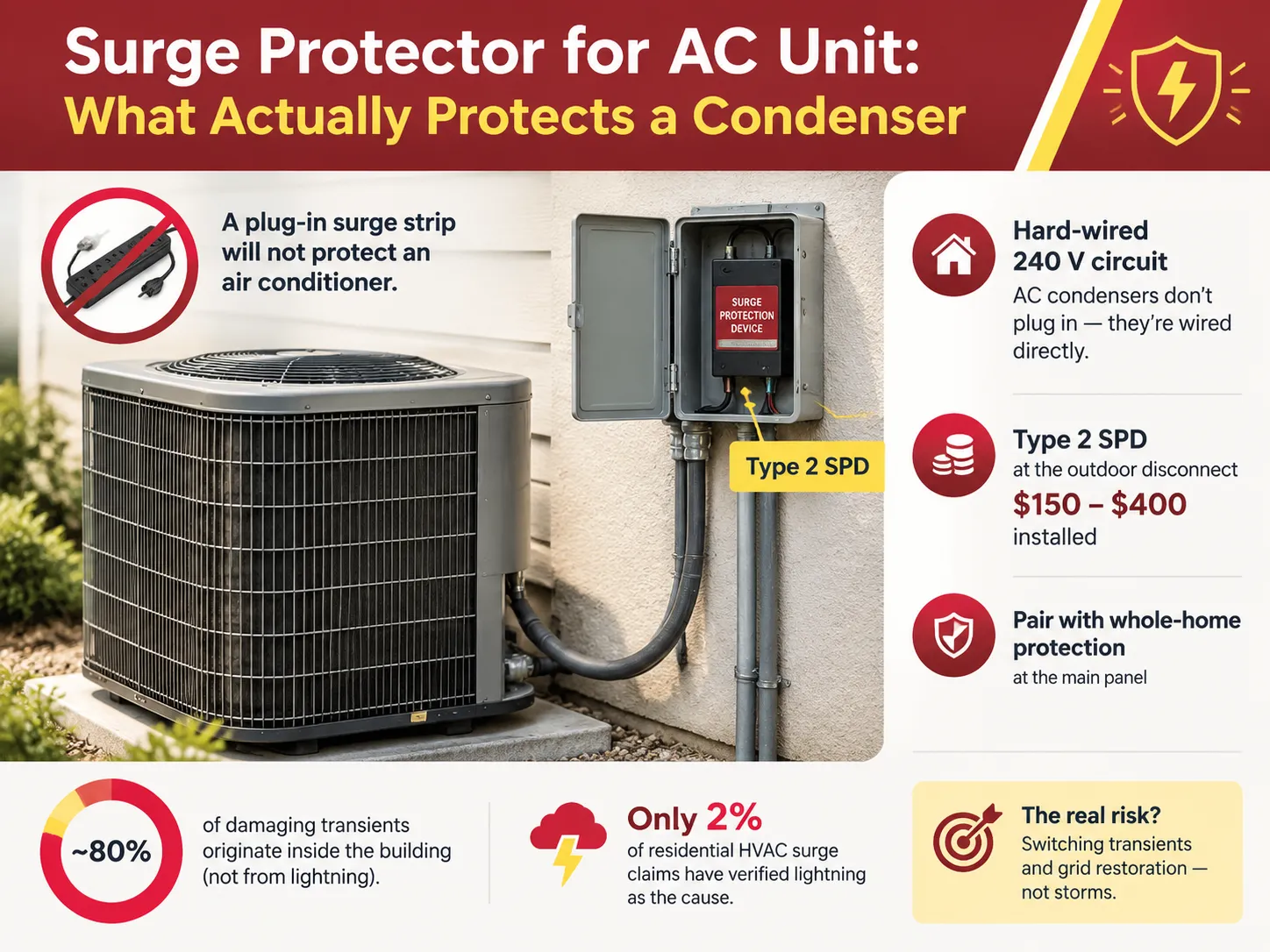
Regarding whether a plug-in surge protector can protect an air conditioning unit, the answer is negative. The reason for this conclusion is that an AC unit has its compressor that gets powered by means of a 240 V circuit, which cannot be reached by a plug-in surge protector. Therefore, a Type 2 surge protection device has to be fitted in the outdoor disconnect, which will cost between $150 and $400 and will work in conjunction with whole house protection installed at the main panel. Furthermore, it is essential to understand that in nearly 20% of all cases, external sources are the reasons for causing harmful transients, while only about 2% of all HVAC claims reveal that the surge was apparently caused by lightning, thus showing that it is the result of the functioning of switching transients and not the storms.
The Short Answer for a Modern AC
In case of having an inverter-driven system or a variable speed one, which is no more than 15 years old, it is advisable to use type II SPD at the outdoor shutoff. The reason for that is that this place offers the optimum protection for the unit as the compressor is located at the end of a long circuit and this circuit acts as an antenna.
For single-stage systems, which consist of a simple contactor and a capacitor, the economics are poorer, thus it would be advisable to spend money on full-home protection of the electric panel instead.
In case the system is nearing the end of life, then it is recommended to skip the device and invest in its replacement, rather than protecting a compressor that will be out of use in two years.
Why an AC Unit Is Unusually Exposed
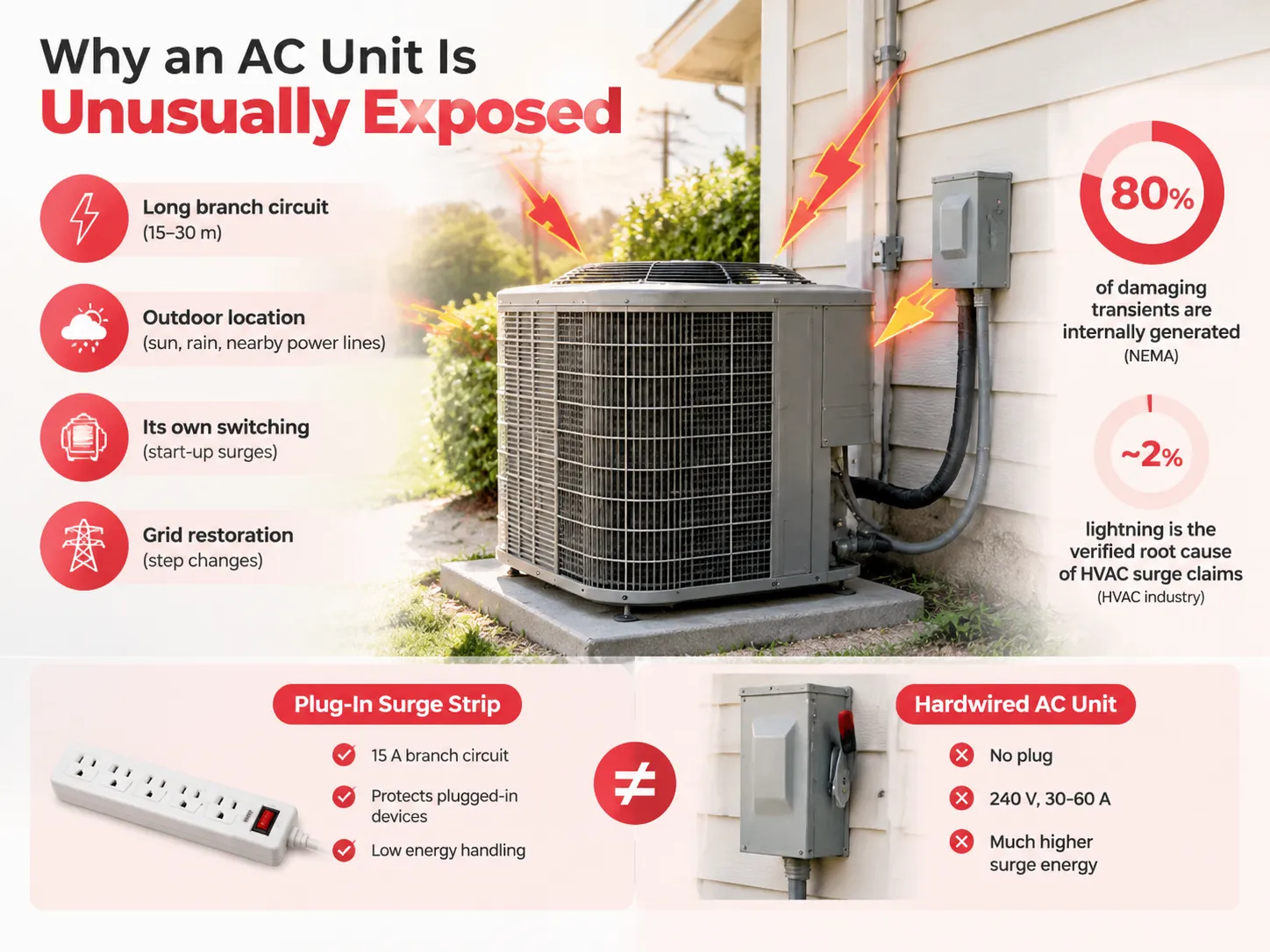
There are four factors to consider, and only one is dependent on the weather.
- Long branch circuits. The distance from the panel to the condenser is usually around 15-30 meters. Transients are likely to occur, and therefore, the device placed at the power panel cannot mitigate the surge.
- Outdoor. The outdoor environment, Marbella, can bring heat or rain on the location where the equipment is positioned and where there is also a potential electric pole and other installations.
- Its own switch action. The process of switching on the device involves currents that are about 6-8 times higher than those used during the regular operation process and generates transients to the same circuit.
- Repair of the electric grid. Once the utility resumes its operations after a breakdown of the electricity supply, the area receives the entire change at once. It happens more frequently than the lightning impact and causes similar damage.
Stats confirm the last statements made. NEMA analysis shows that the source of the electrical problems is internal in up to 80% of the cases.
What a Plug-In Strip Cannot Do
A plug strip is appropriate for circuits that supply electric equipment, typically rated for 15A and providing protection for any device plugged into it. An air conditioning unit does not have a plug; it is wired into a disconnect and operates on a 240V circuit rated between 30A and 60A, and no plug strip can be used in this circuit.
Even if it was possible for this type of protection system to be used, the scale of energy surges involved is different. Plug strips protect circuits with small surges on circuits that supply any electrical device. The surge current experienced on the electrical mains and on a feeder circuit for an air conditioning unit is much higher, therefore, when the surge occurs, the varistors in the device will fail to work properly and equipment connected to it will remain unprotected, although the indicator will still glow.
The source of confusion is the names both items receive. They are both sold as protective devices. Also, both have joule ratings, and these ratings do not allow for easy comparison. The same can be said about surge protective devices which have a specific rating compared to plug strips that are rated according to marketing methods.
What each device in the chain actually contributes, from the branch breaker to the point of use, is the subject of this comparison of a circuit breaker and a surge protector, which is the distinction most homeowners have never had explained.
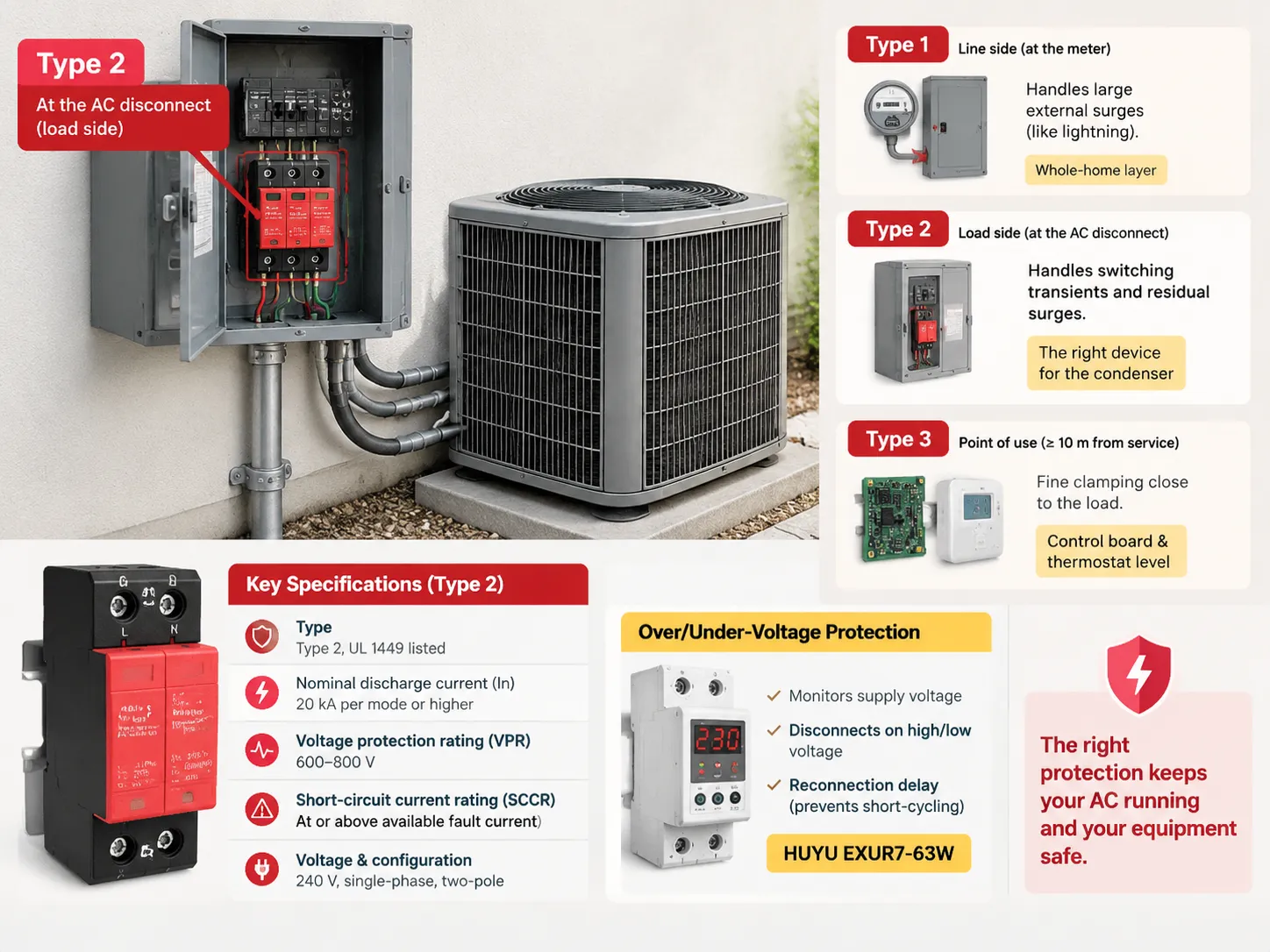
Type 1, Type 2 and Type 3 at an AC Disconnect
| Type | Where it goes | What it handles | Fit for an AC unit |
|---|---|---|---|
| Type 1 | Line side of the service disconnect, at the meter | Large external surges including lightning current | Whole-home layer, not AC-specific |
| Type 2 | Load side of a breaker, at the equipment disconnect | Switching transients, residual surge, internally generated events | The correct device at the condenser |
| Type 3 | Point of use, at least 10 m of conductor from the service | Fine clamping close to the load | Control board and thermostat level |
The Type 2 unit at the disconnect serves the primary function. The unit remains in parallel with the load and does not draw any energy in day-to-day use. However, when the voltage surpasses the mentioned threshold, it gets activated. It is the unit being referred to by most HVAC producers when they wish to emphasize that surge protection is part of their installation warranty conditions.
The use of another type of protection device is warranted as it deals with another matter. The over-voltage and under-voltage relays can monitor the voltage and therefore disconnect the compressor in case of deviation from the voltage window. Also, they provide for a time delay so that the compressor is not short cycled. HUYU’s EXUR7-63W multi-function protector is built for that duty, combining the voltage window with the reconnect delay that a compressor needs.
Sizing: The Four Numbers That Matter
Ignore the headline kA figure and the joule rating. Four specifications decide whether the device does the job.
| Specification | What to look for at an AC disconnect | Why |
|---|---|---|
| Type | Type 2, UL 1449 listed | Matches the location in the circuit |
| Nominal discharge current (In) | 20 kA per mode or higher | The repetitive-event rating, which is what actually wears the device |
| Voltage protection rating (VPR) | 600–800 V | Lower is better; this is the number the board actually sees |
| Short-circuit current rating (SCCR) | At or above the available fault current at the disconnect | An under-rated device is a fire risk, not a protector |
| Voltage and configuration | 240 V, single-phase, two-pole for a residential condenser | Wrong configuration means no protection or a fault |
The clamping number is a weak spot for inexpensive products. A product that has a clamping voltage of 1,200 volts has theoretically safeguarded the circuit while allowing it to pass three times more power than the circuit would ideally receive. A voltage in the 600-800 volt range is ideal for use in residential wall-mounted units or disconnects and any clamping below that cannot be achieved affordably by most homeowners.
The second configuration on the voltage protection relay is the voltage window, which must be configured based on the application rather than simply using the default settings. For example, a compressor that disconnects at 200 volts for three minutes works completely differently than a compressor that disconnects at that same voltage for just 30 seconds, especially during the summer months when the supply is lower than usual in the mornings.The relay in this EXUR7N over and under-voltage protector is adjustable across that range for exactly this reason.
What It Costs, and What the Alternative Costs
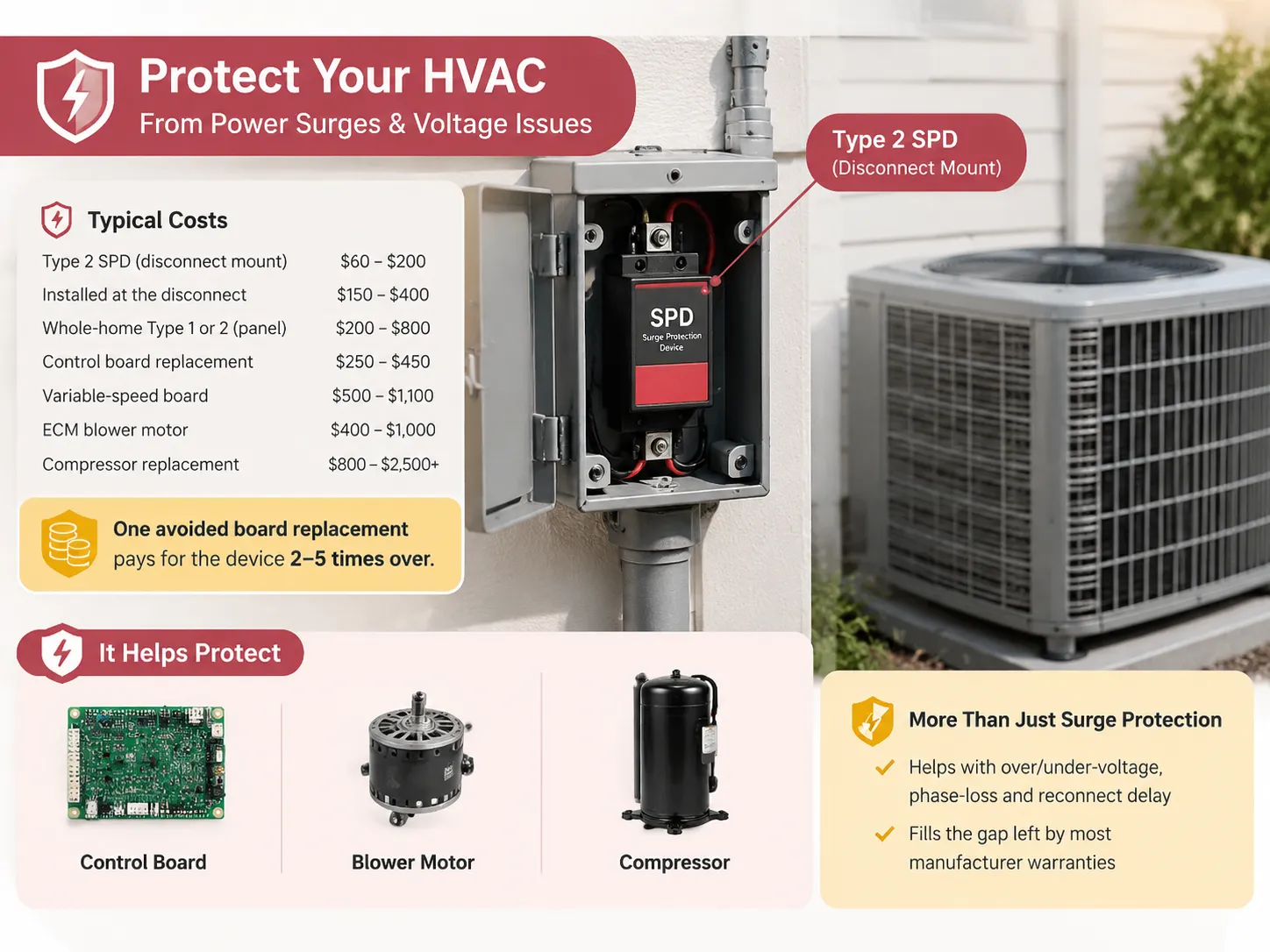
| Item | Typical cost | Notes |
|---|---|---|
| Type 2 SPD, disconnect mount | $60–$200 | Device only |
| Installed at the disconnect | $150–$400 | 30–60 minutes of an electrician’s time |
| Whole-home Type 1 or 2 at the panel | $200–$800 | Layered protection, not a substitute |
| Single-stage control board replacement | $250–$450 | Installed |
| Variable-speed or communicating board | $500–$1,100 | Installed |
| ECM blower motor | $400–$1,000 | Installed |
| Compressor replacement | $800–$2,500+ | Parts alone in many cases |
Replacing a variable-speed board only once is enough in many cases, meaning that the investment pays for itself 2-5 times.
Most homeowners learn too late about the warranty issue. The majority of manufacturer warranties explicitly don’t cover any damage whatsoever due to surge or brownout; therefore, it doesn’t matter whether the system is one year old or ten. The device does not protect the warranty but simply bridges the gap that the warranty has events.
Whether the device also increases the value of the property is a separate and less certain issue, which is why it is advisable to keep these claims apart rather than leaving it up to the salesman. The evidence on value is examined in this look at whether a whole-home surge protector increases property value.
Brands, and Where HUYU Fits
In North America, the market for SPD both for residential and light commercial operations is limited which includes Square D and Schneider, Eaton, Siemens, Leviton, and some specialist manufacturers. In case of Type 2 device mounted directly on the disconnect, the only devices an electrical contractor offers for quotation are as they are crucially impacted by design.
The position of HUYU is both upstream and alongside in different respects. The firm manufactures low-voltage protection and switching devices and it has developed a various models of AC protection that mostly deal with voltage problems, including both surges and falls, loss of phases and reconnect delay for the device used for compressors. This is a whole different type of device rather than the surge clamping one.
Let’s make it clear: HUYU does not manufacture Type 2 module with UL 1449 certification suitable for installation in North America, therefore any homeowner from these geographies should buy one of those available there. HUYU manufactures the protection relay layer, the devices for surge protection for solar panels and the necessary switches and contactors both for an OEM and export equipment rather than being used for IEC standard equipment.
As a result, for OEM manufacturers of HVAC system, these devices are relevant, whereas if it comes to homeowners from the US who work on the installation of the system with a condenser, it is necessary to make a purchase of a designated module Type 2 and the voltage protection relay.
Installation and the Three Points
The complete system involves three locations according to their importance.
- The disconnecting device. A Type 2 surge protection device connected to the disconnect with the utmost shortness of leads and robustly bonded to the disconnect box. This is the most valuable individual item in HVAC systems.
- The main electrical panel. A Type 1 or Type 2 surge protection device suitable for the entire house. This device will filter the big surges before further flow through the house circuits and provide protection to all appliances in the house.
- The weatherproof heat pump and the control system. A Type 3 or a small Type 2 device at the heat pump plus the insulation of low-voltage control wires between the heat and condenser devices which is a long naked wire acting as a radio receiver.
The length of conductor is the key point of performance measurement in all points. Each inch of wire from the protected device to the protected point adds onto the voltage at the output of the device, so a device placed on the opposite side of the disconnect has much poorer performance than a device mounted to the right of the disconnect.
Installation of such equipment cannot be performed by a homeowner. The disconnect has a 240V casing and has live wires while its service terminals keep receiving energy even with the switch turned off.
Maintenance and Replacement
These devices are consumables. Every surge absorbed causes degradation of the metal oxide varistors leading to a service life of approximately five to ten years in normal circumstances, which may be shorter in a rural overhead feeder where there is a lot of switching going on.
Three habits need to be cultivated to make the protection work.
- Checking the indicator. A green light or any light showing means that the device is working. If it is dark or red that means that it has done its job. It’s impossible to know about the failed device in open unless the indicator has been checked.
- Replace after the event. Even if indicator looks normal a nearby lightning strike or an event on the grid may lead to the failure. The cost of changing a $100 device is lower than the cost of replacing a burned $900 circuit.
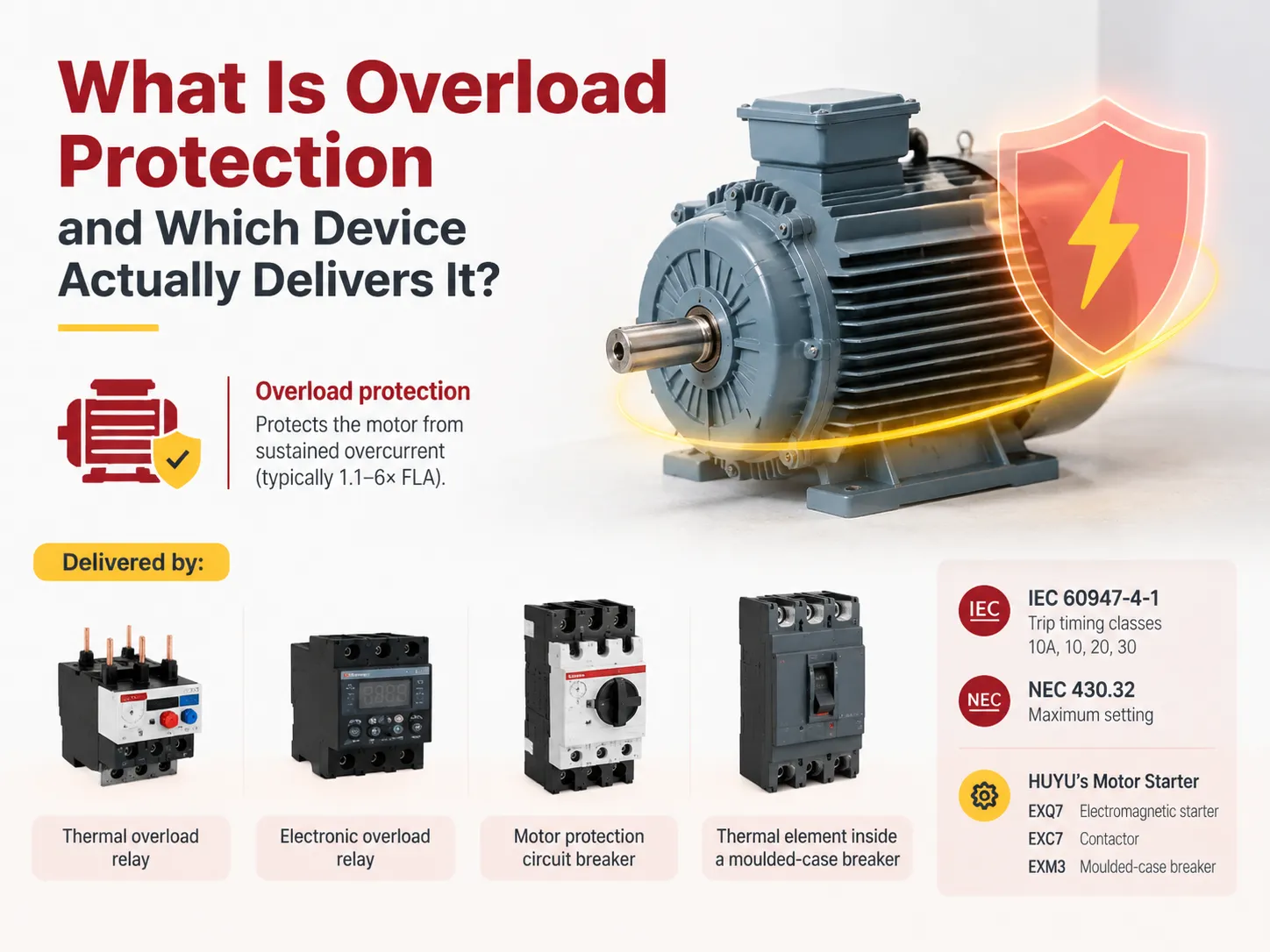
- Isolate before replacing. Although the SPD is connected in parallel with the load and the SPS is upstream the correct procedure involves breaking the circuit and checking it is not live before carrying out any actions.HUYU’s EXM3 moulded-case breaker is the sort of upstream device that makes that isolation possible on a larger packaged system, rather than relying on pulling a fuse block.
Mark installation date inside the switch box. This is the only option to know whether the device in front of you is two years old or twelve.
FAQ
Should you put a surge protector on an AC unit?
Of course, for an inverter or variable-speed system, since the control circuit and the inverter unit are quite costly, susceptible to damage from surges, as well as not being included in the warranty of the manufacturer. With regard to an older single-stage unit with simple controls, the aspect of protecting the whole house is better spent in this case. In view of the age of the system, neither alternative is considered to be sound financially at that point.
Is it safe to plug an air conditioner into a surge protector?
An air conditioning unit cannot be plugged in. A condenser installed centrally is directly wired into a 240 V circuit via a disconnect device, while a window type air conditioner requires constant power exceeding that which is generally permissible for most domestic extension cords. Further, the strip connected to a window air conditioning device may also be dangerous since its contacts are not rated for the inrush of power.
What is the best surge protector for HVAC?
A UL 1449-compliant Type 2 device, mounted at the outdoor disconnect, designed for nominal discharge current of 20 kA or higher and with a voltage protection rating between 600-800 V, and has a short circuit current rating equal to or exceeding the available fault current. Use it in conjunction with a device placed at the whole home panel and an over/under voltage relay having reconnect delay for compressor protection.
Will a power surge damage my AC unit?
It is possible for it to occur, and it usually happens gradually rather than suddenly. Varistors on an electrical circuit board deteriorate with each occurrence until the circuit board is unable to perform its functions, which is often attributed to aging. Direct damage from lightning strikes is exceptional; switching transient damage and grid recovery events occur much more often and are responsible for most of the damage.
References
- NFPA 70 — National Electrical Code, Article 242 and 285
- UL Solutions — UL 1449 Surge Protective Devices
- ABB — Surge Protective Devices for Buildings
- Leviton — Whole-Home and Point-of-Use SPD Range
- U.S. Department of Energy — Surge Protection Guidance
Conclusion
The Type 2 surge canceling devices are mounted on the outside part of the air conditioning units. The price of the installation is between $150 and $400. Air conditioning surge protective device is installed differently from the devices that can be connected directly. Once a control panel has been repaired, multiple times higher amount can be earned then spent on the device.
To protect the compressor voltage relay and reconnecting delay switch are needed. There are different cases of electricity surges and brownouts, which mechanism will be different in each case and the varistors will solve only one of the problems.