
Crouse-Hinds circuit breakers occupy an odd niche in the field of electricity. The brand remains active — it is a subdivision of Eaton and includes industrial solutions for extreme environments — but it refers to outdated models of circuit breakers used in residences and light commercial establishments. People who own such equipment experience difficulties since the original model went out of production long ago and many untrue recommendations can be found on the Internet. This article aims to give the most comprehensive insights on the meaning of the Crouse-Hinds circuit breaker, the modern equivalent models that pass UL testing and the way to check the compliance of the current offering with the label of the original equipment.
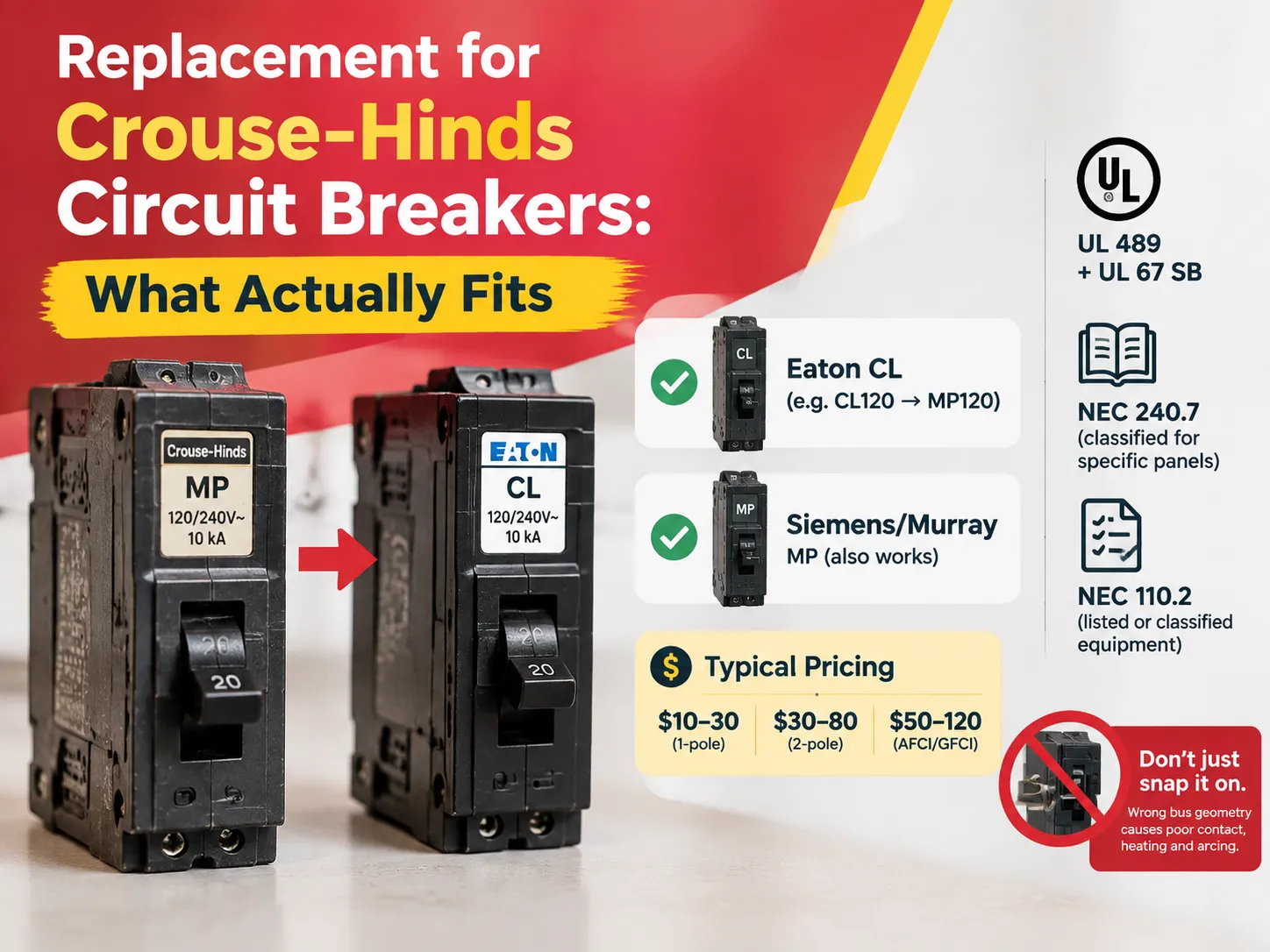
Short answer: The majority of residential Crouse-Hinds circuit breakers have the one-inch type MP configuration, and the recommended replacements are of the Eaton CL series as they are UL certified (for example, the CL120 replaces the MP120 and the CL220 replaces the MP220). As the Murray brand that manufactured the type MP was eventually merged with Siemens, the Siemens/Murray MP breakers are also appropriate for use in the same panels. The legal grounds are based on the UL classification to UL 489 and listing to UL 67 SB for the panel type in question; not on physical compatibility. The National Electric Code states in its Article 240.7 that classified circuit breakers can be used only in their designated panels while Article 110.2 stipulates the requirement of listed or classified equipment being used.
What Crouse-Hinds Breakers Actually Are
The misunderstanding begins with the brand name. Crouse-Hinds is now a brand owned by Eaton and it offers products including explosion proof boxes, HVAC lighting fixtures, and relevant hardware; nevertheless, it is not a current supplier of residential load breakers. This means that when consumers look up information about Crouse-Hinds replacement breakers, they probably see load break panels from 1965-1985.
There is a clear explanation to why the correct answer cannot be simply Crouse-Hinds. The Murray product line that produced the Type MP breaker had changed hands several times before it stopped being produced by Murray and its technology reached Siemens. Besides, the former operation of Arrow-Hart and Crouse-Hinds was taken over by Cooper Indusrries which was acquired by Eaton in 2012. The result of this history for contractors and homeowners is that the design of the breaker has survived through the shifts of ownerships.
Therefore, what follows from the given facts is that there are two major points to be taken into account while searching for the solution. Firstly, the answer should either be Eaton CL series or Siemens/Murray MP breaker which depends on what information was given on the panel before. Secondly, the search for the information should be based on the panel’s documentation rather than on the thread of a forum.
Listed vs Classified: The Distinction That Decides Everything
This is the most crucial concept in the whole topic, and the one which gets mostly confused in online guidance.
A circuit breaker having a UL Listing stands for the fact that this device has been tested and considered as an independent product. A circuit breaker having a UL Classification stands for the fact that it has been tested while being used in specific panels of other manufacturers. The classified series that Eaton produces has passed a certification process along with UL 489 for magnetic breakers, UL 67 SB for loadcentres and panels, UL 943 for ground-fault circuit interrupters, and UL 1699 for arc-fault circuit interrupters and therefore, the company declares that there are more than 750 loadcentre types it is compatible with. This list contains names of the companies such as General Electric, Thomas & Betts, ITE/Siemens, Murray, Crouse-Hinds and Square D.
Why is it more important than just being compatible? Because even if a breaker can be plugged in a busbar, it still can be unsafe there. The geography of bus stalagmites of various manufacturers is similar so a foreign breaker may be able to fix but still the area of contact and pressure may turn out to be wrong, which leads to resistance heating and arcing. NEC 110.2 states that the equipment is to be good only when it is listed; NEC 240.7 indicates that classified breakers are to be used strictly in the panels of certain types according to the classification. If an inspector sees an unlisted breaker in a Crouse-Hinds panel, the installation will fail though it may appear to be working.
There is a commercial consequence of this distinction. Classifications are issued for a range of panels and that is why there are gaps in a line of classified products – for instance, Eaton’s CL does not include the products rated for more than 50 Amp or any other specific type of breakers – only the basic types of AFCI and GFCI breakers are produced. If a panel needs a breaker rated for 60 Amp or more or its configuration is unique, the answer should not be in a classified breaker, the answer should lie in changing the panel. The certification framework behind these products is the same one that governs the breakers feeding the panel in the first place, which is the subject of our guide to what UL 489 certification means for breakers.
The Replacement Chart
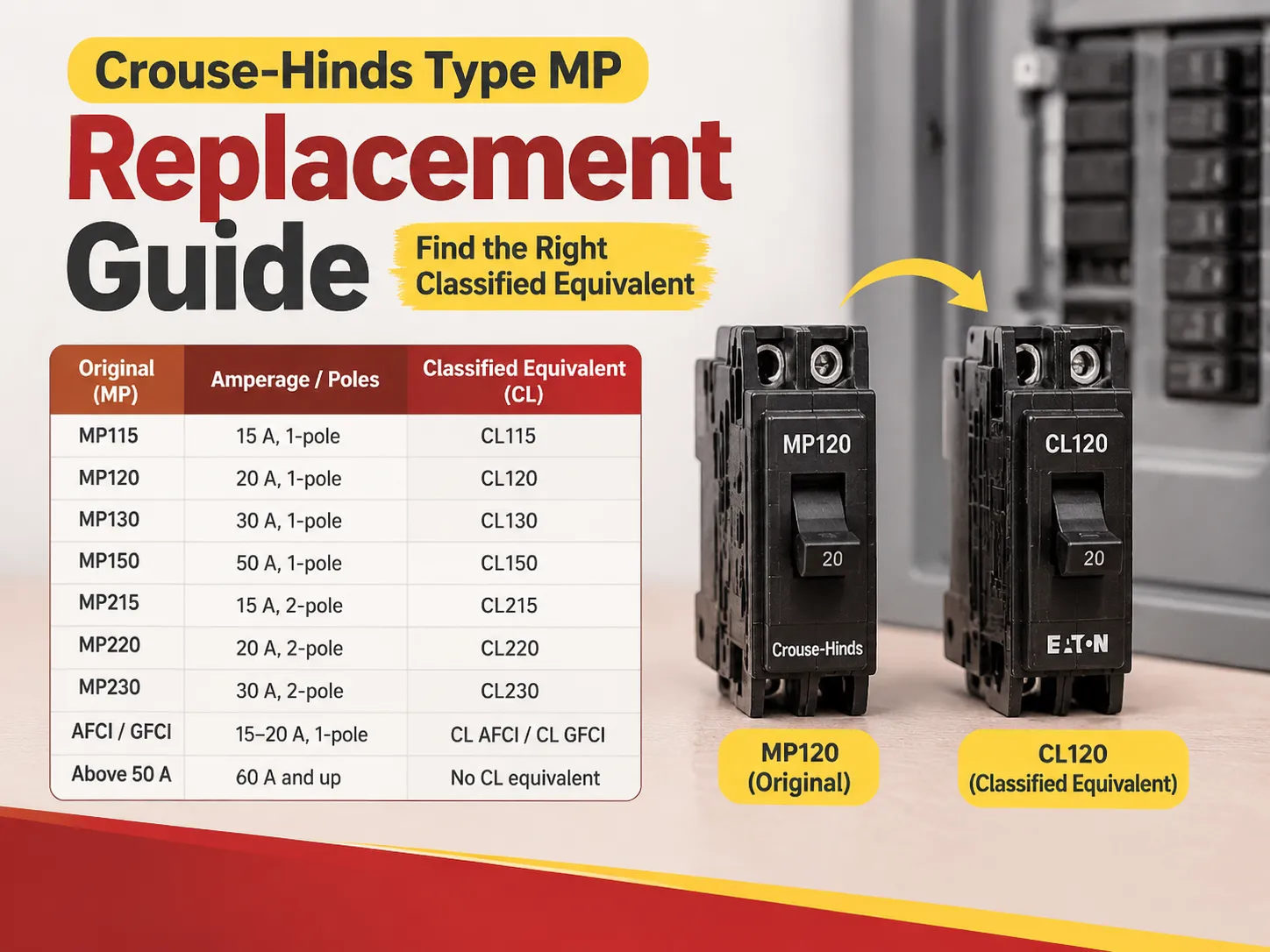
The illustrations of the Crouse-Hinds MP circuit breakers can be found in the table below, in addition to which their equivalent models are presented there. It is crucial that the rated voltage, number of poles, and tripping capacity of the replacement be at least equal to those of the original.
| Crouse-Hinds Type MP (original) | Amperage / poles | Eaton CL classified equivalent | Notes |
|---|---|---|---|
| MP115 | 15 A, 1-pole | CL115 | Standard branch circuit; 10 kAIC |
| MP120 | 20 A, 1-pole | CL120 | The most common replacement in these panels |
| MP130 | 30 A, 1-pole | CL130 | Verify conductor size before upsizing |
| MP150 | 50 A, 1-pole | CL150 | At the upper limit of the classified range |
| MP215 | 15 A, 2-pole | CL215 | Common trip, 120/240 V |
| MP220 | 20 A, 2-pole | CL220 | Common trip, 120/240 V |
| MP230 | 30 A, 2-pole | CL230 | Typical for dryers and small subpanels |
| AFCI / GFCI branch | 15-20 A, 1-pole | CL AFCI and CL GFCI types | Availability varies; check the classified listing for your panel |
| Above 50 A | 60 A and up | No CL equivalent | The honest answer is usually a panel replacement |
This table comes with two caveats. The first is that Eaton’s classified line is not the only acceptable way to connect power; since Siemens has acquired the Murray design that resulted in the Type MP, the current type of Siemens manufactured Murray circuit breakers is also considered appropriate for use with panels indicative of the MP label. In case Siemens MP is used instead for replacement, it would be the closest thing of getting the original product, but the important advantage is that in this case the panel label should clearly indicate the use of board. The second caveat is that “same amperage” does not equal to “same breaker.” A replacement GFCI or an AFCI type breaker means different wiring direction on the load side. There are some other limitations for using two-pole replacements of the multilayered branch circuit as well.
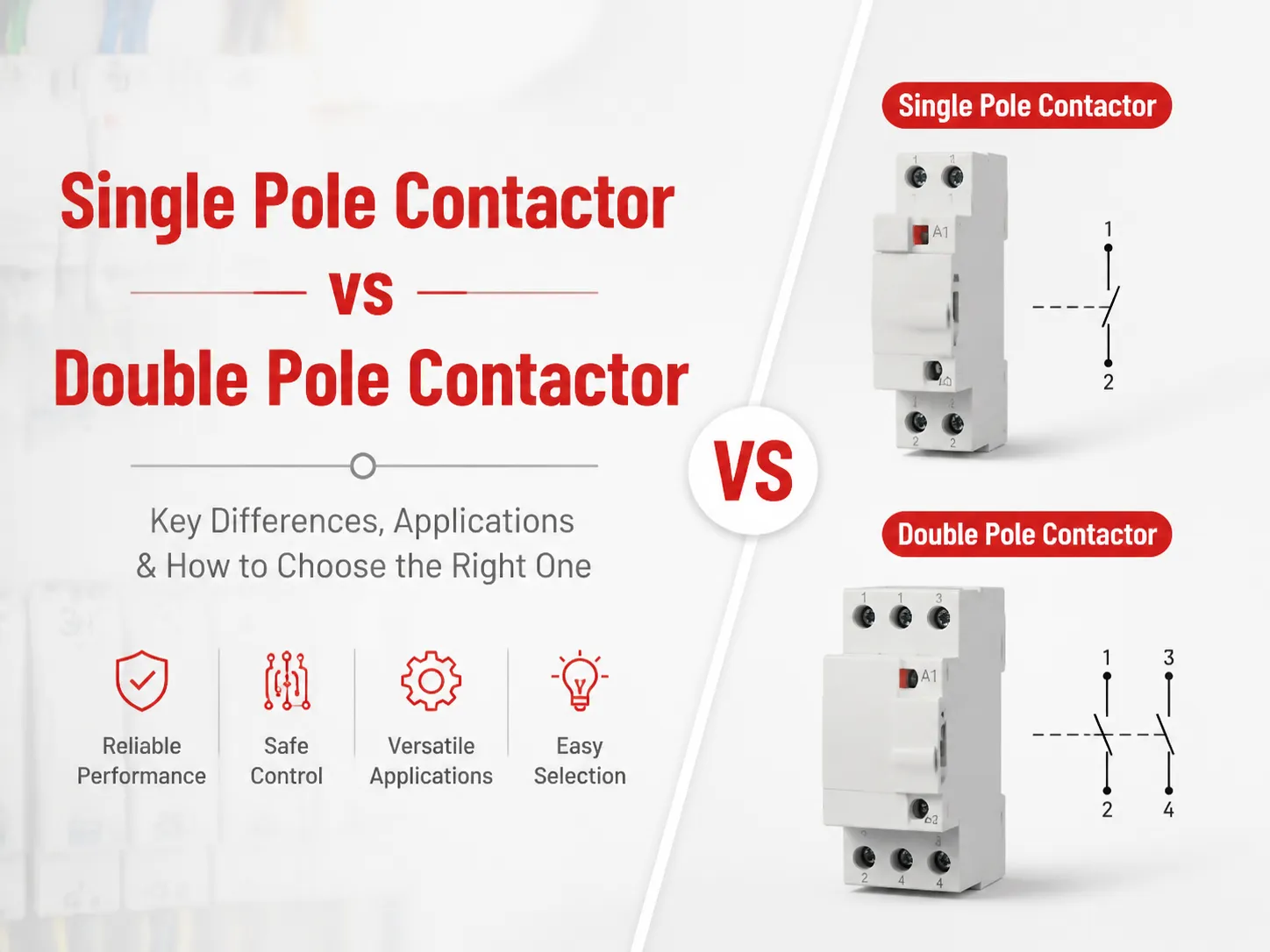
Pole count can be considered an issue since customers often improperly order circuit breakers. A single pole circuit breaker is designed simply for one leg of 120 volt circuit while two poles are used in 240 volt circuits and multiterminal branch circuits for enabling the simultaneous circuit shut down.The selection logic and the space implications are set out in our guide to single-pole versus double-pole breakers, and getting it wrong is the most common reason a replacement breaker has to be returned.
Where to Buy and What It Costs
Classified replacements are a general product, which is beneficial in terms of availability but doesn’t bode well for those searching for cheaper prices on less common items.
- The reliable first step in this case is an electrical distributor. They can cross-check the classified entry against the model of the panel and order the AFCI and GCFI variants that can’t be found in the major retailers.
- Home improvement stores have the usual CL types of the devices — usually 15 A, 20 A, or 30 A for the single-pole and 20 A, 30 A for the two-pole. This is easy and convenient, but the choice on the shelf tends to lack the unusual types.
- The online stores provide an alternative route for comparing the prices and looking up the catalogue where the exact model of the breaker is normally given.
- The approximate street prices for a classified replacement breaker are as follows. A single-pole 15 A or 20 A CL breaker goes for around $10-30. A two-pole 20 A or 30 A one costs approximately $30-80. The price for the AFCI and GFCI versions is generally around $50-120 due to the presence of the additional electronic equipment. If it exists in the classified category, the size of the ratings raises the price even higher.
By comparison, the cost of hiring an electrician to replace a breaker costs about $130-250, while the entire panel replacement costs a lot more.When the arithmetic starts to favour a new panel — and what that costs — is set out in our guide to electrical panel replacement cost, which is worth reading before you commit to chasing one hard-to-find breaker.
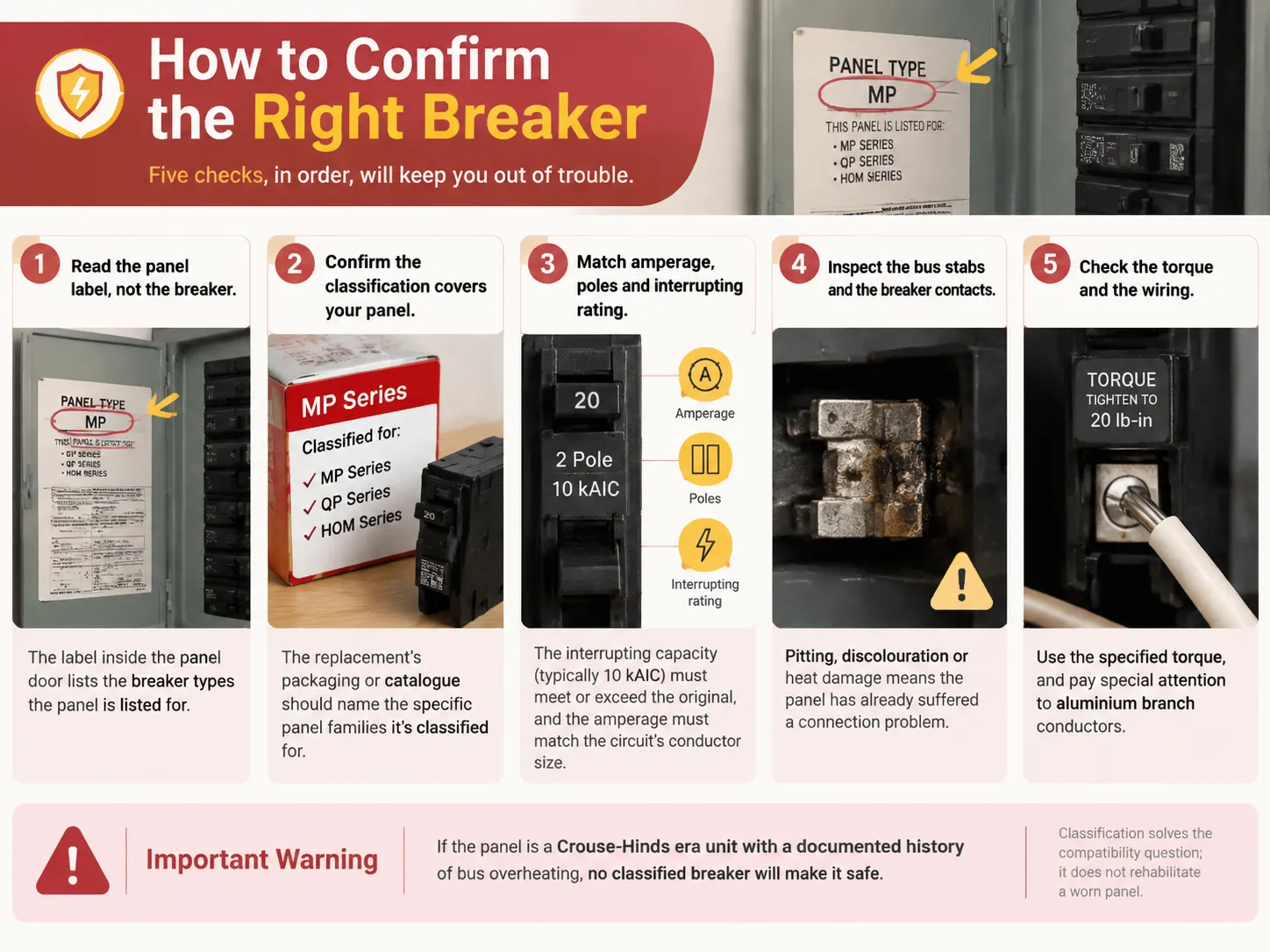
How to Confirm the Right Breaker
If you want to avoid problems, keep five essential checks in mind.
- Examine the label on the panel and not the breaker. You should look for its details. The label inside the panel shows you the types of breakers the panel is suitable for, and that is the information you are actually looking for. If it shows that this is a panel which allows for the use of MP series, then you can use the appropriate replacement, otherwise, it is better to seek expert opinions about the panel.
- Make sure that the classification applies to your panel. By examining a label or catalogue entry you should be able to see the panel families your replacement was made for, don’t believe anything saying “Compatible with most panels”.
- Check the similar specs with original one. Anyone should check the interrupting capacity of the circuit as it should not be lower than that of the original circuit.
- Bear in mind that it is crucial to make sure that bus stabs and breaker contacts are in good condition. If there are any signs of deformities at the stabs, and burnt contacts it means that the previous connection of the circuit failed.A breaker that has been running hot is worth diagnosing rather than simply swapping, using the checks in our guide to how to tell if a breaker is bad.
- It is very important to check if torque indicators and wiring work properly. The breaker has every piece of information concerning terminal torque, and one of the reasons for nuisance tripping is loose terminations. You need to pay special attention to aluminum branches.
There is only one warning which should be highlighted in this case. The Crouse-Hinds panels have systems of connections which have already been overheated, and no classified breaker is able to protect the environment.
Where HUYU Fits
It is important to be honest about this matter to clarify the following: HUYU does NOT provide UL-approved substitutes for Crouse-Hinds Type MP panels, and a manufacturer that makes such claims is not being honest about its product. This kind of classification is assigned by UL for every type of panel and cannot be found in a catalogue of ordinary breakers.
What HUYU produces is the equipment for the second part of the market. If the project is about the installation of new equipment, not the repair of old panels – new subpanels, control boards for machines, OEM products, retrofitted distribution equipment – specifications will be different. HUYU produces an array of protection and distribution products having UL, KEMA, TUV, CE, and IEC certification, including an array of miniature circuit breakers starting from 1P up to 4P, and 63 A in B, C, and D curve. The HUM18-63N MCB range is representative of what a certified modern breaker line looks like when the buyer is specifying new rather than substituting old.
Following the recommendations in this regard is very simple. In the case one is operating a Crouse-Hinds panel, everyone has to purchase the panel-certified products. If one is preparing a new equipment specification, one must define the new certified product and mention that there are no lateral relations connected to the legacy. Getting these two things mixed up is what leads to having a sub-panel with devices from different manufacturers and questions from the inspector.
Repair the Panel or Replace It?
There is a point after which replacing breakers is no longer a good idea; and Crouse-Hinds’s systems reach that point before most. Panel replacement is merited under any of the following conditions: the panel label is unreadable or missing and no breakers can be proven classified for it; the bus is heat-damaged, pitted, or discolored; the required amp rating exceeds the rating allowed for the classified panel; the panel requires AFCI protection that cannot be found and the panel cannot be classified as such; the service ampacity is insufficient to accommodate modern demands; and you are already paying for an electrician to be present.
The determining factor in this case is usually the quantity of breakers that need to be replaced. Replacing a 1 20 A breaker in a working panel is small job. When replacing a number of breakers plus adding AFCI protection for a bedroom circuit finds the bus pitted, it is a complete panel project in disguise.
FAQ
What breakers replace Crouse-Hinds?
The appropriate substitute for the one-inch Crouse-Hinds Type MP breaker is the Eaton CL series: CL120 replaces MP120, CL220 replaces MP220 and so on. Since Murray’s design for the Type MP passed on to Siemens, the current Siemens/Murray MP breakers can also be used when the MP series is called for in the panel label. The ease of utilization with these options relies upon the panel’s own listing: it has to describe either the original breaker type or a device cleared for use with it, not just one that fits the bus but is otherwise indeterminate.
Can I use a Siemens breaker in a Crouse-Hinds panel?
Yes, and the reason for this is that the Murray MP design has been taken over by Siemens. Though the Siemens breaker is a different type from the one involved, the Siemens/Murray MP breaker is still the successor of the original. Consult the panel label to determine if the MP designation is there and buy the MP family breaker.
Can I use Eaton breakers in a Crouse-Hinds panel?
Yes, as long as you opt for the classified line only and do not use the normal residential line of Eaton. The Eaton CL line is UL classified for Crouse-Hinds Type MP panels and hundreds of other load centers available in one- and two-pole breakers and backup models. The usual BR line does not qualify because it belongs to a completely different line. Such distinction can often go unnoticed when making an online order.
Can you provide a replacement chart for Crouse-Hinds circuit breakers?
The table is provided above to show some matching items: MP115 to CL115, MP120 to CL120, MP130 to CL130, MP150 to CL150, MP215 to CL215, MP220 to CL220, and MP230 to CL230, provided also as AFCI and GFCI models, and with subsequent capacity rating of over 50 A having no CL equivalent. Please consider any chart to be just a starting point of your search instead of granting permission to do so. The listing of the panel label should be treated as decisive as it shows which types of breakers are appropriate for that particular panel.
What if no classified breaker exists for my panel?
In that case, you should use only the original-type one if it is available. It is not acceptable to fit an unsuitable one that does not comply with the NEC codes. It must be clearly stated that no use of unlisted breakers is acceptable in any given instance.
References
- Eaton — Classified Circuit Breakers (UL Classified Replacement Breakers, Type CL and CHQ)
- NFPA — National Electrical Code, Articles 110.2 and 240.7
- UL Solutions — UL 489, UL 67 SB, UL 943 and UL 1699 Standards
- Siemens — Murray Type MP Circuit Breakers
Conclusion
When it comes to swapping out a Crouse-Hinds breaker, it’s really more about finding what class you need instead of seeking a particular model. The previous breakers are no longer available under that name. Not only is the circuit breaker already decades old, but also there aren’t really any acceptable replacements other than the original type MP design as stipulated by Siemens/Murray or the Eaton CL series approved by UL for the panels in question. Anything else is a risk, as it’s going to be a warranty nightmare. Step 1 is checking the label on the panel first, and then look for the amperage, poles, and interrupting rating. Many people check the classified listing names of their panels in the third step, and they should check the bus at last before making that purchase. In case the label has been lost, pitting has appeared on the bus, or the amp rating you need can’t be found within the classified range, it’s wiser not to waste money on a new breaker at this time.