
Typically, facility managers do not select their electrical contractor based on any marketing campaigns. They have different motivations for making the choice – for instance, they may have a tenant to fit-out on an urgent basis and feel the need to select an electrical contractor or have to do so due to another problem like an inspection failure or the full distribution board. When looking for electrical contractors for their project, facility managers have only three sources of the shortlist. It can be either an advice of a general contractor, an advice of a distributor or a person who called right in the early morning.
What the companies offer, which companies provide services at what level, how much such services will cost in 2026, how qualified bidders differ from cheap bidders, why the answer may change depending on whether the project is carried out in Europe or North America.
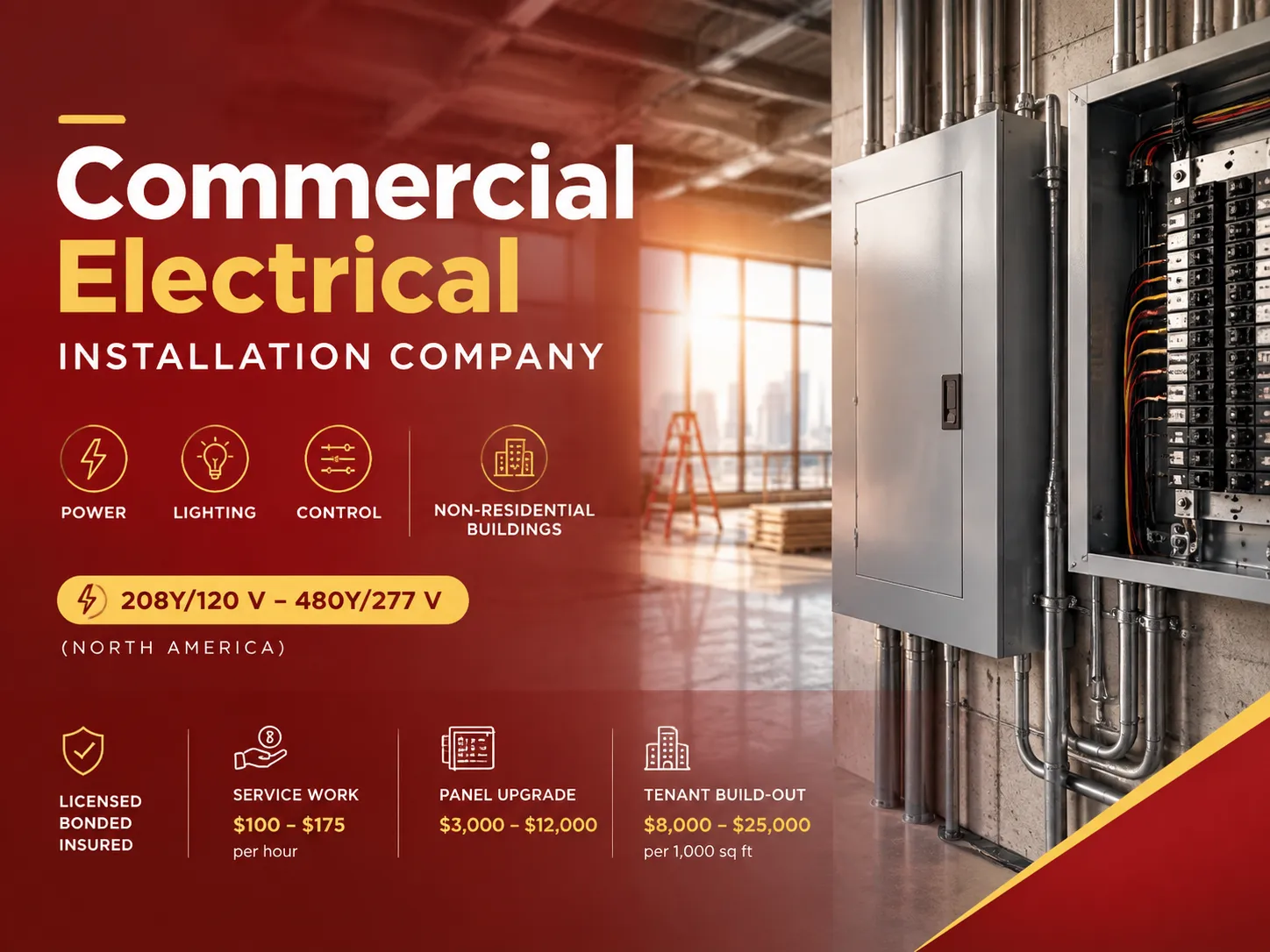
Short answer: An electrical contractor is a business that performs the design, equipment installation, testing, and commissioning of electrical systems in business properties. In North America low-voltage systems operate within the range of nominal voltage of 208Y/120 V to 480Y/277 V, meaning that companies must get a license, surety bond, and proper insurance coverage according to the requirements of the state. The services provided can take as much as 100-175 dollars per hour, from what commercial service panel upgrade might cost 3,000 to 12,000 dollars while tenant build-out can go from 8,000 to 25,000 dollars, per a thousand square feet of premises. Nevertheless, in some cases national companies might be too pricey, since a trustworthy licensee at the local level can be quicker and cheaper than a big corporation. In this context HUYU works with the assembly of low-voltage systems, such as distribution systems, contractors and breakers.
What a Commercial Electrical Installation Company Actually Does
It’s occupancy that determines scope, rather than square footage. For example, a medical office that is 40,000 sq ft and a distribution warehouse that’s also 40,000 sq ft are equal in square footage and vastly different in their requirements. The former will require isolated-ground receptacles, hospital-grade devices, circuits for emergency egress, and some means for generator transfer. The latter will need high-bay lighting, dock leveler circuits, and a substantial motor load.
The contractor is always in charge of the service entrance and main distribution, feeders and branch circuits, power and lighting, heating and cooling, grounding and bonding, and surge suppression. Using a design-and-build model, the same contractor also performs load calculations, creates one-line diagrams, and develops short-circuit and coordination studies needed for design compliance. However, in the case of design-bid-build models, this work is done by engineers, leaving the contractor only with the construction process.
The distinction between commercial and residential buildings lies in the type of system used and not in the quality of craftsmanship. Commercial buildings utilize 3-phase power: 208Y/120 V in commercial buildings and 480Y/277 V in more modern buildings. In addition, the method of wiring involves the use of a conduit and separate conductors rather than a cable. Finally, the system is designed and sized based on demand calculations according to NEC Article 220. The devices and assemblies inside that distribution line-up carry their own standards — UL 489 for moulded-case breakers, UL 1066 for low-voltage power circuit breakers, UL 891 for switchboards, UL 1558 for switchgear — and the full set is covered in our guide to commercial electrical services.

The Largest Commercial Electrical Installation Companies
The scale figures shown are taken from EC&M’s Top 50 electrical contractors list and ENR’s Top 600 specialty contractors list, based on actual annual account gains. The total amount of revenues earned by the Top 50 contractors in the last cycle amounted to a record high amount of $59.5 billion, being mainly driven by the projects related to data centers, grid modernization, and manufacturing of high technologies. This concentration is particularly important for clients: the top contractors actually have long backlogs meaning that they do not prioritize mid-sized commercial projects at all.
| Company | Headquarters | 2025 electrical revenue | Where they are strongest |
|---|---|---|---|
| Quanta Services | Houston, TX | $13.5 bn | Transmission, distribution, utility-scale renewables |
| Rosendin Electric | San Jose, CA | $3.7 bn | Data centres, semiconductor, design-build |
| EMCOR Group | Norwalk, CT | $3.6 bn | Institutional, healthcare, network and communications |
| MYR Group | Thornton, CO | $3.4 bn | T&D lines plus commercial and industrial |
| Everus Construction Group | Bismarck, ND | $2.8 bn | Utility and industrial electrical |
| IES Holdings | Houston, TX | $2.5 bn | Industrial services, infrastructure |
| MMR Group | Baton Rouge, LA | $2.3 bn | Instrumentation and controls, heavy industrial |
| M.C. Dean | Tysons, VA | $1.9 bn | Mission-critical, federal, security systems |
| ArchKey Solutions | St. Louis, MO | $1.7 bn | Technology, healthcare, education |
| Faith Technologies (FTI) | Menasha, WI | $1.4 bn | Prefabrication, industrial controls |
| E-J Electric Installation | Long Island City, NY | $1.36 bn | New York metro institutional and transit |
| Helix Electric | San Diego, CA | $957 m | Multifamily, hospitality, solar |
Understanding how to read the table is more important than knowing it by heart. Quanta and MYR are mainly providing utilities – pole lines, substations, and transmissions – which is a different line of work as compared to wiring the hospital. Rosendin, M.C. Dean, and ArchKey operate in mission-critical environments where the client’s cost of downtime is more than the construction costs. If a project entails 60,000 sq ft office renovation including panel upgrade, none of the three would be competitive and the contractor that would be competitive is a local one who you have probably never heard of. A comparable ranking of the biggest players by workforce rather than revenue is in our breakdown of the largest electrical contractors in the US.
Which Kind of Firm Your Project Actually Needs
The trade has five well-known business models which each tender very differently. The most frequent and costly mistake in this selection is to go with the wrong type; a firm that excels at one type might be structurally unable to perform another type.
| Firm type | Typical contract | Where they win | Where they struggle |
|---|---|---|---|
| National EPC / utility contractor | Substations, transmission, utility-scale solar | Bonding capacity, engineering depth, multi-state crews | Small building work; minimum project size excludes it |
| Regional commercial contractor | Offices, schools, retail, healthcare, fit-outs | Local code knowledge, inspector relationships, competitive pricing | Limited internal engineering; may need an outside engineer |
| Service and maintenance specialist | Time-and-materials, maintenance agreements | Response time, spare parts stock, recurring inspection work | Bid work; small crews, no large-project bonding |
| Industrial and controls integrator | Motor control, PLC, VFD, process power | Commissioning, troubleshooting, production uptime | Architectural and finish-sensitive work |
| Design-build single source | Full scope from concept to commissioning | Single point of accountability, schedule compression | Less price transparency; design changes are billed |
In a case of a facility that operates non-stop like a factory, server room, or a medical center, one of the best solutions is to hire two contractors, one for the construction work and another one for managing equipment. Contracting both providers to the same company usually results in poor performance in both areas.

Credentials That Actually Mean Something
The process of obtaining a license to operate as a contractor within North America is handled at the state, provincial, or local government level rather than at the national level. This means that because an electrical contractor is licensed to carry out work with respect to a certain activity in one state or province does not mean that they can automatically operate in a neighboring jurisdiction without needing a license. In addition to licensing, it is also important to verify the following information:
- Electrical contractor licensing in the relevant jurisdiction — e.g. a C-10 license in California or a master electrician license in jurisdictions that license individuals instead of companies. Keep in mind that such licensing should be verified on the relevant licensing board’s website rather than on the contractor’s letterhead.
- NECA membership — the National Electrical Contractors Association. This organization is an indicator of membership in the respective labor and standards bodies, but it does not mean that the contractor in question has obtained a safety certification.
- Affiliation with the JATC apprenticeship program — the Joint Apprenticeship and Training Committee is responsible for training the respective electricians and collecting their working hours worked in the sector. Please note that independent electrical contractors may have different apprenticeship programs that may be equally credible.
- UL 508A listing — the contractor should have this listing if the company makes the control panels themselves; otherwise, the panels cannot be sold without this listing.
- Certification from NABCEP — this is only applicable when the respective individual performs work on solar and energy storage systems.
- Records proving the completion of NFPA 70E training course by the contractor’s personnel who will be working with electrical installations. Make sure that you are provided with the current training log.
- ISO 9001, 14001 and 45001 certifications — this relates to the quality, environmental and occupational health systems practiced by the contractor.
- Certificates of insurance and liability — this refers to general liability insurance and workers’ compensation coverage that the electrical contractor has with respect to the price of the job.
Another qualification not related to safety is controlling costs: this is the documentation of the code cycle your jurisdiction is enforcing. For a firm whose current experience is noted up until the last two editions of codes, then they will have to relearn what to do and how to do it, at a greater cost to your budget. Our notes on resistance limits for commercial building electrical installation show how quickly those requirements move.
What Commercial Electrical Installation Costs in 2026
In the 2026 reported pricing surveys, an apprentice is charged between $45 and $85, a journey worker charges between $75 and $165, and a master or industrial specialist is charged between $100 and $225 as per market trends. The total amount paid by a client to the contractor will consist of wages, employee benefits, insurance and other expenses. On commercial projects, the billing can go up to 20% more than residential work done in the same facility because of more insurance, documentation efforts and payment duration. Companies with unionized workforce in the Midwestern and Northeastern states tend to bill about 20% to 40% more than their competitors.
| Work item | Typical 2026 range | Notes |
|---|---|---|
| Billed journeyperson hour | $100–$175 | Most contractors bill at firm rate, not individual wage |
| Minimum service call | 2–4 hours billed | Often plus a $75–$195 dispatch fee |
| After-hours or weekend emergency | 1.5–2.0× rate | Storm and restoration work quoted on site |
| Commercial service panel upgrade, 200–400 A | $3,000–$12,000 | Rises to $12,000–$28,000 at 600–800 A |
| Three-phase power installation | $5,000–$20,000+ | Utility coordination time is a variable cost |
| New circuit installation | $300–$1,200 per circuit | Conduit and ceiling access drive the spread |
| LED lighting retrofit, per 1,000 sq ft | $1,500–$6,000 | Per-fixture: $85–$285 installed |
| Tenant electrical build-out, per 1,000 sq ft | $8,000–$25,000 | Includes materials, labour, permits, inspection |
| Commercial EV charger, Level 2 | $2,500–$7,500 per port | DC fast charging: $45,000–$120,000 |
| Standby generator, 100–500 kW installed | $55,000–$180,000 | Transfer switch and fuel storage additional |
| Permits and inspection fees | $300–$2,000 | Multi-point inspections add rounds |
| Load study and panel inspection | $500–$1,500 | Cheapest line on the list; most often skipped |
There are three factors accounting for differences between two quotations for a project of the same nature. First is the age of the building and status of the wiring: obsolete feeder sizes, aluminium branch circuits and hidden junction boxes all relate to labour costs. The second is whether the work can be done live or requires a shutdown: a shutdown is a cost for the client as much as for the contractor. The third factor is access: the height of the ceiling, whether it is finished or whether any lift required will be of greater significance than the equipment.Panel and service pricing specifically is detailed in our cost breakdown for electrical panel replacement.
How to Vet a Bidder Before the Contract Is Signed
The sequence to verify that minimizes the number of financial transactions.
- Check the license number with the issuing authority by looking it up on its official records. Compare the license number of the company, its type, and expiration date with those on the license certificate. A valid license that does not have the necessary coverage is worse than not having a license at all, as it will be discovered during the inspection.
- Get a copy of the insurance policy directly from the insurers. The certificates must state the name of the contractor as the recipient. Ask explicitly if the workers’ compensation insures everyone who will spend time on the job, including subcontractors.
- Figure out who is supposed to run the project. The “face” in the sales meeting will not be the one who is in charge. So ask them for the foreman’s name and license class, and how many projects the foreman is currently managing.
- Ask for a detailed breakdown; not just a total sum. The quote must contain all the items such as raw materials, labors, permits, temporary power, etc. For instance, you will get nothing from a quote like “15000 for electric works.”
- Ask for written exclusions. The exclusions usually include drywall repair after wiring completion, painting, coordination work with the utility company, building permits, and the temporary power cost during the construction. Each one of those is going to appear in the change orders later.
- Get at least three quotes and compare them. You will usually find that quotes may vary significantly – on an average they may differ by 30-50%. A quote on the low end of the scale deserves explanation rather than being taken for granted.
- Require necessary test results as a deliverable. Accepting the final outcome without getting results of insulation resistance, earth continuity, polarity, and loop impedance tests creates problems with the installation.
- Check the progress of two reference projects of the same size. Ask the last client two questions: was the final invoice within the 10% of the total sum; and were the inspections passed?
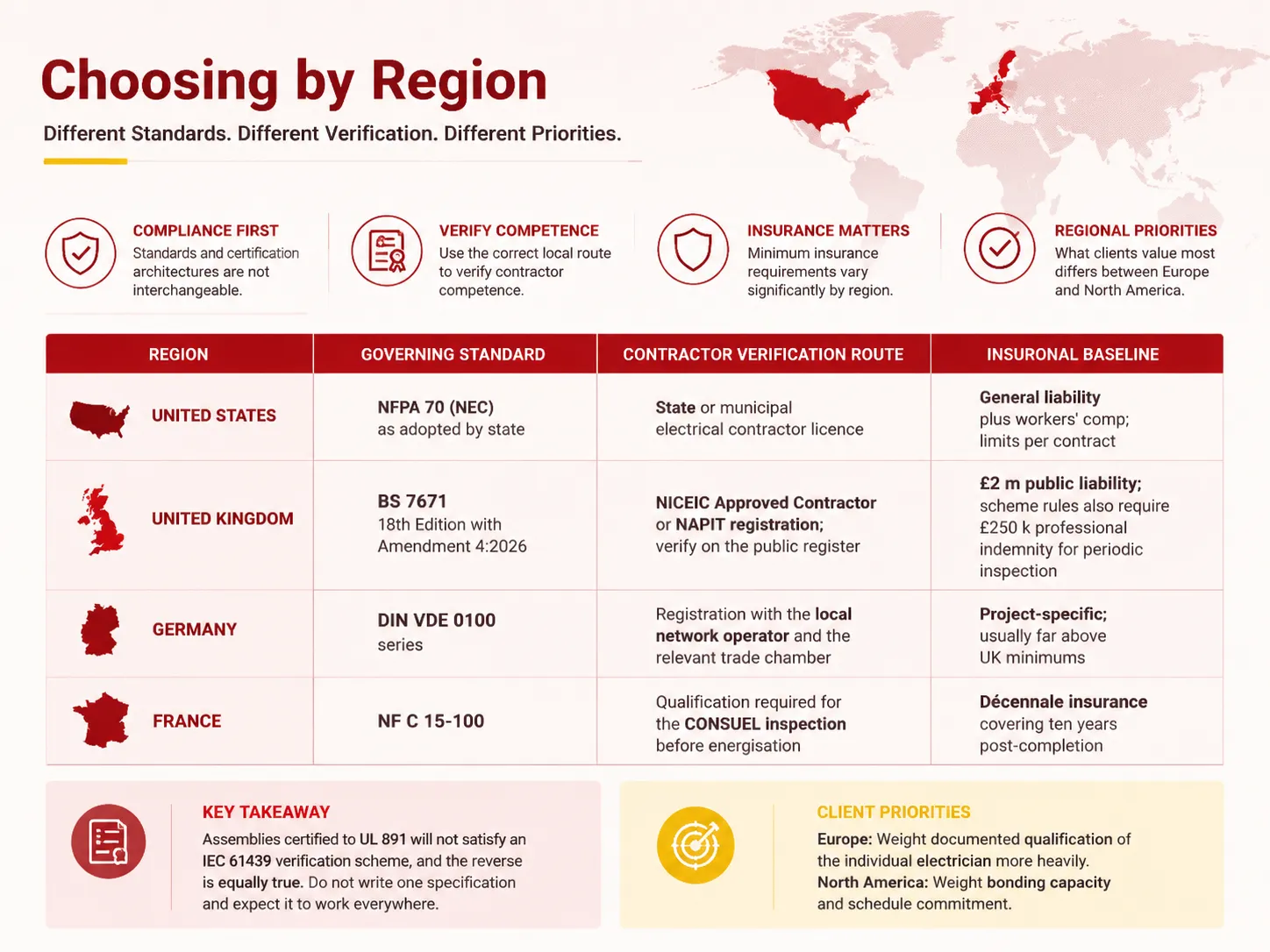
Choosing by Region: United States, United Kingdom and the EU
The differences in selection criteria are greater than most consumers believe since the compliance structure is not the same. North America follows the National Electrical Code (NFPA 70), which is adopted state by state with local amendments, and is certified to UL standards, while Europe follows IEC 60364 via its national wiring regulations and certifies equipment using IEC 61439 series which is different than UL 891 and UL 1558 in construction principles.
| Region | Governing standard | Contractor verification route | Insurance baseline |
|---|---|---|---|
| United States | NFPA 70 (NEC) as adopted by state | State or municipal electrical contractor licence | General liability plus workers’ comp; limits per contract |
| United Kingdom | BS 7671, 18th Edition with Amendment 4:2026 | NICEIC Approved Contractor or NAPIT registration; verify on the public register | £2 m public liability; scheme rules also require £250 k professional indemnity for periodic inspection |
| Germany | DIN VDE 0100 series | Registration with the local network operator and the relevant trade chamber | Project-specific; usually far above UK minimums |
| France | NF C 15-100 | Qualification required for the CONSUEL inspection before energisation | Décennale insurance covering ten years post-completion |
Two important outcomes can be noted. Firstly, in the UK the most important filter that leads to registration is the registered competent-person scheme: the NICEIC registers and certifies nearly 33,000 businesses, conducts audits of some works by each company on an annual basis and obliges them to have the most recent version of the wiring regulations in possession. Consequently, public sector clients insist on the fact that only competent-person scheme registered firms can appear on tender lists. Secondly, in France it is impossible to energize any installation until it is inspected by CONSUEL, meaning that the contractor is certified by a third party before the client receives the service, which control does not exist in most regions of the USA.
When purchasing something that might be subjected to various national regulations, take care not to write one common specification. In the USA assemblies which were verified in accordance with UL 891 certification can be considered compliant with IEC 61439 regulations, and vice versa.
Red Flags and Contract Terms Worth Pushing Back On
Very low bids, those that appear more than 30% below the second lowest bid, are a clearly sign of a problem and invariably indicate one of four issues: use of unlicensed contractors, a lapse in the insurance certificate, the fact that permit fees were not included in the estimate, or avoidance of issues to come later due to incorrect substitution of materials after contract award. All four issues impact the owner eventually, with issues related to the latter usually occurring during failure investigation.
In addition to what has been mentioned above, we should also pay attention to contracting firms that would either not do the permitting under their name, answer scope questions without documents but verbally, or require a deposit of sums that are more than the cost of materials ordered. From a purely contractual standpoint, three items deserve scrutiny in the contract. The retainage clause states that part of the payment is held until the project is in compliance with the standards; the change-order clauses determine the payments in advance of the actual work; the completion and testing clause specifies the documents submitted by the contractor as proof of compliance so that the owner can get these documents in the end.
FAQ
How much does an electrician charge for commercial work?
In 2026, it is expected that commercial work in the U.S. cost around $100–$175 an hour for a licensed journeyman, while master electricians and industrial specialists charge $145–225 in areas with high costs. The majority of commercial contractors charge at a fixed rate which covers all the overhead and costs of insurance rather than simply billing for the person’s pay. Normally there will be a minimum charge of 2–4 hours for a service call and an application of 1.5–2.0 multiplier with a trip charge in case of after-hours call the client receives. Pricing for the projects is considered separately where the service of 200–400 A increases the expenses from $3,000 to $12,000, and for a tenant build-out the prices vary between $8,000 and $25,000 for 1,000 square feet.
Why is Romex not allowed in commercial buildings?
Though non-metallic sheathed cable is not completely forbidden, the list of permitted uses is limited. NEC Article 334 describes the requirements for the use of non-metallic sheathed cable. It is outlined in Section 334.10 that it may be used in one- and two-family dwellings, in addition to other types of buildings of Type III, IV and V constructions — that means wood-framed buildings and heavy-timber buildings, but must be used behind some fire-resistant barrier or inside the areas that are unlikely to be damaged. Section 334.12 bans the use of the cable in Type I and Type II construction due to the fact that this included buildings are made of steel and concrete and includes commercial buildings, such as theatres, motion picture studios, garages and battery rooms, including the places that are located above dropped ceilings in non-residential buildings. Additionally, there may not be the possibility to use the non-metallic cable in constructed concrete or in wet locations. The protection is referred to as justification — a non-metallic coat neither provides mechanical protections nor has any fire protection features in comparison to MC cable or conduit. In most cases, when making the buildings of commercial purposes, this cable is neglected due to the type of construction of it.
Is there a difference between commercial and residential electricians?
Certainly, it is structural in nature rather than cosmetic. The work of the residential electricians is nearly all within the basic single-phase 120/240 V systems with the usage of sheath cables and the dimensions of circuits calculated from the standard dwelling load calculation. On the other hand, the commercial electricians operate with the three-phase systems such as 208Y/120 V and 480Y/277 V systems using conduit and individual conductors and determining their services based on the commercial demand. They should also have experience with motor operations, electric generators, transformer systems, etc. The industrial electricians represent the last specialization that is aimed at machines and conversion of electric energy into another type of work. Many middle-sized companies have all three kinds of work but it is worth being sure of the crew you get because the company might have license but the crew on the site might not have any necessary skills.
What are the three types of electrical installation?
These installations are divided into residential, commercial and industrial categories, and they vary in terms of voltage category, type of wiring and type of potential risks. Residential installations include homes and other dwellings such as homes using low-voltage single-phase AC systems with voltages of 120 or 240-volt, armoured cables, distribution boards and systems to charge electric cars. Commercial installations cover operating buildings from offices to hotels, hospitals and schools with three-phase voltage range from 208 volts to 480 volts, trunks for wiring and systems supplying electric energy for CCTV, ventilation and air conditioning. Industrial installations include plants and other heavy industry sites where large amount electrical power used for running heavy machinery results in losses in a case of a power outage.
References
- NFPA — NFPA 70 National Electrical Code
- NFPA — 70E Standard for Electrical Safety in the Workplace
- UL Solutions — Product safety standards and listings
- National Electrical Contractors Association (NECA)
- EC&M Magazine — Top 50 Electrical Contractors ranking
- ENR — Top 600 Specialty Contractors
- U.S. Bureau of Labor Statistics — Electricians Occupational Outlook
- NICEIC — Approved Contractor scheme requirements
- IET — BS 7671 Requirements for Electrical Installations
- UK Health and Safety Executive — Electrical safety guidance
Conclusion
The ideal commercial electrical installation contractor is one with the proper license for the task, equipped with a competent team trained in the technology used in the facility, and ready to provide the documents necessary to confirm their credentials on the register, not just in a brochure. Size makes a poor indicator of suitability; the top revenue companies are engaged in building transmission lines and data centers, not performing your service upgrade.
Three things must be followed in any project. First, check credentials with the proper authorities before making the first payment rather than after. Second, demand that you receive all “as built” documentation, designs of the panels, and testing results before transferring last payment rather than as an afterthought. Finally, make sure three bidders provide you with the detailed scope of work since differences between the bids reveal the risk associated with a project better than any single price does. If you follow all the above, electrical work will become no more than what it is supposed to be in a project.